
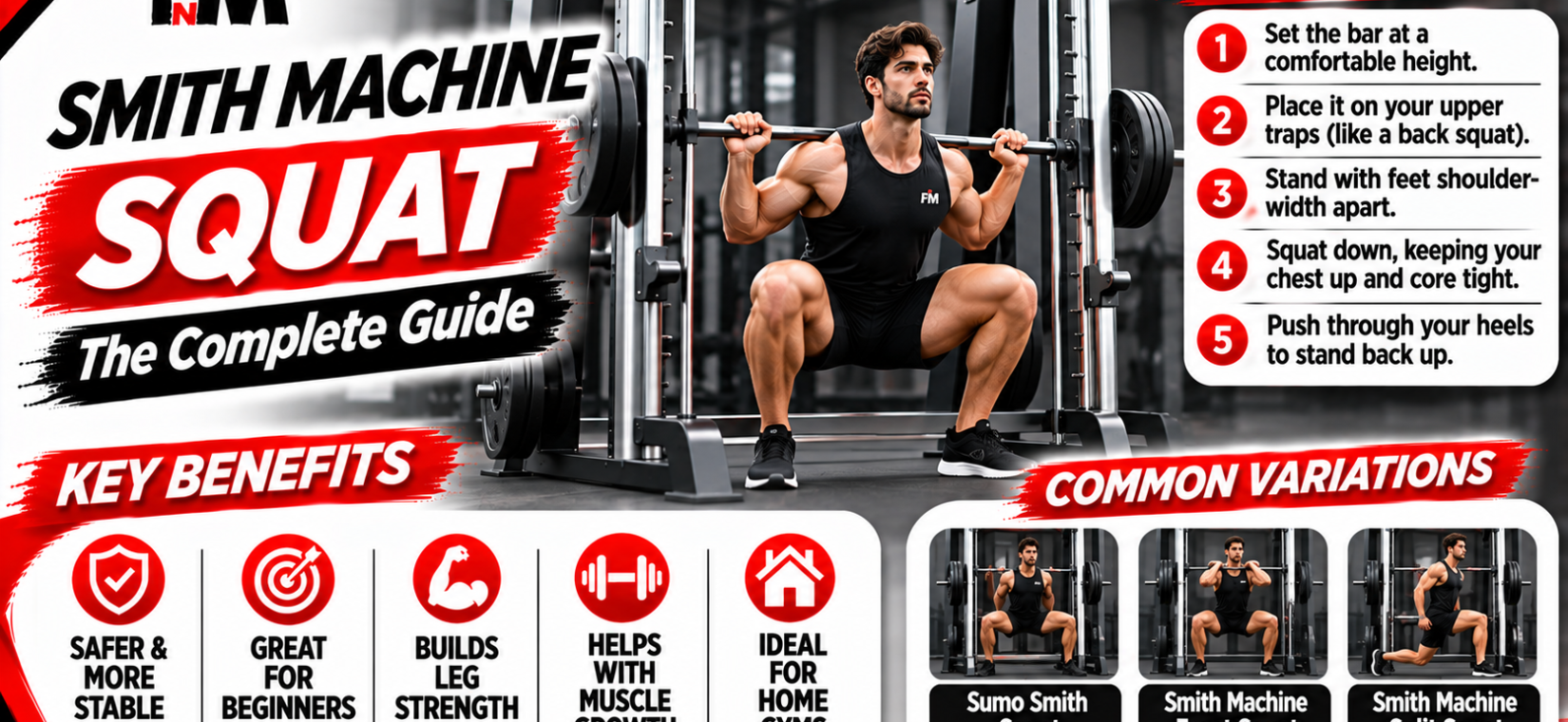
Smith machine squat is a squat performed on a Smith machine, where the barbell travels on fixed vertical rails. The guided path removes the balance demand, letting lifters focus purely on leg drive and train to failure safely with the built-in safeties. Foot placement farther forward shifts emphasis to the glutes and reduces knee stress.
Our pick: Use the smith machine squat as a quad-focused hypertrophy builder, a safe way to train to failure alone, or a rehab-friendly reintroduction to loaded squatting.
Skip if: Your only goal is maximal free-weight strength, athletic transfer to sport, or competition powerlifting — the fixed bar path does not develop the stabilizers those goals demand.
Quick Verdict on the Smith Machine Squat
The smith machine squat is neither the miracle its fans claim nor the joke its critics claim. It is a guided squat variation with a fixed bar path, built-in safety catches, and a movement pattern that shifts emphasis toward the quadriceps. Research comparing muscle activation has found that free-weight squats recruit stabilizer muscles more heavily, while smith machine work allows slightly greater loading of the prime movers with less balance demand.
Bottom line: if you want bigger quads, safe solo training to failure, or a joint-friendly way back to loaded squatting, it belongs in your program. If you want maximal athletic carryover or powerlifting totals, the free barbell remains king. Most smart lifters use both.
What Is a Smith Machine Squat?
A smith machine squat is performed inside a smith machine — a frame with a barbell fixed to vertical (or near-vertical) guide rails, with adjustable safety stops and hooks that let you rack the bar at any height by rotating your wrists. You position yourself under the bar, unhook it, squat, and re-hook it when finished. The smith machine’s design on Wikipedia traces back to the 1950s, making it one of the oldest guided-resistance machines still in every commercial gym.
The fixed path changes the movement in two important ways. First, balance is handled for you: the bar cannot drift forward or backward, so your stabilizer muscles work far less than in a free squat. Second, foot placement becomes a variable you control — stepping your feet forward of the bar creates a more upright torso and greater knee travel, biasing the quadriceps, while feet directly under the bar mimics a conventional squat pattern more closely.
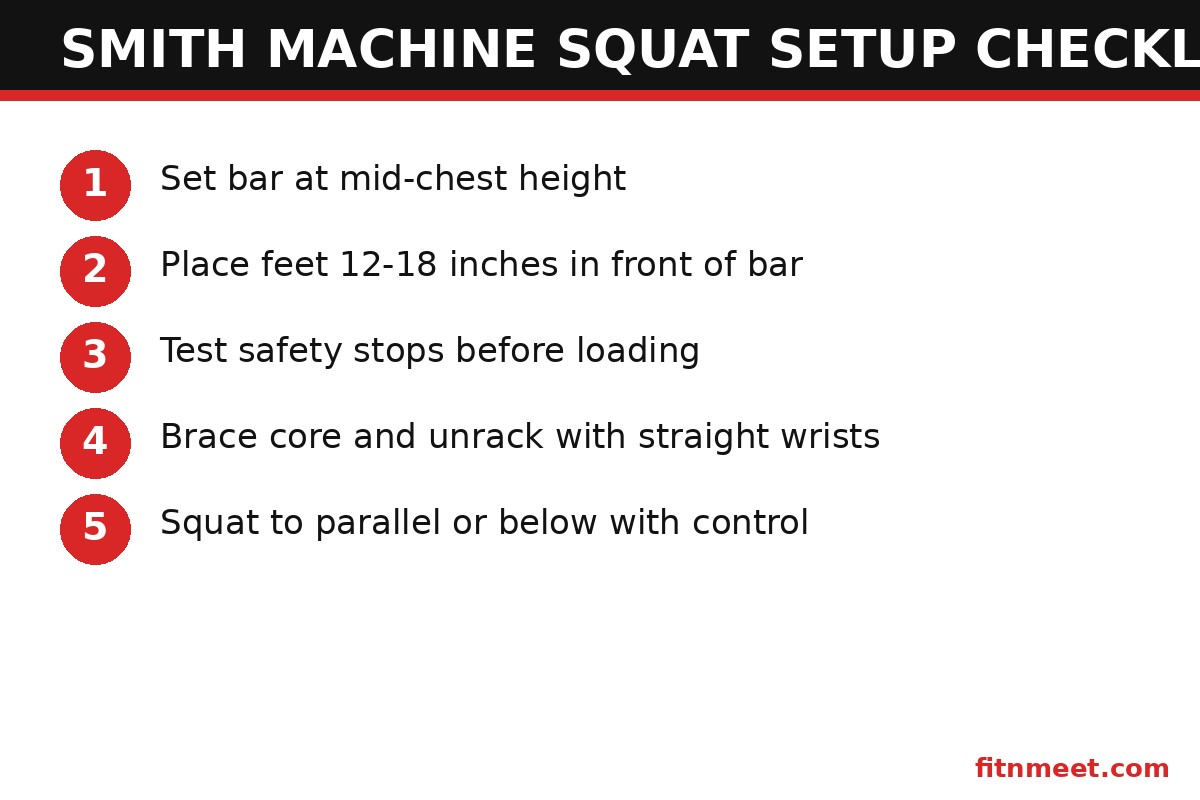
Proper form still matters enormously. Set the safety stops just below your lowest squat depth. Unrack the bar with a firm grip, brace your core as if for a free squat, descend under control to at least parallel, and drive up without bouncing. Never place the safeties so high that they interfere, and never so low that a failed rep leaves you pinned.
Head-to-Head Comparisons
This is where decisions get made. Two tables cover the comparisons that actually matter.
Smith Machine Squat vs Free Barbell Squat
| Factor | Smith Machine Squat | Free Barbell Squat |
|---|---|---|
| Stabilizer demand | Low — rails handle balance | High — full-body stabilization |
| Quad emphasis | Higher (feet-forward option) | Moderate (depends on style) |
| Safety training alone | Excellent — built-in catches | Needs rack + safeties or spotter |
| Athletic transfer | Lower | Higher |
| Loading potential | Often 5–10% heavier | Baseline |
| Learning curve | Short | Longer — technique-intensive |
Electromyography studies have repeatedly shown higher stabilizer and trunk activation in free squats, which is why strength coaches prioritize them for athletes. But the same fixed path that reduces stabilizer work lets many lifters handle slightly heavier loads and push closer to failure safely — a genuine hypertrophy advantage.
Smith Machine Squat vs Leg Press vs Hack Squat
| Factor | Smith Machine Squat | Leg Press | Hack Squat |
|---|---|---|---|
| Spinal loading | Moderate | Low | Low–moderate |
| Core involvement | Moderate | Minimal | Low |
| Depth control | Full control | Machine-limited | Machine-limited |
| Unilateral option | Yes (split squats) | Yes | Rare |
| Space/availability | One machine | Large footprint | Large footprint |
Among machine-based quad builders, the smith machine squat stands out for versatility: it is the only one that easily accommodates split squats, lunges, and calf raises on the same station. If your gym is crowded, one smith machine replaces three machines.
Benefits of the Smith Machine Squat
Quad hypertrophy. The feet-forward position possible on a smith machine creates deep knee flexion with an upright torso — a biomechanical recipe for quadriceps growth. Bodybuilders have used this variation for decades precisely because it isolates the quads better than a free squat.
Safe failure training. Training close to failure drives hypertrophy, but failing a free squat alone is dangerous. The smith machine’s rotating hooks and safety stops let you push a final rep with confidence, re-racking instantly if the rep stalls.
Rehab and reintroduction. After knee or back issues, the guided path and adjustable stops allow progressive reloading with less fear and less balance demand. Many physiotherapists use guided squat patterns for exactly this reason — though you should always follow your clinician’s guidance.
Consistency of stimulus. Because the bar path never varies, every rep looks like the last. That repeatability makes progressive overload cleaner to track: same movement, same path, more weight or more reps over time.
Versatility. Beyond squats, the station handles incline presses, rows, shrugs, lunges, and calf raises. For home gyms with limited space, that multi-use value is significant. Pair your leg training with proper fuel — FitnMeet’s muscle development range supports hypertrophy-focused programming. A post-workout shake made with whey protein isolate supplies the fast-digesting protein your quads need to rebuild after heavy smith machine squat sets.
How to Choose: 5 Decision Questions
Answer these in order to decide whether — and how — the smith machine squat fits your training:
- Do you train alone? If yes, the built-in safeties make the smith machine squat one of the safest ways to squat heavy without a spotter. If you always train with a partner, this advantage shrinks.
- Is quad growth the priority? If yes, the feet-forward smith machine squat deserves a primary slot. If posterior-chain development matters more, prioritize free squats, deadlifts, and hip hinges instead.
- Do you compete in powerlifting? If yes, competition demands the free barbell — use the smith machine only as an accessory. If no, choose freely based on goals.
- Are you managing joint issues? If yes, the guided path and precise safety stops make progressive reloading more approachable. Clear it with your clinician first.
- How much variety does your program need? If you already free-squat heavy twice a week, adding a smith machine variation brings novel stimulus. If you never squat at all, learning the free squat first builds a better foundation.
If you answered “yes” to questions 1, 2, or 4, program the smith machine squat as a main movement. If you answered “yes” to 3, keep it as an accessory at most. For programming frameworks across all your lifts, see FitnMeet’s strength training articles.
Programming the Smith Machine Squat: Sets, Reps, and Placement
Program it like any other compound lift, with the rep range matched to the goal:
| Goal | Sets × Reps | Rest | Placement |
|---|---|---|---|
| Hypertrophy | 3–4 × 8–12 | 90–120 sec | After free compounds or as main lift |
| Strength | 4–5 × 4–6 | 2–3 min | Main lift of the day |
| Rehab reintroduction | 2–3 × 10–15 | 90 sec | Light, controlled, clinician-guided |
| Finisher / burnout | 2 × 15–20 | 60 sec | End of leg day |
Place the smith machine squat early in the session when it is the main lift, and later when it serves as an accessory after free squats. Progress it like any lift: add small increments of weight or reps weekly. Because the movement is so repeatable, even 2.5 kg jumps track cleanly over time.
Safety Considerations
The smith machine is safe, but only when used with respect for its mechanics. Always set the safety stops before your first rep — at a height that catches the bar just below your deepest position. Test the hook-and-rotate motion with an empty bar until re-racking is automatic; fumbling the rotation under load is how accidents happen.
Avoid the common error of placing feet excessively far forward, which can shear the knees under heavy loads — a moderate forward position biases the quads without stressing the joint. Keep your core braced on every rep; the rails handle balance, not spinal stability. And never use collars you cannot quickly remove if you train extreme failure sets — though with proper safety stops set, this is a minor concern.
The National Institutes of Health notes that progressive strength training is one of the most effective interventions for maintaining muscle and bone with age — and safe, guided movements like the smith machine squat lower the barrier to starting. For general training safety principles, the squat exercise overview on Wikipedia is a solid reference.
Common Smith Machine Squat Form Mistakes
Three errors show up constantly. First, skipping the safety stops — the machine’s greatest advantage is worthless if the stops are set wrong or not set at all; always test them with an empty bar before loading weight. Second, excessive forward foot placement — a moderate step forward biases the quads, but planting your feet half a meter ahead turns the smith machine squat into a knee-shear exercise rather than a quad builder. Third, bouncing out of the bottom — the fixed path tempts lifters to rebound off the safeties, which spikes joint stress and kills tension on the muscles you are trying to grow. Descend under control, pause briefly, and drive up.
Fix these three and the movement becomes one of the safest, most productive lifts in the gym. Film a set from the side occasionally — video reveals stance and depth errors that mirrors hide, and reviewing footage for two minutes can correct months of ingrained habits.
This article is for informational purposes only and is not medical advice. Consult a healthcare professional before starting any supplement or exercise program.
Smith Machine Squat FAQs
Is the smith machine squat as good as a free barbell squat?
It depends on the goal. For quadriceps hypertrophy and safe solo training to failure, the smith machine squat is excellent — many lifters handle slightly heavier loads on it. For maximal strength, athletic transfer, and stabilizer development, the free barbell squat is superior. Most well-rounded programs include both.
Does the smith machine squat build glutes?
Yes, though it is quad-dominant compared with a free squat. A deeper stance with feet under the bar recruits the glutes more, while the feet-forward position shifts emphasis to the quads. Pair it with hip hinges like Romanian deadlifts for complete lower-body development.
Is the smith machine squat bad for your knees?
Not inherently. Research does not support the claim that the fixed path damages knees when form is sound. Problems arise from extreme feet-forward positions under heavy loads or bouncing out of the bottom. Use a moderate stance, control the descent, and set safety stops correctly.
How much does the smith machine bar weigh?
Most smith machine bars weigh between 7 and 12 kg (15–25 lbs) because of the counterbalance systems, compared with 20 kg for a standard Olympic barbell. Check your specific machine — count only the plates when tracking progressive overload, and be consistent about it.
Can beginners use the smith machine squat?
Yes — the guided path and safety catches make it one of the most approachable ways for beginners to learn loaded squatting. That said, beginners should still learn basic free-weight movement patterns over time, since the fixed path does not teach balance.
Where should I place my feet for a smith machine squat?
Feet directly under the bar mimics a conventional squat with balanced quad and glute recruitment. Stepping 15–30 cm forward creates a more upright torso and greater quad emphasis. Avoid extreme forward positions, which increase knee shear under load.
Conclusion: Should You Smith Machine Squat?
Compare honestly: if you want quad growth, safe solo training, or a joint-friendly path back to loaded squatting, the smith machine squat earns a regular slot — program it for 3–4 sets of 8–12 and progress it like any main lift. If you chase powerlifting totals or athletic transfer, keep the free barbell as your foundation and use the smith machine as an accessory. Either way, the decision is now an informed one. Browse FitnMeet’s shop for training essentials, and support your leg days with the workout recovery range.