
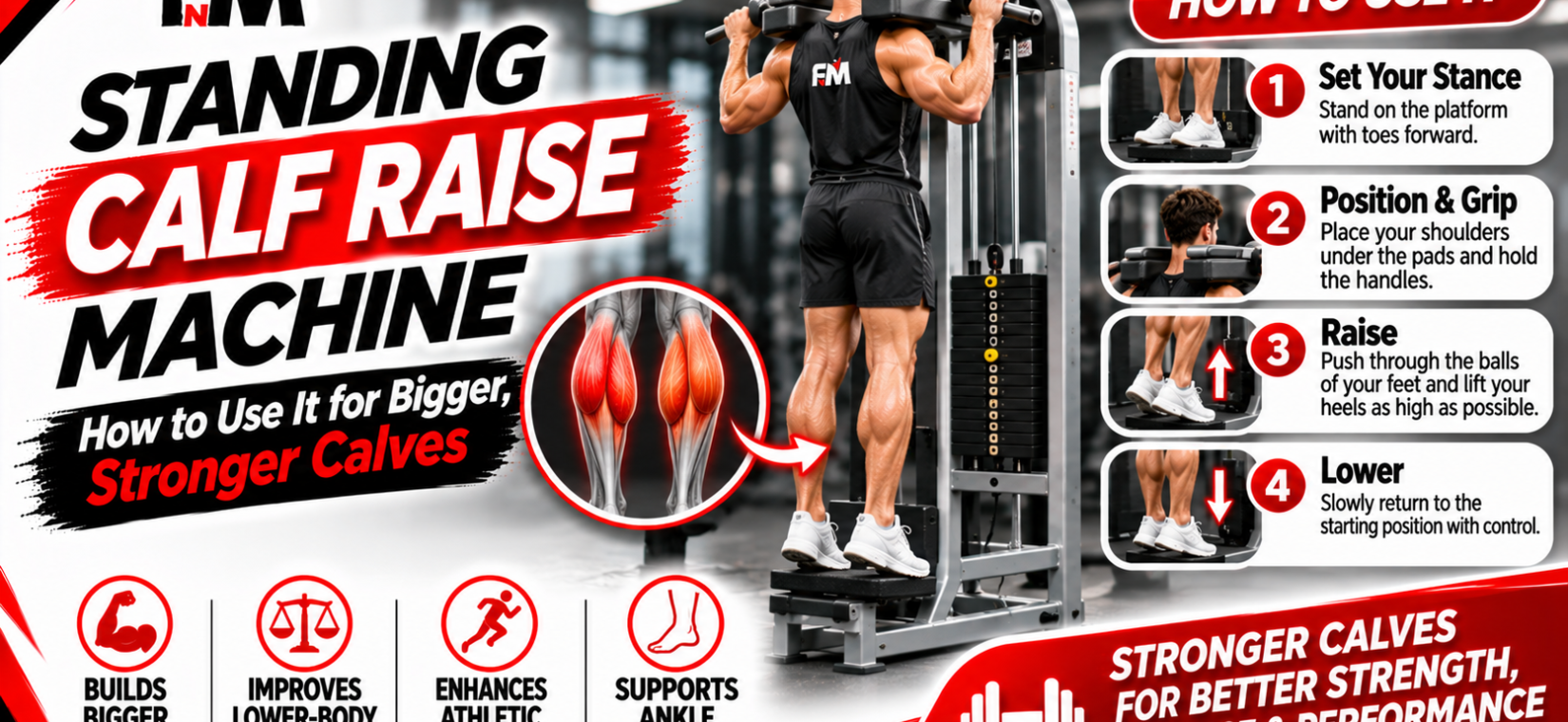
Standing calf raise machine is a gym machine for training the calves with the load on the shoulders while standing on a raised platform. The straight-knee position emphasizes the gastrocnemius, the larger upper calf muscle. Use a full range of motion, pause at the top, and control the stretch at the bottom for best growth.
The Scenario: Leg Day’s Forgotten Five Minutes
It is 7:40 PM. You have just survived squats, leg press, and Romanian deadlifts. Your legs are shaking, your shirt is soaked, and every fiber of your being wants to skip calves — again — and head for the exit. You glance at the standing calf raise machine in the corner. It looks simple. Boring, even. You walk past it. Six months later, your quads have grown two inches and your calves look exactly the same. Sound familiar?
This is the most common calf-training story in every gym on earth. Calves get skipped because they are trained last, when motivation is lowest — and because most people train them wrong when they do bother: bouncing reps, quarter range of motion, weights their ego chose. The standing calf raise machine fixes the second problem completely, and this guide will fix the first — by showing you a calf routine so short and effective that skipping it becomes harder to justify than doing it.
Takeaway: Calves do not grow from neglect. Five focused minutes on the standing calf raise machine, twice a week, beats another skipped session — consistency is the entire game for this stubborn muscle group.
What Is a Standing Calf Raise Machine?
Picture a frame with two padded shoulder yokes, a platform for the balls of your feet, and either a weight stack with a selector pin or a lever arm you load with plates. You step onto the platform, settle the pads onto your shoulders, and rise up onto your toes against the resistance — then lower your heels below the platform for a deep stretch. That is the standing calf raise machine: beautifully simple, brutally effective when used properly.
The biomechanics are what make it special. Standing with a straight knee puts the gastrocnemius — the two-headed muscle forming the visible diamond of the upper calf — in its strongest position. (Bend the knee, as in seated calf raises, and the gastrocnemius slackens, shifting work to the deeper soleus.) EMG research confirms the standing calf raise machine produces the highest gastrocnemius activation of any common calf exercise — which matters because the gastrocnemius is the muscle people mean when they say they want “bigger calves.” The Wikipedia overview of calf raises summarizes the anatomy and movement variations.
Most commercial units offer 100–200 kg of resistance — far more than most lifters will ever need for calves, which is exactly the point: the machine removes load as a limiting factor, leaving only your effort and programming. Unlike free-weight calf work, there is no balance component stealing focus from the target muscle.
Takeaway: The standing calf raise machine = straight knees + heavy load + zero balance demands = maximum gastrocnemius stimulation. That is the whole engineering logic in one line.
Why Your Calves Deserve a Machine
Our scenario lifter is not alone in deprioritizing calves — surveys of gym-goers consistently rank calves among the most-skipped muscle groups. But the case for training them is stronger than aesthetics:
- Athletic performance: the calf-Achilles complex stores and releases elastic energy with every step, hop, and sprint. Studies on sprinters show ankle stiffness and plantar-flexor strength correlate with sprint times — the calf is literally a spring, and springs can be strengthened.
- Injury resilience: stronger calves are associated with lower Achilles tendinopathy risk, one of the most common overuse injuries in runners and court-sport athletes. Eccentric calf training is a frontline rehab prescription.
- Everyday function: stair climbing, hill walking, and rising onto your toes all run through the calves. Age-related calf weakness contributes to balance problems in older adults — the NIH highlights lower-leg strength in fall-prevention research.
- The genetics excuse, examined: yes, calf shape (high vs low insertions) is genetic — but size responds to training like any muscle. The “bad calf genetics” lifters usually just never trained calves with the volume and intensity they gave their chest. A standing calf raise machine program run honestly for six months settles the question.
Takeaway: Train calves for the spring in your step and the armor on your Achilles — the aesthetics are a bonus, not the reason.
Benefits of the Standing Calf Raise Machine
Back to our 7:40 PM lifter — here is what those five minutes actually buy:
- Maximum safe loading: shoulder pads distribute heavy loads comfortably, letting you work in the 6–12 rep hypertrophy range with weights that would be awkward or dangerous as a standing dumbbell raise.
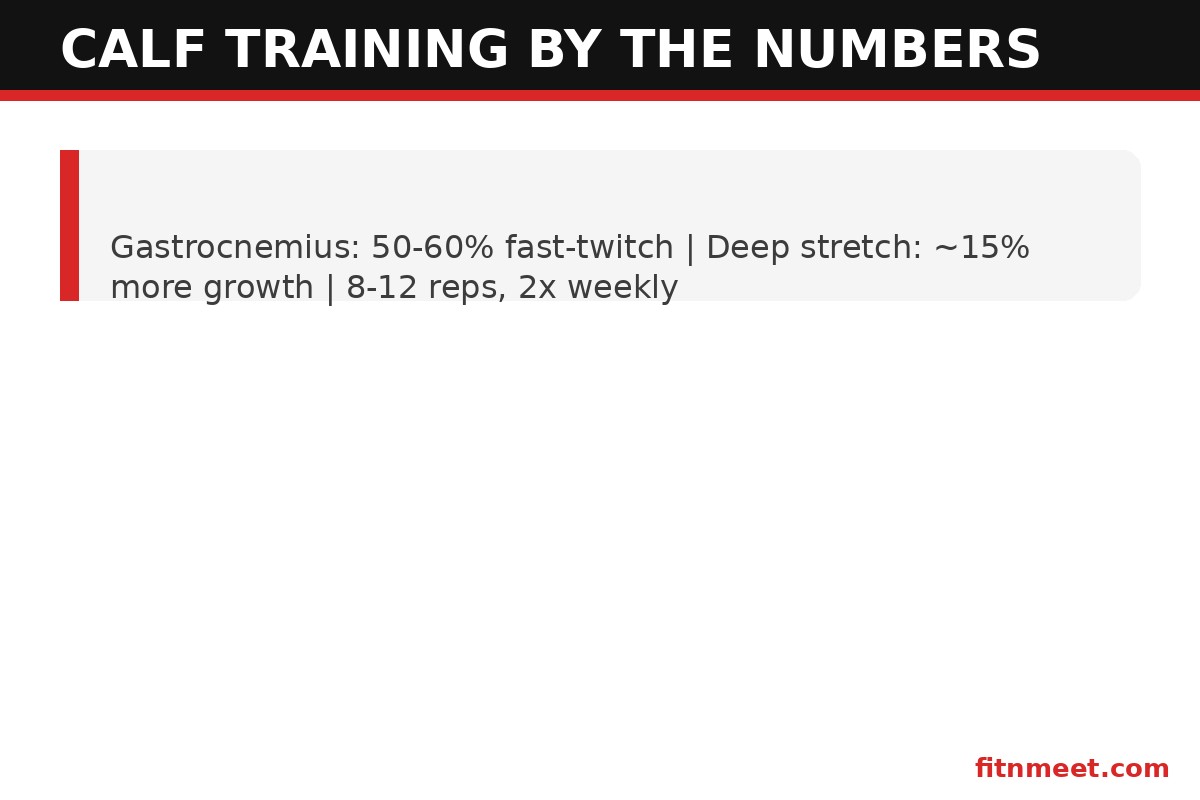
- Full stretch under load: the elevated platform lets heels drop 5–8 cm below foot level — a deep loaded stretch that research increasingly links to superior hypertrophy vs partial-range work. A 2023 study found that deep-stretch calf training produced ~15% more muscle thickness gains than short-range training.
- Strict form enforcement: the fixed movement path eliminates the bouncing and knee-bending that ruin free-weight calf reps. Every rep on the standing calf raise machine looks the same — which means every rep counts the same.
- Unilateral options: most machines allow single-leg work by simply lifting one foot — instantly doubling the relative load for advanced progression without adding plates.
- Quick sessions: 3–4 sets take under 8 minutes including rest. The “no time” excuse dies here.
Takeaway: Heavy + deep stretch + strict reps + 8 minutes. That is the complete value proposition of the standing calf raise machine.
How to Use the Standing Calf Raise Machine
Our lifter steps up to the machine. Here is the story of a perfect set, told as it happens:
- The setup. She sets the shoulder pads to just below shoulder height, steps onto the platform with the balls of her feet on the edge and heels hanging free, then stands up to lift the weight off its rests. Feet hip-width apart, toes pointing forward — the default that evenly loads both calf heads.
- The stretch. She lowers her heels slowly — counting one-one-thousand, two-one-thousand, three-one-thousand — until she feels a deep but comfortable stretch. No bouncing at the bottom; the Achilles is under serious load here and deserves respect.
- The drive. She presses through the balls of her feet, rising as high as possible onto her toes, imagining pushing the platform away. At the top she squeezes for a full second — that peak contraction is where the mind-muscle connection pays off.
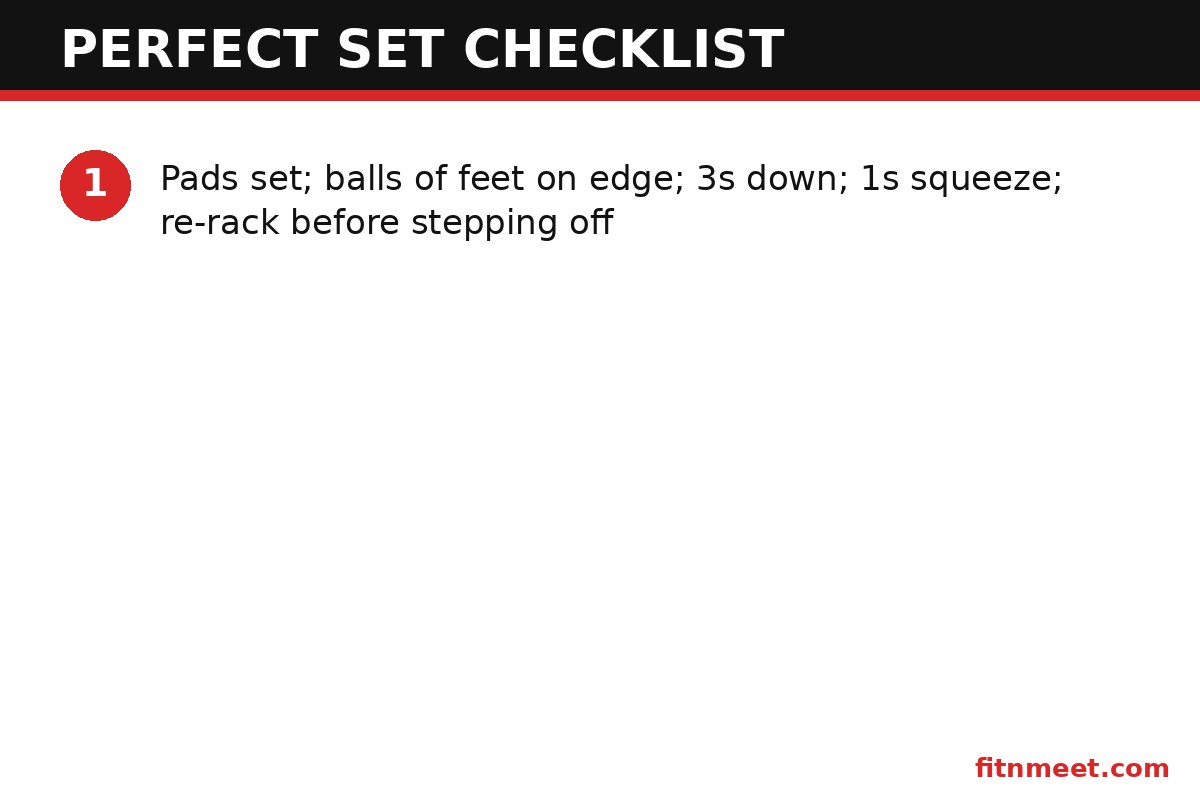
- The rhythm. Three seconds down, one second squeeze at the top, one second up, no pause at the bottom beyond the stretch. Each rep takes about five seconds; a set of 10 takes under a minute of honest work.
- The finish. After the last rep, she lowers the weight back onto its rests before stepping off — never dismount a loaded standing calf raise machine mid-rep. Three to four sets, 60–90 seconds rest between, done in under eight minutes.
Takeaway: 3 seconds down, 1 second squeeze, full stretch every rep, re-rack before stepping off. Memorize that sentence and your form is solved.
Sets, Reps & Programming
Calves are often mistrained because people apply chest-day logic to a very different muscle. The gastrocnemius is roughly 50–60% fast-twitch fibers — it responds to heavy loads — but the Achilles tendon needs gradual progression. The programming sweet spot:
- Hypertrophy focus: 3–4 sets of 8–12 reps, twice weekly, 60–90 seconds rest. Add weight when you hit 12 clean reps on all sets.
- Strength focus: 4–5 sets of 5–8 reps with heavier loads, twice weekly, 2-minute rests. Keep the full stretch — never sacrifice range for weight.
- The stubborn-calves protocol: if calves lag after 3 months, add a third weekly session of single-leg standing calf raise machine work, 3×10–15 per leg. Unilateral loading is the plateau-breaker.
- Tempo prescription: 3-1-1-0 (3s eccentric, 1s squeeze, 1s concentric, no bottom pause beyond the stretch). Faster tempos invite bouncing; slower ones waste time.
- Progression rule: calves recover fast — increase load or reps every 1–2 weeks. If you are using the same weight on the standing calf raise machine in month three as month one, you are maintaining, not building.
Fuel the growth you are programming for — FitnMeet’s muscle development collection and strength training guides cover the protein and programming that turn calf work into visible results.
Takeaway: Twice weekly, 8–12 reps, full stretch, add weight every 1–2 weeks. Simple programming, honestly executed, grows calves.
What to Watch For: Mistakes & Safety
- The bounce: dropping fast and rebounding off the Achilles turns the set into tendon ping-pong — zero muscle tension, real injury risk. If you cannot pause the stretch, the weight is too heavy.
- Quarter reps: the classic calf sin — 5 cm up, 5 cm down, 200 kg on the stack, zero growth. Full range or it did not happen.
- Knee bend creep: as sets get hard, knees start bending, shifting work to the soleus and quads. Lock the knees (soft, not hyperextended) and keep them there.
- Foot position fads: toes-in vs toes-out barely changes gastrocnemius head emphasis in EMG studies — pick neutral and focus on range and load instead of foot-angle astrology.
- Stepping off loaded: always return the weight to its rests before dismounting the standing calf raise machine. A loaded shrug-off sideways is how ankles get sprained.
- Achilles warning signs: sharp pain (not burn) in the Achilles, morning stiffness that worsens over weeks, or swelling — stop calf training and see a professional. Tendons adapt slower than muscles; respect the timeline.
Takeaway: Bouncing, quarter reps, and bent knees are the three thieves of calf growth — eliminate them and the standing calf raise machine does the rest.
Standing Calf Raise Machine vs Other Calf Exercises
| Factor | Standing calf raise machine | Seated calf raise | Leg press calf raise | Dumbbell standing raise |
|---|---|---|---|---|
| Primary target | Gastrocnemius | Soleus | Gastrocnemius | Gastrocnemius |
| Max load | Very high (100–200 kg) | High | Very high | Limited by grip |
| Stretch depth | Excellent (platform) | Good | Excellent | Good (on step) |
| Balance demand | None | None | None | High |
| Best for | Overall calf mass | Soleus depth | Heavy loading at home gyms | Travel, no machine |
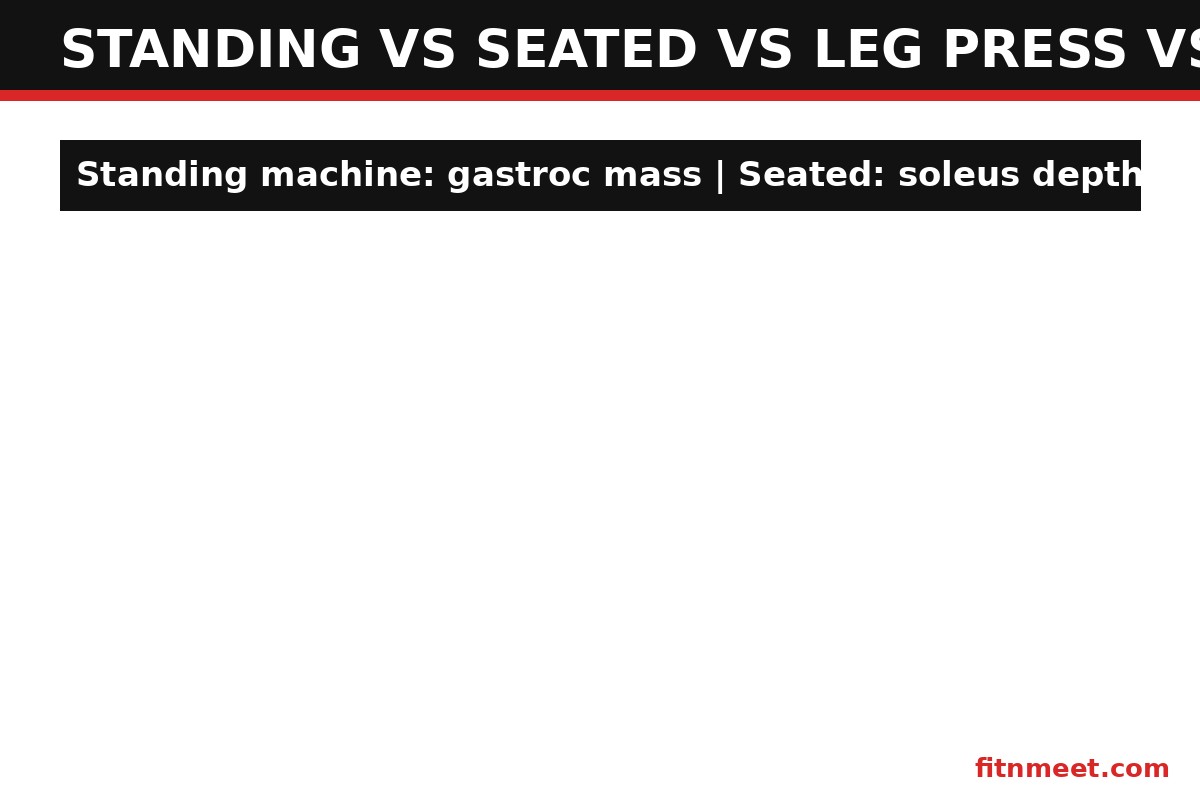
The smart play is combining: standing calf raise machine for gastrocnemius mass plus seated work for soleus thickness. They are complements, not competitors — which is why complete leg programs, like those in FitnMeet’s fitness guides and shop resources, program both.
Takeaway: Standing machine for the visible upper calf, seated for the deep soleus — run both and skip neither.
This article is for informational purposes only and is not medical advice. Consult a healthcare professional before starting any supplement or exercise program.
Frequently Asked Questions
What does the standing calf raise machine work?
Primarily the gastrocnemius — the two-headed muscle of the upper calf — because the straight-knee standing position puts it in its strongest, most activated state. The soleus (deep calf) assists but is better targeted with bent-knee seated work.
How many reps should I do on the standing calf raise machine?
8-12 reps for muscle growth, twice per week, is the evidence-based default. Use a 3-1-1 tempo (3 seconds down, 1 second squeeze at top, 1 second up) with a full stretch on every rep. Add weight whenever you can complete 12 clean reps on all sets.
Why are my calves not growing?
The three usual culprits: (1) bouncing quarter-reps with no stretch, (2) training calves once a week or less with low effort after exhausting leg day, and (3) never progressing the load. Fix all three — full range, twice weekly, heavier over time — and reassess after 3-6 months before blaming genetics.
Is the standing calf raise machine better than seated?
For gastrocnemius (visible upper calf) size, yes — straight knees maximize its activation. For soleus (deep calf) development, seated is better. They target different muscles, so the ideal program includes both rather than choosing one.
Can I do single-leg reps on the standing calf raise machine?
Yes — simply lift one foot and perform the movement unilaterally. This doubles the relative load per leg without adding plates and corrects left-right imbalances. Start with bodyweight-plus-machine-minimum before adding serious load single-legged.
How heavy should I go on the standing calf raise machine?
Heavy enough that 8-12 full-range reps are challenging with a 3-second lowering phase — for most trained lifters this lands between bodyweight-plus and 1.5x bodyweight total. Never sacrifice the deep stretch for extra plates; range of motion drives calf growth more than load alone.
Conclusion
It is 7:40 PM, six months from now. Same lifter, same leg day — but this time she walks to the standing calf raise machine instead of past it. Four sets, eight minutes, full stretch every rep. Her calves have grown an inch, her Achilles feels bulletproof on runs, and the machine in the corner is no longer decoration. The only thing that changed was five minutes, twice a week, done right.
That is the whole story: the standing calf raise machine rewards the lifter who shows up for the boring work. Full range, progressive load, twice a week — and the muscle group everyone skips becomes the one that sets you apart.
Join the lifters who stopped skipping — browse FitnMeet’s training guides and muscle-building resources, and give your calves the five minutes they have been waiting for.
Final takeaway: Five minutes, twice a week, full stretch, heavier over time. The standing calf raise machine does not need your motivation — just your consistency.