
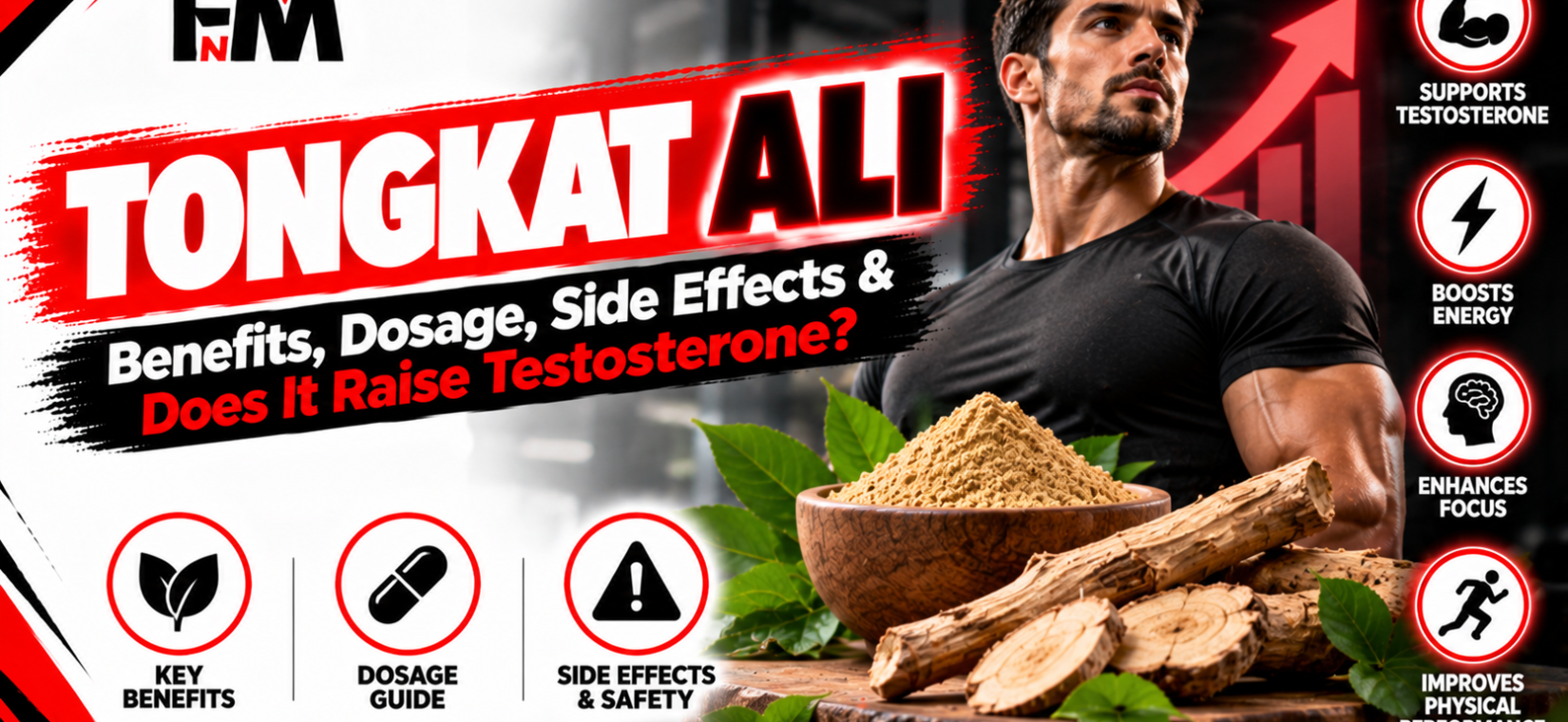
Tongkat ali (Eurycoma longifolia) is a Southeast Asian root traditionally used as a male vitality tonic, now sold as a testosterone-support supplement. Human trials suggest tongkat ali can raise testosterone in men with low baseline levels or high stress — one trial found a 37% increase — though evidence in healthy men is weak. Typical studied doses are 200–400 mg/day.
What Is Tongkat Ali? (With Mechanism)
the extract is the common name for Eurycoma longifolia, a slender tree native to the rainforests of Malaysia, Indonesia, Thailand, and Vietnam. Its taproot has been brewed as a bitter tonic in Southeast Asian traditional medicine for centuries — used for fevers, malaria, and, most famously, male vitality and libido. The name translates roughly to “Ali’s walking stick,” a nod to its traditional reputation.
Modern tongkat ali supplements use water or ethanol extracts of the root, standardized to quassinoid content — typically 1-2% eurycomanone, the compound considered the primary bioactive marker. This standardization matters enormously: raw root powder and a standardized extract are different products, and nearly all human research uses standardized extracts at defined doses.
The proposed mechanism centers on the hypothalamic-pituitary-gonadal (HPG) axis. In animal studies, eurycomanone and related quassinoids appear to stimulate luteinizing hormone (LH) release and directly stimulate testosterone production in Leydig cells of the testes, while possibly reducing sex hormone-binding globulin (SHBG) — the protein that locks up testosterone in inactive form. Lower SHBG would mean more free testosterone even if total testosterone barely moves. That last point is important: several researchers argue tongkat ali’s real action is on free testosterone and the testosterone-to-cortisol ratio, not on total testosterone per se. The honest caveat is that the mechanism in humans is not fully established — most mechanistic data come from rodents and cell studies, not people. For botanical background, see the Eurycoma longifolia overview on Wikipedia.
What the Research Says: Study Spotlights
Human research on tongkat ali is small but real. Here are the three most-cited trials, presented straight:
Study Spotlight: Talbott et al., 2013
Full trial record: Talbott et al. (2013) on PubMed — randomized trial of tongkat ali on stress hormones and mood.
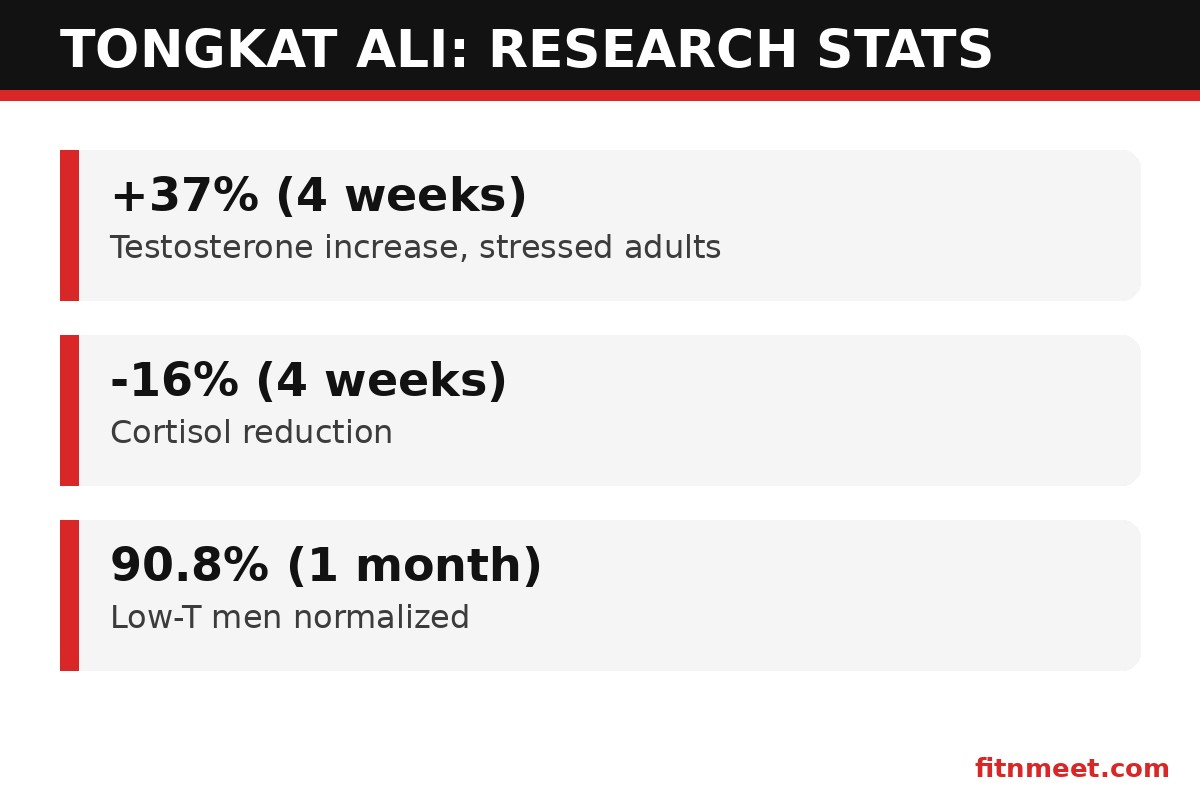
Design: Randomized, double-blind, placebo-controlled trial · Subjects: 63 adults (32 men, 31 women) with moderate stress · Dose: 200 mg/day standardized tongkat ali extract for 4 weeks · Finding: Cortisol exposure dropped 16% and testosterone status rose 37% versus placebo, alongside significant improvements in self-reported tension, anger, and confusion. Takeaway: The strongest evidence that tongkat ali shifts the testosterone-cortisol balance — in stressed people.
Study Spotlight: Henkel et al., 2014
Design: Clinical observation published in Andrologia · Subjects: 76 men with late-onset hypogonadism symptoms and low testosterone · Dose: 200 mg/day for 1 month · Finding: 90.8% of subjects reached normal testosterone values, with parallel improvement in symptom scores. Takeaway: Impressive on paper, but uncontrolled (no placebo group) — expect some placebo and regression-to-the-mean effects. Still, the magnitude is hard to dismiss entirely.
Study Spotlight: Ismail et al., 2012
Design: Randomized, double-blind, placebo-controlled trial · Subjects: 109 men aged 30-55 · Dose: 300 mg/day freeze-dried water extract for 12 weeks · Finding: Significant improvements in erectile function scores and libido versus placebo, with good tolerability. Takeaway: The best-designed trial for sexual-function outcomes — 12 weeks, proper placebo control, meaningful sample size.
The pattern across these studies is consistent: the extract shows the clearest effects in men with low or borderline testosterone, high stress, or age-related decline. In healthy young men with already-normal testosterone, the limited data show little to no meaningful increase — a finding echoed by reviewers who note the absence of strong evidence for performance enhancement in eugonadal (normal-T) athletes.
Tongkat Ali Benefits: Weighing the Evidence
Testosterone support in low-T men. The Henkel (2014) observation and the Talbott (2013) trial both point the same direction: men starting from low testosterone or high cortisol see the largest hormonal shifts, with reported increases of 30-40% in testosterone markers (Talbott et al., 2013, n=63).
Stress and cortisol reduction. The 16% cortisol reduction in Talbott (2013) came with measurable mood improvements — less tension, anger, and confusion on standardized questionnaires. For lifters and high-stress professionals, the testosterone-to-cortisol ratio may matter more than either hormone alone, since chronic cortisol elevation is catabolic (muscle-wasting) and suppresses recovery.
Libido and erectile function. The Ismail (2012) 12-week trial (n=109) is the strongest evidence here, with significant gains in validated erectile-function and sexual well-being scores at 300 mg/day. Traditional use aligns with this outcome more than any other.
Body composition and strength. This is where marketing outruns data. No well-controlled trial has shown tongkat ali directly increases muscle mass or 1-rep max in trained lifters. Any physique benefit is likely indirect — better recovery, libido, and training drive from improved hormonal balance — rather than an anabolic effect comparable to actual testosterone therapy. Treat “muscle builder” claims with skepticism.
Energy and fatigue. Small trials and user reports describe reduced fatigue, but objective measures are thin. The effect, if real, probably rides on the cortisol and sleep-quality improvements rather than a stimulant action — tongkat ali is not a stimulant and contains no caffeine.
How Tongkat Ali Works in the Body
After ingestion, the quassinoids in the extract extract are absorbed in the gut — eurycomanone has modest oral bioavailability, which is one reason effective doses are in the hundreds of milligrams rather than tens. In rodent models, eurycomanone increases LH secretion from the pituitary, which signals the testes’ Leydig cells to synthesize more testosterone from cholesterol. Parallel animal work suggests reduced aromatase activity (less testosterone converted to estrogen) and lower SHBG, both of which would raise the free-testosterone fraction.
The cortisol side of the equation may be equally important. Chronic stress elevates cortisol, which directly suppresses the HPG axis — high cortisol means lower testosterone. By attenuating the stress response (the mechanism is unclear, possibly via effects on glucocorticoid signaling), tongkat ali may raise testosterone partly by removing cortisol’s brake rather than by pressing the accelerator. This would neatly explain why stressed subjects (Talbott, 2013) respond more than relaxed, healthy young men.
What tongkat ali does NOT do: it does not contain testosterone, it is not a prohormone, and it will not shut down your natural production the way exogenous testosterone does. There is no evidence of HPG-axis suppression or need for post-cycle therapy — a meaningful safety distinction from actual anabolic agents, though not a license for reckless dosing.
Tongkat Ali Dosage: An Evidence-Based Protocol
Follow this protocol to use tongkat ali the way the research did:
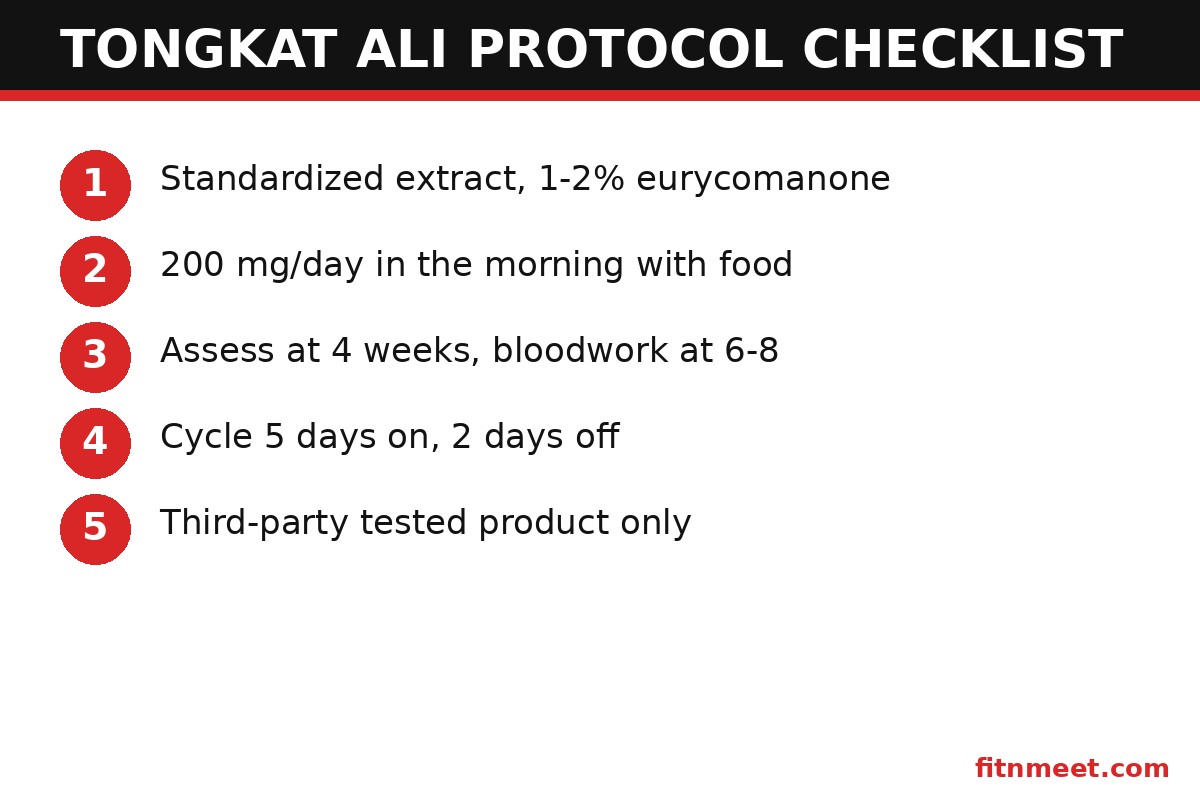
- Step 1: Choose a standardized extract. Look for root extract standardized to 1-2% eurycomanone (or ~100:1/200:1 extract ratios from a reputable manufacturer). Avoid raw root powder capsules — the active dose is unpredictable.
- Step 2: Start at 200 mg/day. This is the most-studied dose (Talbott, 2013; Henkel, 2014). Take it in the morning with food; some users report mild restlessness if taken late in the day.
- Step 3: Assess at 4 weeks. Hormonal and mood effects in trials appeared within 4 weeks. Track subjective markers: morning energy, libido, training recovery, sleep quality. If you want objective data, get total and free testosterone tested before starting and at week 6-8.
- Step 4: Consider 300-400 mg/day if needed. The 12-week sexual-function trial used 300 mg/day (Ismail, 2012). Do not exceed 400 mg/day without a reason — higher doses increase the odds of irritability and insomnia without evidence of proportional benefit.
- Step 5: Cycle it. A common practice is 5 days on / 2 days off, or 4-8 weeks on followed by 1-2 weeks off. Cycling is precautionary rather than evidence-based, but it is cheap insurance against tolerance and unknown long-term effects.
- Step 6: Buy third-party tested. Analyses of commercial tongkat ali products have found adulteration — including undeclared prescription drugs and heavy metals in some samples. Choose products with independent heavy-metal and purity testing; this matters more for the extract than for most supplements.
Pair any hormone-support strategy with the fundamentals that actually move the needle: 7-9 hours of sleep, adequate dietary fat and calories, heavy compound lifting, and stress management. Our health articles and vitamin collection cover the broader foundation.
Tongkat Ali Side Effects and Safety
At studied doses (200-400 mg/day), tongkat ali is generally well tolerated. Reported side effects are mild and dose-dependent: insomnia or restlessness (most common, especially with evening dosing), irritability or short temper at higher doses, and occasional mild gastrointestinal discomfort. These typically resolve with dose reduction or morning-only dosing.
The more serious cautions are about product quality, not the herb itself. Rare cases of liver injury have been reported in bodybuilders using tongkat ali products — though in several cases the products were later found to be adulterated, making it unclear whether the herb or the contaminant was responsible. This reinforces the third-party-testing rule above.
Who should avoid tongkat ali: pregnant or breastfeeding women (no safety data — avoid), anyone with hormone-sensitive conditions such as prostate cancer (theoretical concern with anything that may raise androgens; discuss with your oncologist), and people taking medications with narrow safety margins unless a clinician approves. Men with diagnosed hypogonadism should get proper medical evaluation first — the extract is not a substitute for prescribed testosterone therapy when that is indicated.
Tongkat Ali vs Alternatives
| Supplement | Best evidence for | Human trial quality | Typical dose | Key limitation |
|---|---|---|---|---|
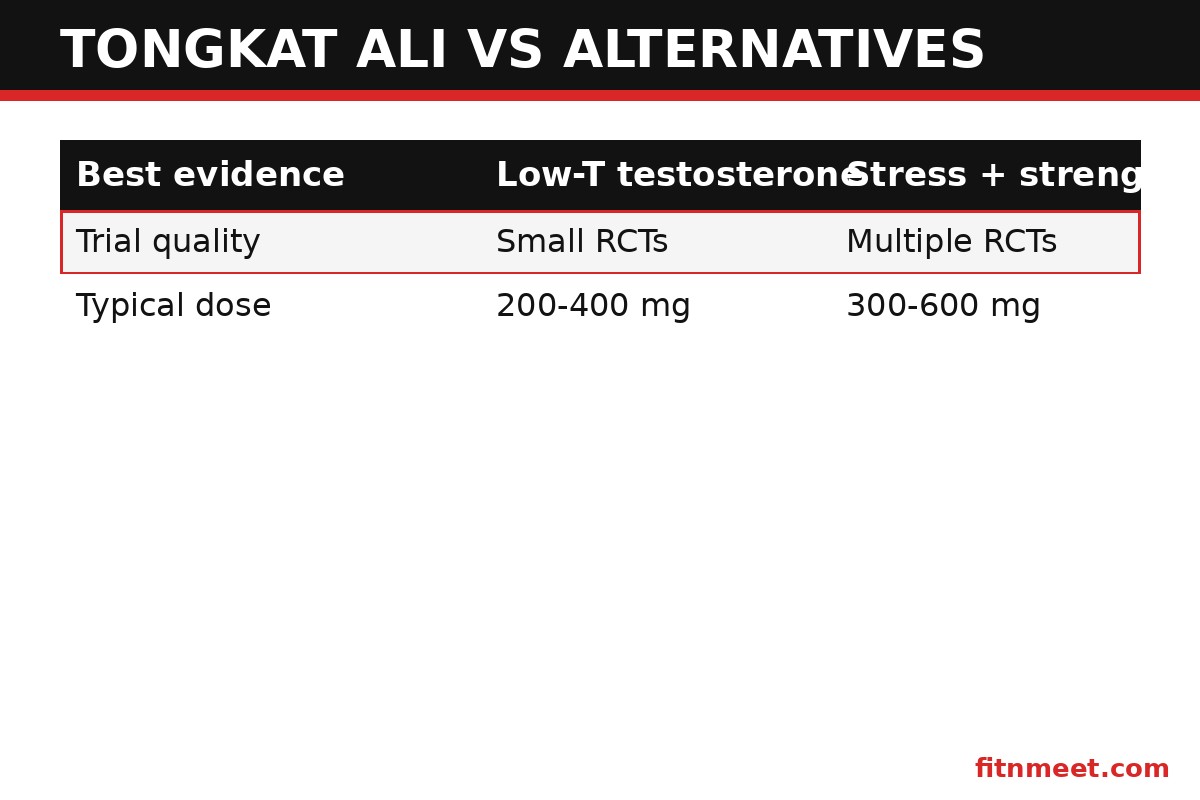
| Tongkat ali | Testosterone in low-T/stressed men; libido | Small RCTs (n=63-109) | 200-400 mg/day | Weak data in healthy young men |
| Ashwagandha | Cortisol reduction; strength; testosterone | Multiple RCTs (n=50-150) | 300-600 mg/day | Sedating for some; thyroid caution |
| Fenugreek | Libido; modest testosterone support | Small RCTs | 500-600 mg/day | Maple-syrup body odor; GI upset |
| D-aspartic acid | Short-term LH/testosterone bump | Mixed; effects fade after weeks | 3 g/day | Benefits appear transient |
| Zinc | Correcting deficiency-linked low T | Strong (for deficiency) | 15-30 mg/day | Does nothing if already sufficient |
No supplement in this table replaces the big levers: sleep, body composition, and training. Among the options, ashwagandha has the broadest RCT base for stress and strength outcomes, while tongkat ali’s niche is specifically libido and testosterone in men starting from a deficit. They are sometimes stacked, but combined safety data are limited — introduce one at a time. Browse the FitnMeet health support collection for foundational options.
Frequently Asked Questions
Does tongkat ali really raise testosterone?
It can, but mainly in men with low baseline testosterone or high stress. A 2013 trial (63 subjects, 200 mg/day for 4 weeks) found a 37% testosterone increase alongside 16% lower cortisol, and a 2014 clinical observation found 90.8% of low-T men normalized their levels. Evidence in healthy young men with normal testosterone is weak.
How long does the extract take to work?
Hormonal and mood effects in trials appeared within 4 weeks at 200 mg/day. Sexual-function benefits in the best-designed trial took the full 12 weeks at 300 mg/day. Give it at least a month before judging, and consider bloodwork at 6-8 weeks for objective data.
What is the best tongkat ali dosage?
200 mg/day of standardized root extract (1-2% eurycomanone) is the most-studied dose. The 12-week sexual-function trial used 300 mg/day. Most users stay within 200-400 mg/day, taken in the morning with food, often cycled 5 days on / 2 days off.
Is tongkat ali safe?
At studied doses it is generally well tolerated; the most common side effects are insomnia, restlessness, and irritability at higher doses. Rare liver injury cases have been linked to tongkat ali products, though adulteration may explain some cases. Choose third-party tested products, and avoid it in pregnancy or with hormone-sensitive conditions.
Does tongkat ali work like steroids?
No. Tongkat ali contains no testosterone and is not a prohormone; it does not shut down natural production and requires no post-cycle therapy. Its effects are modest and indirect (supporting your own production), which is also why it is far weaker than actual testosterone therapy.
Can women take the extract?
The 2013 stress trial included 31 women and found cortisol and mood benefits, so it is not exclusively a men’s supplement. However, most research focuses on male hormonal outcomes, and safety data in pregnancy are lacking — women who are pregnant, breastfeeding, or managing hormonal conditions should consult a clinician first.
Conclusion
The research verdict on tongkat ali is nuanced rather than hype-worthy: modest but real benefits for testosterone, stress, and libido in men starting from a deficit, thin evidence for everyone else. If that describes you, 200 mg/day of a standardized, third-party-tested extract for 4-12 weeks is a reasonable, low-risk experiment — alongside the sleep, training, and nutrition habits that drive 90% of hormonal health. Explore more evidence-based supplement guides on the FitnMeet blog and browse the shop for foundational nutrition support.
This article is for informational purposes only and is not medical advice. Consult a healthcare professional before starting any supplement.