
Trace mineral drops are concentrated liquid supplements delivering microminerals — magnesium, zinc, iron, selenium, iodine, chromium, and others — in drop form. Trace mineral drops appeal to advanced users for precise titration and fast absorption, but they demand respect: minerals interact, compete for absorption, and accumulate, so protocol design matters more than with most supplements.
Trace Mineral Drops: Quick Answer
This liquid format make the most sense for experienced supplement users who want fine control: correcting a specific shortfall identified by diet analysis or bloodwork, titrating doses that capsules cannot provide, or covering microminerals during restrictive diets (keto, vegan, heavy training blocks). They make the least sense as a blind daily “cover everything” habit — indiscriminate mineral stacking risks imbalances, especially zinc-induced copper depletion and iron accumulation. Start with testing, dose to the gap, cycle periodically, and re-test.
Protocol snapshot: Morning — the protocol in water on an empty stomach (away from coffee/tea) → Midday — food-based minerals from meals → Evening — magnesium-focused dose if sleep support is the goal. Cycle 8–12 weeks on, 2–4 weeks reassessment.
Trace Mineral Drops: Mechanisms of Action
Understanding the drops requires understanding mineral competition. Microminerals share intestinal transporters — most notably DMT1 (divalent metal transporter 1), which carries iron, zinc, manganese, and copper. Flood the gut with one mineral and the others lose absorption share. This is the central mechanism governing every this liquid format protocol: dose balance matters as much as dose size.
Each mineral in the protocol plays distinct enzymatic roles. Zinc is a cofactor for 300+ enzymes including those driving immune cell function and testosterone synthesis. Selenium powers glutathione peroxidases — the body’s master antioxidant enzymes — at microgram doses. Iodine is the non-negotiable raw material for thyroid hormones T3/T4. Chromium influences insulin signaling. Magnesium (often the bulk mineral in this liquid format) drives ATP metabolism. Iron carries oxygen via hemoglobin. The drops format matters mechanistically too: dissolved ionic minerals bypass tablet disintegration, and liquid dosing on an empty stomach avoids phytate and fiber binding that can cut mineral absorption from food by 50% or more.
The advanced user’s edge with the drops is exploiting timing: taking competing minerals at different times of day sidesteps transporter competition entirely. Zinc in the morning, magnesium in the evening, iron midday with vitamin C — this temporal separation is the core trick that makes this liquid format protocols outperform “everything in one multivitamin” approaches. For the nutritional science foundation, see Wikipedia’s overview of minerals in nutrition and the NIH Office of Dietary Supplements fact sheet library.
Advanced Benefits of Trace Mineral Drops
- Precision correction of shortfalls: bloodwork showing low zinc, selenium, or iodine can be addressed with exact drop counts — 1 mg increments that no capsule offers. This is the primary evidence-based use of the drops.
- Support during restrictive diets: vegan diets risk B12, iron, zinc, and iodine gaps; keto diets flush electrolytes including magnesium and potassium. Trace mineral drops fill these predictable gaps efficiently.
- Immune and thyroid support: zinc and selenium both have RCT support for immune function in deficient populations; iodine repletion restores thyroid hormone synthesis where intake is low.
- Electrolyte management for athletes: heavy sweaters lose meaningful magnesium, sodium, and potassium — trace mineral drops in water provide rapid, measurable replacement.
- Absorption efficiency: liquid minerals taken away from meals avoid the phytate, oxalate, and fiber interactions that can halve mineral uptake from food matrices.
- What they do not do: trace mineral drops do not “detox” anything, do not alkalize the body, and do not compensate for a diet devoid of whole foods. Marketing claims about “72 ionic minerals” sound impressive; the body needs about a dozen in meaningful amounts.
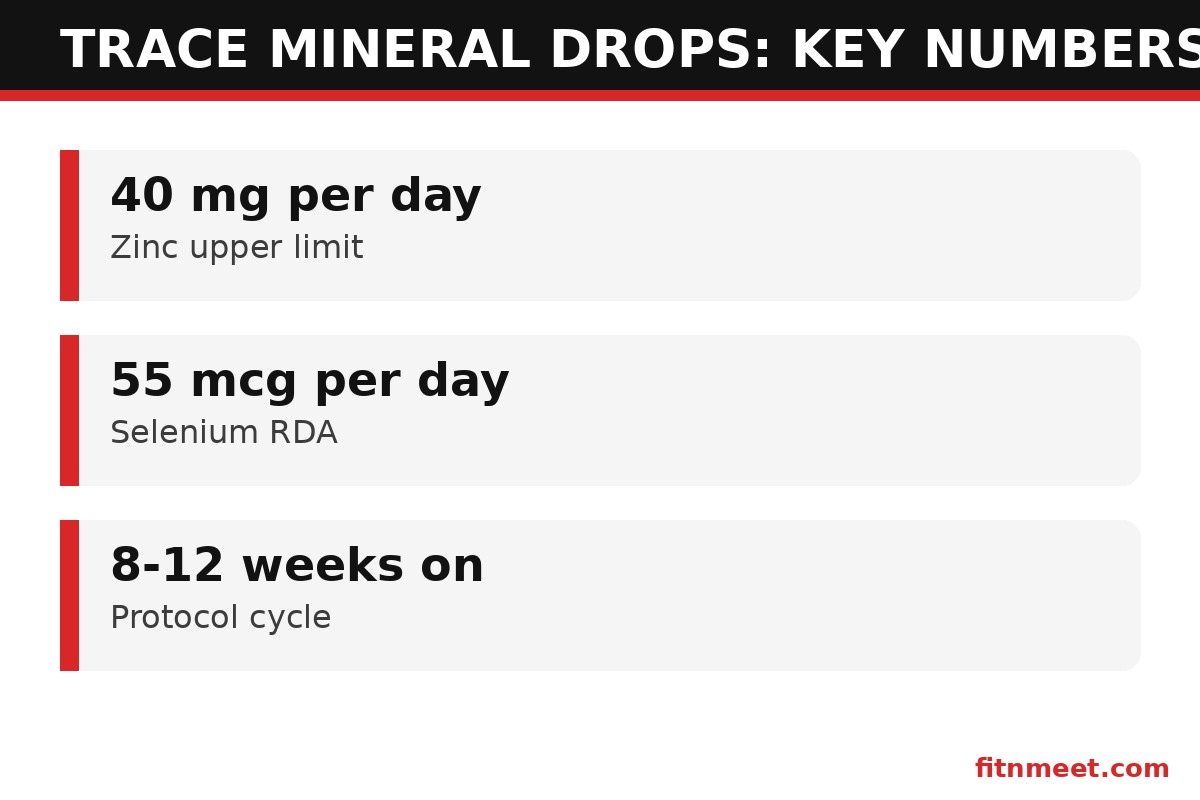
Trace Mineral Drops Protocols (Timing, Stacking, Cycling)
Phase 1 — Assess (weeks 1–2)
Do not start trace mineral drops blind. Get baseline data: a diet audit (3 days of tracking) plus bloodwork where it matters — ferritin for iron, serum zinc if deficiency is suspected, TSH plus iodine intake estimate for thyroid. Define the gap in numbers before buying drops. Most advanced users discover 1–3 genuine shortfalls, not the dozen a marketing label implies. For help structuring those diet audits, the FitnMeet nutrition articles cover food-tracking basics.
Phase 1 protocol: Diet audit → targeted bloodwork → identify 1–3 shortfalls → select trace mineral drops covering only those minerals. Duration: 2 weeks. No supplementation yet.
Phase 2 — Titrate (weeks 3–6)
Introduce one mineral at a time, starting at 25–50% of the target dose. This isolation lets you attribute any effect — good or bad — to the right mineral. Use temporal separation for competitors:
| Time | Mineral | With / without | Rationale |
|---|---|---|---|
| Morning, empty stomach | Zinc (from trace mineral drops) | Water only; no coffee for 1 hr | Avoids phytate binding; separates from iron |
| Midday, with lunch | Iron (if indicated) | With vitamin C source | Vitamin C triples non-heme iron absorption |
| Afternoon | Selenium / iodine | With food | Microgram doses; food buffers the stomach |
| Evening, before bed | Magnesium | Water or herbal tea | Supports relaxation; separated from zinc/calcium |
Phase 2 protocol: One mineral at a time → 25–50% dose → increase every 4–5 days to target → log energy, sleep, digestion, training. Duration: 4 weeks.
Phase 3 — Maintain and cycle (weeks 7–12, then reassess)
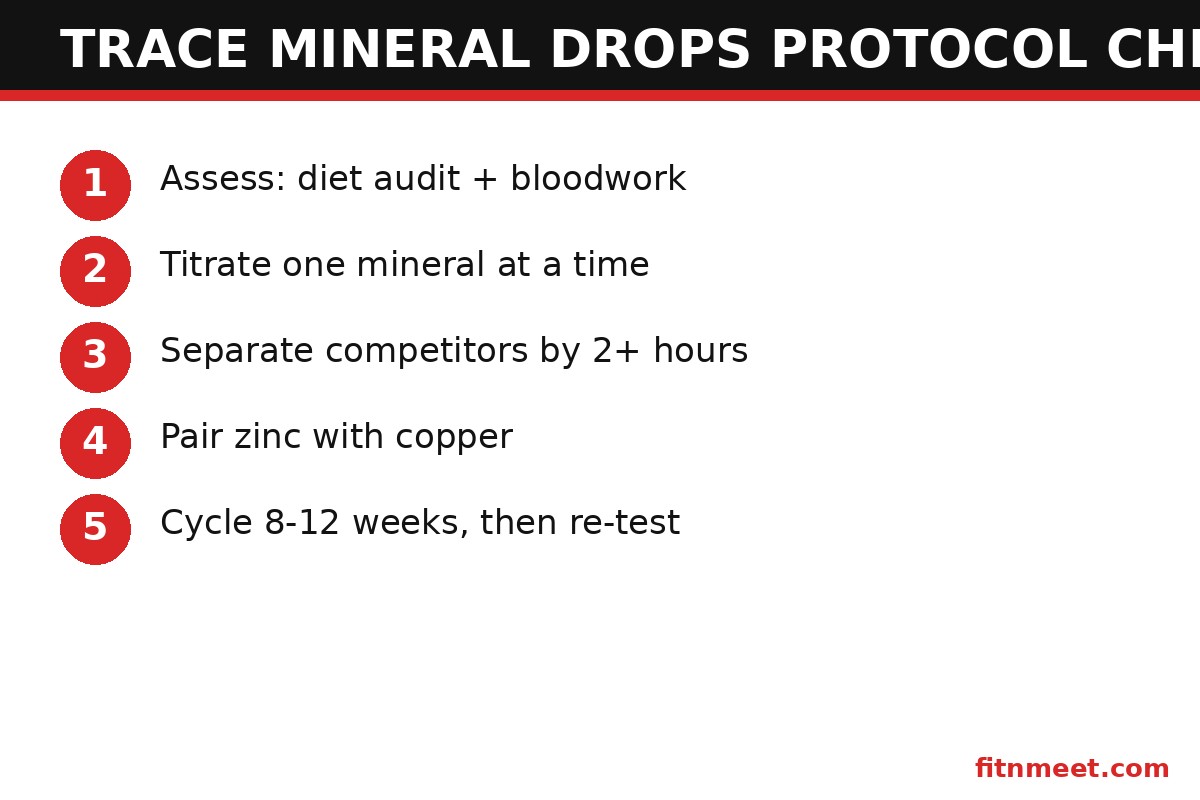
Once at target doses with good tolerance, maintain for 8–12 weeks total, then take 2–4 weeks at half dose or off while re-testing key markers. Minerals accumulate — unlike water-soluble vitamins, you cannot assume excess simply washes out. Cycling prevents the slow creep into excess that causes zinc-induced copper deficiency (the classic trace mineral drops pitfall: months of 30–50 mg zinc daily depleting copper).
Phase 3 protocol: Full targets for 8–12 weeks → taper 2–4 weeks → re-test ferritin/zinc/thyroid markers → adjust or discontinue. Repeat only if the gap persists.
Trace Mineral Drops: Dosage Ranges
Dosage tables with numbers — the advanced user’s reference. All values are daily elemental amounts for adults:
| Mineral | RDA / adequate intake | Typical trace mineral drops target | Upper limit (UL) |
|---|---|---|---|
| Magnesium | 310–420 mg | 100–250 mg (gap fill) | 350 mg (supplements) |
| Zinc | 8–11 mg | 8–15 mg (up to 25 mg short-term) | 40 mg |
| Iron | 8–18 mg | 8–18 mg only if deficient | 45 mg |
| Selenium | 55 mcg | 55–100 mcg | 400 mcg |
| Iodine | 150 mcg | 150 mcg (150–300 if low intake) | 1,100 mcg |
| Chromium | 20–35 mcg | 20–50 mcg | None set (stay modest) |
| Manganese | 1.8–2.3 mg | Usually from diet; supplement rarely | 11 mg |
| Copper | 900 mcg | 1 mg if supplementing zinc long-term | 10 mg |
Key dosage principles for trace mineral drops: never exceed the UL from all sources combined; pair zinc with copper (roughly 10:1 zinc-to-copper ratio) when supplementing zinc beyond 2–3 weeks; supplement iron only with confirmed low ferritin — iron is the mineral most dangerous to take blindly; and count food — a varied diet already provides most of these, so drops fill gaps, not totals.
Trace Mineral Drops: Stacking Rules
Stacking trace mineral drops with other supplements follows three rules. Rule 1: separate the competitors. Zinc, iron, calcium, and magnesium all use the same intestinal transporters — taking them together means they fight for absorption and everyone loses. Space competing minerals at least 2 hours apart, using the morning/midday/evening schedule from the protocol section. Rule 2: pair the synergists. Vitamin D improves calcium and magnesium utilization; vitamin C dramatically boosts iron absorption; vitamin K2 works alongside vitamin D and calcium for bone metabolism. These combinations multiply value rather than dividing it. Rule 3: audit the total stack monthly. Advanced users accumulate products — a pre-workout with zinc, a sleep formula with magnesium, plus trace mineral drops — and suddenly exceed upper limits without realizing it. Once a month, total every mineral across every product you take. If the sum approaches the upper limit for any mineral, trim the stack. The most advanced protocol is often the simplest one that still covers the measured gaps.
Interactions & Safety
- Zinc vs copper: the #1 trace mineral drops hazard. Chronic zinc above 25–40 mg/day without copper depletes copper, causing anemia and neurological symptoms. Any zinc protocol longer than a month needs copper alongside it.
- Iron vs everything: iron competes with zinc, manganese, and calcium for DMT1 transporters. Separate iron from other trace mineral drops by 2+ hours, and never supplement iron without ferritin testing — iron overload damages the liver and heart.
- Calcium vs magnesium/zinc: high-dose calcium (1,000 mg+) taken simultaneously can inhibit magnesium and zinc absorption. Temporal separation solves this.
- Thyroid medication: iron, calcium, and magnesium all reduce levothyroxine absorption — take thyroid meds alone, 4 hours from trace mineral drops.
- Antibiotics: zinc, iron, and magnesium bind tetracyclines and fluoroquinolones — separate by 2–4 hours.
- Kidney disease: impaired excretion turns modest mineral doses into accumulation risks. Medical supervision is mandatory.
- “More minerals = better”: false. Each added mineral increases interaction surface. The advanced move is fewer minerals, precisely dosed — not a kitchen-sink formula.
Disclaimer: This article is for informational purposes only and is not medical advice. Consult a healthcare professional before starting trace mineral drops or any supplement, especially if you have kidney disease, take prescription medications, are pregnant or breastfeeding, or plan to supplement iron.
Trace Mineral Drops vs Alternatives (Comparison)
| Factor | Trace mineral drops | Multimineral capsules | Food-first approach |
|---|---|---|---|
| Dose precision | Excellent — drop-level titration | Poor — fixed doses | Imprecise but self-regulating |
| Absorption control | High — timing separation possible | Low — competitors taken together | Moderate — food matrix effects |
| Convenience | Moderate — measuring, timing | High — one pill | High — just eat |
| Cost per month | $15–$40 | $10–$25 | $0 (grocery budget) |
| Risk of imbalance | Moderate — user-dependent | Low–moderate — balanced formulas | Very low |
| Best for | Advanced users fixing known gaps | General insurance | Everyone, as the foundation |
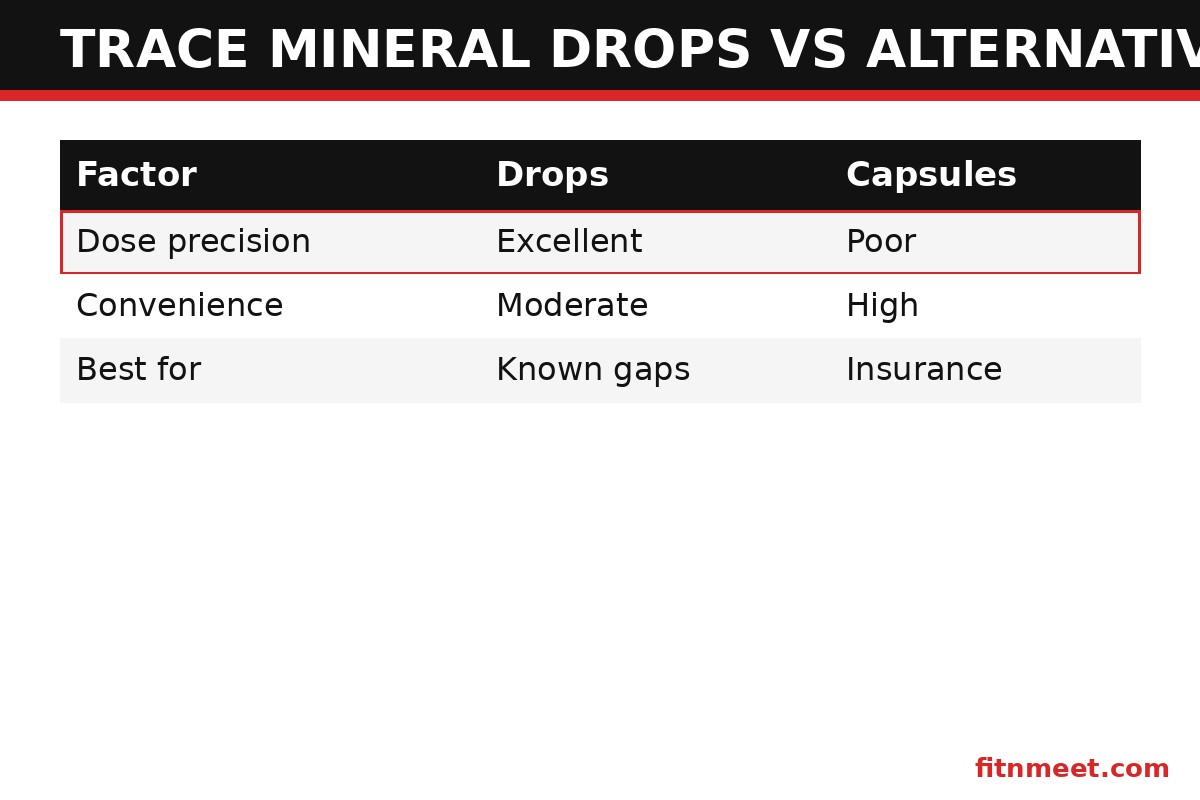
The expert verdict: food first, capsules for general insurance, trace mineral drops for precision work on confirmed shortfalls. Explore foundational options in FitnMeet’s vitamins collection, targeted picks in health support, and everyday essentials in the FitnMeet shop.
Trace Mineral Drops FAQs
What are trace mineral drops?
Trace mineral drops are concentrated liquid supplements providing microminerals like magnesium, zinc, selenium, iodine, and chromium in drop form, allowing precise, adjustable dosing that capsules cannot match.
Are trace mineral drops better than multivitamins?
For precision work on confirmed deficiencies, yes — drops allow exact dosing and timing separation of competing minerals. For general nutritional insurance, a quality multivitamin is simpler and cheaper.
How do you take trace mineral drops?
Typically in water, often on an empty stomach away from coffee and tea. Separate competing minerals (zinc, iron, calcium, magnesium) by 2+ hours, and follow the product’s drop-to-milligram conversion carefully.
Can trace mineral drops cause side effects?
Yes, mainly from excess or imbalance: too much zinc depletes copper, unneeded iron accumulates dangerously, and high single doses cause nausea or digestive upset. Dose to confirmed gaps and respect upper limits.
Should you cycle trace mineral drops?
Yes — a sensible advanced protocol runs 8-12 weeks at target doses, then 2-4 weeks tapered or off with re-testing. Minerals accumulate, so indefinite blind supplementation risks gradual excess.
Do trace mineral drops need to be refrigerated?
Most commercial trace mineral drops are shelf-stable at room temperature; check the label. Keep them away from heat and direct sunlight, and verify the dropper’s milligram conversion before each new bottle.
Conclusion
Trace mineral drops are precision instruments, not daily vitamins: most powerful in the hands of users who test first, dose to the measured gap, separate competing minerals by timing, and cycle with re-testing. Used that way, they correct shortfalls that capsules address clumsily. Used blindly, they create the imbalances they were meant to fix. Respect the transporters, respect the upper limits, and let data — not marketing — drive the protocol.
Expert-toned next step: start with assessment, not purchase — then fill confirmed gaps from the FitnMeet vitamins collection or begin at fitnmeet.com for more advanced supplement guides.