
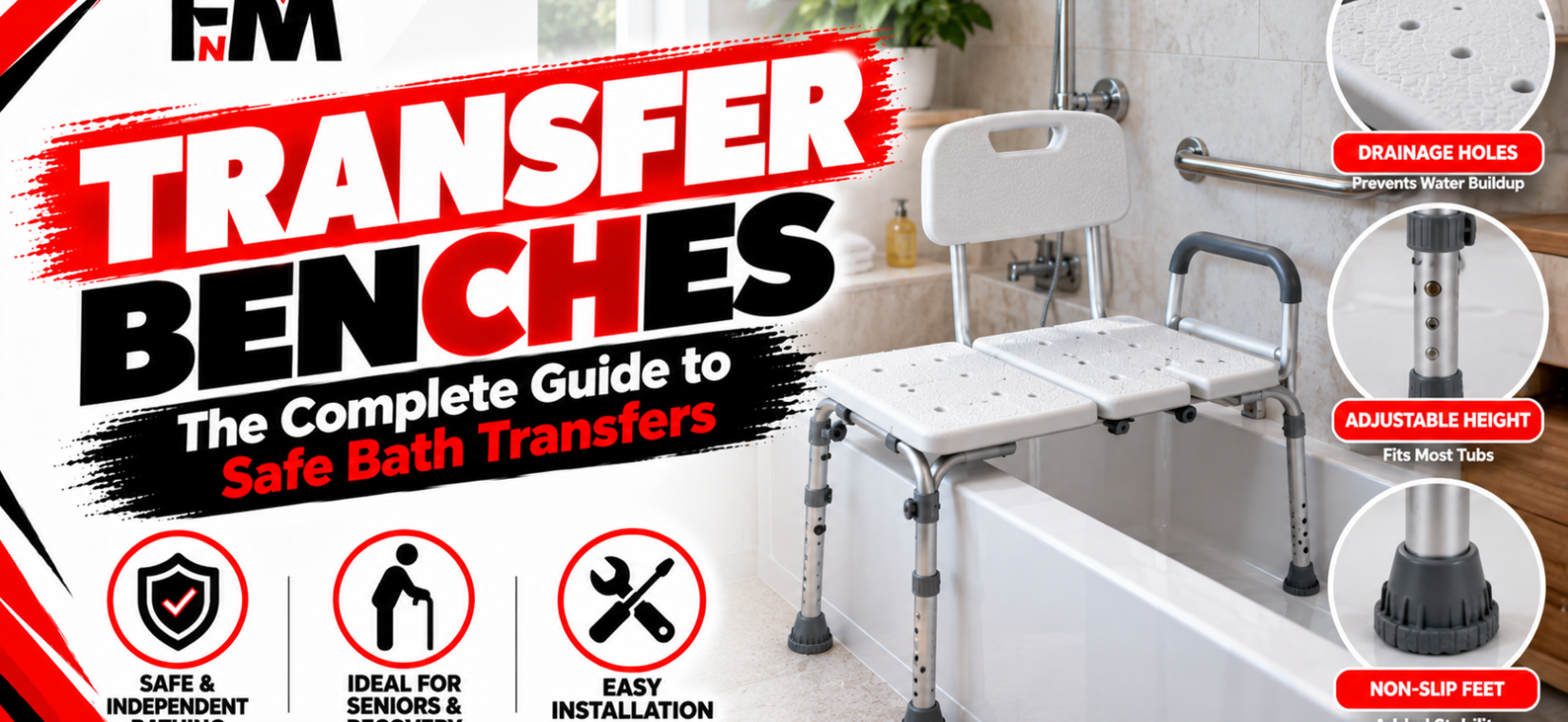
Transfer benches are bath safety seats that span the bathtub wall so you can sit down outside the tub, then slide across into it — eliminating the risky step over the tub edge. They are commonly used by older adults, people recovering from surgery, and anyone with limited mobility or balance.
1Pro tip: The single most important feature of any transfer bench is correct sizing — the bench must be level, stable, and matched to your bathtub’s width. An ill-fitting bench is worse than no bench at all.
Quick Answer: What Is a Transfer Bench?
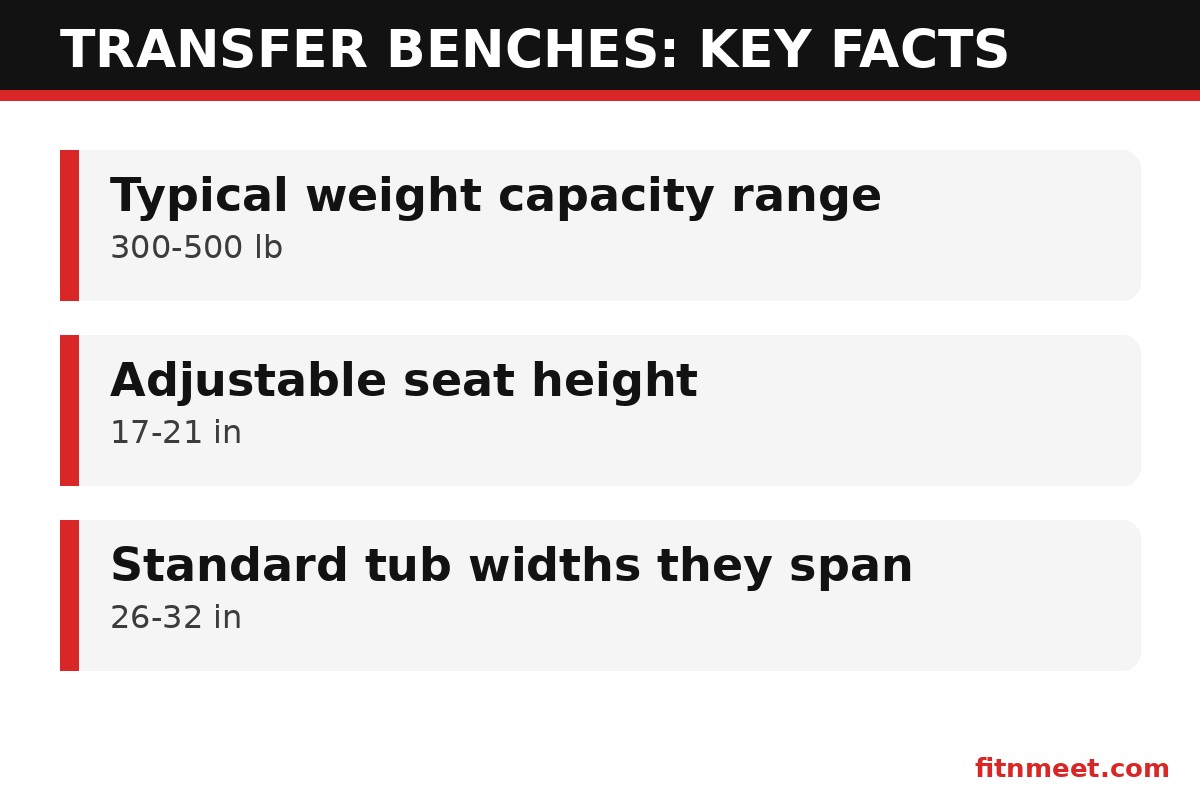
A transfer bench is a wide bath seat designed so that two of its legs sit inside the bathtub and two sit on the bathroom floor outside it. You sit on the outer half of the seat, lift your legs over the tub wall, and slide across to the inner half — never stepping over the high tub edge while standing on a wet surface. Most transfer benches support 300 to 400 pounds, adjust in height from about 17 to 21 inches, and include a backrest and a handheld showerhead pairing for seated bathing.
What Transfer Benches Are and How They Differ
Transfer benches come in several designs, and the differences matter for comfort and safety:
- Standard transfer benches: a plastic seat with aluminum legs, a backrest, and suction-cup or rubber feet. Two legs extend longer to reach the bathroom floor outside the tub. Affordable and widely available.
- Padded transfer benches: add a cushioned seat and back for people with bony prominences, arthritis, or pressure sensitivity. The padding must be sealed and waterproof.
- Sliding/swivel transfer benches: the seat slides along rails or rotates, so the user barely needs to scoot — helpful after hip replacement or for very weak users. More expensive but the easiest to use.
- Bariatric transfer benches: wider seats and reinforced frames rated for 500 to 600+ pounds.
- Tool-free assembly models: snap together without wrenches; useful if a caregiver is setting it up solo.
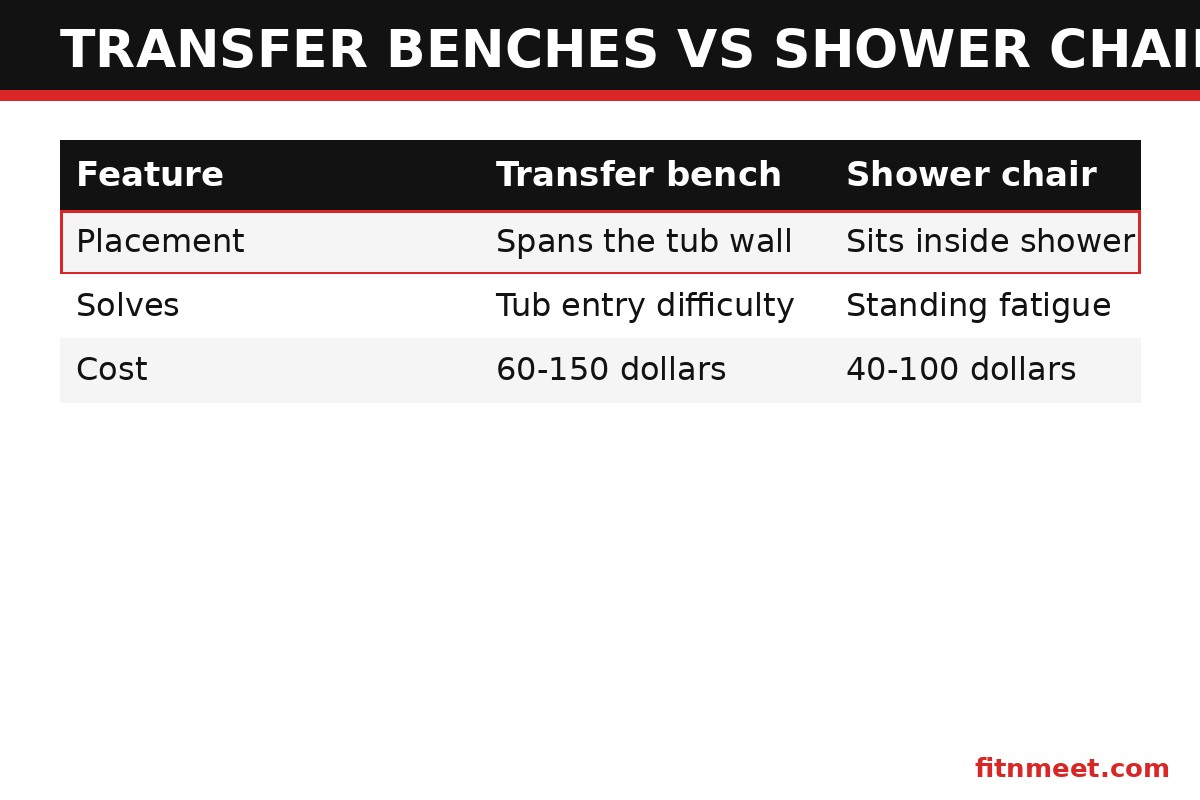
What all transfer benches share is the core geometry: they bridge the tub wall. That is what distinguishes them from shower chairs (which sit entirely inside the shower) and from bath lifts (powered seats that lower you into the water). If the hardest part of bathing is getting into the tub, transfer benches are usually the right answer; if the hardest part is standing during the shower, a shower chair may suffice.
Why Transfer Benches Matter: Fall Risk in the Bathroom
The bathroom is one of the most dangerous rooms in the house. The U.S. National Institute on Aging notes that about one in three adults aged 65 and older falls each year, and bathrooms concentrate the hazards: wet tile, a high tub wall (typically 14–18 inches), and nowhere good to grab. Research on bathroom injuries has found hundreds of thousands of emergency-department visits annually in the U.S. alone, with the tub/shower area the most common injury site. You can read the NIA’s falls guidance on nia.nih.gov. For more guidance on fall prevention and home safety for older adults, explore the FitnMeet health articles.
Stepping over a tub edge combines three fall risk factors at once: single-leg balance on a slippery surface, hip flexion past 90 degrees (restricted after hip surgery), and a lateral weight shift. Transfer benches eliminate all three by converting the maneuver into a seated slide. For someone recovering from a hip or knee replacement — where surgeons typically restrict hip bending and twisting for weeks — transfer benches are often explicitly recommended by physical therapists as part of discharge planning.
2Pro tip: Pair the bench with a handheld showerhead and a long bath sponge. Seated bathing only works well when the water comes to you — a fixed showerhead forces awkward reaching.
Step-by-Step Guide: Using a Transfer Bench Safely
Follow this sequence every time. Consistency builds safe habits.
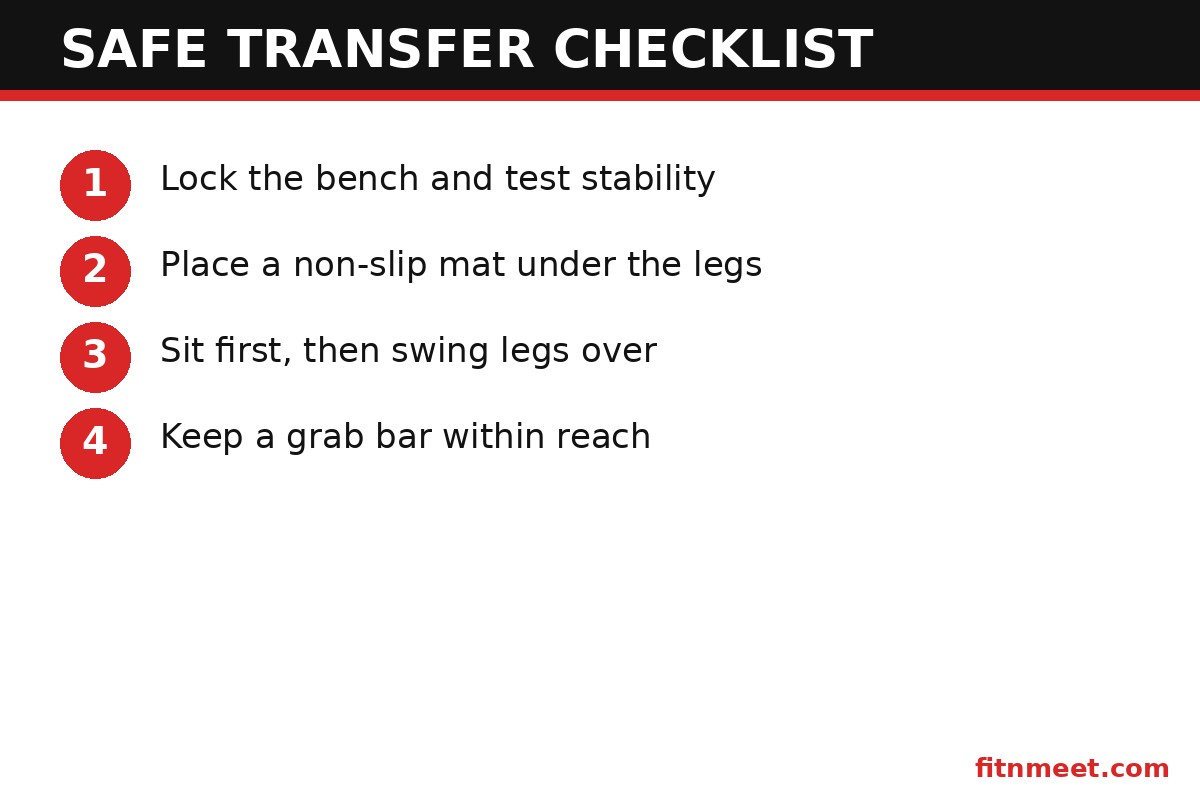
- Prepare the bench and bathroom.
- Confirm all four legs are locked at the same height setting and the bench sits level — press down on each corner to check for rocking.
- Place a non-slip bath mat on the bathroom floor where you will stand, and one inside the tub under the bench legs.
- Set the handheld showerhead, soap, and towel within arm’s reach of the seated position.
- Back up to the bench.
- With your walker or cane (if you use one), back up until you feel the outer edge of the seat against the back of your thighs.
- Reach back with both hands to grip the seat or armrests before sitting — never sit down “blind.”
- Sit on the outer half of the seat.
- Lower yourself onto the part of the seat that is outside the tub. Keep both feet flat on the bathroom floor.
- Make sure your weight is centered on the seat, not on the edge.
- Lift your legs over the tub wall one at a time.
- Using your hands on the seat for support, lift one leg over the tub edge and place the foot in the tub.
- Then lift the second leg over. Move slowly — this is the step the bench makes safe.
- Slide across to the inner half.
- Scoot sideways along the seat until you are positioned over the tub, centered between the inner legs.
- If you have a sliding model, release the lock, slide, and re-lock.
- Bathe seated.
- Keep the grab bar or seat edge within reach. Avoid standing up mid-bath to reach items — arrange everything beforehand.
- Reverse the process to exit.
- Slide back to the outer half, lift legs over the wall one at a time, and stand only once both feet are on the dry mat outside — using the grab bar or walker.
Usage Guidelines: Setup, Fit, and Daily Use
Think of this as the “dosage” section for equipment — the settings that make transfer benches safe:
- Seat height: adjust so your feet rest flat on the floor (outside) with knees at roughly 90 degrees. Too high and you will slide; too low and standing up becomes hard.
- Level installation: the two outer legs are longer than the inner legs to account for the tub wall height. All leg pins must click into the same numbered hole on each leg.
- Tub width match: measure your tub’s outer width (typically 26–32 inches) and confirm the bench’s span covers it with the outer legs fully on the floor — not on the tub apron edge.
- Weight capacity: choose a bench rated at least 50 pounds above the user’s weight. Standard models handle 300–400 lb; bariatric models 500–600+ lb.
- Daily check: suction cups lose grip over time; rubber tips wear. A 10-second wobble check before each use prevents most accidents.
- Cleaning: rinse and air-dry after use; disinfect weekly. Biofilm on the seat is a skin-infection risk for users with fragile skin.
Benefits of Transfer Benches
- Eliminates the tub-wall step-over — the single riskiest motion in bathroom transfers.
- Restores bathing independence — many users go from needing a caregiver’s help to bathing alone.
- Protects surgical precautions — after hip replacement, the seated slide respects hip-flexion and rotation limits.
- Reduces caregiver strain — less lifting and catching means fewer back injuries for helpers.
- Affordable — most models cost $60–$150, far less than a bathroom remodel or walk-in tub ($3,000+).
- No installation — they rest in place; renters can use them without modifying the bathroom.
- Energy conservation — seated bathing uses far less energy, important for cardiac, pulmonary, or chronic-fatigue conditions.
Mistakes to Avoid
- Skipping the level check: a bench with legs at mismatched heights rocks — and a rocking bench in a wet tub is dangerous. Check every use.
- Standing on the bench: transfer benches are for sitting and sliding only. Never stand on the seat.
- Wrong tub fit: if the outer legs rest partly on the curved tub apron instead of flat floor, the bench can tip. Measure before buying.
- Ignoring weight ratings: exceeding capacity risks sudden collapse. Size up to bariatric models when in doubt.
- No grab bar: the bench handles the transfer, but a securely mounted grab bar (into studs, not suction cups) is still essential for the sit-to-stand.
- Reaching for dropped items: leaning far off the seat shifts your center of gravity past the base. Let it go and pick it up after.
- Using a damaged bench: cracked plastic seats and bent aluminum legs fail without warning — replace, don’t repair, structural parts.
3Pro tip: If you use a walker, practice the back-up-and-sit sequence with your physical therapist before the first solo bath. One supervised rehearsal prevents most first-week mistakes.
Transfer Benches vs Alternatives
| Feature | Transfer benches | Shower chairs | Bath lifts |
|---|---|---|---|
| Placement | Spans the tub wall | Entirely inside shower/tub | Inside the tub |
| Solves | Getting into the tub | Standing fatigue | Lowering into deep water |
| Transfer method | Seated slide across | Stand, turn, sit | Powered lowering |
| Typical cost | $60–$150 | $40–$100 | $300–$800 |
| Installation | None | None | None (heavy to move) |
| Best for | Tub entry difficulty, post-surgery | Walk-in showers, weak legs | Deep soaker tubs |
The FDA’s home-use medical device guidance is a useful reference for understanding how bath safety equipment is regulated. For general mobility and recovery support products, you can also browse FitnMeet’s health support collection and the FitnMeet shop.
Safety Notes and When to Get Help
Transfer benches are assistive equipment, not restraints — they reduce risk but do not remove it. Seek an occupational therapist’s assessment if the user has cognitive impairment (may forget the sequence), severe balance loss even when seated, or skin fragility that needs pressure planning. After any fall or near-fall involving the bench, stop using it and have the setup re-evaluated before the next bath.
Caregivers: never leave a high-risk person unattended on a transfer bench during the first weeks of use, and keep the bathroom door unlocked (or ajar) so help can reach them. A simple bath thermometer ($10) prevents scalds for users with reduced sensation — set water below 120°F (49°C). For more caregiver-friendly wellness and safety topics, visit the FitnMeet blog.
Frequently Asked Questions About Transfer Benches
How do transfer benches work?
Transfer benches span the bathtub wall with two legs inside the tub and two on the bathroom floor. You sit on the outer half, lift your legs over the tub wall one at a time, and slide across — avoiding the risky standing step over the tub edge.
What size transfer bench do I need?
Measure your tub’s outer width (usually 26-32 inches) and choose a bench that spans it with the outer legs fully on flat floor. Adjust seat height so feet rest flat with knees near 90 degrees, and pick a weight rating at least 50 lb above the user’s weight.
Are transfer benches safe for elderly users?
Yes — they are one of the most recommended bath-safety devices for older adults because they eliminate the step over the tub wall, the highest-risk bathroom motion. Correct sizing, a level setup, and a grab bar make them very safe.
Can I use transfer benches after hip replacement surgery?
Usually yes, and physical therapists often recommend them. The seated slide respects common hip precautions (limited bending and twisting). Confirm with your surgeon or therapist, as precautions vary by surgical approach.
Do transfer benches fit all bathtubs?
Most fit standard alcove tubs 26-32 inches wide. They do not work well with clawfoot tubs, very narrow tubs, or tubs with curved aprons that prevent the outer legs from sitting flat. Measure carefully before buying.
How much do transfer benches cost?
Standard models cost about $60-150, padded or sliding models $150-300, and bariatric models $200-400. Some insurance plans or Medicare Advantage plans may cover them with a prescription — check your plan.
Conclusion
Transfer benches solve one specific, high-stakes problem — getting into the bathtub safely — with elegant simplicity. A level, correctly sized bench plus a grab bar and a handheld showerhead turns the most dangerous room in the house into a manageable one, and for many people it is the difference between bathing independently and needing daily help.
If mobility or recovery support is part of your household’s needs, explore FitnMeet’s health support collection and the FitnMeet shop for everyday wellness essentials — and check the FitnMeet FAQ for help with orders and shipping.
Disclaimer: This article is for informational purposes only and is not medical advice. Bath safety needs are individual — consult an occupational therapist or healthcare professional for a proper assessment before selecting mobility equipment, especially after surgery.