
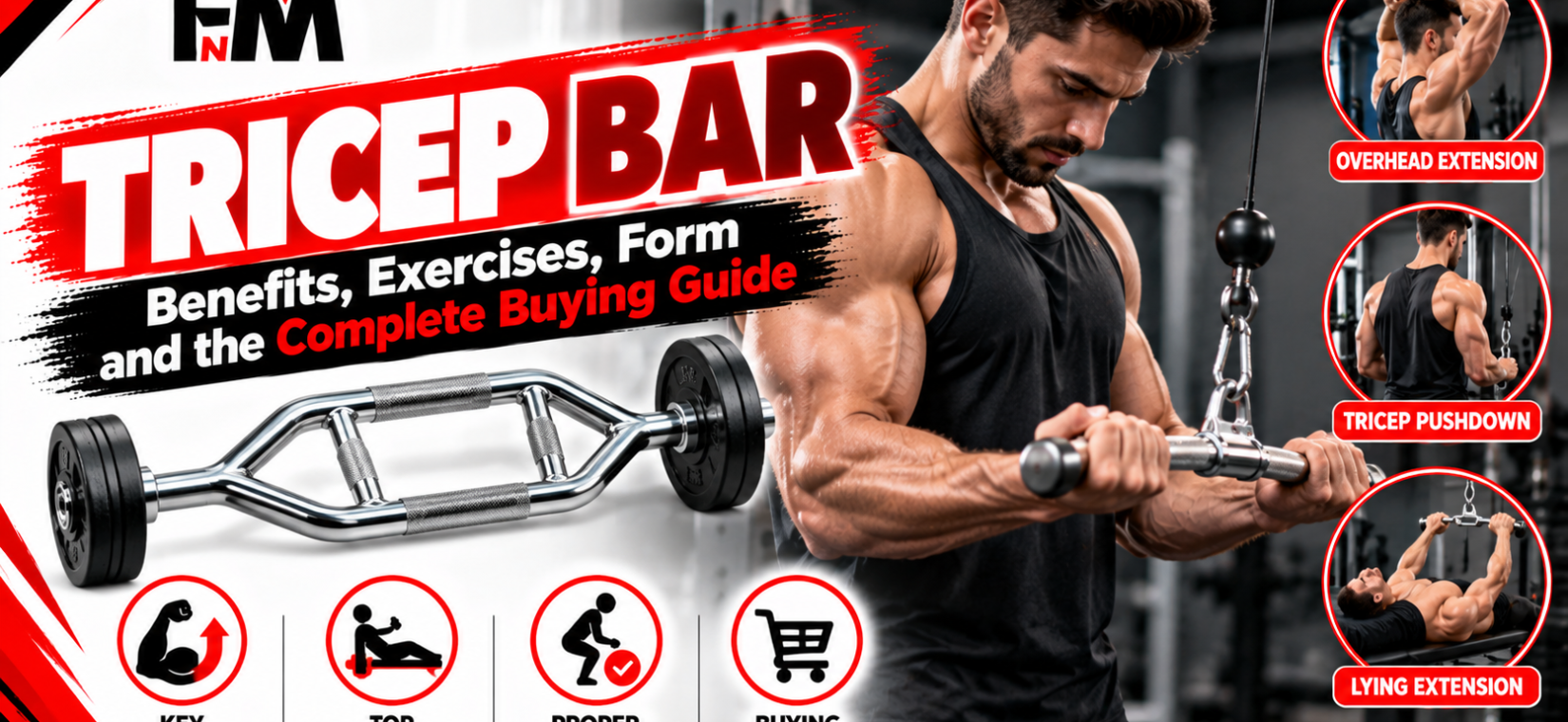
A tricep bar is a short barbell with parallel angled handles designed to keep the wrists in a neutral position during arm exercises. A tricep bar typically measures 34 to 36 inches, weighs 15 to 25 pounds, and lets you perform skull crushers, overhead extensions, close-grip presses and hammer curls with less wrist and elbow strain than a straight bar.
What Is a Tricep Bar?
This bar is a short Olympic or standard barbell with two parallel handles set at an angle, usually between 30 and 45 degrees. When you grip a tricep bar, your palms face each other in what trainers call a neutral grip. That is the single biggest difference between this bar and a straight barbell, where your palms must face either up or down and your wrists end up bent at awkward angles under load.
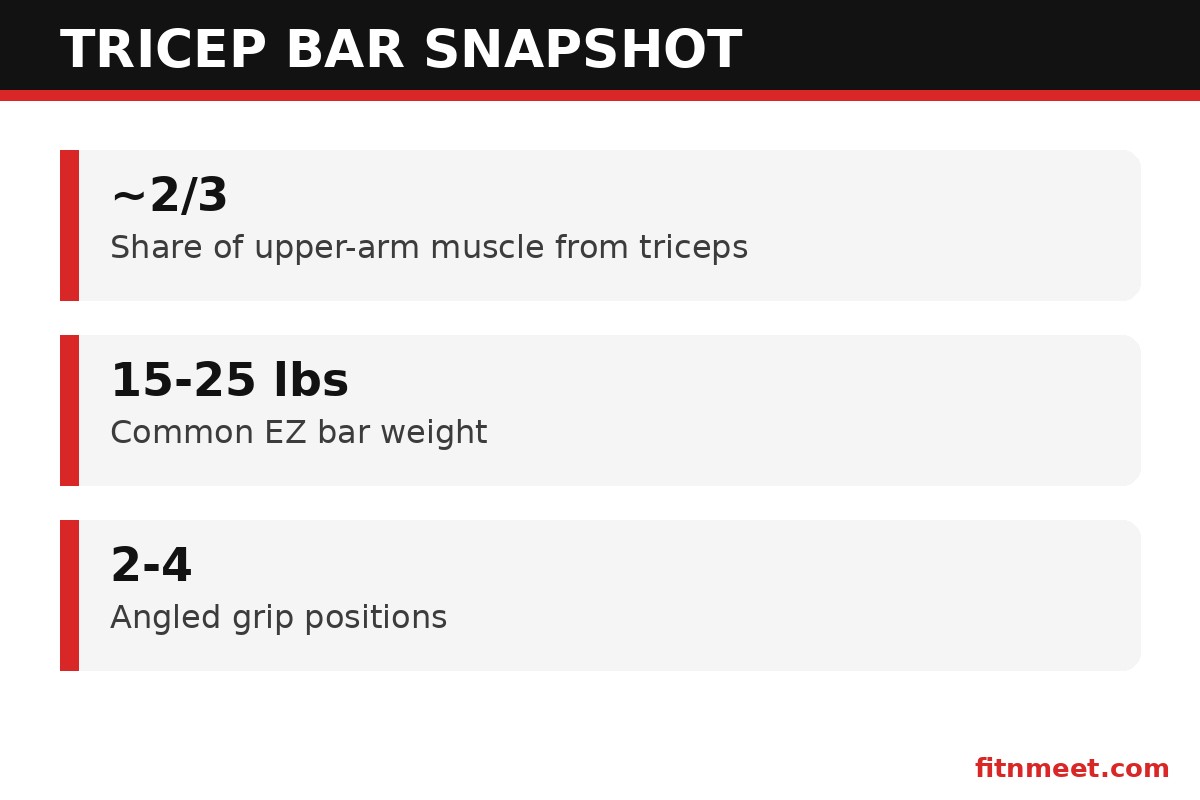
Most measure 34 to 36 inches in total length and weigh between 15 and 25 pounds unloaded. The loading sleeves on either side accept standard or Olympic plates depending on the model, so this bar can be loaded from just the bar weight up to several hundred pounds. Because the bar is short, this bar is also easy to store in a home gym and easy to maneuver in a crowded commercial gym.
The angled parallel handles are what make the tricep bar special. On a straight bar, exercises like skull crushers force the wrists into full extension while the elbow carries the load through a long lever arm. Many lifters feel that as aching in the wrists or a pinching sensation in the elbows. This bar removes that problem at the source: the neutral grip keeps the wrist joint stacked over the forearm bones, and the angled handles let the elbows track naturally instead of flaring or twisting.
Despite the name, this bar is not only for triceps. The neutral grip also makes it excellent for hammer curls, which target the brachialis and brachioradialis muscles of the upper arm and forearm. Some lifters also use this bar for close-grip rows and even overhead presses, though triceps isolation work is where this bar earns its place in the gym.
Why the Tricep Bar Matters for Arm Size
Here is the number that matters: the triceps brachii makes up roughly two-thirds of your upper-arm muscle mass. The biceps gets the glory, but the triceps is the larger muscle group by a wide margin. If your goal is bigger arms, the fastest path is not more biceps curls — it is better, heavier, more consistent triceps training. A tricep bar exists to make exactly that training possible.
According to Wikipedia’s anatomy overview of the triceps brachii, the muscle has three heads — the long head, the lateral head, and the medial head — each attaching at a different point around the elbow and shoulder. Complete triceps development requires training the muscle through different arm positions, because the long head crosses the shoulder joint and is stretched most when the arm is overhead. This bar lets you hit all three heads: overhead extensions stretch the long head, pushdowns emphasize the lateral head, and close-grip pressing works the medial head under heavy load.
The practical advantage of a tricep bar is comfort that turns into consistency. Exercises you can perform without joint pain are exercises you will actually do, week after week, for years. Lifters who switch from straight-bar skull crushers to this bar frequently report that nagging elbow pain disappears within two to three weeks, which lets them train triceps twice per week instead of once — and that frequency difference compounds into visibly larger arms over a training year.
Key Benefits
The benefits of training with this bar go beyond comfort. Here is what a tricep bar actually does for your training:
- Neutral wrist position: This bar keeps wrists straight and stacked, which removes the bending stress that causes wrist pain during skull crushers and French presses with a straight bar.
- Reduced elbow stress: The angled handles let the elbows track in their natural groove. Lifters with cranky elbows can often use this bar pain-free when a straight barbell hurts.
- Heavier safe loading: Because the joints are in stronger positions, most lifters can use 10 to 20 percent more weight on this bar than they can on a straight bar for the same exercise — more load means more growth stimulus.
- Three-head coverage: This bar handles overhead extensions (long head), pushdowns (lateral head), and close-grip presses (all heads under load) with one piece of equipment.
- Hammer-curl friendly: The same neutral grip that protects the wrists on pressing moves makes a tricep bar ideal for hammer curls that build the brachialis, the muscle that pushes the biceps up and makes the whole arm look thicker.
- Home-gym friendly: At under 3 feet long, this bar fits in a closet corner, and at 15 to 25 pounds it is light enough to travel to the park or the garage gym.
For lifters focused on strength and muscle, pairing consistent work with this bar and solid nutrition is what drives results. Explore FitnMeet’s pre-workout collection for training-day fuel, and browse the muscle development category for protein support.
How to Use It (Step-by-Step)
Follow these steps for the two foundational movements below. Master these before adding advanced variations.
Skull Crushers
- Lie on a flat bench with a loaded tricep bar held above your chest, arms extended, neutral grip on the parallel handles.
- Brace your core and pin your upper arms so they point straight up — only the forearms will move.
- Slowly lower the tricep bar toward your forehead or just behind your head, bending only at the elbows. Take about 3 seconds down.
- Stop when your forearms are just past parallel to the floor, then press the bar back up by straightening the elbows. Squeeze the triceps hard for 1 second at the top.
- Perform 3 to 4 sets of 8 to 12 reps, resting 60 to 90 seconds between sets.
Overhead Extensions
- Stand or sit upright holding the tricep bar with both hands on the parallel grips, arms extended overhead.
- Keep your upper arms close to your head and pointing straight up throughout the movement.
- Lower the tricep bar slowly behind your head by bending the elbows until your forearms are roughly parallel to the floor.
- Extend the elbows to return to the start, focusing on feeling the long head of the triceps stretch and contract.
- Perform 3 sets of 10 to 15 reps — overhead work responds well to slightly higher reps.
Choosing the Right Size and Weight
These bars come in two sleeve standards: standard (1-inch) and Olympic (2-inch). If you already own plates, match the tricep bar to your plates. Olympic versions are the better long-term buy for most lifters because Olympic plates are more widely available and the thicker sleeves spin, which is easier on the wrists during extensions.
Bar weight matters less than you think because you will load plates on it, but a 20-pound tricep bar is a sensible middle ground — heavy enough to feel stable, light enough for warm-up sets. Check the load capacity before buying: a cheap bar rated for only 100 pounds total will become a paperweight within a year if you are serious about training. Look for a capacity of at least 200 to 300 pounds, knurled (textured) handles for grip security, and welded rather than bolted handle joints.
Length is the other variable. A 34-inch bar fits tight spaces and is fine for most isolation work. A 36-inch bar gives slightly more room between the handles and the plates, which helps taller lifters on overhead extensions. Either length works; prioritize sleeve standard and load capacity over an inch of bar.
Best Exercises
Beyond the two foundational moves above, this bar supports a full arm routine:
- Close-grip bench press with this bar: Use a bench and lower the bar to the lower chest. The neutral grip reduces shoulder strain versus a straight bar, letting you load heavy for triceps mass.
- Tricep bar hammer curls: Stand tall and curl the bar with palms facing each other. This builds the brachialis and forearms — the thickness muscles of the arm.
- Tricep bar pushdowns (cable attachment): If your gym’s cable station accepts it, this bar makes an excellent pushdown handle with a comfortable neutral grip.
- Overhead press: Seated or standing, press the tricep bar from behind the head to lockout. Great long-head stretch under moderate load.
- Tricep bar floor press: Lie on the floor to limit range of motion — a joint-friendly heavy triceps builder that also protects cranky shoulders.
A complete arm day might pair skull crushers (4×8-12) with hammer curls (3×10-12) using this bar and finish with bodyweight dips. Train arms twice weekly, and keep a training log — the FitnMeet strength training blog has programming templates that pair well with arm-specialization phases.
Safety and Injury Prevention
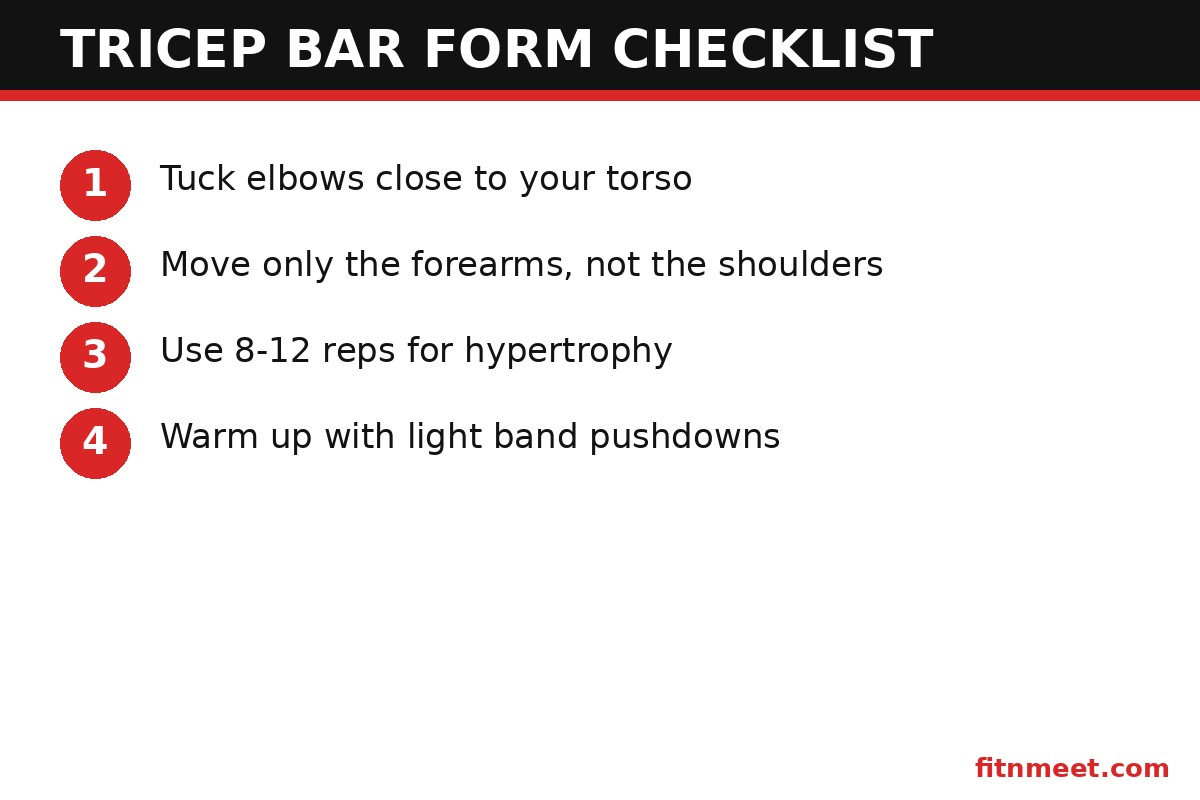
A tricep bar is joint-friendly by design, but no tool is injury-proof. The most common mistake is going too heavy too fast on skull crushers, which loads the elbow tendons aggressively at the stretched bottom position. Start with a weight you can control for 12 clean reps, and add load in small 2.5 to 5 pound increments.
Always warm up before using this bar: 2 minutes of light band pushdowns or bodyweight dips raises blood flow to the elbows and triceps. Keep the upper arms fixed during isolation moves — if your elbows drift forward or flare wide, the weight is too heavy and the stress shifts to the shoulder joint. For overhead extensions, avoid arching the lower back; brace the core and, if needed, perform the movement seated with back support.
Inspect your bar periodically. Check that collars clamp tightly on the sleeves, that the handle welds show no cracks, and that knurling has not worn smooth. A bar that rattles or has loose handles should be retired — a dropped bar on skull crushers is a serious hazard, which is why many lifters use a spotter or perform them on the floor instead of a bench.
Tricep Bar vs EZ Bar vs Straight Bar
How does a tricep bar stack up against the other bars in the rack?
| Feature | Tricep Bar | EZ Curl Bar | Straight Barbell |
|---|---|---|---|
| Grip | Fully neutral (palms facing) | Semi-neutral (angled) | Pronated or supinated |
| Wrist comfort | Highest | Good | Lowest on extensions |
| Best exercise | Skull crushers, overhead extensions | Curls, rows | Heavy pressing, deadlifts |
| Elbow stress | Lowest | Moderate | Highest on isolation moves |
| Hammer curls | Excellent | Possible but awkward | Not possible |
| Price | $30–$80 | $40–$100 | $100–$300+ |
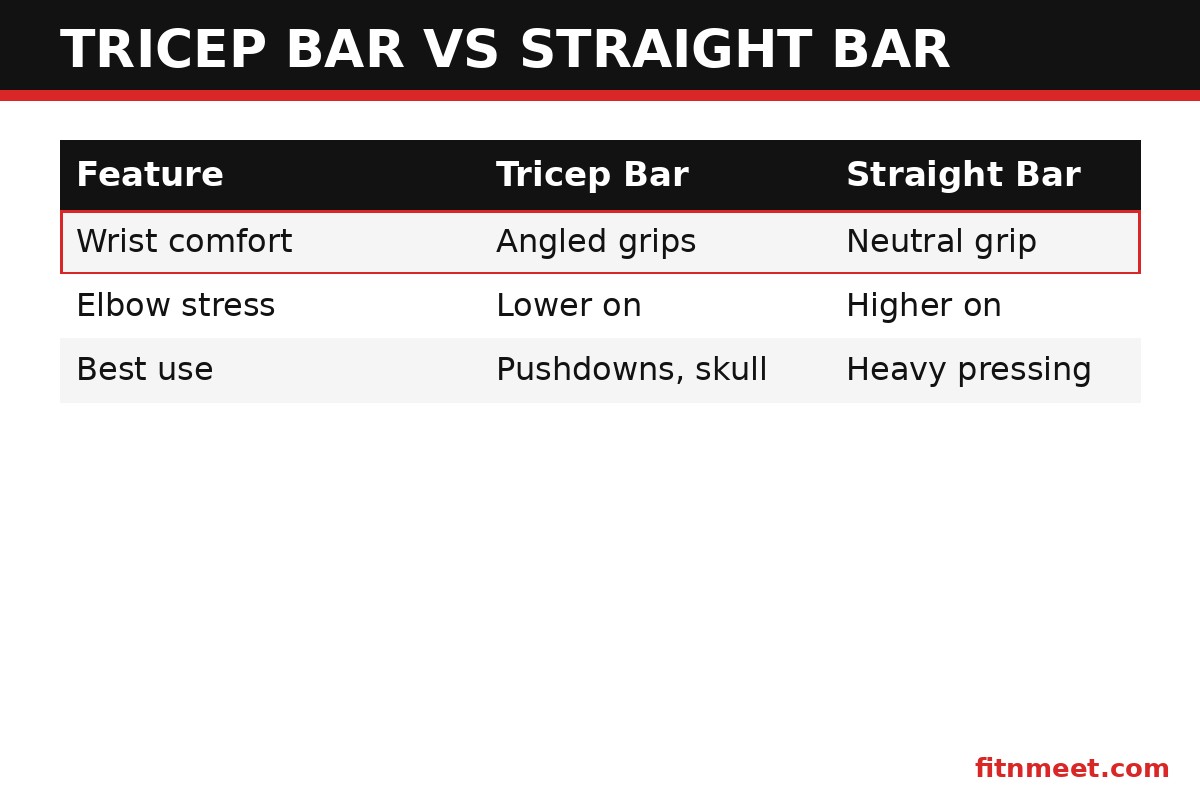
The verdict: a tricep bar is the best dedicated tool for triceps isolation work. An EZ bar is a good generalist for curls and rows, and a straight barbell remains king for heavy compound pressing. Most well-equipped home gyms eventually own all three, but if arm size is the priority, the tricep bar is the one to buy first.
Alternatives
No tricep bar available? These alternatives train the same muscles:
- Dumbbells: Dumbbell skull crushers and overhead extensions allow a natural wrist angle and unilateral work that exposes left-right imbalances. See FitnMeet’s shop for training gear categories.
- Cable machine with rope: The rope attachment mimics the neutral grip of this bar and provides constant tension through the full range.
- Resistance bands: Band pushdowns and overhead extensions are joint-friendly and portable — a good travel substitute for this bar.
- Bodyweight dips: Between two benches or on parallel bars, dips are the heaviest triceps builder that needs no equipment at all. Learn more in Wikipedia’s weight training overview.
- Diamond push-ups: Hands in a diamond under the chest shifts emphasis to the triceps — a zero-equipment finisher after a session with this bar.
Frequently Asked Questions
What is a tricep bar used for?
A tricep bar is used for arm isolation exercises, mainly skull crushers, overhead triceps extensions, close-grip presses and hammer curls. Its parallel angled handles keep the wrists in a neutral position, which reduces wrist and elbow strain compared to a straight barbell.
How much does a tricep bar weigh?
Most tricep bars weigh 15 to 25 pounds unloaded and measure 34 to 36 inches long. Always check the manufacturer’s listed bar weight and total load capacity, and look for a capacity of at least 200 to 300 pounds if you plan to train heavy.
Is a tricep bar better than an EZ bar for triceps?
For pure triceps isolation, yes. A tricep bar offers a fully neutral grip, while an EZ bar is only semi-neutral. The tricep bar’s parallel handles reduce wrist and elbow stress more on skull crushers and overhead extensions. An EZ bar is more versatile for curls and rows.
Can you do hammer curls with a tricep bar?
Yes. A tricep bar is excellent for hammer curls. The neutral grip targets the brachialis and brachioradialis, building arm thickness and forearm size. Use a controlled tempo, keep the elbows pinned to your sides, and avoid swinging the weight.
How many times per week should I train with a tricep bar?
Most lifters get the best results training triceps with a tricep bar 1 to 2 times per week. Because the neutral grip is joint-friendly, many people tolerate a second weekly session. Allow at least 48 hours between hard triceps sessions for recovery.
What weight should a beginner start with on a tricep bar?
Beginners should start with just the tricep bar (15 to 25 pounds) or the bar plus light plates, for a total of 25 to 40 pounds. Choose a weight you can perform for 12 clean reps with strict form, then add 2.5 to 5 pounds per week.
Conclusion
A tricep bar is one of the highest-value tools in arm training: a short, affordable bar that removes the wrist and elbow pain standing between you and the triceps volume that builds real size. Learn the two foundational moves, pick a bar with Olympic sleeves and a 200-plus-pound capacity, train triceps once or twice a week, and the triceps — two-thirds of your upper arm — will respond.
Ready to support your arm training with proper fuel? Browse FitnMeet’s protein collection and the workout recovery category to keep your muscles growing between sessions.
This article is for informational purposes only and is not medical advice. Consult a healthcare professional before starting any new exercise program.