
A supplement provides concentrated vitamin E, a fat-soluble antioxidant nutrient that protects cell membranes from oxidative damage. Most people get enough vitamin E from food, but a vitamin E supplement is used for skin health, immune support, and antioxidant protection, typically supplying 15-400 IU of alpha-tocopherol per capsule.
Pro tip: Vitamin E is fat-soluble, which means taking it with a meal containing fat can roughly double how much your body absorbs compared with taking it on an empty stomach.
Quick Answer: Who Needs a supplement?
Probably not, if your diet is already solid. True vitamin E deficiency is rare in healthy adults because the nutrient is widespread in nuts, seeds, and vegetable oils. Supplementing makes sense in three situations: your diet is very low in fat (which blocks absorption of fat-soluble nutrients), you have a digestive condition that impairs fat absorption, or you are deliberately using a vitamin E supplement for targeted antioxidant or skin support at doses above what food provides. If none of those apply, the money is usually better spent on food.
Pro tip: Before buying a supplement, audit your diet for one week. A daily handful of almonds (about 28 g) provides roughly 7.7 mg of vitamin E, more than half the adult RDA of 15 mg, no capsule required.
What Is Vitamin E?
A vitamin E is a capsule, softgel, or oil that delivers concentrated vitamin E, a group of eight related fat-soluble compounds: four tocopherols (alpha, beta, gamma, delta) and four tocotrienols. Of the eight, alpha-tocopherol is the form the human body preferentially retains and the form used to set the recommended dietary allowance. Most vitamin E supplement products contain alpha-tocopherol, either as d-alpha-tocopherol (natural) or dl-alpha-tocopherol (synthetic).
The label math on a supplement can be confusing because doses appear in both IU (international units) and mg. The conversion matters: 1 mg of natural d-alpha-tocopherol equals 1.49 IU, while 1 mg of synthetic dl-alpha-tocopherol equals 2.22 IU. That means a 400 IU capsule of natural vitamin E delivers about 268 mg, while 400 IU of synthetic delivers only 180 mg. Two capsules both labeled “400 IU” are not the same dose, which is why reading the form matters more than reading the IU number.
Did you know? The human liver contains a dedicated protein, alpha-tocopherol transfer protein, whose entire job is to grab alpha-tocopherol and put it into the bloodstream. No other vitamin E form gets this VIP treatment, which is why alpha-tocopherol dominates every vitamin E supplement on the shelf.
A vitamin E supplement is fat-soluble, stored in the liver and fatty tissue, and excreted slowly. This is a double-edged sword: the body maintains a reserve, so missing a day does not matter, but excess doses accumulate instead of washing out in urine the way vitamin C does. That slow clearance is the reason the tolerable upper limit exists and the reason megadosing it is a genuinely bad idea.
Why Vitamin E Matters
Vitamin E’s core job is antioxidant defense of cell membranes. Every cell membrane contains polyunsaturated fatty acids that are vulnerable to attack by free radicals, and alpha-tocopherol sits inside those membranes neutralizing the threat. During intense exercise, free radical production rises sharply, which is one reason athletes have long been interested in whether a vitamin E supplement can support recovery. The evidence there is mixed: some studies show reduced markers of oxidative damage after hard training, while others suggest very high antioxidant doses might blunt training adaptations. The sensible middle ground is covering the RDA reliably, not megadosing.
The immune angle is better established. Vitamin E supports T-cell function, and trials in older adults, whose immune responses naturally decline, have found that modest vitamin E supplementation improves certain immune markers. One well-known trial gave elderly nursing-home residents 200 IU of vitamin E daily and observed fewer upper respiratory infections compared with placebo. That is a modest, realistic benefit, and it is the kind of outcome a supplement can credibly support.
Skin is the third pillar of vitamin E’s reputation. Because vitamin E concentrates in the skin’s outer layers, where it absorbs some UV-generated free radicals, a vitamin E supplement is marketed heavily for skin health. The evidence is moderate: vitamin E alone is not sunscreen, but combined with vitamin C it appears to modestly increase the skin’s resistance to UV damage. Anyone buying a supplement primarily for skin should keep expectations proportional to that evidence.
Step-by-Step Guide to Using a Vitamin E Supplement
Follow these steps to get a vitamin E supplement right, in order:
- Check whether you need one.
- Track your nut, seed, and oil intake for a week. If you regularly eat almonds, sunflower seeds, spinach, avocado, or olive oil, you may already be near the 15 mg RDA.
- Consider supplementing only if your diet is low-fat, you have a fat-malabsorption condition, or you want targeted antioxidant support.
- Choose the right form.
- Pick d-alpha-tocopherol (natural) over dl-alpha-tocopherol (synthetic) when the price difference is small; it has roughly twice the bioavailability.
- If the label says “mixed tocopherols,” that is a plus: you get gamma-tocopherol alongside alpha, closer to what food provides.
- Avoid products that do not state the form at all.
- Pick a sensible dose.
- For general coverage, choose a supplement providing 15-100 IU per day, which covers the RDA with margin.
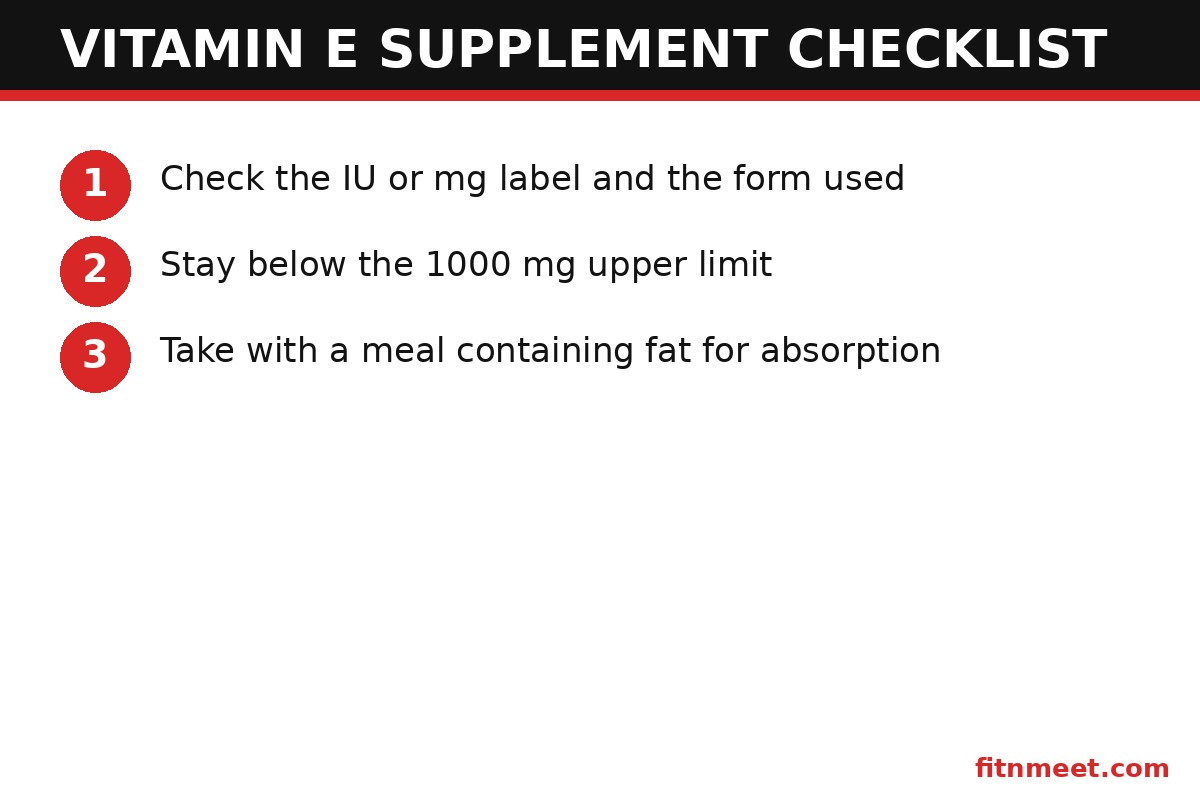
- For targeted antioxidant use, products commonly provide 200-400 IU; stay below the 1,000 mg (about 1,500 IU natural) upper limit.
- Time it with food.
- Take your vitamin E supplement with the fattiest meal of the day. Studies show fat co-ingestion can roughly double absorption of fat-soluble vitamins.
- Keep the same daily slot so the habit sticks; consistency beats perfect timing.
- Give it time, then reassess.
- Fat-soluble nutrients build up slowly. Allow 4-8 weeks before judging any effect on skin or general wellbeing.
- If you started a supplement for a specific goal and see no change after two months, stop and reconsider.
Pro tip: A supplement pairs naturally with vitamin C: the two antioxidants regenerate each other in the body’s defense cycle, which is why many formulas and many diets combine them.
Vitamin E Supplement Dosage
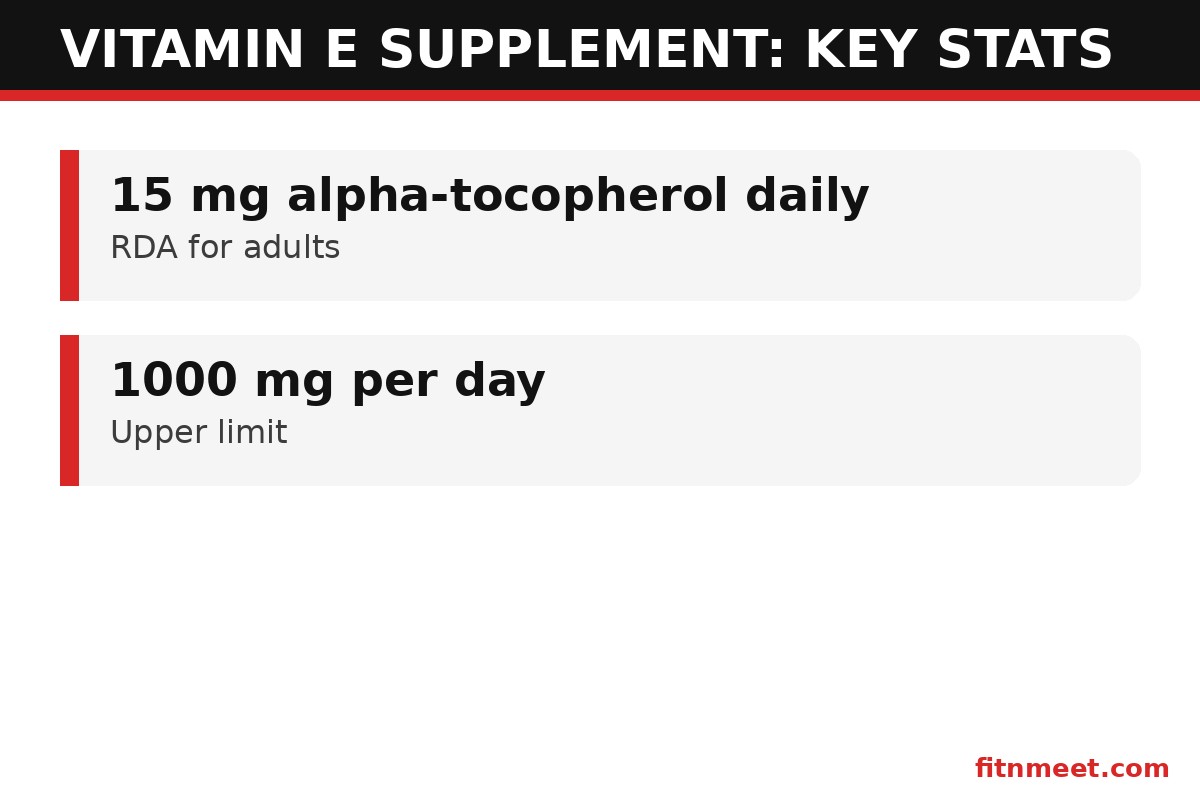
Dosage for a vitamin E supplement is one of the few supplement topics with clear official numbers. The U.S. National Institutes of Health sets the adult recommended dietary allowance at 15 mg of alpha-tocopherol per day (about 22 IU natural or 33 IU synthetic), and the tolerable upper intake level at 1,000 mg per day for adults. Typical label doses fall into three tiers:
- Maintenance (15-100 IU/day): covers the RDA with a comfortable margin. This is the right tier for most people taking a vitamin E supplement as nutritional insurance.
- Targeted antioxidant use (200-400 IU/day): the range used in most clinical trials of immune and skin outcomes. Still well under the upper limit.
- High dose (above 400 IU/day): used in some older cardiovascular trials, but the evidence of benefit is weak and the SELECT trial linked 400 IU/day to a 17% higher prostate cancer risk in men over several years. There is no good reason for healthy people to go here.
One more dosage detail specific to vitamin E: because it is fat-soluble and stored, daily dosing is not strictly necessary at maintenance levels. Taking your supplement 3-4 times per week with fatty meals achieves nearly the same steady state as daily dosing for most people, which can stretch a bottle considerably.
Benefits of a Vitamin E Supplement
The realistic benefits of a vitamin E supplement, ranked by strength of evidence:
- Correcting low intake: the clearest win. If your diet is low in nuts, seeds, and oils, a supplement reliably restores intake to the 15 mg RDA and prevents the nerve and immune problems of true deficiency.
- Immune support in older adults: trials using 200 IU daily show improved immune markers and fewer respiratory infections in elderly populations.
- Antioxidant protection during heavy training: a vitamin E supplement at 200-400 IU reduces exercise-induced markers of lipid peroxidation in several studies, though effects on actual performance are inconsistent.
- Skin resilience: combined with vitamin C, vitamin E modestly increases resistance to UV-induced skin damage. A supplement alone is a weaker intervention than the combination.
- Eye and nerve health: severe deficiency causes ataxia and retinopathy, so maintaining adequate status protects both systems. Supplementation beyond adequacy has not shown extra benefit.
Vitamin E supplement shopping list
- ☐ d-alpha-tocopherol (natural form) on the label
- ☐ Dose between 15 and 400 IU per serving
- ☐ “Mixed tocopherols” listed as a bonus
- ☐ Softgel format for best oil absorption
- ☐ Third-party tested, with an expiry date printed
Compare options in FitnMeet’s vitamins collection.
Mistakes to Avoid with a Vitamin E Supplement
Most problems with a vitamin E supplement come from avoidable user errors, not from the nutrient itself:
- Megadosing for “extra” protection. Doses above 400 IU daily have no proven additional benefit for healthy people and carry the prostate-cancer signal from the SELECT trial plus increased bleeding risk. The upper limit of 1,000 mg is a safety ceiling, not a target.
- Taking it on an empty stomach. Without dietary fat, absorption of a supplement drops sharply. The capsule is not defective; the timing is.
- Ignoring the natural-vs-synthetic gap. Buying 400 IU of synthetic dl-alpha-tocopherol and assuming it equals 400 IU of natural is a 40-50% dosing error. Check which form the IU refers to.
- Stacking multiple sources unknowingly. Multivitamins, “antioxidant blends,” and standalone vitamin E supplement capsules add up. Total your daily IU from every product before adding another.
- Expecting drug-like effects. A vitamin E supplement will not lower cholesterol like a statin or clear skin like a retinoid. It fills a nutritional gap and supports antioxidant defenses; judge it on those terms.
- Using it as a blood-thinner substitute. Vitamin E mildly inhibits platelet aggregation, which is a side effect to manage, not a therapy to rely on. Anyone on anticoagulants should clear a supplement with their doctor first.
Comparing Vitamin E Supplement Forms
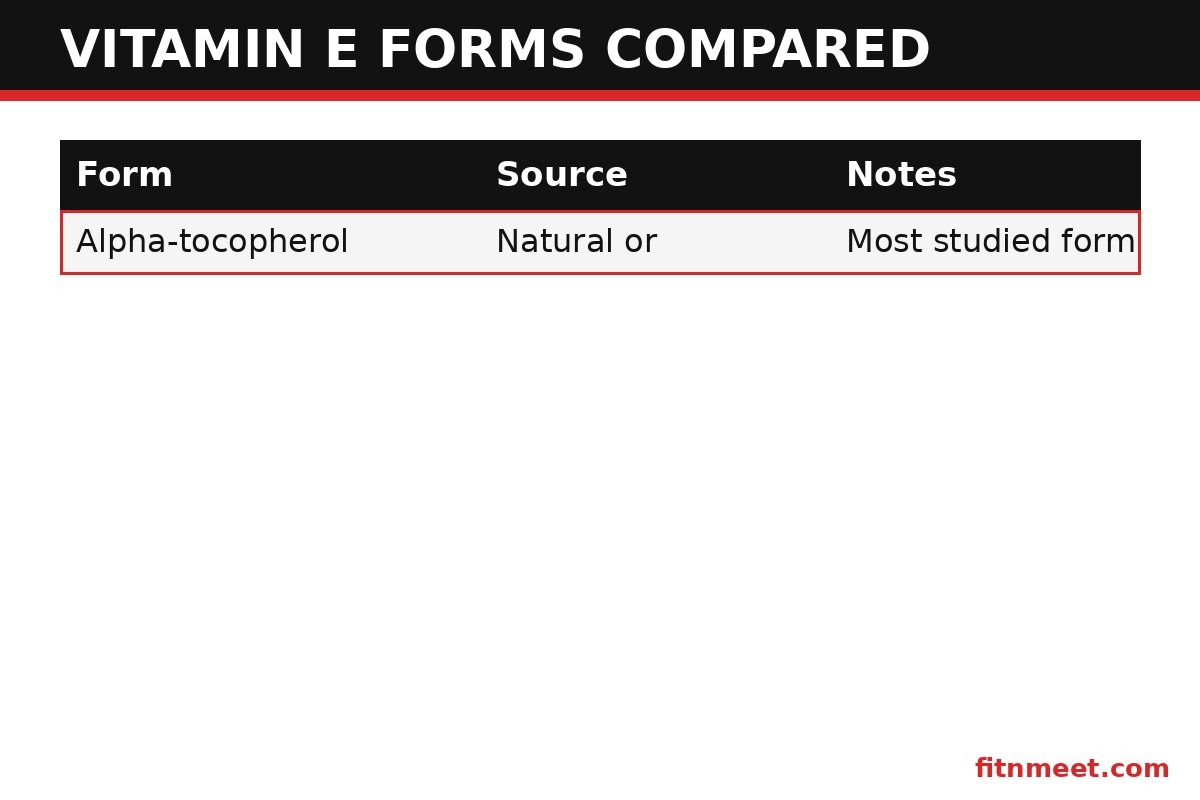
Not every vitamin E supplement contains the same chemistry. The table below breaks down the options:
| Form | Label name | Relative potency | Best for |
|---|---|---|---|
| Natural alpha-tocopherol | d-alpha-tocopherol | 100% (reference) | Best all-round choice |
| Synthetic alpha-tocopherol | dl-alpha-tocopherol | ~50% of natural | Budget option; double-check IU math |
| Mixed tocopherols | alpha + beta + gamma + delta | Varies | Closest to food-like vitamin E |
| Tocotrienols | alpha/gamma-tocotrienol | Different activity profile | Emerging research interest |
| Vitamin E oil (topical) | tocopheryl acetate | Skin-local | Direct skin application, not nutrition |
For most buyers, the decision is simple: a vitamin E supplement with natural d-alpha-tocopherol, ideally with mixed tocopherols, at 100-400 IU. Tocotrienol products are interesting but the human evidence base is much thinner, and topical oils solve a different problem entirely. Shoppers comparing labels in the FitnMeet shop can use this table as a pocket reference.
Side Effects and Safety
A vitamin E supplement at RDA-level doses is very safe. Problems concentrate at high doses and in specific situations:
- Bleeding risk: vitamin E inhibits platelet aggregation. Doses above 400 IU daily can increase bleeding tendency, which is why surgery patients are told to stop supplementation 2 weeks before procedures.
- Drug interactions: combined with blood thinners or antiplatelet drugs, a vitamin E supplement can amplify bleeding risk. It may also interfere with the effectiveness of certain chemotherapy regimens; cancer patients should not self-supplement.
- Prostate cancer signal: the SELECT trial of 35,533 men found that 400 IU/day of vitamin E raised prostate cancer risk by about 17% over extended follow-up. This remains the strongest caution against long-term high-dose use in men.
- Mortality meta-analyses: pooled analyses of trials using 400 IU/day or more have reported small increases in all-cause mortality. The signal is debated, but it consistently points the same direction: more is not better.
- Mild effects: nausea, headache, and blurred vision are reported occasionally at high doses and resolve when the dose is lowered.
The safety summary for a supplement is straightforward: stay at or below 400 IU daily, check interactions if you take blood thinners, and men considering long-term use should know about the SELECT findings. For broader nutritional context, the health support category covers complementary basics. For broader wellness context on antioxidants and healthy aging, explore the FitnMeet health articles.
Frequently Asked Questions
What does a vitamin E supplement do?
It provides concentrated alpha-tocopherol, a fat-soluble antioxidant that protects cell membranes from oxidative damage and supports immune function. It is used for nutritional insurance, skin health, and antioxidant support during periods of high physical stress. It does not act like a drug; its benefits come from maintaining adequate vitamin E status.
How much vitamin E supplement should I take daily?
Most adults do well with 15 to 100 IU per day from a vitamin E supplement, which covers the 15 mg RDA with margin. Targeted antioxidant use in studies typically runs 200 to 400 IU daily. Stay below the 1,000 mg upper limit, and note that 400 IU per day was linked to higher prostate cancer risk in the SELECT trial, so there is no reason to exceed that level without medical guidance.
Should I take a vitamin E supplement with food?
Yes. A vitamin E supplement is fat-soluble, so taking it with a meal containing fat can roughly double absorption compared with an empty stomach. Breakfast with eggs, a lunch with olive oil, or dinner are all fine. Consistency matters more than which meal you choose.
Is natural or synthetic vitamin E supplement better?
Natural d-alpha-tocopherol is better absorbed, with roughly twice the bioavailability of synthetic dl-alpha-tocopherol. Because IU conversions differ (1 mg natural = 1.49 IU vs 1 mg synthetic = 2.22 IU), a natural product delivers more actual vitamin E per labeled IU. Choose natural when the price gap is small.
Can a vitamin E supplement improve skin?
Modestly. Vitamin E concentrates in skin layers and helps neutralize UV-generated free radicals, and combined with vitamin C it slightly increases the skin’s resistance to sun damage. A vitamin E supplement is not a substitute for sunscreen and will not transform skin on its own, but it is a reasonable part of a skin-support routine.
Who should not take a vitamin E supplement?
People taking blood thinners or antiplatelet drugs should check with a doctor first because vitamin E can increase bleeding risk. Anyone scheduled for surgery should stop high-dose vitamin E two weeks beforehand. Men considering long-term doses of 400 IU or more should know about the prostate cancer signal from the SELECT trial. Pregnant women should stay near the RDA unless advised otherwise.
Conclusion
A vitamin E supplement is one of the least complicated supplements you can buy: cover the 15 mg RDA, choose natural d-alpha-tocopherol, take it with a fatty meal, and stay at or below 400 IU daily. Used that way, it is a cheap, safe piece of nutritional insurance with credible benefits for immunity and antioxidant defense. Used at megadoses, it becomes a case study in why more is not better.
To compare quality options, browse the vitamins collection on FitnMeet, or start from the shop to see the full range.
This article is for informational purposes only and is not medical advice. Consult a healthcare professional before starting any supplement.
Sources: Vitamin E fact sheet — NIH Office of Dietary Supplements · Vitamin E — Wikipedia · Tocopherol — Wikipedia