
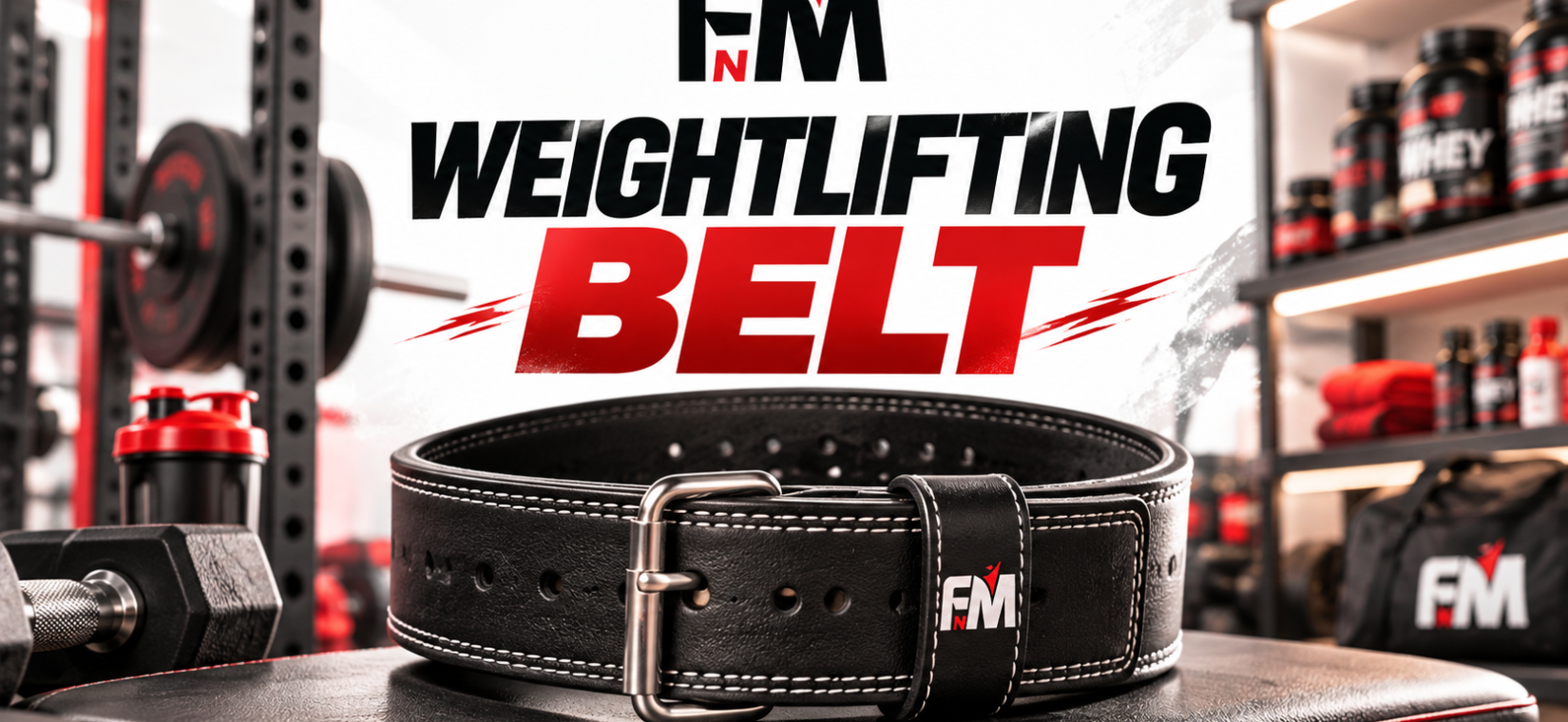
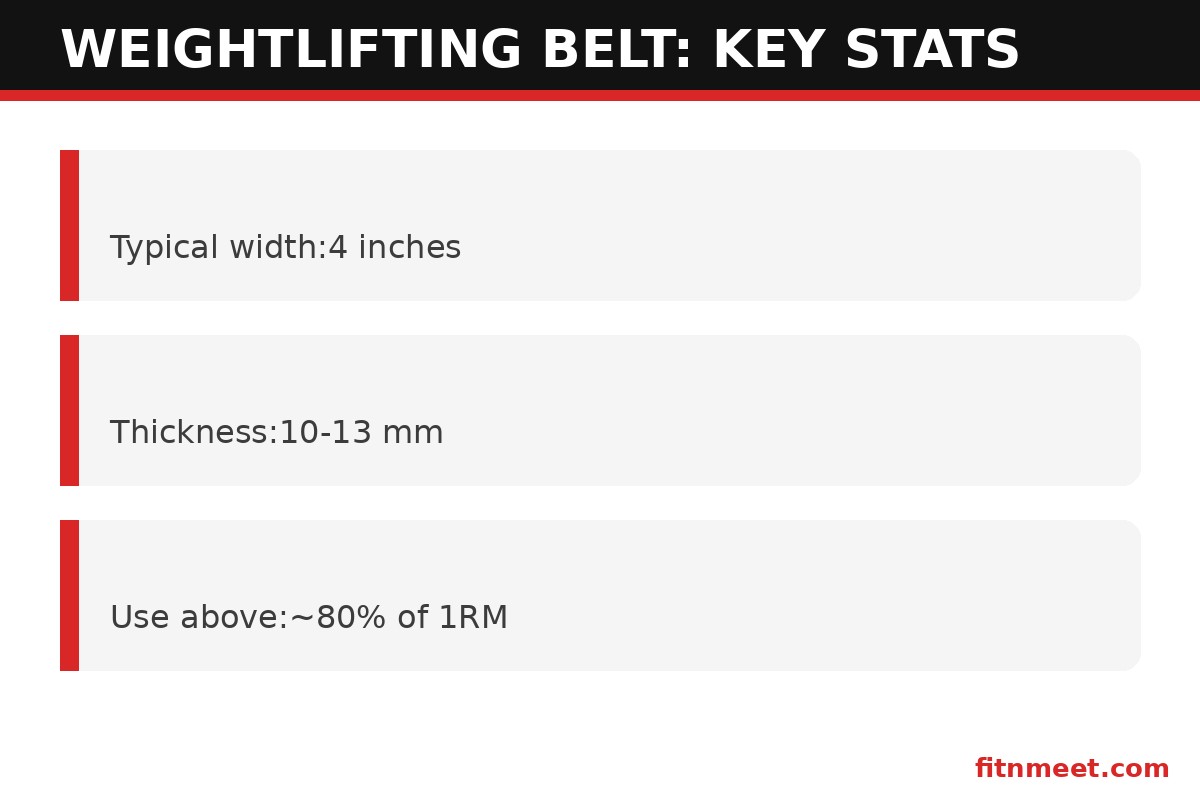
Weightlifting belt is a wide, stiff belt worn around the waist during heavy squats, deadlifts, and overhead presses. It works by giving the abdominal muscles something to brace against, increasing intra-abdominal pressure and spinal stability. A belt does not replace proper bracing technique, and most lifters only need one for sets above 80 percent of max.
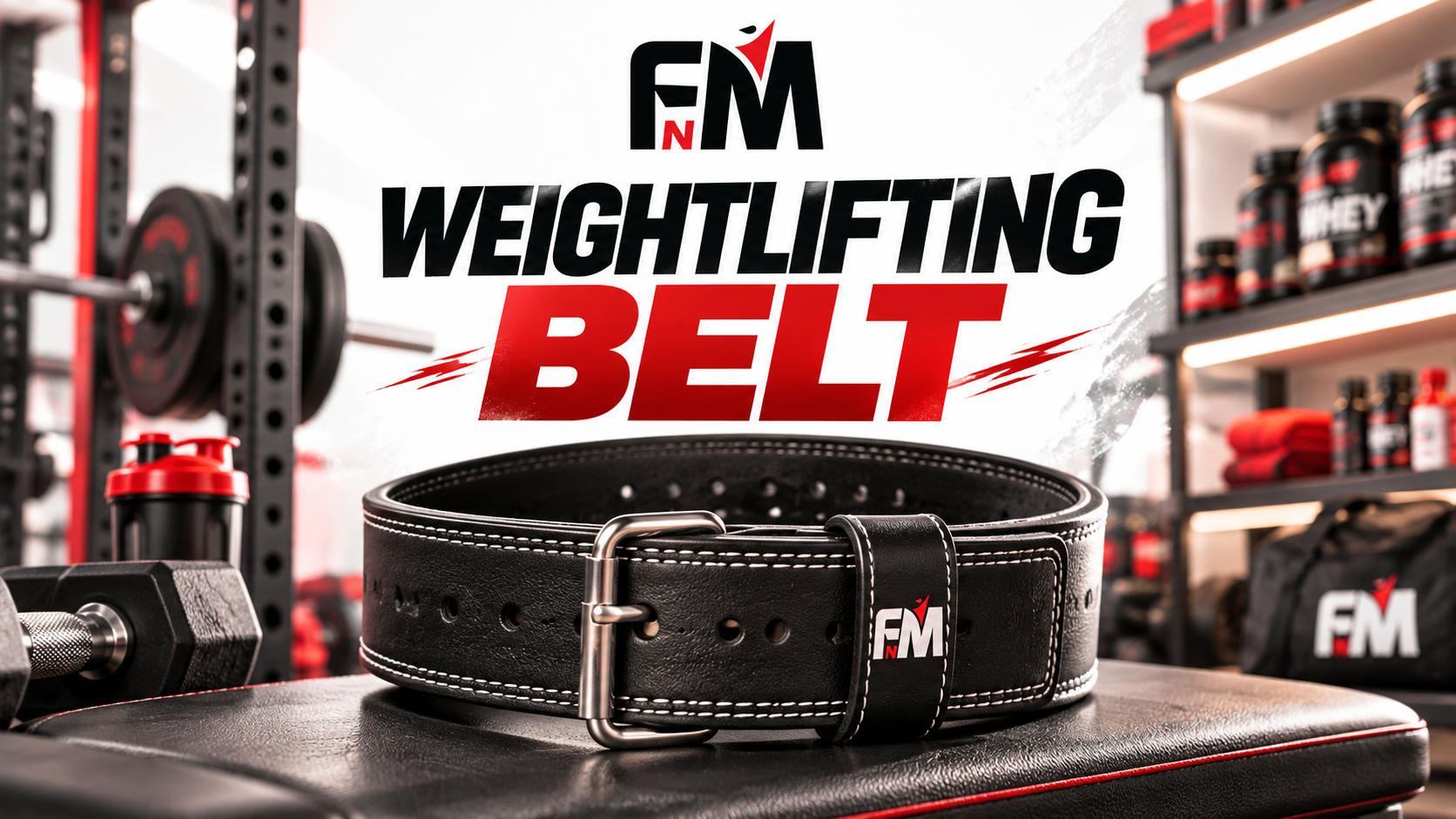
Quick Answer: Should You Wear a Weightlifting Belt?
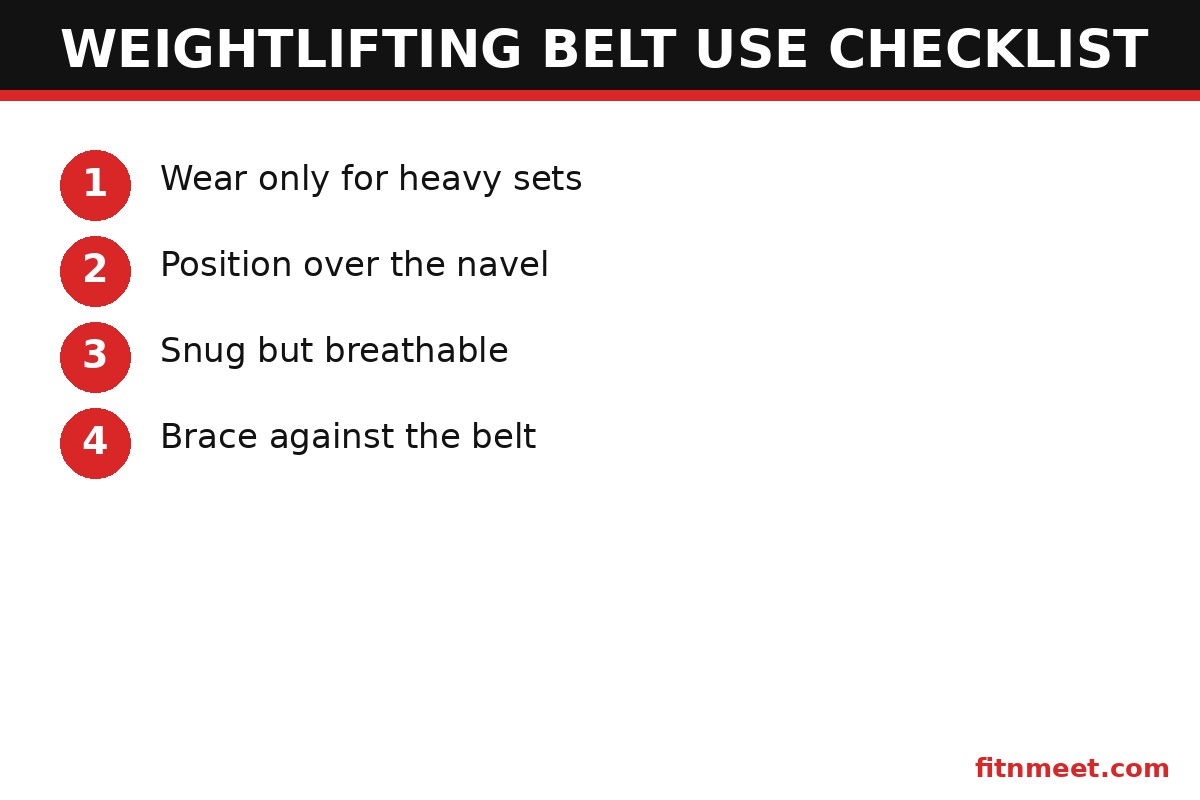
Wear a weightlifting belt for heavy compound lifts, primarily squats, deadlifts, overhead presses, and heavy rows, when the load exceeds roughly 80 percent of your one-rep max or when you are testing maxes. Below that threshold, train beltless to develop natural trunk stability. The belt does not lift the weight for you; it gives your abdominal wall something rigid to push against, amplifying the intra-abdominal pressure your own brace creates.
If you are new to lifting, the answer is different: spend your first 6 to 12 months building a beltless base. A beginner who belts every set never learns to brace, and the belt becomes a crutch masking weak trunk control. Intermediate and advanced lifters, roughly one year of consistent training or a bodyweight-plus squat, earn the most from a weightlifting belt because they already know how to brace and simply need the pressure ceiling raised on their heaviest sets.
The expert consensus is refreshingly narrow: a weightlifting belt is a performance tool for maximal and near-maximal efforts, not an all-day accessory. Lifters who wear it for warm-ups, accessories, and cardio gain nothing and may blunt the trunk adaptations those lighter sets are supposed to build. Use it strategically, and it adds kilograms to your total; use it constantly, and it adds nothing but dependence.
Mechanisms: How a Weightlifting Belt Actually Works
The weightlifting belt works through one primary mechanism: increased intra-abdominal pressure (IAP). When you take a deep diaphragmatic breath and brace your trunk as if expecting a punch, your diaphragm pushes down while your pelvic floor and abdominal wall contract inward. This pressurizes the abdominal cavity like an inflated tire. A rigid belt wrapped around the waist gives the abdominal muscles a firm surface to contract against, which proprioceptively cues a harder brace and mechanically contains the pressure. Direct measurements show IAP rises 25 to 40 percent when lifters brace against a belt versus bracing beltless.
That pressure matters because the spine is a flexible column that buckles under compressive load. Intra-abdominal pressure acts as a hydraulic support in front of the lumbar spine, reducing the net compressive and shear forces on the intervertebral discs during heavy squats and deadlifts. Biomechanical models estimate that maximal IAP can offload a meaningful fraction of spinal compression, which is why belted lifters consistently report that heavy weights “feel” more stable and why bar speed data shows 5 to 10 percent faster reps at the same load when belted.
A secondary mechanism is proprioceptive feedback. The belt’s pressure against the abdomen and obliques gives the nervous system a constant tactile cue to maintain trunk rigidity. Lifters often discover that their beltless bracing improves after a belted training block, because the belt taught them what a maximal brace feels like. This is the opposite of the “belt makes your core weak” myth: used correctly, a weightlifting belt is a bracing coach, not a core replacement. Electromyography studies confirm that rectus abdominis and external oblique activation is equal or slightly higher when belted, not lower.
The third mechanism is reduced spinal flexion under fatigue. As sets grind on, lifters tend to lose trunk position rep by rep. The belt’s rigid wall makes flexion mechanically harder and sensorily obvious, helping maintain a neutral spine deeper into hard sets. This protective effect is most valuable on high-RPE deadlift and squat sets where form breakdown is the main injury risk. The fundamentals of heavy barbell training all assume a rigid trunk; the belt simply enforces it.
Advanced Benefits Beyond the Basics
Measurable performance gain. Controlled studies on experienced lifters show belted squats produce higher bar velocities and allow 5 to 10 percent more load for the same RPE compared with beltless. In competition terms, that is the difference between a 180 kg and a 190 kg squat. The effect is largest in the deadlift, where trunk rigidity is the limiting factor off the floor, and smallest in the bench press, where the belt’s role is mainly leg-drive stability.
Greater training volume at high intensity. Because each heavy rep costs less systemic fatigue when the trunk is stabilized, belted lifters can accumulate more quality volume above 85 percent. Over a 12-week strength block, that compounds into meaningfully greater strength gains than the same program run entirely beltless. This is why powerlifting programs prescribe the weightlifting belt specifically for top sets and heavy back-off work. Fuel that extra heavy volume with support from the FitnMeet muscle development collection.
Confidence under maximal loads. Underestimated and real: the psychological effect of a tight belt before a max attempt. Lifters report feeling “locked in,” which reduces hesitation and technical breakdown during the highest-stakes reps. Sports psychology would call this a pre-performance routine anchor; lifters just call it armor.
Longevity for the competitive lifter. Years of maximal spinal loading accumulate. By reducing per-rep spinal stress on the heaviest sets, a weightlifting belt may lower cumulative disc and facet joint wear across a lifting career. It is not injury-proofing, but it shifts the stress-recovery math favorably on the sets that matter most. Our strength training library covers career-long joint management in more depth.
Protocols: Timing, Stacking, and Cycling Belt Use
⏱ Protocol A — Top-set only (strength focus): Warm up beltless through 70 percent. Belt up for top sets at 80 percent and above plus heavy back-offs. Remove the belt for all accessories. Best for powerlifters and anyone peaking for a max.
Phase 1: Learn beltless (months 1-12 of training). No belt. Master diaphragmatic breathing, the Valsalva maneuver, and trunk rigidity on every compound lift. If you cannot brace hard without a belt, a belt will only hide the deficit.
Phase 2: Introduce the belt (month 12+). Add the weightlifting belt for one heavy compound per session, top sets only. Expect 2 to 3 weeks of awkwardness while you learn belt breathing: the cue is to push your abs out into the belt, not to suck in.
Phase 3: Strategic integration (ongoing). Run Protocol A on heavy days and go fully beltless on volume or technique days. Many advanced lifters belt squats and deadlifts but stay beltless on presses and rows, matching the tool to the spinal demand.
⏱ Protocol B — Beltless blocks (cycling): Train 4 to 6 weeks belted for overload, then 2 to 3 weeks fully beltless at slightly reduced loads to re-sensitize natural bracing. This cycling prevents psychological dependence and keeps trunk stabilizers honest.
Stacking with other tools. The belt stacks well with lifting shoes (stable base), wrist wraps on heavy pressing, and chalk for grip, since each solves a different limiting factor. It does not stack meaningfully with a second belt cue like excessive arching; keep the spine neutral and let pressure do the work. Avoid combining a maximal belt brace with breath-holding beyond the rep on heavy singles if you have blood pressure concerns; exhale slightly through the sticking point (the “tss” exhale) on grinders.
Dosage Ranges: Tightness and Usage Tables
A weightlifting belt has no milligram dose, but tightness and usage frequency are its dosage variables. Get them wrong and the belt either does nothing or becomes a tourniquet.
| Tightness level | How it should feel | When to use it |
|---|---|---|
| Snug (1 notch loose) | You can fit two fingers between belt and belly; full breath possible | Learning the belt; sets at 70-80% |
| Working tight (standard) | One finger fits; deep breath requires effort against the belt | Top sets at 80-92%; the default |
| Max tight | Barely one finger; you would not wear it between sets | Singles and doubles above 92%; competitions |
| Lift | Belt threshold | Notes |
|---|---|---|
| Squat | ~80% of 1RM | Highest value; belt every heavy set |
| Deadlift | ~80-85% of 1RM | Some prefer one notch looser for the hinge |
| Overhead press | ~85% of 1RM | Stabilizes the trunk against lean-back |
| Barbell row | Heavy sets only | Supports the hinge position |
| Bench press | Optional | Only for leg-drive stability; minimal spinal load |
| Accessories / warm-ups | Never | Build natural stability here |
Position the weightlifting belt over the navel, covering the lower ribs to the top of the pelvis, not cinched around the waist like a fashion belt. Leather belts need a break-in period of 2 to 4 weeks before they mold to your torso; nylon Velcro belts are comfortable immediately but offer slightly less rigid support. Re-check tightness as you warm up, since the abdomen expands with blood flow and bracing practice. The FitnMeet shop resources include gear guides for matching belt type to training style.
Interactions and Safety
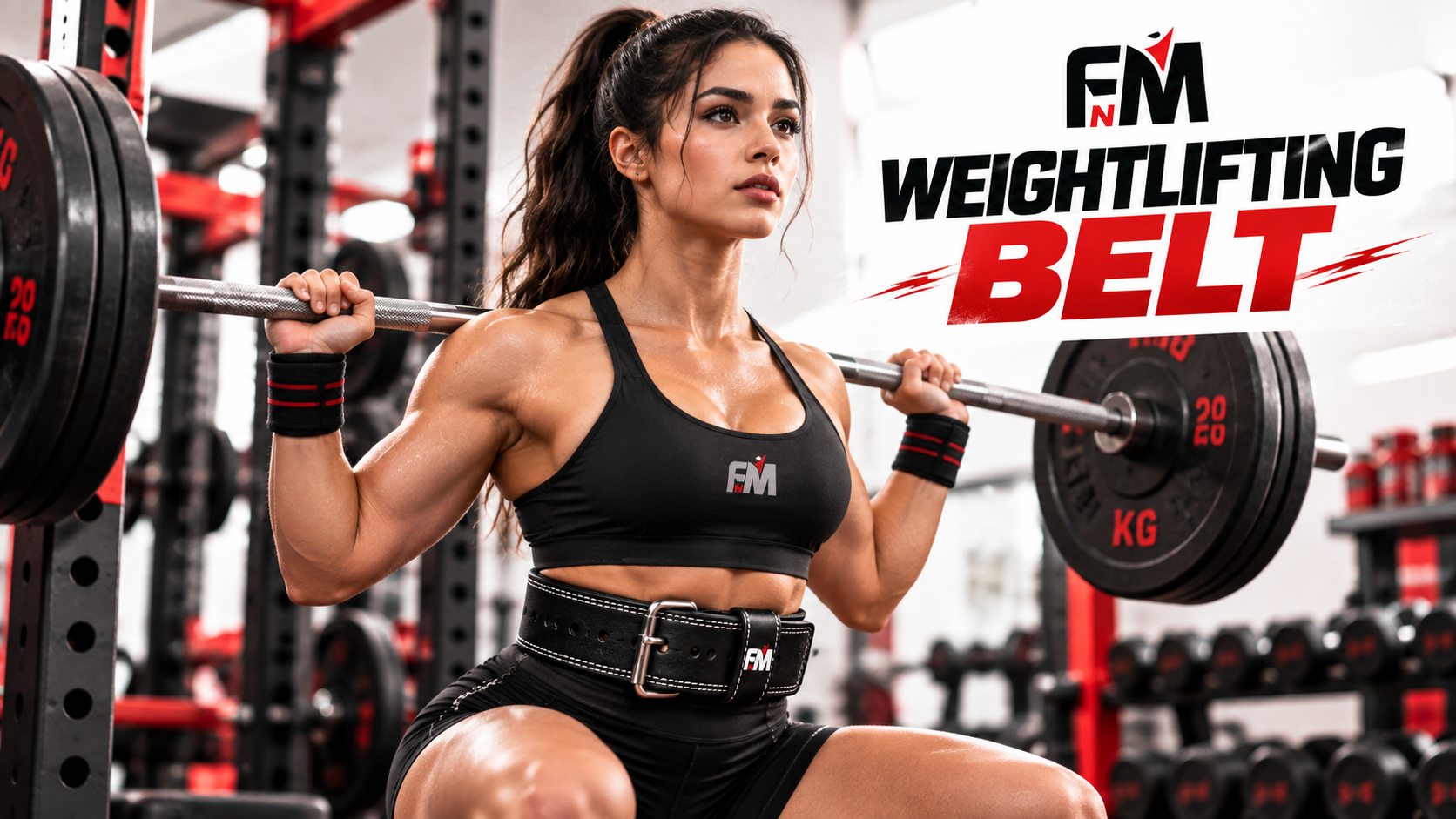
A weightlifting belt interacts with your body in ways that demand respect. The Valsalva maneuver plus a tight belt spikes blood pressure transiently, with systolic readings above 300 mmHg recorded during maximal lifts in research settings. For healthy lifters this spike is brief and well tolerated, but lifters with uncontrolled hypertension, aneurysm risk, or a history of stroke should get medical clearance before heavy belted training, and should favor submaximal loads with controlled breathing.
When not to wear a weightlifting belt: during pregnancy (compresses the abdomen and spikes IAP), with an untreated inguinal hernia (pressure can worsen it), during high-rep metabolic circuits (the brace-breathe cycle disrupts conditioning pacing), or when rehabbing a trunk injury without clinician guidance. The belt also interacts poorly with poor bracing: a lifter who holds their breath into the chest rather than the belly gets little from the belt and all of the blood pressure spike, so fix the breathing pattern first.
Common safety mistakes include wearing the belt for entire sessions, which overheats the trunk and dulls the brace cue; cinching it so tight that breathing becomes shallow and dizziness follows; and using the belt to mask pain. A weightlifting belt that makes a painful lift painless is a red flag, not a green light: pain is information, and the correct response is assessment, not equipment. The research on belts and spinal loading supports their protective role when used with sound technique, not as a workaround for it.
Weightlifting Belt Comparisons
| Factor | Leather Weightlifting Belt (10-13 mm) | Nylon Weightlifting Belt (Velcro) | No Belt (Beltless) |
|---|---|---|---|
| Support rigidity | Maximum; does not deform | Good; slight give under max loads | None; pure trunk strength |
| Break-in | 2-4 weeks | None | N/A |
| Adjustability | 1-inch hole spacing (lever: infinite) | Infinite; micro-adjustable | N/A |
| Comfort | Stiff initially; molds over time | Comfortable immediately | Most comfortable |
| Durability | 10+ years | 3-5 years (Velcro wears) | Forever |
| Best for | Powerlifting, max strength | Cross-training, Olympic lifting, comfort | Volume phases, beginners, technique work |
Within leather belts, the lever vs prong debate matters: lever belts offer the tightest, most repeatable cinch with a quick release, ideal for competitors who want identical tightness every set; single-prong belts adjust in 1-inch steps and release faster between exercises, suiting varied training. Tapered bodybuilding belts (wide back, narrow front) are a legacy design; the uniform 4-inch powerlifting cut gives the abs more wall to push against and is the evidence-backed choice for a weightlifting belt used for strength. Our fitness gear explainers break down more equipment choices.
This article is for informational purposes only and is not medical advice. Consult a healthcare professional before starting any supplement or exercise program.
Frequently Asked Questions
Does a weightlifting belt weaken your core?
No, when used correctly. EMG studies show abdominal activation is equal or slightly higher when bracing against a belt, because the belt gives the abs a rigid wall to push into. Belts only weaken the core if worn for every set, which robs light training of its trunk-stability stimulus. Keep warm-ups and accessories beltless.
When should a beginner start using a weightlifting belt?
After roughly 6 to 12 months of consistent beltless training, once you can brace hard on command and your squat approaches bodyweight or beyond. Beginners who belt too early never develop natural trunk stability. Earn the belt with a solid foundation first.
How tight should a weightlifting belt be?
Working tightness means one finger fits snugly between the belt and your belly, and a full breath requires real effort against the belt. For max attempts, go one notch tighter, but loosen or remove the belt between sets. If you feel dizzy or cannot breathe deeply, it is too tight.
Should you wear a weightlifting belt for deadlifts?
Yes for heavy deadlifts above 80 to 85 percent of your max. The belt increases intra-abdominal pressure and helps maintain a neutral spine off the floor. Some lifters prefer it one notch looser for deadlifts than squats to allow the hinge position, which is a legitimate personal adjustment.
Leather or nylon weightlifting belt: which is better?
Leather (10 to 13 mm) gives maximum rigidity and lasts a decade or more, making it the choice for powerlifting and max strength. Nylon Velcro belts are comfortable immediately, infinitely adjustable, and better for Olympic lifting and Cross-training, but the Velcro wears out in 3 to 5 years.
Can a weightlifting belt cause injury?
The belt itself rarely causes injury, but misuse can contribute: extreme tightness plus maximal breath-holding spikes blood pressure dangerously, and belting through sharp pain masks injuries that need assessment. Lifters with uncontrolled hypertension, hernias, or pregnancy should avoid heavy belted lifting or get medical clearance.
Is a 4-inch weightlifting belt better than a tapered belt?
For strength training, yes. A uniform 4-inch belt gives the entire abdominal wall a rigid surface to brace against, maximizing intra-abdominal pressure. Tapered belts with a narrow front were designed for comfort during long bodybuilding sessions, but they sacrifice the very bracing surface that makes a belt effective.
Conclusion
The weightlifting belt is one of the few pieces of gym equipment with genuine biomechanical evidence behind it: 25 to 40 percent more intra-abdominal pressure, faster bar speeds, and a more stable spine on the sets that matter. The advanced lifter’s edge is not owning a belt but programming it, top sets belted, volume beltless, tightness matched to the load, and the humility to build the brace before buying the leather. Apply the protocols above for one training block and let your logbook deliver the verdict. Explore FitnMeet’s training resources to keep refining your approach.