
Anterior knee pain gets blamed on a handful of usual suspects — patellar tendinopathy, runner’s knee, arthritis — while one genuinely common cause quietly gets missed for months: the fat pad sitting just behind your kneecap. If you’ve got pain right below the patella that gets worse with a straight leg or a deep squat, and every scan has “ruled out” the obvious stuff, Hoffa’s fat pad is worth putting on the list.
This guide covers what the fat pad actually is, how it becomes a source of pain, how it’s diagnosed, and what treatment typically looks like.
What Is Hoffa’s Fat Pad?
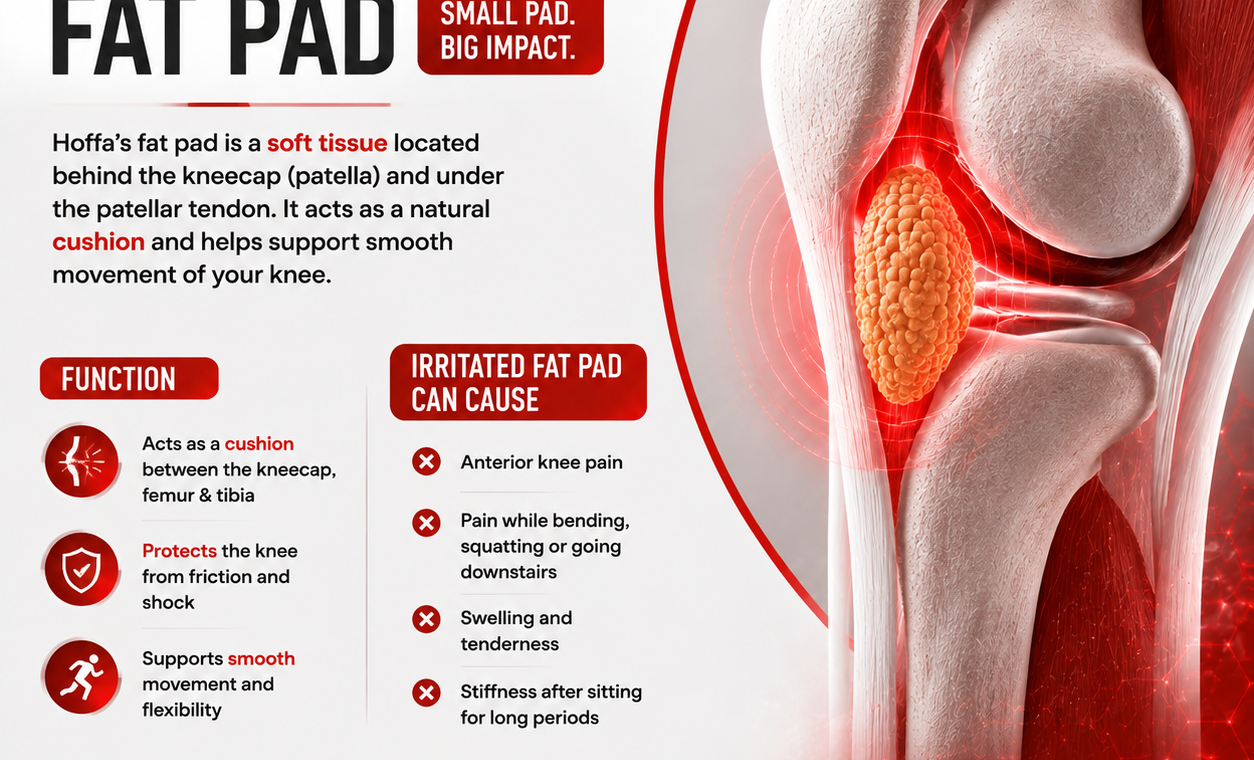
Hoffa’s fat pad — more formally the infrapatellar fat pad (IFP) — is a <cite index=”49-1″>pad of fatty tissue at the front of the knee, sitting behind the patellar tendon and below the kneecap</cite>. It’s named after Albert Hoffa, the German surgeon who first described problems arising from it back in 1904.
Far from being inert padding, it’s <cite index=”49-1″>a normal, functional part of knee anatomy that acts as a shock absorber, cushioning the patella and preventing it from striking the thigh bone</cite> during impact or a direct blow to the front of the knee. It also plays a role in joint lubrication and helps fill space within the joint capsule as the knee bends and straightens.
The detail that makes this fat pad clinically important is its nerve supply. It’s <cite index=”53-1″>one of the most densely innervated tissues in the knee</cite> — which means when it becomes irritated or inflamed, it can generate significant pain, out of proportion to what you’d expect from “just fat tissue.”
What Is Hoffa’s Syndrome (Fat Pad Impingement)?
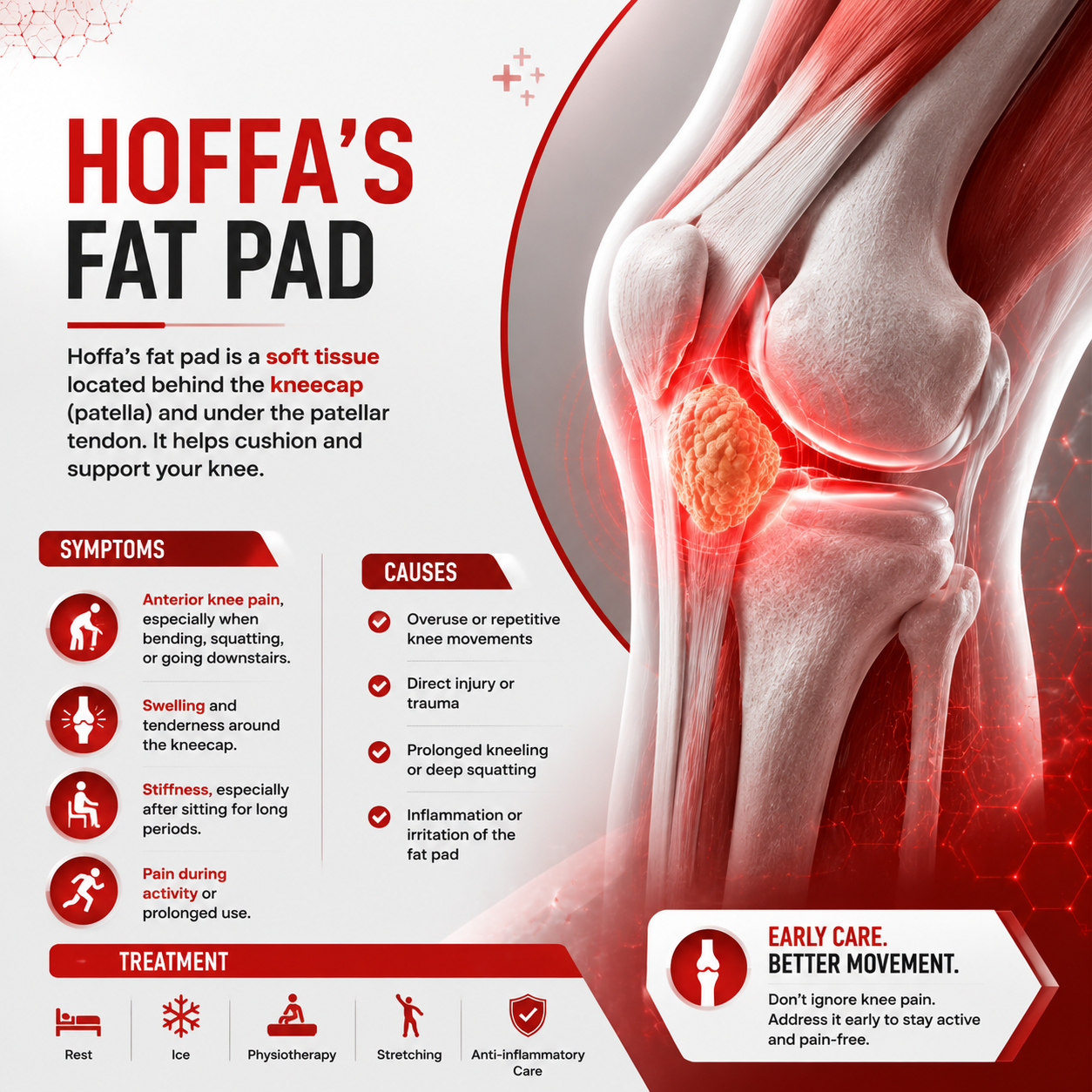
Hoffa’s syndrome — also called infrapatellar fat pad impingement, fat pad syndrome, or simply Hoffa’s disease — happens when the fat pad gets <cite index=”53-1″>pinched between the femur and tibia, or between the patella and femur</cite>, during knee movement. Repeated pinching or a single traumatic impact can trigger inflammation, and once inflamed, the fat pad can swell — which then makes it even more likely to get pinched again. It’s a cycle that, left alone, tends to reinforce itself.
This isn’t a rare or obscure diagnosis. It’s considered <cite index=”48-1″>one of the leading causes of anterior knee pain</cite>, though it’s also widely regarded as underdiagnosed, in part because its symptoms overlap heavily with more commonly recognized causes of front-of-knee pain.
What Does Hoffa’s Fat Pad Pain Actually Feel Like?
Patients typically describe a <cite index=”50-1″>sharp or burning pain in the front of the knee, located just beneath and beside the patellar tendon</cite>, near where the tendon attaches to the shin bone.
Common patterns reported with this condition:
- Pain that worsens with <cite index=”50-1″>full knee extension (straightening the leg completely)</cite>
- Discomfort climbing stairs or holding the knee in a bent position for a while
- Crepitus (a grinding or crackling sensation) with <cite index=”53-1″>activities like stair climbing, squatting, jumping, or running</cite>
- Swelling or fluid buildup around the front of the knee
- A sense of the knee not fully straightening, in more significant cases.
- Discomfort from prolonged standing or long walks, particularly in flat, unsupportive shoes
Because these symptoms overlap with patellar tendinopathy and infrapatellar bursitis, self-diagnosis from symptoms alone is genuinely difficult — this is a case where getting an actual clinical evaluation matters more than most.
What Causes Hoffa’s Fat Pad Impingement?
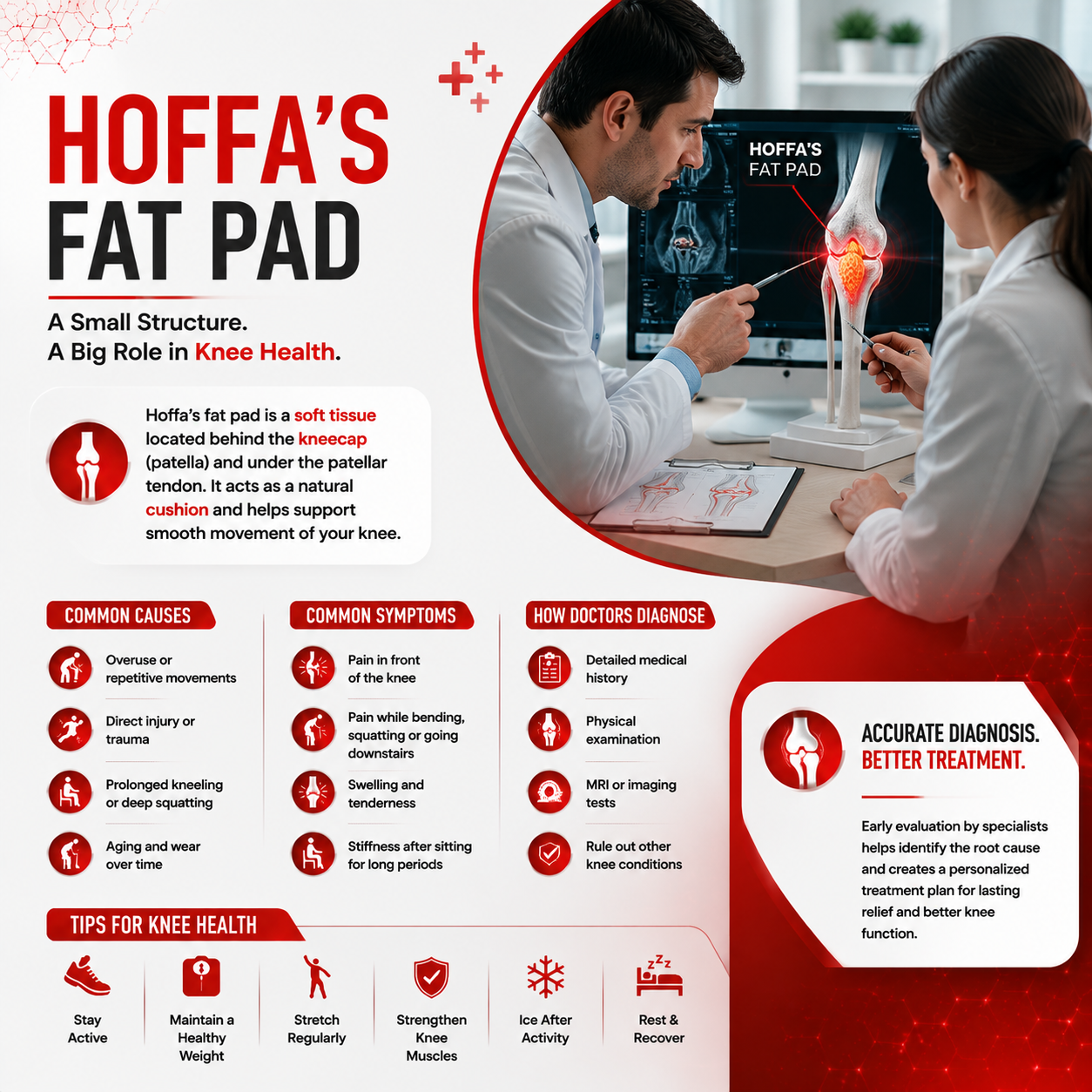
The most common trigger is direct trauma — a fall onto a bent knee, a blow to the front of the knee in a contact sport, or knee surgery, which can leave the fat pad inflamed or scarred afterward. Beyond acute trauma, repetitive stress is a major contributor: activities involving frequent knee hyperextension, deep squatting, or repeated jumping and landing put the fat pad at risk of chronic irritation over time.
A 2023 systematic review looking at predisposing factors found the condition tends to cluster around a combination of anatomical and biomechanical variables rather than any single cause — meaning two people can develop the same symptom picture through fairly different mechanical pathways.
How Is Hoffa’s Fat Pad Impingement Diagnosed?
Diagnosis typically starts with a physical exam of Hoffa’s Fat Pad, where a clinician will assess pain location and try to reproduce your symptoms using movements designed to compress or “pinch” the fat pad — a maneuver clinicians sometimes refer to as Hoffa’s test.
Imaging plays an important confirming role. <cite index=”51-1″>Sagittal MRI is considered the best imaging option for assessing the infrapatellar fat pad</cite>, since it can show the structural changes — swelling, fibrosis, or abnormal signal — associated with the condition. On a normal MRI, the fat pad appears similar to the fat found elsewhere in the body, aside from some lower-signal fibrous partitions running through it.
Because the differential list for anterior knee pain is long, part of a proper diagnostic workup involves ruling out other likely culprits — <cite index=”51-1″>patellar tendinopathy and infrapatellar bursitis being the two most commonly confused conditions</cite> — as well as things like patellofemoral pain syndrome and meniscal injury.
How Is Hoffa’s Fat Pad Syndrome Treated?
Treatment generally follows a conservative-first approach, escalating only if symptoms don’t respond.
First-line, conservative treatment typically includes <cite index=”54-1″>rest, ice, anti-inflammatory medication, and activity modification</cite> to reduce the mechanical irritation driving the inflammation. Targeted physical therapy is also commonly used, often focused on correcting movement patterns that repeatedly stress the fat pad. According to clinicians who specialize in this condition, the large majority of patients <cite index=”55-1″>improve with this kind of conservative treatment</cite> before anything more invasive is needed.
If symptoms persist, for Hoffa’s Fat Pad,the corticosteroid injections into the fat pad are a common next step, aimed at reducing localized inflammation directly. Some patients need more than one injection over time to get lasting relief.
For cases that don’t respond to conservative care, surgical options exist. The most common is arthroscopic partial resection — a minimally invasive procedure using a small camera to trim or remove the inflamed portion of the fat pad. Research on long-term outcomes is encouraging: a study following patients for a <cite index=”52-1″>minimum of 10 years after arthroscopic resection found favorable, sustained improvement in knee function scores, with no significant progression of patellofemoral osteoarthritis</cite>. That said, the same study found roughly <cite index=”52-1″>28% of patients still reported some persistent symptoms at long-term follow-up</cite> — a reasonable success rate, but not a guaranteed fix for everyone.
One nuance worth knowing: research indicates <cite index=”55-1″>partial removal of the fat pad tends to be roughly as effective as more extensive removal</cite>, which is part of why surgeons generally favor a more conservative resection when surgery is warranted.
A word of caution on total removal: research specifically looking at total excision of the fat pad performed alongside total knee replacement surgery found <cite index=”55-1″>worse outcomes compared with knee replacement alone</cite> — a reminder that the fat pad serves a real mechanical function, and removing more of it isn’t automatically better.
How Long Does Hoffa’s Fat Pad Recovery Take?
The recovery period depends on how bad it is and what you do about it and can be extremely different in each case. If you go the conservative route and change the things you do and do physical therapy, it may be weeks to a few months, not days. Injections may help relieve symptoms faster, but they don’t necessarily solve the underlying mechanical problem by themselves. That’s why they are often used in conjunction with physical therapy, rather than on their own.
If the surgery is required, therapy afterward often focuses on restoring full knee extension and normal kneecap motion, while minimizing the scar tissue formation that can otherwise re-trigger impingement.
Is Hoffa’s fat pad syndrome serious?
Hoffa’s Fat Pad is not dangerous in the way a fracture or ligament tear is, but it can be genuinely disabling if left untreated, given how nerve-rich the fat pad is. Most cases respond well to conservative treatment, but persistent, unaddressed impingement can become a chronic pain source.
Can Hoffa’s syndrome go away on its own?
Mild cases sometimes settle with rest and reduced aggravating activity, but ongoing impingement tends to reinforce itself through repeated swelling and pinching. If pain persists more than a few weeks despite activity modification, it’s worth getting evaluated rather than waiting it out indefinitely.
What’s the difference between Hoffa’s syndrome and patellar tendinopathy?
Both cause pain in a similar location, but patellar tendinopathy is an overuse injury of the tendon itself, typically worse with jumping-heavy activity. At the same time, Hoffa’s syndrome involves the fat pad behind the tendon and is often worse with full knee extension specifically. Because the two frequently get confused, proper imaging and clinical exam matter for getting the right treatment.
Can I exercise with Hoffa’s fat pad impingement?
Generally yes, with modification — activities that involve deep knee bending, hyperextension, or repetitive impact are usually the ones to scale back first. At the same time, a physical therapist can guide which movements are safe to continue.
Does Hoffa’s syndrome show up on an X-ray?
Not reliably. X-rays are useful for ruling out bone-related causes of knee pain. Still, the fat pad itself is soft tissue, so MRI is the imaging method that actually visualizes the condition.
Is surgery usually needed for Hoffa’s fat pad impingement?
No — surgery is typically reserved for cases that don’t improve with conservative treatment and injections. Most patients recover without ever needing an operation.
Can Hoffa’s fat pad impingement come back after treatment?
It can be, especially if the movement pattern or activity that produced it is not corrected. This is part of the reason why physical therapy centered around mechanics, aside from merely pain management, is usually included in a complete treatment plan.
Who is most likely to get Hoffa’s fat pad syndrome?
It’s particularly common among athletes involved in jumping, running, and pivoting sports, as well as anyone with a history of direct knee trauma or prior knee surgery.
The Bottom Line
Hoffa’s fat pad is a normal, functional structure that becomes a genuine pain generator once it starts getting pinched between the bones surrounding it. The good news is that most cases respond to conservative treatment — rest, activity modification, and physical therapy — without ever needing an injection or surgery. If you’ve got persistent pain right below the kneecap that worsens with a straight leg, and other diagnoses haven’t explained it, this is a condition worth specifically asking a knee specialist to evaluate for, ideally with an MRI to confirm what’s actually going on.
This article is for general information and isn’t a substitute for a diagnosis or treatment plan from a qualified healthcare provider. If you’re experiencingthe Hoffa’s Fat Pad, see a doctor or physical therapist for an individualized evaluation.