
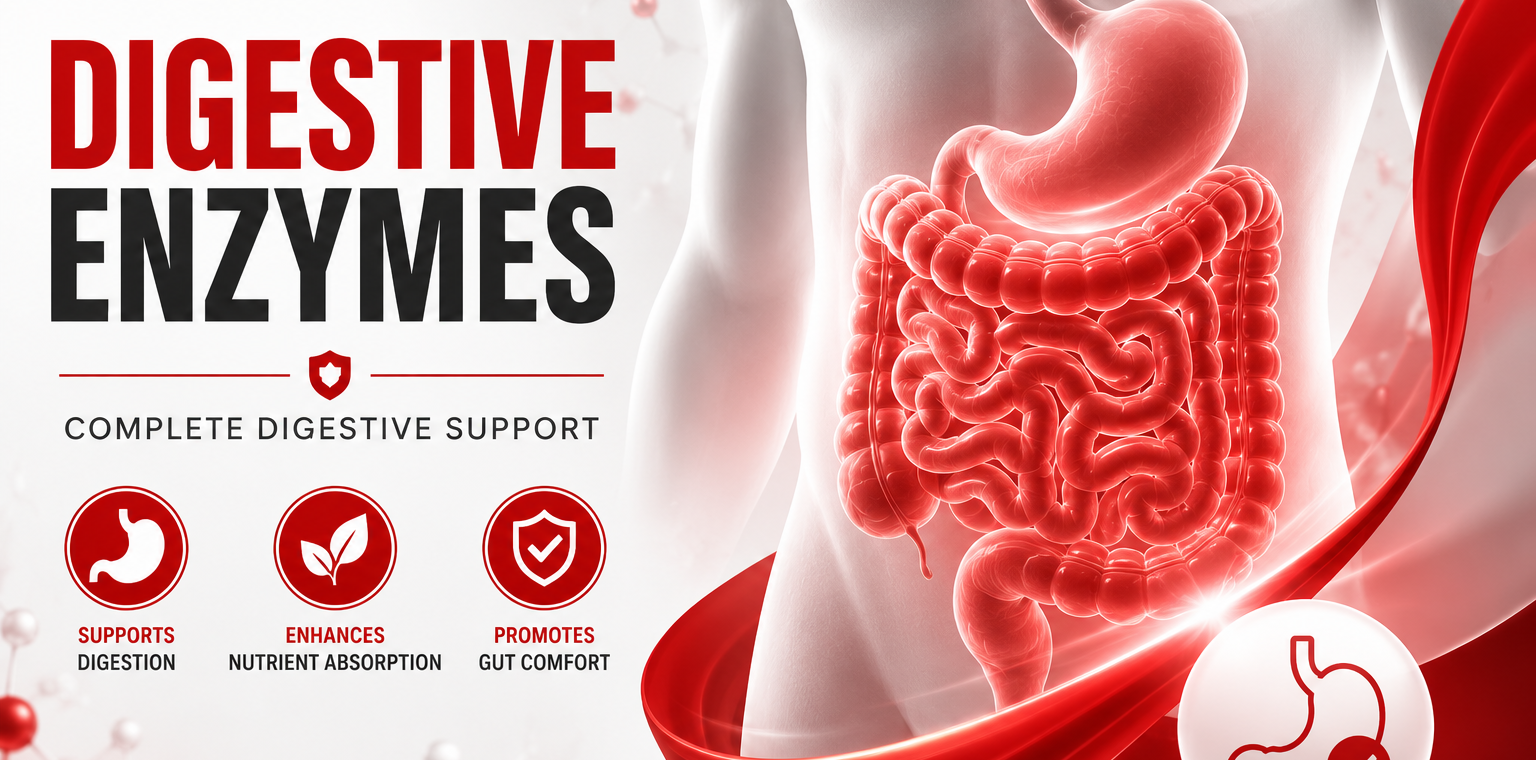
Big feast. An hour later and your stomach feels like it has a grudge. Bloated, heavy, maybe a bit achy in the way that makes the sofa look more inviting than whatever you were intended to accomplish next. So you search “digestive enzymes”, and suddenly you’re looking at fifteen different supplement bottles all promising to fix your stomach, your energy, and even your metabolism too.
Some of that is legitimate. A good chunk of it is marketing dressed up as biology. Here’s the difference in Digestive Enzymes.
What Digestive Enzymes Actually Are
They’re proteins your body makes to break food into pieces small enough to absorb. No Digestive Enzymes, no real digestion — that sandwich would pass through you mostly intact, doing nothing for you nutritionally.
Three main types handle three main jobs:
- Amylases go after carbs and starches. Made in your saliva and pancreas.
- Proteases break down protein. Mostly stomach and pancreas.
- Lipases handle fat, working with bile from your liver and gallbladder.
There’s a smaller cast too, and this is where most digestive complaints actually come from. Lactase breaks down lactose — and it tends to decline with age, which is why a lot of adults suddenly can’t handle dairy the way they could at twelve. Sucrase and maltase deal with specific sugars. Cellulase handles plant fiber, though humans barely make any of it naturally, which is part of why raw veggies sit heavier than cooked ones.
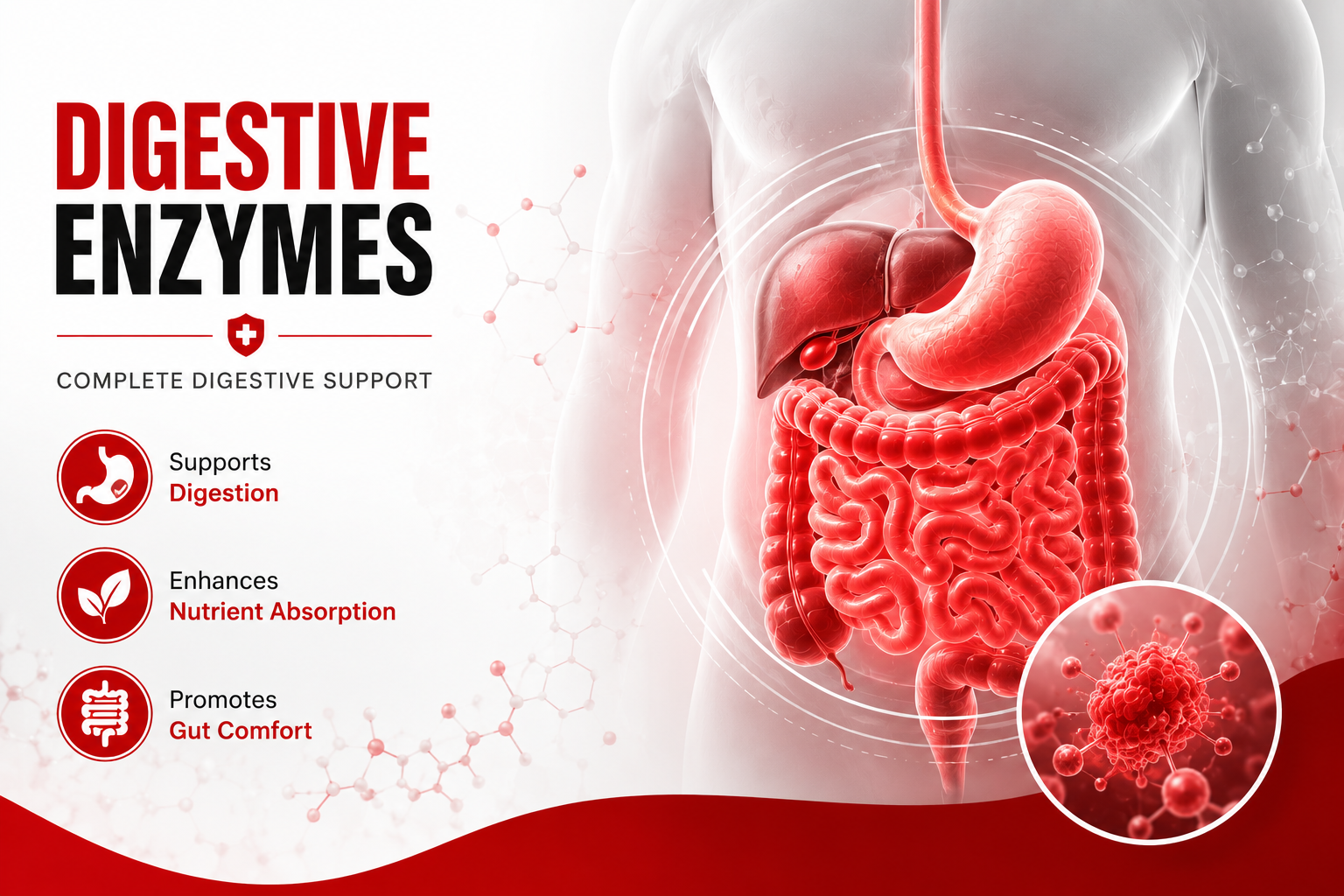
Digestion starts in your mouth (chewing turns on amylase), continues in your stomach (acidic environment, proteases in overdrive) and is pretty well finished in your small intestine, where your pancreas releases most of its enzyme arsenal.
So Why Do People Take Digestive Enzymes Supplements At All?
Fair question. If your body already makes Digestive Enzymes, why is there a whole aisle dedicated to replacing them?
Because production isn’t fixed. It drops for specific, identifiable reasons, and the symptoms that follow are pretty predictable.
Pancreatic insufficiency is the clear medical case. Chronic pancreatitis, cystic fibrosis, pancreatic cancer — these can tank the pancreas’s enzyme output significantly. Doctors usually confirm it with a stool test measuring an enzyme called elastase, and treatment is prescription-strength pancreatic enzyme replacement, not the capsules sitting next to the protein powder at the pharmacy.
Age plays a role too, mostly through declining lactase. It’s a big part of why lactose sensitivity tends to show up later in life instead of being something you’re born with.
Certain gut conditions — IBS, celiac disease, some inflammatory bowel diseases — can mess with enzyme function even when the pancreas itself is fine.
And surgery matters. Gallbladder removal, bariatric procedures, some pancreatic surgeries — all of these change how enzymes and bile actually reach your food.
If none of that applies to you, digestion is probably working the way it’s supposed to. Worth sitting with that before assuming a supplement is the fix for the bloating you got from eating too fast at lunch.
Do the Digestive Enzymes Supplements Actually Work?
Depends entirely on what you’re dealing with, and the evidence isn’t uniform across the board — despite what the marketing copy implies.
For diagnosed pancreatic insufficiency, prescription enzyme replacement has solid clinical backing. This isn’t fringe stuff. It’s standard gastroenterology.
There is decent evidence for lactase supplements that reduce symptoms when taken with dairy for lactose intolerance. And for that very reason dietitians commonly recommend them.
For general, no-known-cause bloating? The evidence for over-the-counter blends gets thinner. Some individuals swear by them. Controlled studies on the general population tend to show smaller, messier effects than the bottle suggests.
That gap between anecdotal experience and what happens in trials is something to think hard about – not as proof that Digestive Enzymes don’t work, but as a reason to keep your expectations realistic. A lot of people feel a tremendous difference especially with fatty meals or products that have always been a concern . Just don’t anticipate a miracle because a label included the words “clinically studied.”
The Main Types, and How They Differ
Not every enzyme supplement is built the same way.
Animal-derived Digestive Enzymes, usually from pig or cow pancreas, are the basis of prescription therapy and some OTC products. They closely mirror what your own pancreas makes, which is why they’re the standard for diagnosed insufficiency.
Plant-based Digestive Enzymes — bromelain from pineapple, papain from papaya — work across a wider pH range, meaning they stay active in both your acidic stomach and your more neutral small intestine. Common in vegetarian and vegan formulations.
Microbial Digestive Enzymes are common in modern products, made by fermentation using fungi or bacteria They are often promoted as broad spectrum, with amylase, protease, lipase and sometimes lactase all in one capsule.
| Type | Source | Best For | Watch Out For |
|---|---|---|---|
| Animal-derived (pancreatin) | Pig or cow pancreas | Diagnosed pancreatic insufficiency | Needs medical oversight at prescription strength |
| Lactase | Fungal fermentation | Lactose intolerance | Take right before the dairy, not after |
| Bromelain / papain | Pineapple, papaya | Protein digestion | Broad pH range, plant-based |
| Microbial blends | Bacteria/fungi | General digestive support | Enzyme units vary wildly between brands |
| Betaine HCl | Synthesized | Low stomach acid | Not technically an enzyme; different mechanism |
Reading a Label Without Getting Fooled
If you’re going to try one, this is what actually matters on the bottle.
If you’re going to sample one, this is what genuinely important on the bottle.
Look at activity units, not milligrams 500mg protease” tells you almost nothing about how active it is. You want standardized units – HUT for protease, DU for amylase, FIP or LU for lipase. Weight is only a marketing figure, not a functioning quantity.
Match the formula to your actual problem. Broad-spectrum makes sense if you’re not sure what’s causing symptoms. Lactase-specific makes more sense if dairy is your known trigger and nothing else is.
Check for third-party testing — NSF, USP, or Informed Choice. Supplements are loosely regulated, and label accuracy isn’t guaranteed without independent verification.
Pay attention to timing. Most Digestive Enzymes need to be taken right before or with a meal. Taking them afterward defeats the point.
And skip the products stuffed with extra herbs, probiotics, and proprietary blends that dilute the actual enzyme dose. If you can’t tell how much of the active ingredient you’re getting, that’s a red flag, not a bonus.
Mistakes People Make Constantly
Taking the capsule after the meal instead of before it. Digestive Enzymes need to be present when food shows up — after the fact, they’re mostly useless.
Assuming a bigger dose means better results. It doesn’t, and high doses of some Digestive Enzymes, protease especially, can occasionally cause their own irritation in sensitive people.
Using Digestive Enzymes to paper over something that needs an actual diagnosis. If bloating or pain keeps coming back and a supplement is just managing it rather than solving it, that’s not success — that’s a sign to see a doctor.
Ignoring the basics. Eating too fast, not chewing enough, eating well past comfortable fullness — these produce symptoms that look a lot like enzyme insufficiency, and no capsule fixes bad habits.
When This Stops Being a Supplement Question
Occasional bloating after a big meal? Normal, not worth worrying about. These aren’t:
- Unexplained weight loss alongside digestive symptoms
- Abdominal pain that’s persistent and getting worse
- Oily, floating, or unusually foul-smelling stools — a possible sign of fat malabsorption
- Symptoms that started suddenly and just haven’t gone away
- A family history of pancreatic or digestive disease plus new symptoms of your own
Any of those, and it’s time for an actual doctor’s visit, not another bottle off the shelf. They can point toward something like pancreatic insufficiency that genuinely needs diagnosis and prescription treatment.
Do digestive enzymes help with weight loss?
Not directly. Their job is breaking food down for absorption, not burning calories. Any weight-related effect would come from reduced bloating making eating more comfortable, not some metabolic boost.
Is it safe to take them every day?
For most healthy adults, occasional or regular use of a standard OTC formula is generally low-risk. Long-term daily use is worth a quick chat with a doctor, especially if you’re on other medications.
What’s the difference between enzymes and probiotics?
Digestive Enzymes break food down. Probiotics are live organisms that support your gut’s bacterial balance. Different jobs entirely, sometimes bundled together, but you don’t automatically need both.
Can I just get enzymes from food?
Pineapple, papaya, mango, and fermented foods like kimchi contain natural enzymes or support enzyme activity, but the amounts are much smaller than what’s in a concentrated supplement.
Do they actually help with gas and bloating?
For lactose intolerance or a known food trigger, often yes. For general, unexplained bloating, results are more mixed, and other causes — eating habits, underlying conditions — deserve a look too.
Is it harmful to take them if I don’t need them?
For most healthy people, occasional use when it isn’t strictly necessary is unlikely to cause harm. It’s also unlikely to do much, since your own enzymes are probably already handling things fine.
How fast do they work?
Because they act on the meal you take them with, a lot of people notice something within that meal or shortly after — much faster than supplements that need weeks to show an effect.
Can kids take these?
That’s a pediatrician conversation, not a shelf decision — especially for conditions like cystic fibrosis where prescription enzymes are standard care.
Are plant-based enzymes better than animal-derived ones?
Not better or worse, just different. Plant-based ones work across a wider pH range. Animal-derived ones more closely match what your pancreas naturally produces.
What foods are hardest to digest without enough enzymes?
High-fat meals, dairy if you’re lactase-deficient, and large protein portions come up most often, since fat and protein digestion lean heavily on pancreatic enzyme output.
Where That Leaves You
For people with a real, diagnosed insufficiency, digestive enzymes aren’t optional — they’re established medical treatment. For everyone else dealing with occasional discomfort, supplements might help, might not do much, and are worth trying with reasonable expectations rather than as a guaranteed cure. Before reaching for a bottle, it’s worth actually noticing what triggers your symptoms. And if the pattern doesn’t add up, a doctor’s visit will tell you more than another label ever will.
This article is educational, not medical advice. If digestive symptoms are persistent or concerning, talk to a healthcare provider who can evaluate your specific situation.