
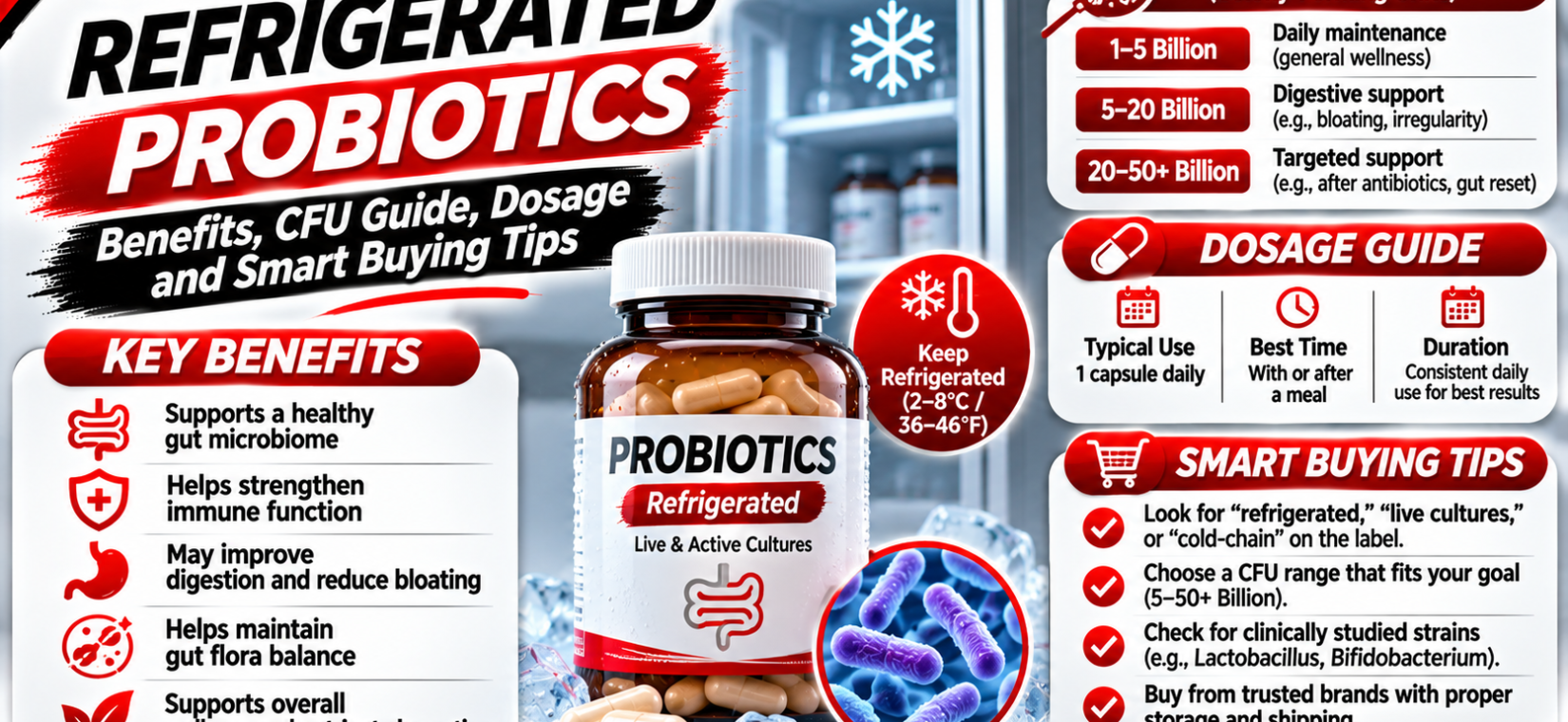
Refrigerated probiotics are live beneficial bacteria products that must be kept cold (2–8°C / 35–46°F) to preserve potency through their expiration date. Refrigerated probiotics typically deliver 10–50 billion CFU per serving across named strains, and the cold chain protects fragile strains that lose viability at room temperature.
Refrigerated Probiotics: Quick Answer
Do refrigerated probiotics work better than shelf-stable ones? For many strains, yes — and the reason is viability. Probiotics only work if the bacteria are alive when they reach your gut. Heat and moisture kill them. Refrigerated probiotics stay in a cold chain from factory to your fridge, so the CFU count printed on the label is far more likely to match what is actually in the capsule at the time you take it.
What Are Refrigerated Probiotics?
Refrigerated probiotics are supplements containing live microorganisms — mostly Lactobacillus and Bifidobacterium species — that are formulated and shipped to be stored in the refrigerator. According to the NIH Office of Dietary Supplements probiotics fact sheet, probiotics are defined as live microorganisms that, when administered in adequate amounts, confer a health benefit on the host. That word “live” is doing all the work: dead bacteria do not colonize or meaningfully interact with your gut.
A quality refrigerated probiotic lists each strain by its full scientific name, including the strain designation — for example, Lactobacillus acidophilus NCFM or Bifidobacterium lactis Bi-07. This matters because benefits are strain-specific: one strain may have clinical evidence for reducing antibiotic-associated diarrhea while a closely related strain has none. Products that list only “Lactobacillus blend” without strain IDs are a red flag.
Why Do Some Probiotics Need Refrigeration?
Many probiotic strains are sensitive to heat, humidity and oxygen. At room temperature, fragile strains like Lactobacillus rhamnosus GG can lose 1–2 log units of viability (90–99% of live cells) within months, meaning a 25-billion-CFU capsule might deliver under 1 billion live cells by the time you take it. Refrigeration at 2–8°C slows bacterial metabolism dramatically, preserving viability for 12–24 months.
Shelf-stable probiotics solve this differently: they use hardier spore-forming strains (like Bacillus coagulans), freeze-dried cultures with protective coatings, or desiccant-packed blister packaging. These are legitimate products, but they limit which strains a formula can include. Refrigerated probiotics can use the widest range of clinically studied strains precisely because the cold chain does the preserving.
The trade-off is logistics. Refrigerated probiotics cost more to ship (cold packs, expedited delivery), cannot sit in a hot mailbox, and are a poor choice for travel. If you buy them, plan to get them into your fridge within hours of delivery. More evidence-based explainers live in our nutrition section.
Step-by-Step Guide to Using Refrigerated Probiotics
Step 1: Choose the right strains for your goal
- General gut health: multi-strain formulas with L. acidophilus, B. lactis and L. plantarum
- Antibiotic-associated diarrhea: Saccharomyces boulardii or L. rhamnosus GG have the strongest evidence
- IBS-type symptoms: Bifidobacterium infantis 35624 is the most studied single strain
- Immune support: L. casei DN-114 001 and B. lactis Bi-07
Step 2: Verify the label before buying
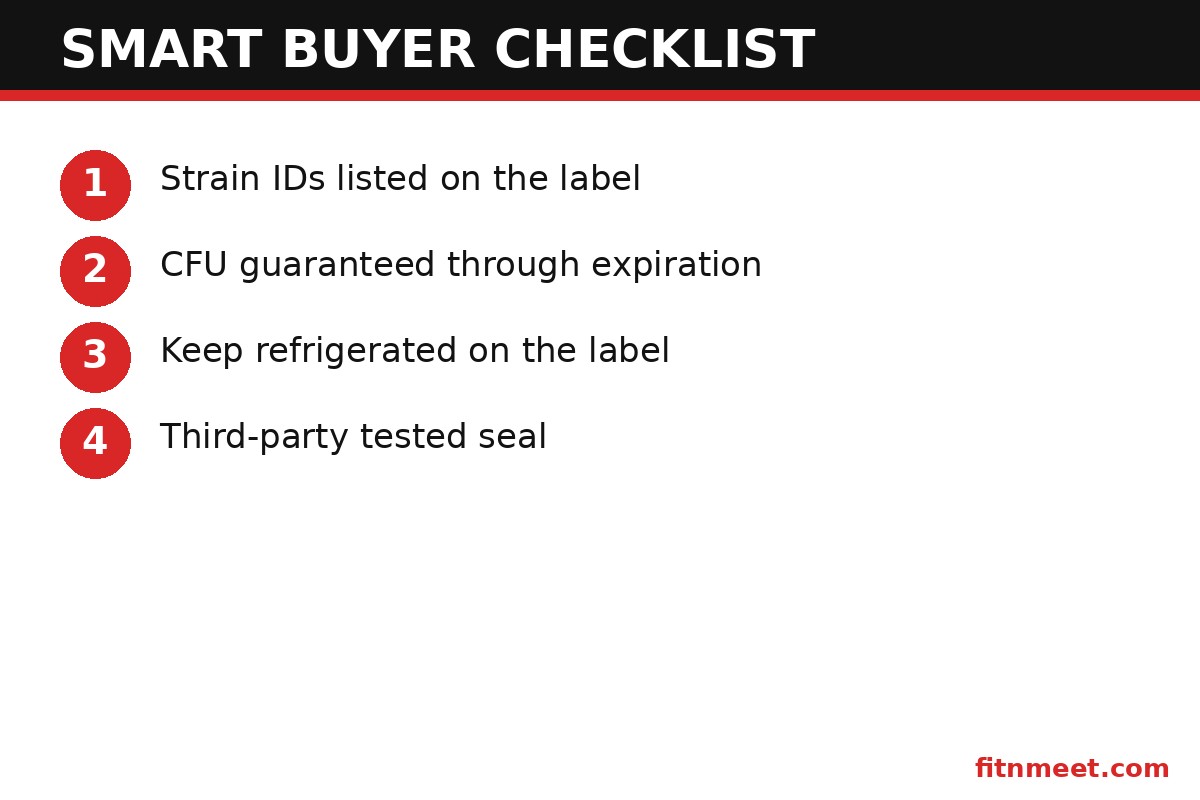
- Full strain IDs printed (genus, species, strain code)
- CFU count guaranteed through the expiration date, not just at manufacture
- “Keep refrigerated” storage instructions
- Expiration date at least 6 months out
- Third-party testing seal (NSF, USP or equivalent)
Step 3: Protect the cold chain
- Order from retailers that ship with cold packs in insulated packaging
- Track delivery and refrigerate within 2–4 hours of arrival
- Store at 2–8°C (35–46°F) — the main compartment, not the door where temperatures swing
- Never freeze probiotics unless the label specifically allows it
Step 4: Take them consistently
- Take at the same time daily — morning with breakfast works for most people
- Most strains survive stomach acid adequately with food; follow label directions
- Allow 2–4 weeks of daily use before judging results; gut ecology shifts slowly
- Keep taking them through the full course of antibiotics, then for 1–2 weeks after

Refrigerated Probiotics Dosage Guide
Probiotic “dosage” is measured in CFU — colony-forming units, meaning viable bacterial cells. Common daily doses in refrigerated probiotics range from 10 billion to 50 billion CFU, with clinical trials using anywhere from 1 billion to 100 billion depending on the strain and condition. More is not automatically better: a 10-billion-CFU product with the right clinically studied strain beats a 100-billion-CFU generic blend.
For general digestive wellness, 10–25 billion CFU daily from a multi-strain refrigerated probiotic is the standard starting point. For antibiotic-associated diarrhea prevention, trials of S. boulardii typically use 250–500 mg daily (roughly 5–10 billion CFU). For IBS symptom support, B. infantis 35624 was studied at 100 million (1×10⁸) CFU daily — proof that the strain matters more than the raw number.
Start at the label’s suggested serving for two weeks. If you tolerate it well, stay there — there is rarely a reason to double the dose. People with compromised immune systems, central lines, or serious illness should consult a physician before using any probiotic, refrigerated or otherwise.
Your Probiotic Shopping List
Stocking up for gut health? Pair your refrigerated probiotics with foundational nutrition from FitnMeet: browse the vitamins collection and the health support category, or start at the FitnMeet shop.
Benefits of Refrigerated Probiotics
- Higher viable CFU at consumption: The cold chain preserves live cells, so label claims hold up better than in heat-exposed products.
- Access to fragile, well-studied strains: Many of the most clinically researched strains require refrigeration.
- Digestive regularity: Meta-analyses link multi-strain probiotics to improved stool consistency and reduced bloating in functional gut disorders.
- Antibiotic-associated diarrhea prevention: S. boulardii and L. rhamnosus GG reduce risk by roughly 40–50% in pooled trial data.
- Immune support: Around 70% of immune tissue resides in gut-associated lymphoid tissue; certain strains modestly reduce the duration of upper respiratory infections.
- Vaginal and urinary health: L. rhamnosus GR-1 and L. reuteri RC-14 are studied for urogenital health.
- Skin and allergy links: Early evidence suggests specific strains may ease eczema symptoms in children, though results are mixed.
7 Mistakes to Avoid
- Leaving them on the counter. A week at room temperature can slash viable CFU in fragile strains. Fridge, always.
- Buying by CFU count alone. 100 billion CFU of unstudied strains loses to 10 billion of a clinically validated one.
- Expecting overnight results. Most trials run 4–12 weeks. Give any refrigerated probiotic at least 2–4 weeks.
- Taking them with hot drinks. Heat above ~45°C (113°F) kills live cultures. Lukewarm water or food is fine.
- Ignoring the expiration date. Viability declines over time even refrigerated. Do not stockpile past the date.
- Using one product for every condition. Match the strain to the goal — there is no universal probiotic.
- Skipping prebiotic fiber. Beneficial bacteria need fuel. Feed them with fiber from vegetables, oats and legumes, or they will not thrive.
Refrigerated vs Shelf-Stable Probiotics
| Feature | Refrigerated | Shelf-Stable |
|---|---|---|
| Strain options | Widest — includes fragile strains | Limited to hardy or spore-forming strains |
| CFU reliability | Highest when cold chain is kept | Good with blister packs and desiccants |
| Travel friendly | No — needs a cooler | Yes |
| Cost | Higher (cold shipping) | Lower |
| Best for | Targeted clinical strains | Daily general use, travel |
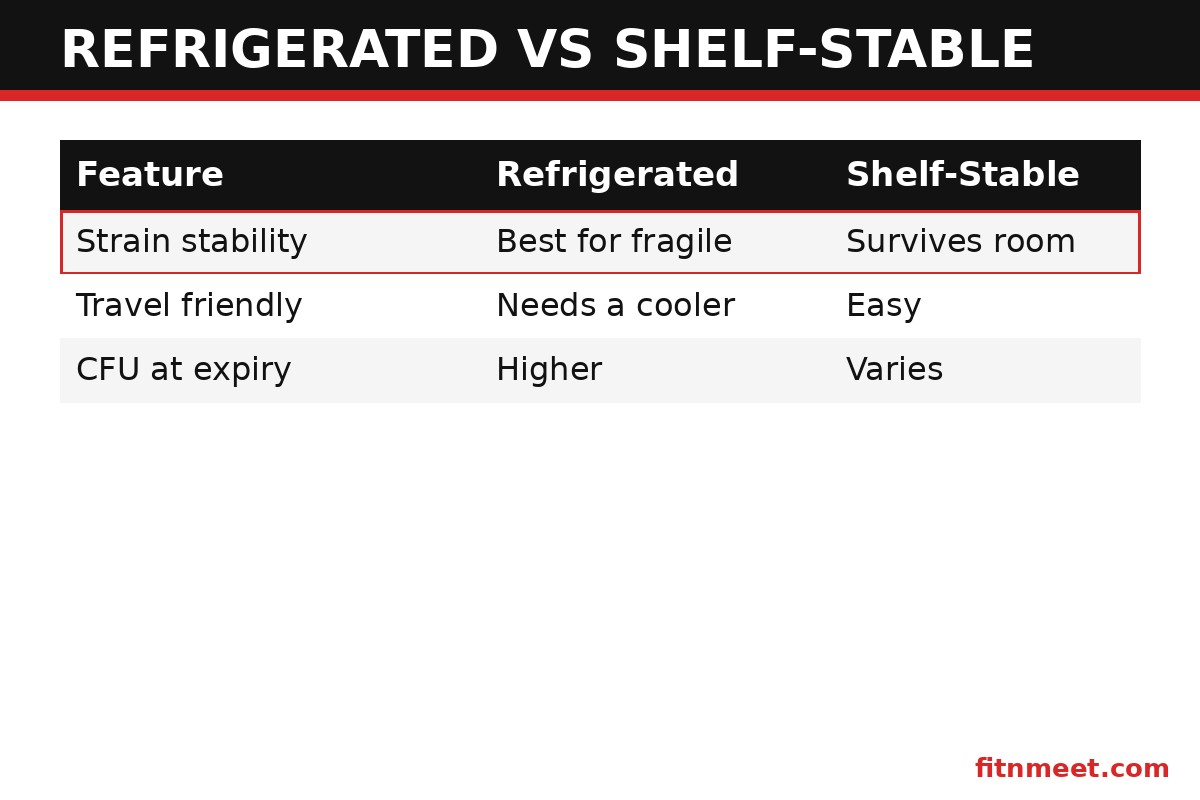
Neither type is universally superior. Choose refrigerated probiotics when you want specific clinically studied strains at reliable potency, and shelf-stable for convenience and travel. Background reading: Wikipedia’s probiotic overview covers mechanisms and the state of the evidence.
Side Effects and Safety
Refrigerated probiotics are well tolerated by healthy adults. The most common side effects are mild and temporary: gas, bloating or mild digestive rumbling during the first 3–7 days as gut ecology adjusts. Starting with half the label dose for a week, then increasing, minimizes this.
Serious risks are rare but real for specific groups. People with severely compromised immunity, critical illness, or central venous catheters have developed bloodstream infections from probiotic strains in case reports. If you are immunocompromised, have short bowel syndrome, or are critically ill, do not use probiotics without direct medical supervision.
Quality matters for safety too. Because the FDA regulates probiotics as dietary supplements (not drugs), manufacturing quality varies. Choose refrigerated probiotics from makers with third-party testing and transparent strain labeling — the cold chain preserves potency, but only good manufacturing ensures what is on the label is in the bottle.
Frequently Asked Questions
Do refrigerated probiotics work better than shelf-stable ones?
Often yes for potency. Refrigerated probiotics keep fragile, clinically studied strains viable through the expiration date via the cold chain. Shelf-stable products use hardier strains and protective packaging and are legitimate, but they cannot include every strain. Match the product type to your goal.
How many CFU should refrigerated probiotics have?
Most refrigerated probiotics provide 10 to 50 billion CFU per serving, which covers the doses used in most clinical trials. Strain identity matters more than the raw number — 10 billion CFU of a studied strain beats 100 billion of an unstudied blend.
What happens if refrigerated probiotics get warm?
Brief warmth during shipping is expected and usually fine if cold packs are used. But days at room temperature can kill 90 percent or more of fragile strains. If your refrigerated probiotics arrived warm with no cold pack, contact the seller rather than assuming they are fine.
How long do refrigerated probiotics last?
Typically 12 to 24 months from manufacture when kept at 2 to 8 degrees C (35 to 46 degrees F). Always follow the expiration date — viability declines over time even under ideal refrigeration.
Should I take refrigerated probiotics with food?
Taking them with breakfast or a light meal is fine for most products and may buffer stomach acid. Follow the label — a few strains are studied on an empty stomach. Avoid taking them with very hot food or drinks above about 45 degrees C.
Can I travel with refrigerated probiotics?
For trips under a day, an insulated pouch with a small ice pack works. For longer travel, switch to a shelf-stable probiotic temporarily rather than letting refrigerated probiotics sit warm for days.
Traveling With Refrigerated Probiotics: Keeping Cultures Alive
Taking refrigerated probiotics on the road requires a plan, because heat is the enemy of live cultures. For flights, pack the bottle in your carry-on — never checked luggage, where cargo holds can swing to extreme temperatures — inside an insulated pouch with a small gel ice pack; TSA allows gel packs for medications and supplements. Most quality refrigerated probiotics tolerate room temperature for several days during transit without meaningful potency loss, so a travel day without ice is not a disaster — it is a week on a sunny dashboard that kills them. At your destination, refrigerate immediately and keep the bottle away from the mini-fridge’s freezer compartment. For camping or destinations without reliable refrigeration, consider switching temporarily to a shelf-stable spore-forming formula rather than gambling your premium refrigerated bottle. And keep the desiccant in the bottle: moisture degrades probiotics faster than brief warmth, so always reseal tightly and never transfer capsules to an unsealed pill organizer for the trip.
Conclusion
Refrigerated probiotics are the precision option: cold-chain storage preserves the fragile, well-studied strains that shelf-stable formulas often cannot include. Choose by strain (not CFU hype), protect the cold chain from doorstep to fridge, take them daily for at least a month, and feed them with fiber. That is the complete formula.
Building a full gut-health routine? Explore FitnMeet’s health articles and shop the health support collection for complementary nutrition.
This article is for informational purposes only and is not medical advice. Consult a healthcare professional before starting any supplement.