
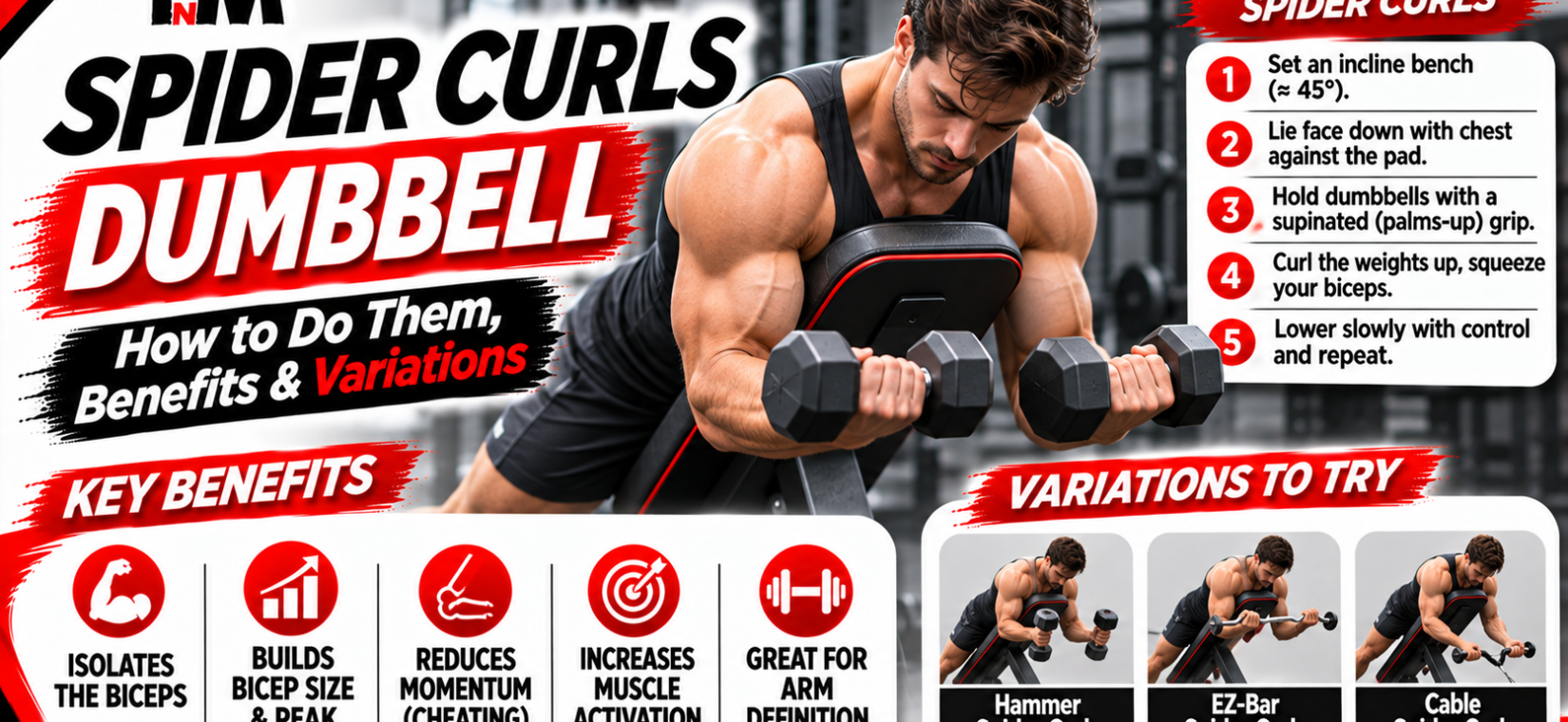
Spider curls dumbbell describes spider curls performed with dumbbells while lying chest-down on an incline bench. The prone position eliminates momentum and keeps the biceps under constant tension through the full range. Use lighter weights than standard curls, control the negative, and squeeze hard at the top for maximum bicep isolation.
Quick Verdict
✅ Our pick if: you want strict, momentum-free biceps work with a deep stretch. The spider curls dumbbell setup is one of the best curl variations for lifters who cheat their reps, because the bench physically prevents swinging.
⛔ Skip if: you have shoulder impingement that flares with arms hanging in front of the body, or you train in a gym without an adjustable bench. Standard standing curls will serve you better until then.
What Are Spider Curls?
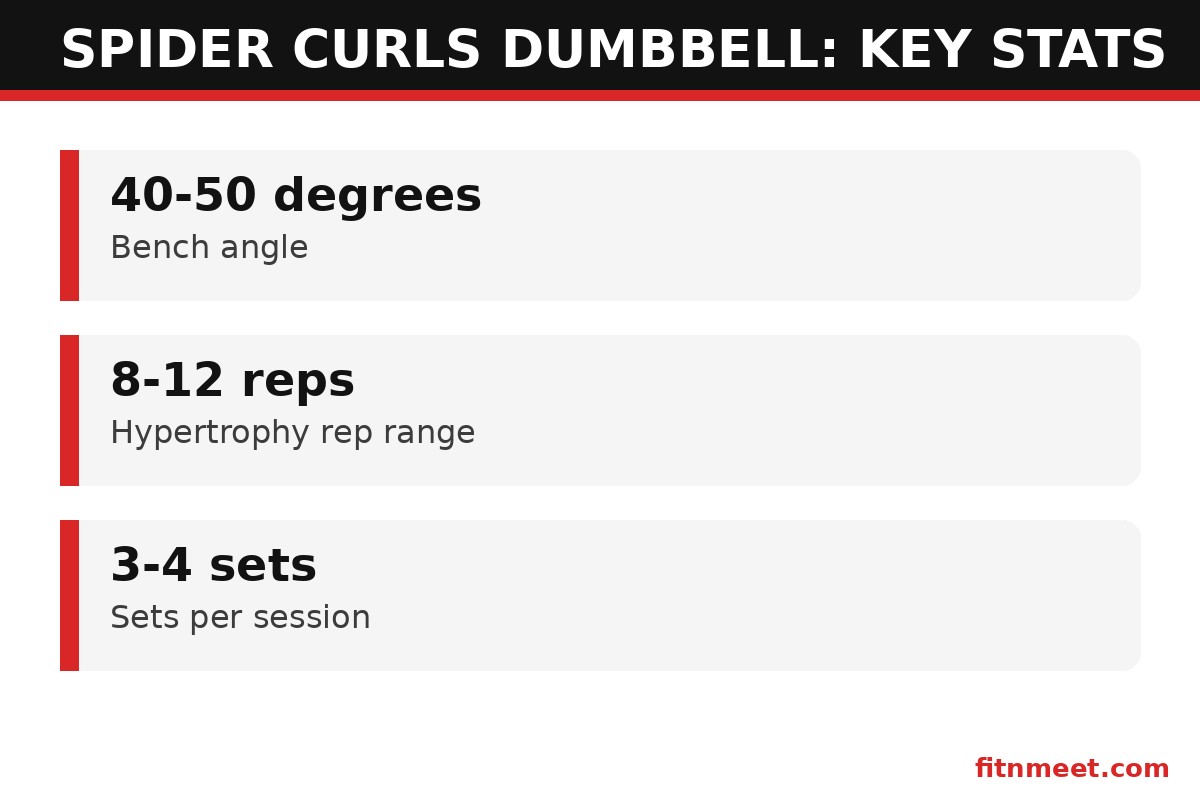
Spider curls are performed lying chest-down on an incline bench — typically set to 40–50 degrees — with your arms hanging perpendicular to the floor. The name comes from the look: from the side, your splayed arms resemble spider legs. The spider curls dumbbell version uses a dumbbell in each hand, which allows a natural wrist rotation (supination) and independent arm work that a barbell cannot provide.
The biomechanics are what make the spider curls dumbbell exercise special. With your upper arms fixed against gravity in front of your torso, the biceps work hardest in the shortened position (the top of the curl), while the hanging start position gives a loaded stretch most curl variations lack. This combination of stretch plus peak contraction is exactly what hypertrophy research points to: a 2023 body of evidence suggests muscles grow best when trained through a full range of motion with tension at long muscle lengths — and the spider curls dumbbell setup delivers both ends of the range.
The biceps brachii has two heads: the long head (outer) and the short head (inner). Because the shoulder is slightly flexed in the spider position, the long head is put on slack, shifting more work to the short head — the part of the biceps that creates width and the coveted “peak” from the front. Read the anatomy background on Wikipedia’s biceps page.
How to perform the spider curls dumbbell exercise
- Set an adjustable bench to 45 degrees and lie chest-down on it, chin just above the top pad.
- Hold a dumbbell in each hand with an underhand grip, arms hanging straight down, palms facing forward.
- Keeping your upper arms still, curl both dumbbells up toward your shoulders, squeezing hard for 1 second at the top.
- Lower slowly over 3 seconds until your arms are fully extended — feel the stretch, do not just drop the weight.
- Repeat for 8–12 reps. Rest 60–90 seconds between sets.
Head-to-Head Comparisons
Spider curls dumbbell vs other curl variations
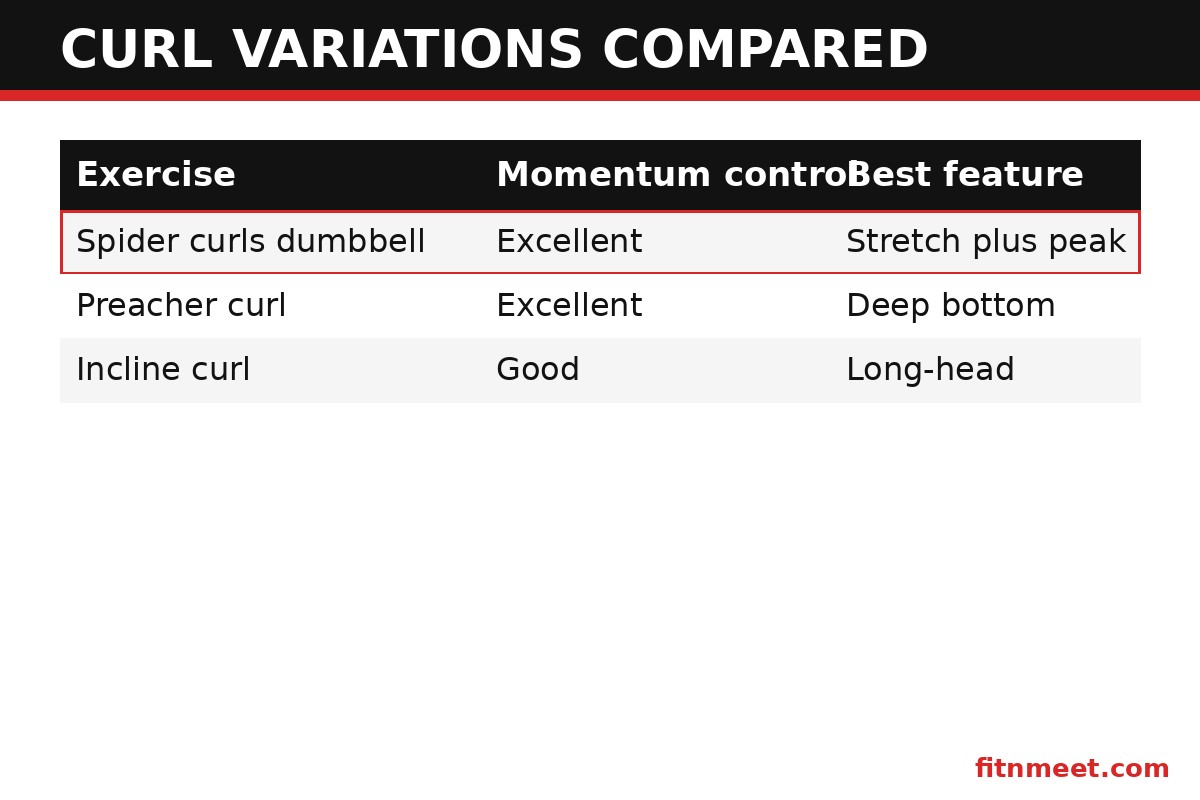
| Exercise | Momentum control | Stretch at bottom | Peak contraction | Primary head targeted |
|---|---|---|---|---|
| Spider curls dumbbell | Excellent (chest-supported) | Deep | Very strong | Short head |
| Preacher curl | Excellent (pad-supported) | Very deep | Weak (tension drops at top) | Short head |
| Incline dumbbell curl | Good (seated, braced) | Deepest | Weak | Long head |
| Standing barbell curl | Poor (easy to swing) | Moderate | Moderate | Both |
| Concentration curl | Excellent | Moderate | Very strong | Short head |
Implement choice for spider curls
| Implement | Unilateral option | Wrist freedom | Loading potential | Verdict |
|---|---|---|---|---|
| Dumbbells | Yes | Full supination | Moderate | Best all-rounder for spider curls |
| EZ-bar | No | Semi-pronated (easier on wrists) | High | Good if wrists ache with straight supination |
| Cable | Yes | Full | Moderate | Constant tension, but setup is awkward prone |
| Kettlebells | Yes | Full | Low–moderate | Works in a pinch; handle shifts the balance |
Programming comparison: where spider curls fit in an arm day
| Slot in workout | Exercise choice | Sets × reps | Purpose |
|---|---|---|---|
| 1st (heavy) | Standing barbell curl | 4 × 6–8 | Overload the biceps with maximum weight |
| 2nd (strict) | Spider curls dumbbell | 3 × 8–12 | Strict hypertrophy work, deep stretch + peak squeeze |
| 3rd (finisher) | Hammer curl | 2–3 × 12–15 | Brachialis/brachioradialis, elbow health |
The spider curls dumbbell exercise shines in the middle slot: after heavy work has fatigued the muscle, strict chest-supported reps force the biceps to do all the work with zero help from momentum. For more programming ideas, browse the FitnMeet strength training articles.
Benefits of the Spider Curls Dumbbell Exercise
| Benefit | Detail |
|---|---|
| Zero cheating | The bench locks your torso in place. Every rep of the spider curls dumbbell exercise is strict — studies link strict form to better hypertrophy per unit of volume than sloppy reps. |
| Loaded stretch | Arms hang fully extended under load at the bottom. Training at long muscle lengths is associated with superior growth versus partial ranges. |
| Peak contraction | Unlike preacher curls, where tension vanishes at the top, the spider curls dumbbell position keeps the biceps loaded through the squeeze — train both ends of the strength curve. |
| Short-head emphasis | Shoulder flexion puts the long head on slack, biasing the short head — the head responsible for front-view biceps width. |
| Joint-friendly | Dumbbells allow natural wrist rotation, reducing the elbow and wrist strain some lifters feel with fixed bars. A typical spider curls dumbbell session uses 60–70% of your standing curl weight — lighter loads, stricter stimulus. |
| Mind-muscle connection | Chest support removes balance demands, letting you focus entirely on the biceps. Lifters typically report the strongest biceps pump of any curl variation from this one. |
How to Choose: Is the Spider Curls Dumbbell Variation Right for You?
Work through these decision questions in order:
- Can you currently curl without swinging? If your standing curls turn into full-body heaves, the spider curls dumbbell setup is the fix — the bench makes cheating physically impossible. → Choose spider curls.
- Do you have access to an adjustable bench? The spider curls dumbbell exercise needs a bench set to 40–50°. No bench? Do concentration curls or preacher curls instead until you have one. → No bench = pick another variation.
- Is your goal biceps width or peak? For width and front-view thickness, the short-head bias of the spider curls dumbbell exercise is ideal. For peak height, add incline curls (long-head bias) alongside. → Width = spider curls; peak = incline curls; both = do both.
- Do your wrists or elbows hurt with supinated curls? Try the spider curls dumbbell version with a neutral-to-supinated rotation first — dumbbells are kinder than bars. If pain persists, switch to EZ-bar spider curls or hammer curls and see a professional. → Pain = modify or skip.
- Where are you in your workout? The spider curls dumbbell exercise works best as a second biceps movement after a heavy compound curl, when the muscle is warm but not destroyed. → Program it mid-arm-day.
Programming: Sets, Reps and Progression
Treat the spider curls dumbbell exercise as a hypertrophy movement, not a strength lift. The strict setup means lighter weights and higher reps work best:
| Goal | Sets | Reps | Load | Rest | Tempo |
|---|---|---|---|---|---|
| Hypertrophy (standard) | 3–4 | 8–12 | RPE 8–9 (1–2 reps in reserve) | 60–90 s | 3-0-1-1 |
| Metabolic pump finisher | 2 | 15–20 | Light (RPE 7) | 45 s | 2-0-1-0 |
| Strength-hypertrophy mix | 4 | 6–8 | Heavy strict (RPE 9) | 2 min | 3-0-1-1 |
Progress the spider curls dumbbell exercise with double progression: when you hit the top of the rep range on all sets with good form, increase each dumbbell by the smallest available increment (1–2.5 kg) and rebuild. Because the movement is so strict, expect your spider curls dumbbell weights to sit at roughly 60–70% of your standing dumbbell curl — that is normal, not a weakness. Train biceps twice per week with at least 48 hours between sessions for optimal growth.
Spider Curls Dumbbell: Advanced Techniques
Once the basic spider curls dumbbell form is dialed in, these intensifiers take the stimulus further. First, try the 1.5-rep method: curl all the way up, lower halfway, curl back up, then lower fully — that is one rep. This doubles the time spent in the hardest mid-range of the movement and creates a pump that standard reps rarely match. Second, experiment with offset loading: perform the set one arm at a time while the other arm holds the top contracted position isometrically. The isometric hold floods the biceps with blood while the working arm does the reps, and alternating sides extends the set without rest.
A third option is the mechanical drop set. Start your set with the bench at 45 degrees and curl to near-failure, then immediately raise the bench to 60 degrees — the more upright torso angle shortens the lever arm slightly, letting you squeeze out another 4–6 reps with the same dumbbells. Because the chest-supported setup already enforces strict form, these techniques add intensity without adding joint stress, making them safer than cheating out extra reps on standing curls. Use intensifiers sparingly: one technique per session, on your final set only, is plenty.
Safety and Form Cues
The spider curls dumbbell exercise is inherently safe — the supported position protects the lower back completely — but keep these cues in mind:
- Do not hyperextend the elbows at the bottom. Stop just short of lockout to keep tension on the biceps and protect the joint.
- Keep the upper arms perpendicular to the floor. Letting them drift forward turns the movement into a front raise and unloads the biceps.
- Control the eccentric. A 3-second lowering phase on every spider curls dumbbell rep roughly doubles time under tension versus dropping the weight.
- Warm up the elbows. One light set of 15–20 reps before work sets prepares the tendons, especially if you train early in the morning.
- Stop for sharp pain. Muscle burn is fine; sharp elbow or shoulder pain is not. The general principles of safe lifting are covered well on Wikipedia’s strength training page.
Support your training with proper fuel — the muscle development collection and workout recovery range cover the nutrition side of arm growth.

This article is for informational purposes only and is not medical advice. Consult a healthcare professional before starting any supplement or exercise program.
Frequently Asked Questions
What is the spider curls dumbbell exercise?
The spider curls dumbbell exercise is a biceps curl performed face-down on an incline bench set to about 45 degrees, with arms hanging straight down. Using dumbbells allows natural wrist rotation and independent arm work while the bench eliminates momentum.
What muscles do spider curls dumbbell work?
The spider curls dumbbell variation primarily targets the biceps brachii, with emphasis on the short head, plus the brachialis underneath. The forearms assist as stabilizers.
Are spider curls dumbbell better than preacher curls?
They serve different purposes. The spider curls dumbbell exercise keeps tension at the top of the rep where preacher curls go slack, while preacher curls load the bottom stretch more. Many lifters use both in the same program.
How many sets and reps for spider curls dumbbell?
For muscle growth, do 3-4 sets of 8-12 reps with a 3-second lowering phase and 60-90 seconds rest. Expect to use about 60-70% of your normal standing curl weight because the strict form removes momentum.
What angle should the bench be for spider curls dumbbell?
Set the bench to 40-50 degrees, with 45 degrees the standard. Too flat and your arms hit the bench; too steep and it becomes a regular incline curl with less chest support.
Can beginners do the spider curls dumbbell exercise?
Yes – it is actually ideal for beginners because the bench enforces strict form from day one. Start with light dumbbells, master the 3-second lowering phase, and progress weight only when you can complete all reps cleanly.
Conclusion: The Comparison Winner
After comparing every major curl variation, the verdict is clear: the spider curls dumbbell exercise wins the “strict hypertrophy” category. No other curl combines a deep loaded stretch, constant tension through peak contraction, and total momentum elimination the way chest-supported dumbbell spider curls do. Pair them with a heavy standing curl for overload and a hammer curl for the brachialis, and your biceps programming is complete.
Ready to build bigger arms? Get training with gear and guidance from the FitnMeet shop, fuel growth with the muscle development collection, and keep learning in the FitnMeet blog.