
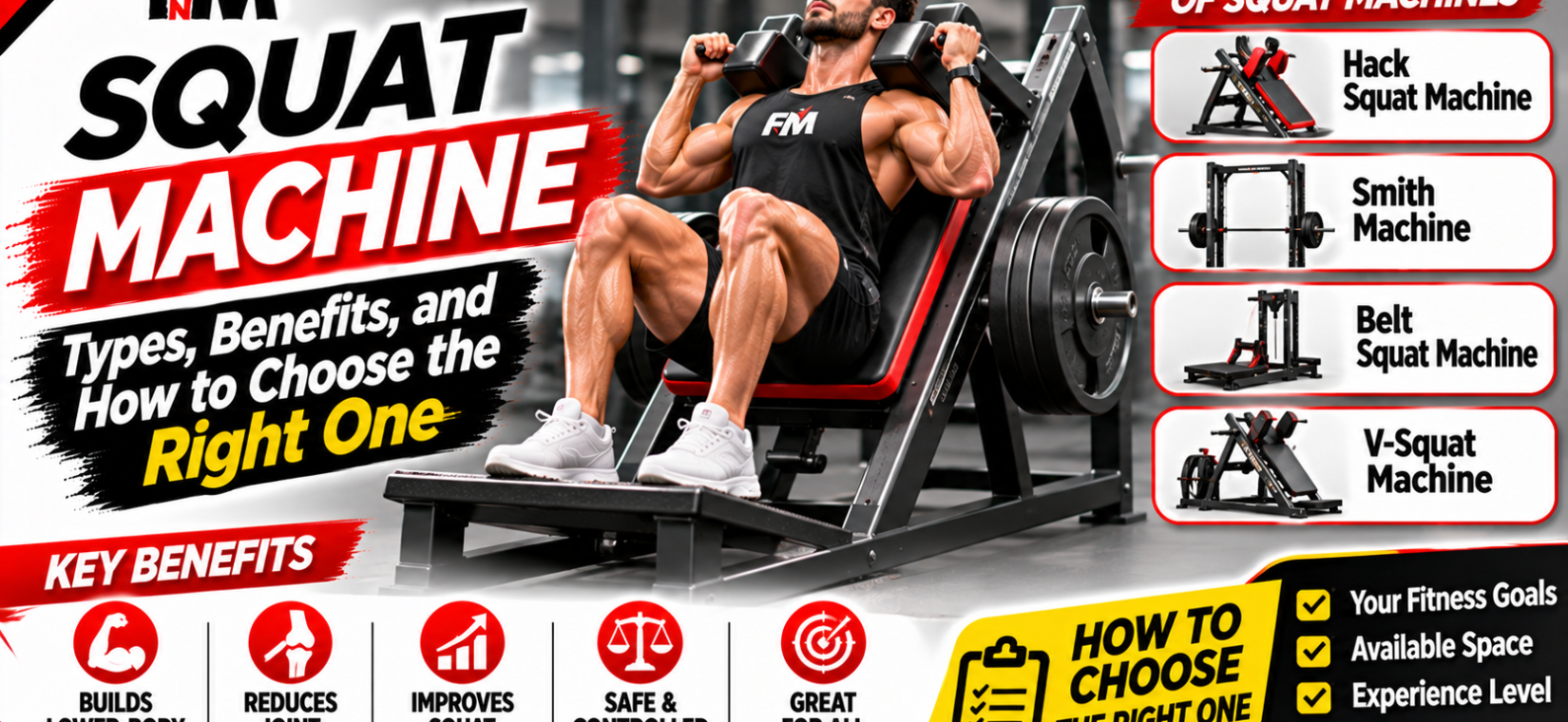
A squat machine is guided gym equipment that supports the squat movement along a fixed or assisted path, letting lifters train legs heavy with less balance demand than a barbell. The right squat machine depends on your goals: Smith machines suit general strength, hack squats target quads, and belt squats spare the spine.
Skip a squat machine if: you compete in powerlifting (you must practice the free barbell squat) or your space and budget only allow one piece — a power rack with a barbell covers more.
Squat Machine: Quick Verdict
A final note on cost per use: a quality squat machine typically lasts 15 to 20 years with basic maintenance, which makes even a $1,000 purchase work out to a few dollars per month over its life. Compare that to a commercial gym membership used mainly for leg day, and the machine often wins on economics alone — before counting the hours saved on commuting. Buy the best frame you can afford, maintain the moving parts, and the machine becomes the cheapest training partner you will ever have.
Short on time? Here is the decision in 30 seconds. A squat machine is worth buying if you train alone and want to push leg strength safely past failure, if joint issues make free-weight balance work painful, or if you want quad-focused volume without taxing your lower back. It is not worth buying if you are a competitive powerlifter, if you only have room for one major station, or if you simply prefer the skill and carryover of the free barbell squat. For everyone in the middle — the vast majority of home-gym lifters — the right machine is a genuine upgrade, not a crutch.
What Is a Squat Machine?
A squat machine is any piece of resistance equipment that guides or assists the squatting movement. Unlike a free barbell, which you must balance in three dimensions, a machine constrains the load to a set path — vertical on a Smith machine, angled on a hack squat, or hanging from a belt on a belt squat. That single change reshapes the exercise: less energy goes to stabilization, more goes to the prime movers, and the safety margin grows dramatically.
The three main families cover most of the market. The Smith machine is a barbell fixed in vertical steel rails with catch hooks every few inches; you rack and unrack by rotating the bar. The hack squat machine — named after early-1900s strongman George Hackenschmidt — puts you on an angled sled with shoulder pads, driving up along a 45-degree track that hammers the quadriceps. The belt squat machine hangs the load from a belt around your hips while you stand on platforms, loading the legs with almost zero spinal compression. Pendulum squats and leverage squat machines are newer variants that swing the load on an arc for a deep, knee-friendly quad stretch.
The barbell squat remains the king of lower-body training for good reason, but machines have earned their place. Research comparing the two is instructive: Schwanbeck and colleagues (2009, Journal of Strength and Conditioning Research) found that free-weight squats produced greater muscle activation than Smith machine squats across several lower-body muscles. The takeaway is not that machines are useless — it is that they are different tools: slightly less total muscle recruitment, but more targeted loading and far more safety when training alone.
Head-to-Head Squat Machine Comparisons
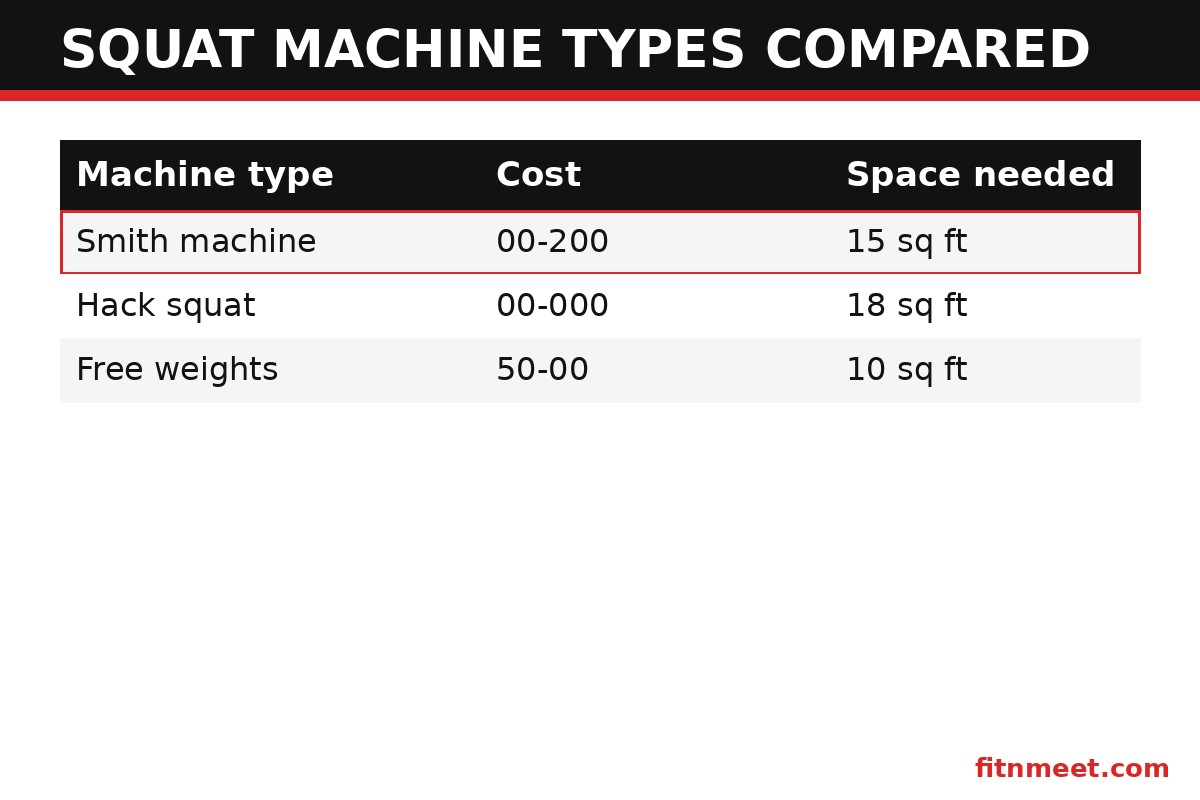
Table 1: Machine types at a glance
| Machine type | Typical cost | Footprint | Capacity | Primary target |
|---|---|---|---|---|
| Smith machine | $300–$1,200 | ~15 sq ft | 400–800 lb | Full lower body + pressing |
| Hack squat | $500–$2,000 | ~18 sq ft | 500–1,000 lb | Quadriceps |
| Belt squat | $400–$1,500 | ~12 sq ft | 400–700 lb | Legs, spine-friendly |
| Pendulum squat | $1,500–$4,000 | ~16 sq ft | 400–600 lb | Quads, deep stretch |
Table 2: Squat machine vs free-weight squat
| Factor | Squat machine | Free barbell squat |
|---|---|---|
| Balance demand | Low — guided path | High — full stabilization |
| Muscle activation | Targeted, slightly lower total | Higher total (Schwanbeck 2009) |
| Safety training alone | Excellent — built-in catches | Needs rack + safeties |
| Learning curve | Minutes | Weeks to months |
| Carryover to sport | Moderate | High |
| Joint friendliness | High — fixed mechanics | Depends on technique |
Table 3: Which machine for which lifter
| Your situation | Best squat machine | Why |
|---|---|---|
| Small home gym, one station | Smith machine | Squats + presses + rows in one frame |
| Quad development priority | Hack squat | Biomechanics isolate the quads |
| Back pain or herniation history | Belt squat | Near-zero spinal loading |
| Training alone, heavy | Any with safeties | Fail safely without a spotter |
Benefits of Training on a Squat Machine
- Push past failure safely: a squat machine with catch hooks or safeties lets you take sets to true muscular failure alone — the single biggest hypertrophy advantage over solo barbell work.
- Targeted muscle loading: hack and pendulum variants shift load onto the quads in ways a free squat cannot easily replicate, making them superb accessory lifts.
- Lower skill barrier: beginners can load a Smith machine productively in their first session, while a safe free squat takes weeks of coaching.
- Joint-friendly options: belt squats remove spinal compression entirely; fixed-path machines reduce shear forces for cranky knees.
- Consistent mechanics: every rep on a squat machine looks the same, which makes progressive overload clean and measurable.
- Rehab and return-to-training: guided loading lets injured lifters rebuild strength with controlled, repeatable stress.
How to Choose: Decision Steps
Work through these questions in order — your answers point to the right machine:
- What is your primary goal? General strength → Smith machine. Bigger quads → hack or pendulum squat. Pain-free leg training → belt squat.
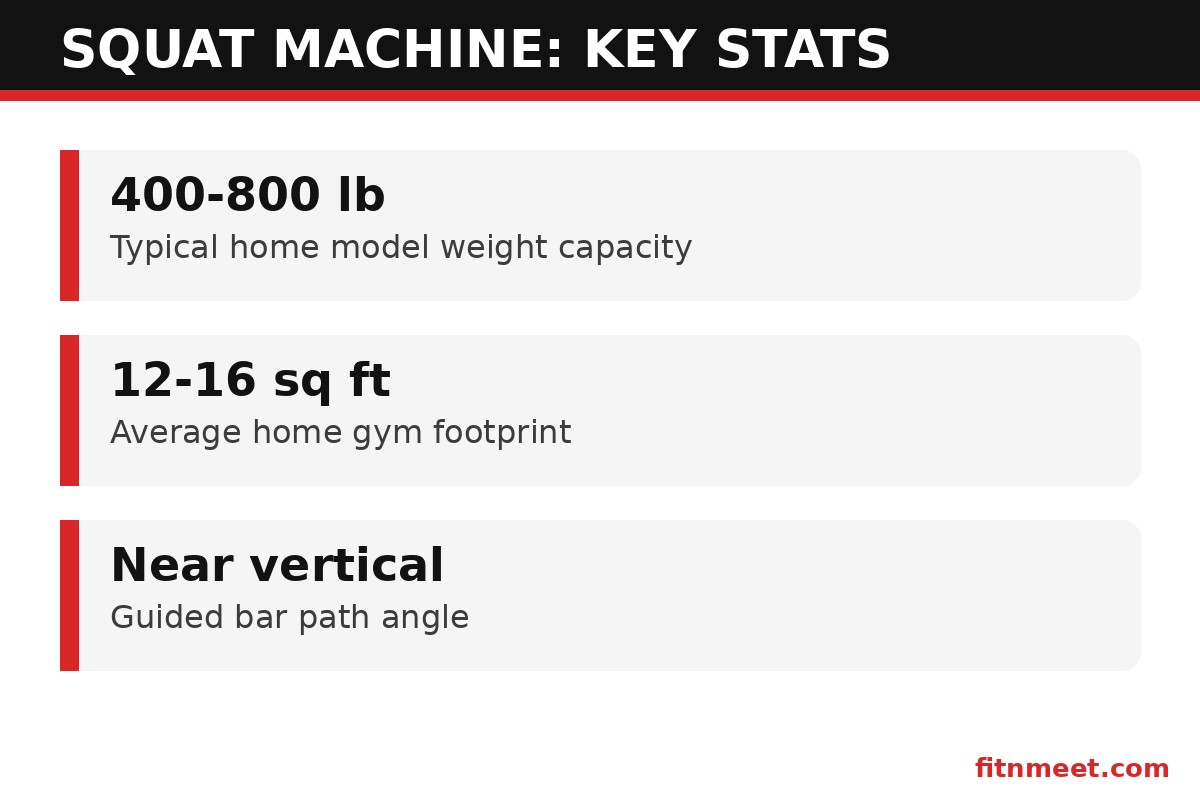
- How much floor space do you have? Measure twice. A Smith machine needs about 15 square feet plus loading room; hack squats need more depth. If you are under 12 square feet, a belt squat or a rack with safeties fits better.
- What is your budget? Under $500 points to a used Smith machine or a basic belt squat. $1,000-plus opens quality hack squats. Over $2,000 buys commercial-grade anything.
- Do you train alone? If yes, prioritize machines with adjustable safeties or catch hooks — this is the core safety argument for owning a squat machine at all.
- What are your joints telling you? Knee pain under free squats often improves on a hack squat’s fixed track; back pain often disappears on a belt squat. Let symptoms guide the choice.
- New or used? Machines are excellent used buys — frames do not wear out. Check welds, bearings, and pad condition; budget 40 to 60 percent of retail.
Once you have decided, round out the home gym with support gear from FitnMeet’s shop and programming ideas from the strength training blog. For conditioning ideas that complement your leg work, explore the FitnMeet fitness articles.
Loading, Specs, and Setup
Before buying any squat machine, verify four specifications. Weight capacity: home models typically rate 400 to 800 pounds; make sure the rating covers your 3-rep max with headroom, not just your working weight. Footprint and ceiling height: Smith machines stand 7-plus feet tall — measure your ceiling, especially in basements. Plate compatibility: confirm Olympic (2-inch) versus standard (1-inch) sleeves match the plates you own. Safety mechanisms: adjustable safeties or multi-position catches are non-negotiable; a machine without them is just an expensive accident.
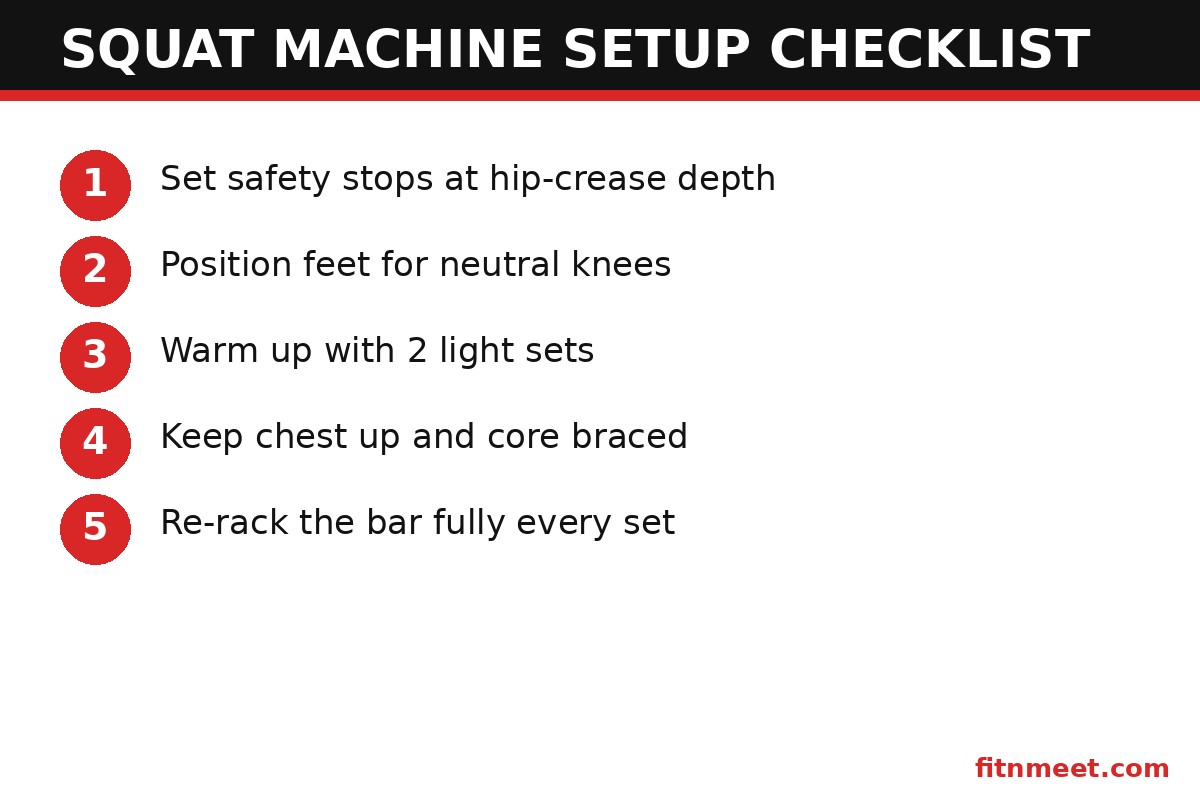
Setup basics apply to every type. Place the machine on rubber flooring at least 8 mm thick, level the frame, and test the safeties with an empty bar before loading. On a Smith machine, set the hooks so the bar rests just below your bottom position; on a hack squat, adjust the back pad so your lower back stays planted through the full range. Warm up with two light sets — the guided path tempts lifters to load up cold, and cold knees on a heavy hack squat are a classic recipe for a strain. Fuel hard leg days properly; lifters often pair heavy machine work with support from FitnMeet’s muscle development collection.
Safety on a Squat Machine
Machines are safer than free weights, not safe outright. The most common Smith machine injury comes from mis-set hooks: lifters unrack, discover the next hook is out of reach mid-set, and get stuck. Always test the full rotation — unrack and re-rack — with light weight first. On hack squats, the danger is depth beyond your mobility: the sled lets you sink deeper than your hips allow, rounding the lower back under load. Stop each rep where your back would start to tuck, not where the machine stops.
General rules: never skip safeties, never load plates beyond the machine’s rating, keep collars on (plates sliding on a Smith bar shift the balance unexpectedly), and re-rack deliberately rather than slamming. Inspect cables, bearings, and welds monthly — a fraying cable on a counterbalanced Smith machine is a failure waiting to happen. Train hard, but respect that a few hundred pounds on any guided path still demands full attention. The fundamentals of safe weight training apply to machines exactly as they do to barbells.
This article is for informational purposes only and is not medical advice. Consult a healthcare professional before starting any supplement or exercise program.
Frequently Asked Questions
Is a squat machine as good as free weights?
A squat machine builds leg strength effectively but produces slightly less total muscle activation than free-weight squats, per Schwanbeck 2009. Machines win on safety and targeted loading; free weights win on stabilization demand and athletic carryover. Most lifters benefit from using both.
What is the best squat machine for a home gym?
For most home gyms, a Smith machine is the best squat machine because one frame handles squats, presses, rows, and more. If quads are the priority, a hack squat is better; if your back is the limiter, a belt squat is the smartest buy.
Can you build big legs with just a squat machine?
Yes. Progressive overload on a squat machine — adding weight or reps over time — builds substantial leg size and strength. Many lifters with joint limitations have built impressive legs using only machines, proving consistency and progression matter more than the tool.
Are Smith machine squats bad for your knees?
Smith machine squats are not inherently bad for knees. Foot placement matters: placing feet slightly forward of the bar reduces knee shear and is the standard recommendation. Lifters with existing knee issues should start light and stop at pain-free depth.
How much space does a squat machine need?
Most squat machine types need 12 to 18 square feet plus room to load plates and step in. Smith machines also need 7-plus feet of ceiling height. Measure your space, including plate-loading clearance on both sides, before ordering.
Is a belt squat machine worth it?
A belt squat machine is worth it for lifters with back pain or anyone wanting heavy leg volume without spinal loading. It is a specialist tool, though — if you can only buy one machine, a Smith machine covers more exercises for the money.
Conclusion: Which Squat Machine Should You Buy?
The comparison comes down to this: a Smith machine is the all-rounder, a hack squat is the quad specialist, and a belt squat is the joint-friendly workhorse. Match the machine to your goal, your space, and your joints using the decision steps above, verify capacity and safeties before buying, and you will own a tool that pays off for a decade. Ready to complete your leg-day setup? Explore FitnMeet’s workout recovery collection to support the heavy training a good squat machine makes possible.