
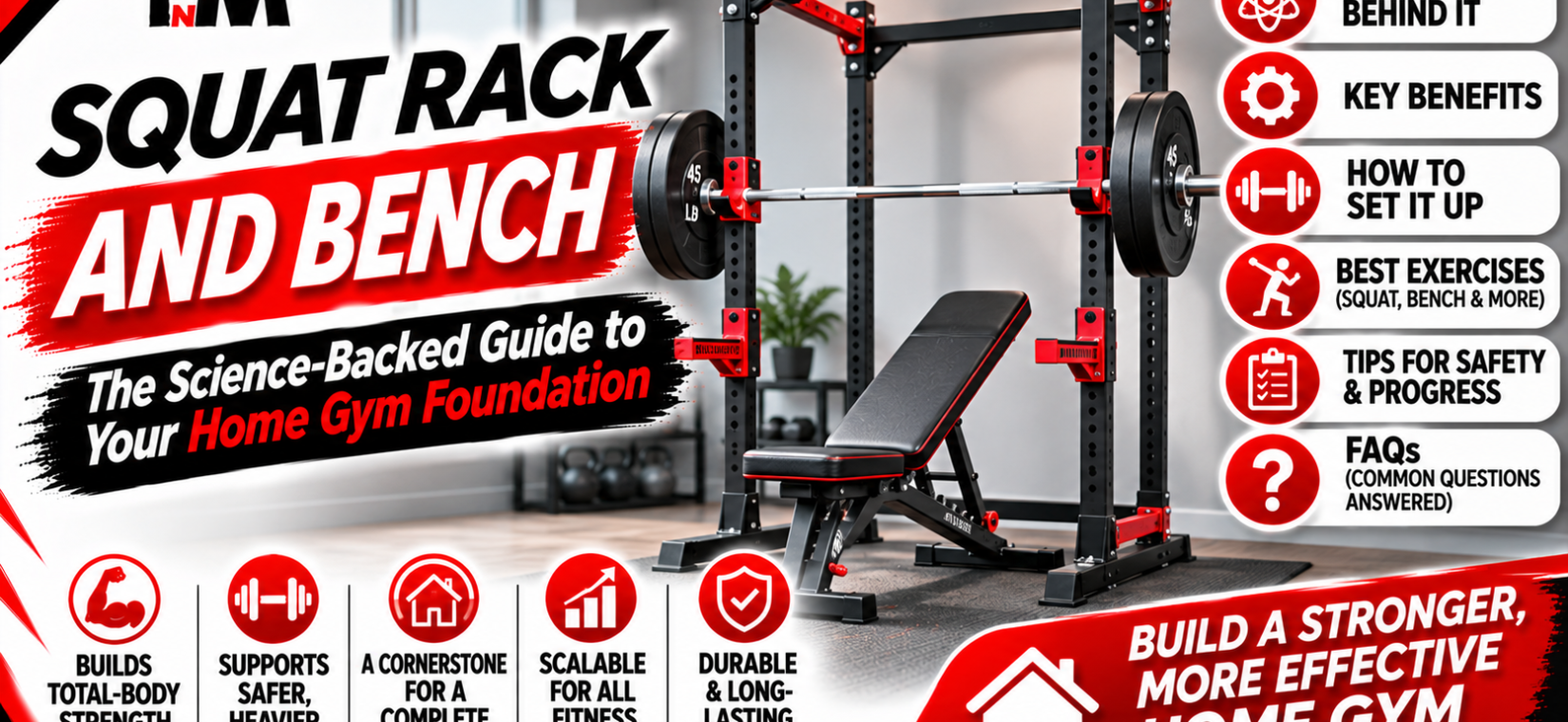
Squat rack and bench is the classic home-gym pairing of a squat rack with an adjustable weight bench. Together they cover squats, bench presses, overhead presses, and rows in a small footprint. When buying as a set, match the bench’s weight capacity to the rack’s and leave at least a few feet of clearance on all sides.
What Is a Squat Rack and Bench? (Mechanism)
A squat rack and bench is not one product but a paired system. The squat rack (usually a power rack with four uprights, or a half-rack with two) is a steel frame with adjustable J-hooks that hold a loaded barbell at any height, plus safety spotter arms that catch the bar if you fail a rep. The bench is a padded, height-regulated platform — flat, or adjustable from flat to incline — that puts your torso in position for pressing and supported rowing movements.
The mechanism by which a squat rack and bench builds strength is mechanical tension through free-weight compound lifts. Unlike machines that fix the bar path, a barbell in a squat rack moves freely in three dimensions, forcing your stabilizer muscles to control it. Electromyography (EMG) research consistently shows higher stabilizer activation in free barbell squats than in guided Smith-machine squats — your body does more work per rep because nothing is doing the balancing for you. The bench extends this to horizontal pressing: a free barbell bench press demands shoulder stabilizers, lats, and leg drive in ways a chest-press machine cannot replicate. Background on the movements is on Wikipedia’s squat page and bench press page.
The rack’s safety mechanism deserves emphasis because it changes training psychology. Adjustable spotter arms set just below your lowest safe bar position mean you can attempt a true one-rep max or train to failure alone — the bar lands on steel, not on you. This single feature is why a squat rack and bench, rather than a bench alone, is the recommended home-gym starting point: it removes the fear constraint that otherwise caps intensity.
📊 Study spotlight: Schwanbeck et al. (2020, Journal of Strength and Conditioning Research) randomized 21 trained men to 8 weeks of free-weight vs machine-based training. The free-weight group — training movements a squat rack and bench enables — gained significantly more strength on transfer tests and showed greater muscle activation, supporting the free-weight advantage hypothesis.
What the Research Says
The case for building training around a squat rack and bench rests on several converging lines of evidence:
Compound lifts drive the most growth per set. A 2022 systematic review (Kassiano et al.) found multi-joint exercises produced comparable or superior hypertrophy to single-joint work across the same weekly set counts — and the squat, bench press, overhead press, and barbell row (all squat rack and bench staples) are the canonical multi-joint lifts. When training time is limited, compounds win on efficiency.
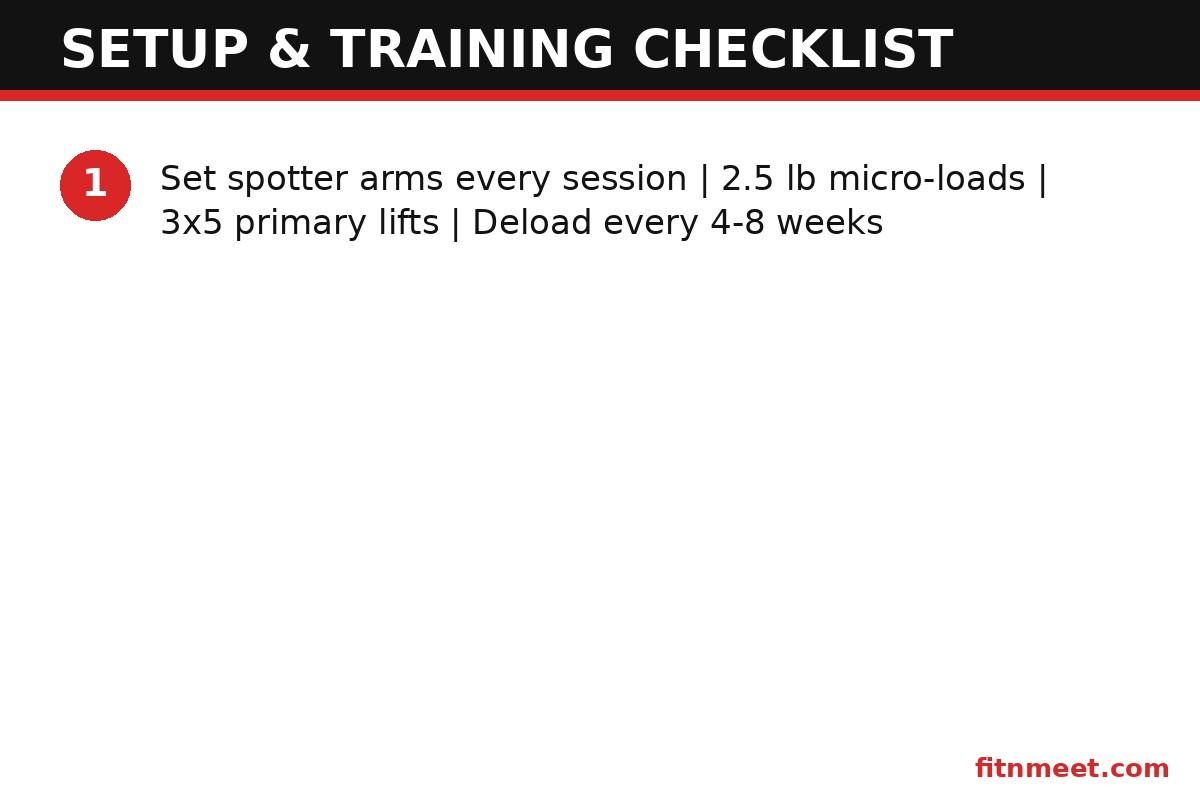
Progressive overload is simplest with barbells. Strength adapts to gradually increasing mechanical tension. A squat rack and bench with an Olympic barbell allows 2.5 lb (1.25 kg) micro-increments — the smallest practical progression step in resistance training. Dumbbell-only setups typically jump 5+ lbs per hand, which stalls novice progression sooner.
📊 Study spotlight: A 2017 meta-analysis (Grgic et al., Sports Medicine, 21 studies) confirmed that heavier loads (>60% 1RM) produce superior strength gains to lighter loads — and a squat rack and bench is precisely the equipment that lets home lifters load heavy safely, with spotter arms as the backstop.
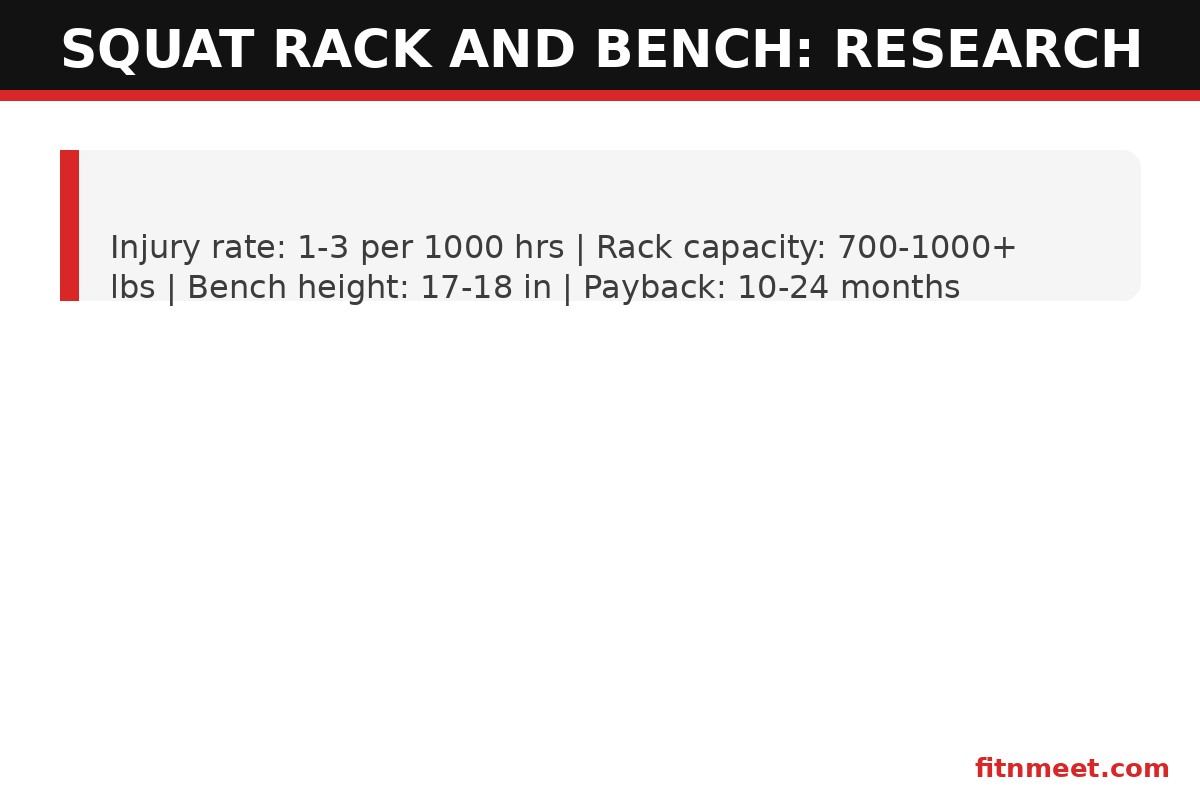
Safety data favors racks over benches alone. Weight-training injury surveillance consistently shows low injury rates — roughly 1–3 injuries per 1,000 training hours, far below team sports — and catastrophic barbell accidents overwhelmingly involve bench pressing heavy without safeties or spotters. A squat rack and bench used with spotter arms set correctly essentially eliminates the crush-injury scenario that makes solo heavy benching dangerous.
Bone and metabolic effects. Heavy axial loading (squats with a bar on your back) is among the most osteogenic stimuli available: a 2018 trial (Watson et al., Journal of Bone and Mineral Research) found high-intensity resistance training including squats and deadlifts improved bone mineral density in postmenopausal women. The squat rack and bench is the delivery system for that stimulus at home.
Benefits of a Squat Rack and Bench
Translating the research into practical benefits of owning a squat rack and bench:
- Full-body training in ~40 square feet: squats, bench press, overhead press, rows, rack pulls, Romanian deadlifts, lunges, dips (with attachments), and pull-ups (most racks include a bar) — a complete program from one footprint.
- True progressive overload at home: 2.5 lb jumps, fractional plates, and pin-adjustable heights mean your programming never outgrows the equipment.
- Solo heavy training, safely: spotter arms convert a home garage into a safe heavy-training environment — no training partner required.
- Cost per workout collapses over time: a quality squat rack and bench (~$500–1,200 combined) pays for itself versus a $50/month gym membership in 10–24 months, then trains you free for a decade or more — quality racks carry lifetime structural warranties.
- Time efficiency: no commute, no waiting for equipment. Studies of home vs gym adherence show the removed friction measurably improves consistency — and consistency is the primary driver of results.
- Versatility for all levels: pin heights adjust from ~24 inches to 70+ inches, serving everyone from rehab-level partial movements to tall lifters’ overhead work.
How a Squat Rack and Bench Works in Training
In the body, training with a squat rack and bench works through the standard hypertrophy and strength mechanisms — mechanical tension, muscle damage, and metabolic stress — applied via the highest-tension exercises available. The squat loads the entire axial skeleton and lower-body musculature simultaneously; EMG data shows the back squat produces among the highest quadriceps and gluteus maximus activation of any exercise. The bench press similarly dominates upper-body pushing musculature, with the flat barbell bench press showing the highest pectoralis major activation in comparative EMG studies (Schoenfeld et al.).
Programming around a squat rack and bench follows a simple protocol: For full programming frameworks across the big lifts, see the FitnMeet strength training category.
- Anchor each session on one primary compound (squat, bench, overhead press, or row/deadlift variation) performed first, when neural freshness is highest.
- Work in the 3–8 rep range for the primary lift at 75–90% of your estimated max — the intensity zone the Grgic meta-analysis identifies for maximal strength development.
- Follow with 2–3 accessory movements (dumbbell work, dips, pull-ups on the rack) in the 8–15 rep range for hypertrophy volume.
- Progress the primary lift by 2.5–5 lbs per week as a novice, slowing to monthly progression as you advance — the rack’s micro-loading capacity makes this sustainable.
- Set spotter arms every heavy session: for squats, 1–2 inches below your bottom position; for bench, at chest level so a failed rep rests on the arms, not your ribcage.
Fueling this training matters as much as the equipment: heavy compound sessions demand adequate protein, which is why lifters pair their garage setup with staples from FitnMeet’s muscle development range.
Programming: Sets, Reps, and Frequency
Think of programming as the “dosage” of a squat rack and bench. Evidence-based starting points:
- Frequency: full-body sessions 3x per week (e.g., Starting Strength / StrongLifts style) maximize novice gains; upper/lower splits 4x per week suit intermediates.
- Volume: 10–20 hard sets per muscle per week is the hypertrophy sweet spot (Schoenfeld 2017 meta-analysis, 15 studies).
- Squat: 3–5 sets of 5 reps, 2–3x weekly for novices; the single highest-ROI exercise in the program.
- Bench press: 3–5 sets of 5–8 reps, 2x weekly; add incline bench (adjustable bench required) for upper-chest emphasis.
- Progression: add 5 lbs per session to squats and 2.5–5 lbs to bench as a novice; expect this linear phase to last 3–9 months.
- Deload: every 4–8 weeks, cut volume ~50% for one week to dissipate accumulated fatigue.
Injury Risks and Safety
A squat rack and bench is among the safest ways to lift heavy — when used correctly. The risks and their mitigations:
- Crush injuries: the catastrophic risk, almost exclusive to bench pressing heavy without safeties. Mitigation: always bench inside the rack with spotter arms set at chest level, or train with a competent spotter — no exceptions on heavy sets.
- Lower-back strain in squats: usually a bracing or depth issue, not an equipment issue. Mitigation: learn the Valsalva maneuver, keep a neutral spine, and use the rack’s pin settings to practice partial-range squats while grooving form.
- Shoulder impingement in bench press: linked to excessive elbow flare and over-wide grip. Mitigation: tuck elbows ~45–75 degrees, touch the bar to the lower chest/sternum, and keep shoulder blades retracted on the bench pad.
- Equipment failure: vanishingly rare with rated gear — but verify your rack’s weight capacity (700–1,000+ lbs for quality racks), use 3×3″ 11-gauge steel uprights as the quality benchmark, and bolt down or weigh down light racks before heavy use.
- Bench specs that matter: pad height ~17–18 inches (IPF competition standard is 17.7″), pad width 10–12 inches, capacity 600–1,000 lbs, and a grippy vinyl that prevents sliding during leg drive.
Disclaimer: This article is for informational purposes only and is not medical advice. Consult a qualified coach or healthcare professional before beginning heavy resistance training, especially with pre-existing injuries or medical conditions.
Squat Rack and Bench vs Alternatives
| Factor | Squat Rack and Bench | Smith Machine | Dumbbells + Adjustable Bench | All-in-One Home Gym |
|---|---|---|---|---|
| Bar path | Free — full stabilizer demand | Fixed — reduced stabilizer work | Free | Fixed |
| Max load progression | 700–1,000+ lbs capacity | Usually 300–600 lbs | Limited by dumbbell size | 150–300 lb stacks |
| Micro-loading | 2.5 lb jumps possible | Yes | No — 5+ lb jumps | Usually 10 lb jumps |
| Footprint | ~40 sq ft | ~30 sq ft | ~20 sq ft | ~50+ sq ft |
| Typical cost | $500–1,200 | $400–1,500 | $300–800 | $1,500–4,000 |
| Solo heavy safety | Excellent (spotter arms) | Good (catches) | Good (dumbbells droppable) | Excellent |
| Research support | Strongest — free compounds | Weaker transfer to free strength | Good | Weakest evidence base |
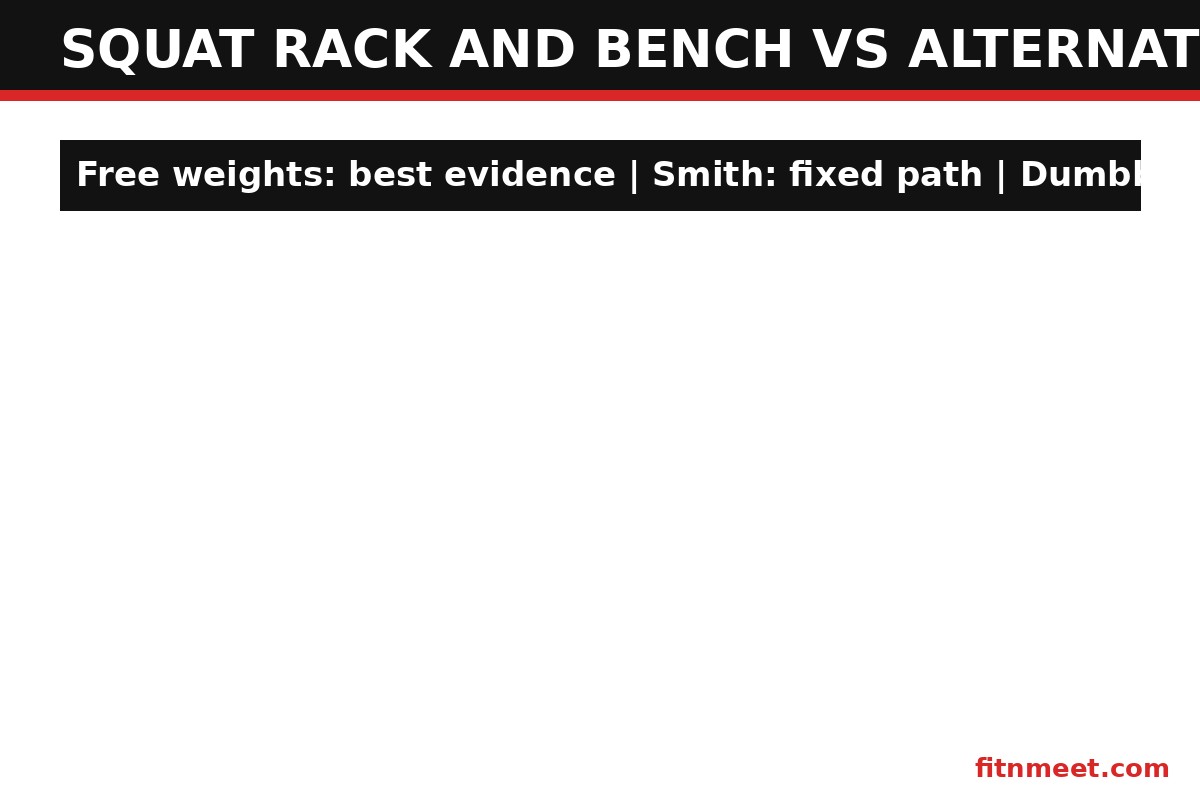
The table makes the research-toned verdict clear: a squat rack and bench offers the best ratio of evidence, load capacity, and long-term value per dollar. Smith machines trade away the stabilizer stimulus the research favors; dumbbell setups hit a progression ceiling; all-in-one machines cost triple for fixed-path movements. For lifters who want the training the literature supports, the squat rack and bench is the rational buy. Recovery between those heavy sessions matters too — see FitnMeet’s workout recovery collection and sports nutrition range.
Frequently Asked Questions About Squat Rack and Bench
What is a squat rack and bench used for?
A squat rack and bench is the foundation of a home gym. The rack holds a barbell safely for squats, presses, and rows with adjustable safety arms, while the bench enables bench pressing and supported accessory work. Together they cover nearly every major barbell exercise.
How much space do you need for a squat rack and bench?
Plan for about 40 square feet: roughly 4×6 feet for the rack itself plus room to load plates and walk out a squat. A 7-foot Olympic barbell needs about 8 feet of width clearance. Most garages and spare rooms accommodate a squat rack and bench comfortably.
Is a squat rack and bench safe for beginners?
Yes, arguably safer than a commercial gym. Set the spotter arms correctly and a beginner can fail any rep without danger. Start with an empty 45 lb bar, learn form with light loads, and add 5 lbs per session during the novice phase.
What should I look for when buying a squat rack and bench?
For the rack: 3×3 inch 11-gauge steel uprights, 700+ lb capacity, 1-inch hole spacing, and included spotter arms. For the bench: 17-18 inch pad height, 10-12 inch pad width, 600+ lb capacity, and adjustable incline if you want incline pressing.
Can you build muscle with just a squat rack and bench?
Absolutely. Squat, bench press, overhead press, barbell row, rack pull, lunges, dips, and pull-ups from a squat rack and bench cover every major muscle group. Research shows multi-joint barbell lifts produce comparable or superior hypertrophy to machine-based routines.
How much does a good squat rack and bench cost?
A quality power rack runs $300-800 and a solid adjustable bench $150-400, so budget $500-1,200 total. That pays for itself against gym memberships in 10-24 months, and quality racks carry lifetime structural warranties.
Conclusion
The research converges on a simple conclusion: if you train with barbells, a squat rack and bench is the highest-evidence equipment purchase you can make. Free-weight compounds drive the strength and hypertrophy adaptations the literature measures, spotter arms make heavy solo training safe, and the cost amortizes to nearly nothing over a decade of use. Buy once — 3×3″ steel, 1-inch spacing, a bench at proper height — and the equipment will outlast every program you run on it.
Then give that training the fuel it deserves: adequate protein, smart recovery, and consistent programming. Explore the FitnMeet shop, the muscle development collection, and the FitnMeet blog for more research-graded training guides.