
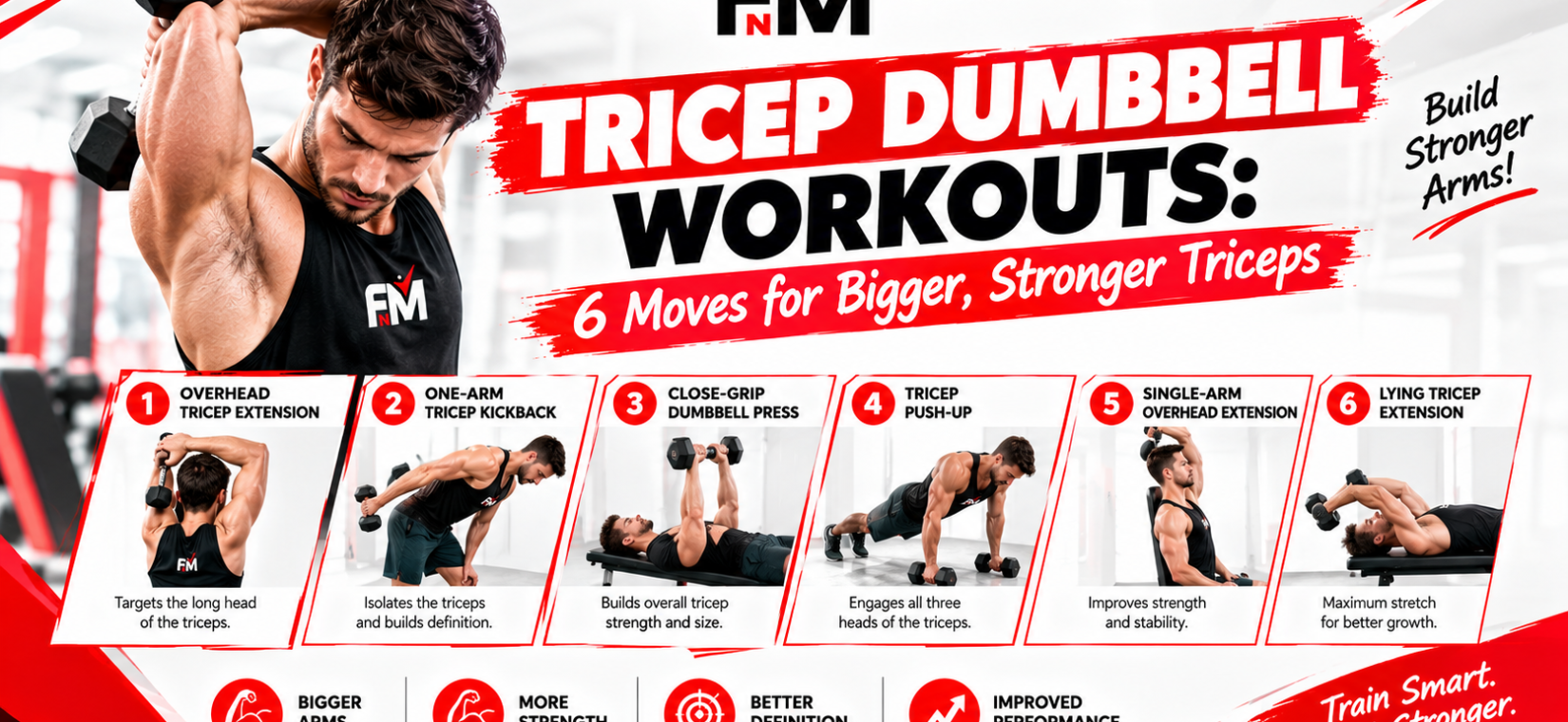
Tricep dumbbell workouts are arm-training routines built around dumbbell exercises that target the triceps brachii — overhead extensions, kickbacks, skullcrushers, and close-grip presses. The best tricep dumbbell workouts train all three tricep heads with 3–4 sets of 8–12 reps, twice per week, using strict form and progressive overload for maximum arm growth.
Quick Answer
Tricep dumbbell workouts build the back of your upper arm using just dumbbells. The triceps make up roughly two-thirds of your upper-arm mass, so if your arms look small despite curling, weak triceps are almost always the reason. A complete tricep dumbbell workout needs one overhead move (for the long head), one press or dip-style move (for overall mass), and one isolation move (for the lateral head) — done for 3–4 sets of 8–12 reps, twice weekly.
1Pro tip: Start every tricep dumbbell workout with the heaviest compound move (close-grip press or overhead extension) while you are freshest — isolation moves like kickbacks belong at the end.
What Are Tricep Dumbbell Workouts?
Tricep dumbbell workouts are structured training sessions in which every working set uses dumbbells to load elbow extension — the triceps’ job. The triceps brachii has three heads: the long head (runs along the back of the arm and crosses the shoulder joint), the lateral head (the outer “horseshoe” you see from the side), and the medial head (deep underneath, active in every press). Because only the long head crosses the shoulder, overhead tricep dumbbell workouts stretch it more — and stretched-position training is a powerful growth driver, per a 2023 study in the Journal of Strength and Conditioning Research on overhead vs. pushdown tricep training.
A proper tricep dumbbell workout therefore isn’t six random exercises — it is a deliberate selection that covers all three heads. Most lifters undertrain the long head because pushdowns and dips (elbows at the sides) barely stretch it. The fix is simple: make an overhead extension the cornerstone of your tricep dumbbell workouts and everything else falls into place.
Did you know? The word “triceps” literally means “three heads” — and EMG research shows the long head can be up to 1.4× more active in overhead extensions than in pushdown-style moves. Exercise selection matters more than exercise quantity.
Why Dumbbells for Triceps?
Dumbbells have three advantages for tricep training that barbells and machines can’t fully match. First, independent loading: each arm works on its own, which exposes and fixes strength imbalances — if your right tricep does 70% of every barbell press, dumbbell work forces the left to catch up. Second, freedom of movement: dumbbells let your wrists and elbows find their natural path, which is kinder to cranky elbows than a fixed barbell. Third, range of motion: a dumbbell skullcrusher or overhead extension can travel deeper than a barbell version before the bar hits your head.
The trade-off is stability demand — dumbbells recruit more stabilizer muscle, which slightly limits the absolute load you can use versus a machine. For hypertrophy that hardly matters: a 2021 comparison of free-weight and machine arm training found equivalent tricep growth when sets were taken near failure. Tricep dumbbell workouts give you the growth stimulus plus the stabilizer bonus.
Step-by-Step Tricep Dumbbell Workouts Guide
Here are the six essential moves. Perform them in the order listed — heaviest compounds first — as a complete tricep dumbbell workout, or pick 3–4 to finish an upper-body day.
Step 1 — Dumbbell overhead extension (long head)
- Setup: Sit or stand tall holding one dumbbell with both hands, arms extended overhead.
- Execution: Keeping your upper arms vertical and elbows pointing forward, lower the dumbbell behind your head until your forearms are roughly parallel to the floor. Press back up without letting the elbows flare.
- Cues: Tuck your chin slightly; think “elbows to the ceiling.” Stop the set if your lower back starts arching — that means the weight is too heavy.
- Sets/reps: 3–4 × 8–12.
Step 2 — Dumbbell skullcrusher / lying tricep extension (overall mass)
- Setup: Lie on a bench holding a dumbbell in each hand, arms extended over your shoulders.
- Execution: Bend only at the elbows, lowering the dumbbells toward your temples. Extend back to the start without locking out violently.
- Cues: Keep upper arms perpendicular to the floor — if they drift toward your head, your shoulders are stealing the work.
- Sets/reps: 3 × 8–12. Start light: the elbow position makes this move humbling.
Step 3 — Close-grip dumbbell press (mass + medial head)
- Setup: Lie on a bench, dumbbells pressed together over your chest, palms facing each other.
- Execution: Lower the dumbbells to your lower chest keeping elbows tucked at roughly 45 degrees. Press up, squeezing the triceps hard at the top.
- Cues: This is the heaviest move in most tricep dumbbell workouts — load it like a press, not an isolation.
- Sets/reps: 3–4 × 6–10.
Step 4 — Single-arm overhead extension (imbalance fixer)
- Setup: Stand with one dumbbell overhead, free hand supporting the working elbow if needed.
- Execution: Lower behind the head and extend. The unilateral load exposes left-right differences immediately.
- Cues: Start with your weaker arm and match reps with the stronger side — never exceed what the weak side can do.
- Sets/reps: 2–3 × 10–12 per arm.
Step 5 — Dumbbell kickback (lateral head peak contraction)
- Setup: Hinge forward with a flat back, one knee and hand on a bench, working arm’s upper arm parallel to the floor.
- Execution: Extend the forearm straight back until the arm is fully extended; squeeze for one second. Lower slowly.
- Cues: If your upper arm drops below parallel, the tension leaves the tricep. Go lighter and keep the humerus pinned.
- Sets/reps: 2–3 × 12–15.
Step 6 — Tate press (lateral head finisher)
- Setup: Lie on a bench, dumbbells held with elbows flared wide, weights near your chest.
- Execution: Press the dumbbells up and slightly inward by extending the elbows — the flared position hammers the lateral head.
- Cues: Use modest weight; the leverage is awkward by design. Perfect as the last move of your tricep dumbbell workouts.
- Sets/reps: 2 × 10–15.
2Pro tip: Film one set of overhead extensions from the side. If your elbows drift more than a few inches, lighten the load — form slippage on tricep dumbbell workouts almost always means too much weight, not too little strength.
Sets, Reps, and Weekly Volume
Triceps are a small muscle group that also assists in every press — so they need less direct volume than you think, but more than most people do. Evidence-based guidelines for tricep dumbbell workouts:
- Weekly sets: 8–14 direct sets per week, split across 2 sessions. Count pressing volume too — heavy bench press already taxes the triceps.
- Rep ranges: 6–10 for heavy presses, 8–12 for extensions, 12–15 for kickbacks and finishers. Mixing ranges across the week beats living in one.
- Proximity to failure: Take isolation moves to 1–2 reps shy of failure; take the final set of one move per workout to true failure (safely — dumbbells can be dropped).
- Rest: 90 seconds between heavy sets, 60 seconds for isolation work.
- Progression: When you hit the top of the rep range on all sets, increase the dumbbell weight by the smallest increment and restart at the bottom of the range.
Did you know? Triceps recover in roughly 48 hours after moderate volume. Training tricep dumbbell workouts on Monday and Thursday gives you two full growth cycles per week without overlap fatigue.
🛒 Your tricep-growth shopping list: (1) enough protein — 1.6–2.2 g/kg daily (see FitnMeet’s protein range); (2) creatine or recovery support from workout recovery; (3) a training log — the cheapest growth tool there is. Browse the full shop to stock up.
Benefits of Tricep Dumbbell Workouts
- Visibly bigger arms: Since the triceps are two-thirds of upper-arm mass, dedicated tricep dumbbell workouts add circumference faster than any amount of extra curling.
- Stronger presses: Lockout strength in bench press and overhead press comes from the triceps. Stronger triceps routinely add 5–10% to pressing numbers.
- Balanced arm development: Unilateral dumbbell work corrects the left-right imbalances that barbells hide.
- Elbow-friendly loading: Dumbbells allow natural wrist rotation, reducing the elbow strain some lifters get from straight-bar extensions.
- Minimal equipment: A single pair of adjustable dumbbells covers every move in this guide — tricep dumbbell workouts are the ultimate home-gym arm solution.
- Better mind-muscle connection: Slower, stricter dumbbell reps teach you to feel the tricep working, a skill that transfers to every press.
Mistakes to Avoid
- Elbow flare on every rep. Letting the elbows drift turns extensions into a shoulder-dominant mess. Pin them — use a mirror or film yourself.
- Skipping overhead work. Pushdown-only routines undertrain the long head, which is the biggest head. Every one of your tricep dumbbell workouts should include an overhead move.
- Bouncing out of the stretch. The deep stretch is where growth happens; bouncing through it with momentum wastes the most productive inch of the rep.
- Too much weight, too soon. The triceps’ tendons adapt slower than the muscle. Jumping 5 kg on skullcrushers overnight is how elbows get cranky — progress in small increments.
- Training triceps the day before heavy pressing. Sore triceps sabotage bench day. Separate tricep dumbbell workouts and heavy press days by at least 48 hours.
- Ignoring the squeeze. A one-second hard contraction at full extension measurably increases motor-unit recruitment — don’t rush the top.
3Pro tip: If your elbows ache, swap skullcrushers for overhead extensions for 4–6 weeks. The shoulder-flexed position changes the stress angle on the elbow and usually resolves the irritation while you keep growing.
Tricep Dumbbell Workouts vs Other Methods
| Method | Long-head emphasis | Load potential | Elbow friendliness | Equipment needed |
|---|---|---|---|---|
| Tricep dumbbell workouts | ★★★★★ (overhead moves) | ★★★★☆ | ★★★★☆ | Dumbbells only |
| Cable pushdowns | ★★☆☆☆ | ★★★★☆ | ★★★★★ | Cable station |
| Barbell skullcrushers | ★★★☆☆ | ★★★★★ | ★★☆☆☆ | Barbell + bench |
| Bodyweight dips | ★★☆☆☆ | ★★★★★ (weighted) | ★★★☆☆ | Dip bars |
| Machine extensions | ★★★☆☆ | ★★★★☆ | ★★★★☆ | Full gym |
No single method wins everything, which is why smart lifters combine them: tricep dumbbell workouts for the long head and unilateral balance, plus pushdowns or dips for heavy lateral-head loading. If you could only pick one approach for life, though, dumbbells’ versatility — every head, every angle, home or gym — makes them the best default.
Side Effects and Safety
Tricep dumbbell workouts are safe for healthy lifters, with one joint to respect: the elbow. The triceps tendon attaches at the olecranon (the point of the elbow), and aggressive progression on skullcrushers is the classic recipe for tendinopathy — aching, stiffness, and pain when extending under load. Prevent it by progressing loads no more than ~5% per week on extension moves, warming up with a light high-rep set, and varying exercises every 6–8 weeks.
Overhead extensions demand shoulder mobility: if you can’t get your biceps beside your ears without arching your lower back, work on thoracic extension first and use lying extensions meanwhile. And as with all resistance training, stop any set that produces sharp joint pain — muscle burn is the goal, joint pain is the stop sign.
Beginners, older adults, and anyone returning from an elbow or shoulder injury should start with the lightest dumbbells that allow perfect form for 12–15 reps, and consider a clinician’s clearance before loading overhead positions heavily. For general protein and recovery guidance that supports tendon and muscle health, the NIH protein fact sheet is a solid reference.
This article is for informational purposes only and is not medical advice. Consult a healthcare professional before starting any supplement or exercise program.
Frequently Asked Questions
How often should I do tricep dumbbell workouts?
Twice per week works best for most lifters, with at least 48 hours between sessions. That gives you 8-14 direct weekly sets, which is the evidence-based sweet spot for tricep growth.
What is the single best move in tricep dumbbell workouts?
The dumbbell overhead extension. It stretches the long head — the largest of the three tricep heads — more than any other dumbbell move, and stretched-position training drives superior growth.
Can tricep dumbbell workouts be done at home?
Yes. Every move in this guide needs only dumbbells and optionally a bench. A pair of adjustable dumbbells is enough for complete tricep dumbbell workouts at home.
Why do my elbows hurt during tricep dumbbell workouts?
Elbow pain usually means too much load too soon on extension moves like skullcrushers. Reduce the weight, slow the tempo, swap to overhead extensions for a few weeks, and progress loads by no more than 5 percent per week.
Should I train biceps and triceps on the same day?
You can. An arm day pairing tricep dumbbell workouts with 2-3 curl moves is efficient and popular. Just keep total arm volume in check — 14-20 combined sets is plenty for most lifters.
How long until tricep dumbbell workouts build visible size?
Strength gains appear in 3-4 weeks; visible arm growth typically takes 8-16 weeks of consistent progressive training plus adequate protein (1.6-2.2 g per kg of body weight daily).
Conclusion
Tricep dumbbell workouts are the simplest path to bigger arms: six moves, two sessions a week, strict form, and steady progression. Prioritize the overhead extension for the long head, press heavy on the close-grip press, finish with isolation — and give it 8–12 weeks. Your sleeves will tell you it’s working before the mirror does.
Fuel the growth with quality nutrition from FitnMeet — start with the muscle development collection and keep your protein on target. (Background reading: triceps anatomy on Wikipedia and dumbbells on Wikipedia.)