
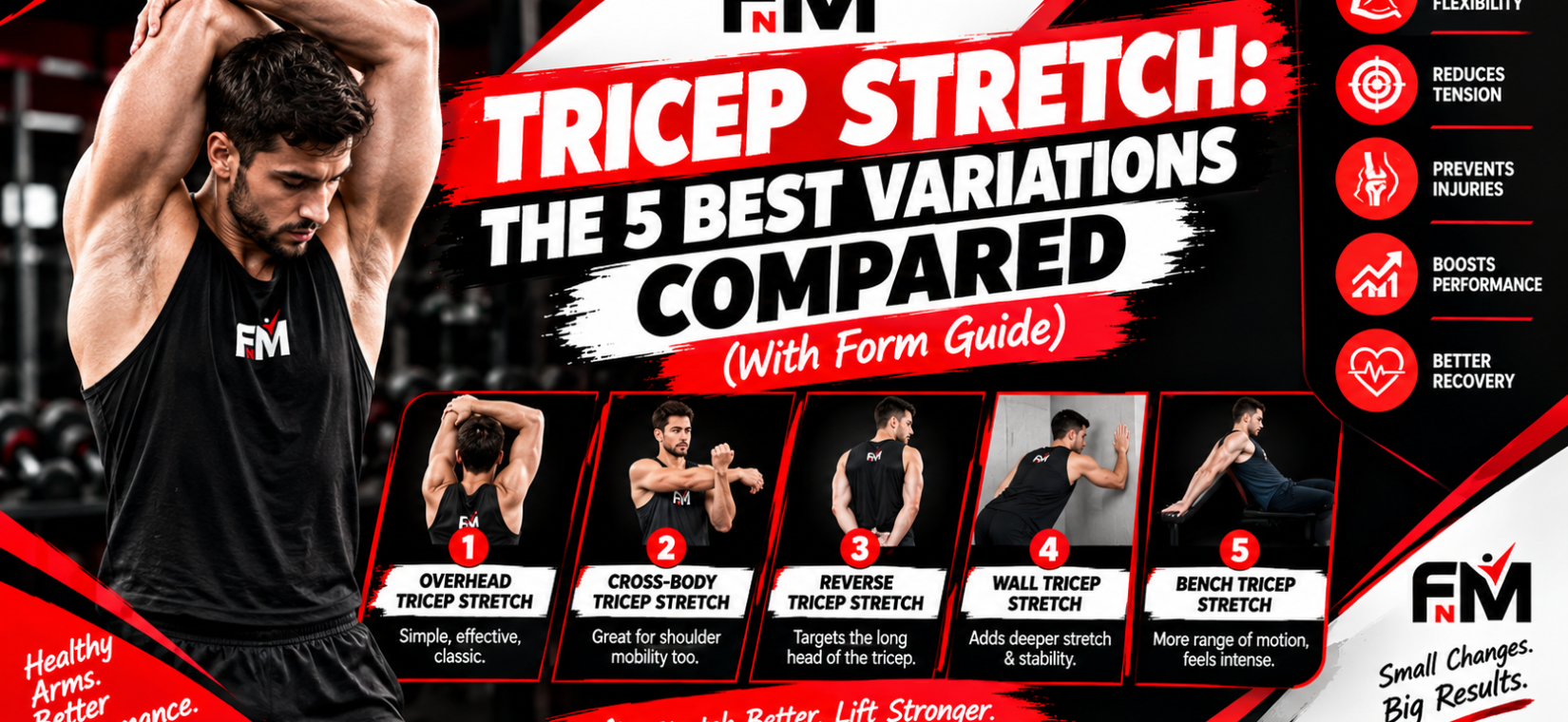
A tricep stretch lengthens the triceps brachii — the three-headed muscle covering the back of your upper arm. The overhead tricep stretch is the most effective variation for most people: raise one arm overhead, bend the elbow so your hand drops behind your head, and hold 20–30 seconds per side.
Quick Verdict
There are five tricep stretch variations worth knowing, but you only need two: the overhead tricep stretch for the long head and the cross-body tricep stretch for the lateral head. Do them after upper-body workouts, 2–3 sets of 20–30 seconds per arm. That 3-minute routine covers everything a casual lifter needs from tricep stretching. It fits easily into any cool-down, requires no equipment and no extra gym time, and addresses the two heads responsible for most pressing performance. Lifters who train pressing movements twice a week will accumulate over 12 minutes of quality mobility work weekly without scheduling a single dedicated flexibility session. The detailed comparisons below explain when the other three variations earn their place.
What Is a Tricep Stretch?
It is any position that lengthens the triceps brachii by combining elbow flexion (bending the elbow) with shoulder movement. The triceps has three heads: the long head (crosses the shoulder joint, biggest contributor to mass), the lateral head (the outer “horseshoe”), and the medial head (deep, active in all elbow extension). A good stretching program addresses all three, though the long head — which shortens when the arm hangs at your side — needs the most attention.
The triceps make up roughly 60–70% of your upper-arm mass, yet most lifters stretch their biceps and chest while ignoring the back of the arm. Chronically short triceps limit overhead pressing depth, worsen elbow flare on bench press, and contribute to the “desk posture” of rounded shoulders. A regular stretching habit reverses all three.
Tricep Stretch Variations: Head-to-Head
Here is how the five main variations compare:
| Tricep stretch variation | Primary head targeted | Difficulty | Equipment | Best for |
|---|---|---|---|---|
| Overhead stretch | Long head | Easy | None | Everyday use; the default pick |
| Cross-body stretch | Lateral head | Easy | None | Quick gym-floor stretch between sets |
| Doorway stretch | Long head | Easy | Doorframe | Deep stretch for very tight lifters |
| Towel stretch | Long head | Moderate | Towel | Limited shoulder mobility |
| Behind-back stretch | Long + medial | Moderate | None | Posture correction at a desk |
Now the second comparison that matters: how you stretch, not just which variation you pick.
| Method | How it works | ROM gain | Strength effect | When to use |
|---|---|---|---|---|
| Static hold | Hold the lengthened position 20–30 sec | High | May briefly reduce power if held >60 sec pre-lift | After workouts |
| Dynamic arm swings | Controlled arm circles, gradually bigger | Moderate | None negative; warms tissue | Before workouts |
| PNF (contract-relax) | Press into resistance 5 sec, then stretch deeper | Highest | Minimal when done post-workout | Stubborn tightness, 1–2×/week |
The research consensus is clear: long static holds (over 60 seconds per muscle) immediately before heavy lifting can temporarily reduce strength and power output by a few percent. Short holds under 30 seconds show negligible effects. So the rule is simple — save your serious static work for after training, and warm up beforehand with dynamic arm swings instead.
| Timing | Recommended tricep stretch | Duration | Why |
|---|---|---|---|
| Pre-workout | Dynamic arm swings + band pull-aparts | 2–3 min | Raises tissue temperature without dulling power |
| Intra-workout | Cross-body tricep stretch between sets | 15–20 sec/arm | Maintains mobility without fatigue |
| Post-workout | Overhead tricep stretch, static holds | 2–3 × 30 sec/arm | Best window for lasting flexibility gains |
| Rest days | PNF overhead stretch or doorway stretch | 5–10 min total | Deeper work when recovery is the goal |
Tricep Stretch Benefits
- Bigger, safer overhead press. A lengthened long head lets you lock out overhead without the lower back hyperextending to compensate.
- Healthier elbows. Tight triceps increase shear stress at the elbow during pressing; regular stretching is cheap insurance against tendinopathy.
- Better bench press bar path. Mobile triceps allow proper elbow tuck, keeping the bar over the wrists instead of drifting toward the face.
- Posture improvement. Short triceps internally rotate the shoulder; stretching them helps open the chest — useful for anyone at a desk 8 hours a day.
- Faster recovery perception. While stretching does not “flush lactic acid” (a myth), lifters consistently report less next-day stiffness after a proper cool-down stretch routine.
- Potential growth stimulus. Emerging research on long-duration stretching (e.g., 2023 studies on calf muscles) suggests very long stretch protocols may contribute modestly to hypertrophy — though evidence for the triceps specifically is still preliminary.
These benefits compound with good workout recovery habits: stretching plus protein plus sleep beats any single intervention alone. For general programming ideas, browse our fitness guides. For structured arm-day programming, explore the FitnMeet strength training category.
How to Choose the Right Tricep Stretch
Answer these questions in order — your choice picks itself:
- Can you comfortably clasp hands behind your back, one over the shoulder and one from below?
- Yes → Use the overhead version as your main stretch.
- No → Start with the towel-assisted version; the towel bridges the mobility gap until your shoulders open up.
- Is your goal pre-workout mobility or post-workout flexibility?
- Pre-workout → Dynamic arm swings only. Skip static holds before heavy pressing.
- Post-workout → Static overhead holds, 2–3 sets of 20–30 seconds per arm.
- Do your elbows ache during skull crushers or dips?
- Yes → Add the doorway variation on rest days and consider joint-support nutrition alongside form checks.
- No → The basic two-stretch routine is plenty.
- Do you sit at a desk all day?
- Yes → Add the behind-back version hourly — it doubles as a posture reset.
- No → Skip it; your post-workout routine covers you.
Overhead Variation: Step-by-Step Form
Since the overhead version is our top pick, here is exactly how to perform it for maximum benefit and zero shoulder irritation:
- Stand tall or sit upright. Stack your ribs over your pelvis; do not let the lower back arch. Good posture is the foundation of every effective stretch.
- Raise your right arm straight overhead. Reach toward the ceiling with the palm facing inward, bicep close to your ear.
- Bend the elbow. Let your right hand drop behind your head, reaching down your upper back as far as comfortable. Keep the upper arm vertical — do not let the elbow drift forward.
- Apply gentle pressure. With your left hand, lightly press the right elbow further back and down. The pressure should be gentle; think guidance, not force.
- Hold and breathe. Settle into mild tension and take slow nasal breaths. With each exhale, allow the elbow to sink a millimeter deeper. Hold 20–30 seconds.
- Switch sides and repeat. Do 2–3 sets per arm. If one side is noticeably tighter, give it one extra set rather than pushing harder.
Common form errors: letting the elbow flare out to the side (reduces the stretch on the long head), arching the lower back to fake more range (shifts the stretch to the spine), and yanking the elbow aggressively (risks shoulder irritation). Film yourself from the side once — most people are surprised how far their elbow drifts.
If you cannot get your hand behind your head without pain, use the towel-assisted version from the comparison table above for 2–3 weeks, then retest. Shoulder mobility improves quickly with consistent, gentle work.
How Long to Hold a Tricep Stretch
Dosage matters as much as variation. The evidence-based prescription:
- Hold time: 20–30 seconds per stretch. Gains plateau beyond 30 seconds for most people.
- Sets: 2–4 sets per arm, per session.
- Frequency: At least 2–3 days per week; daily is fine and slightly better.
- Intensity: Mild tension, never pain — about 6–7 out of 10 on a stretch-discomfort scale.
- Breathing: Exhale as you ease deeper; never hold your breath.
- Progression: When 30 seconds feels easy, add a set or try the PNF contract-relax method rather than forcing more range.
This aligns with the American College of Sports Medicine’s flexibility guidelines: 2–3 days per week minimum, 15–30 second holds, 2–4 repetitions per muscle group. A single 3-minute stretching session after each upper-body workout hits every target.
Safety: When Not to Stretch
- Sharp or pinching pain = stop. Stretching should produce mild tension, never sharp pain. Pinching at the front of the shoulder suggests impingement — see a physiotherapist.
- Do not stretch an acutely injured tricep. A strained or partially torn tricep needs rest and medical guidance, not stretching.
- Skip aggressive stretching with hypermobility. If your elbows hyperextend significantly, focus on strength and stability instead of more range.
- Warm up first. Stretching cold muscles is less effective and slightly riskier — do 2–3 minutes of light arm movement first.
- Do not bounce. Ballistic bouncing while stretching triggers the stretch reflex and can strain the muscle; use smooth, sustained holds.
For anatomy background, see Wikipedia’s articles on the triceps brachii and stretching.
This article is for informational purposes only and is not medical advice. Consult a healthcare professional before starting any supplement or exercise program.
Frequently Asked Questions
What is the best tricep stretch?
The overhead tricep stretch is the best all-around choice: it targets the long head (the largest tricep head), needs no equipment, and takes 60 seconds. Raise one arm overhead, bend the elbow so your hand drops behind your head, gently press the elbow with the other hand, and hold 20-30 seconds per side.
How long should you hold a tricep stretch?
Hold each stretch for 20-30 seconds, for 2-4 sets per arm, at least 2-3 days per week. Research shows flexibility gains plateau beyond 30-second holds, so add sets rather than longer holds when 30 seconds feels easy.
Should you do a tricep stretch before or after working out?
Do dynamic arm swings before workouts and save static holds for after. Static holds longer than 60 seconds immediately before heavy pressing can temporarily reduce strength and power by a few percent.
Can a tricep stretch help with elbow pain?
Often, yes. Tight triceps increase stress on the elbow during pressing movements, and regular gentle stretching can reduce that strain. However, sharp pain, swelling, or pain that worsens with stretching needs a physiotherapist’s assessment, not more stretching.
What does the tricep stretch target: which head?
The overhead version primarily targets the long head, which crosses the shoulder joint and contributes most to upper-arm mass. The cross-body variation emphasizes the lateral head. The medial head is engaged in all elbow extension and gets stretched by every variation.
Is it bad to stretch your triceps every day?
No — daily gentle stretching is safe and slightly more effective than 2-3 days per week, per ACSM guidelines. Keep intensity at mild tension (6-7 out of 10) and avoid aggressive PNF work more than twice weekly.
Conclusion: Our Comparison Verdict
Compared head-to-head, the overhead version wins for long-head targeting and convenience, the cross-body version wins for quick between-set mobility, and the doorway variation wins for stubborn tightness. Pick two, do them after upper-body sessions at 20–30 seconds per side, and your pressing will thank you.
Want more training structure? Browse FitnMeet’s fitness collection for workout programs and recovery guides that keep your arms growing and your joints happy.