
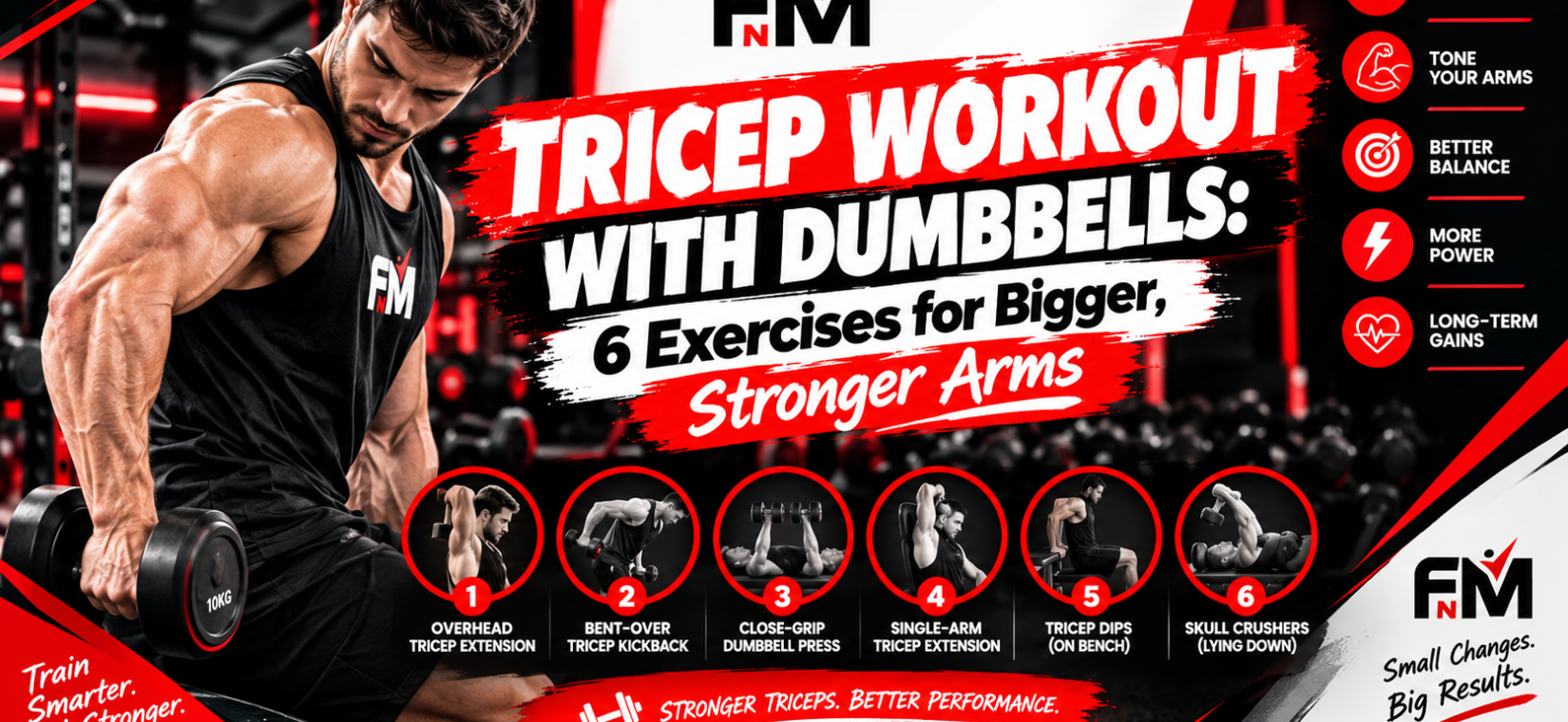
A tricep workout with dumbbells is an arm-training session built around dumbbell exercises that target the triceps brachii — the three-headed muscle on the back of your upper arm. The most effective version includes 4–6 exercises covering overhead extensions, kickbacks, and presses, performed for 3–4 sets of 8–12 reps with strict form and full range of motion.
Quick Answer: The Best Tricep Workout With Dumbbells
If you want the short version: the best tricep workout with dumbbells hits all three heads of the triceps with 4–6 exercises, starting with an overhead movement (best for the long head), followed by a lying extension and kickbacks, finishing with a close-grip press. Do 3–4 sets of 8–12 reps per exercise, rest 60–90 seconds between sets, and train triceps 1–2 times per week. A complete tricep workout with dumbbells takes 45–60 minutes start to finish. The full step-by-step guide below gives you exact form cues for every movement.
Pro tip: Always start your tricep workout with dumbbells with the overhead extension. Research on muscle activation shows the long head of the triceps — the biggest of the three heads — works hardest when your arms are overhead, so lead with the movement that targets the largest growth area.
What Is a Tricep Workout With Dumbbells?
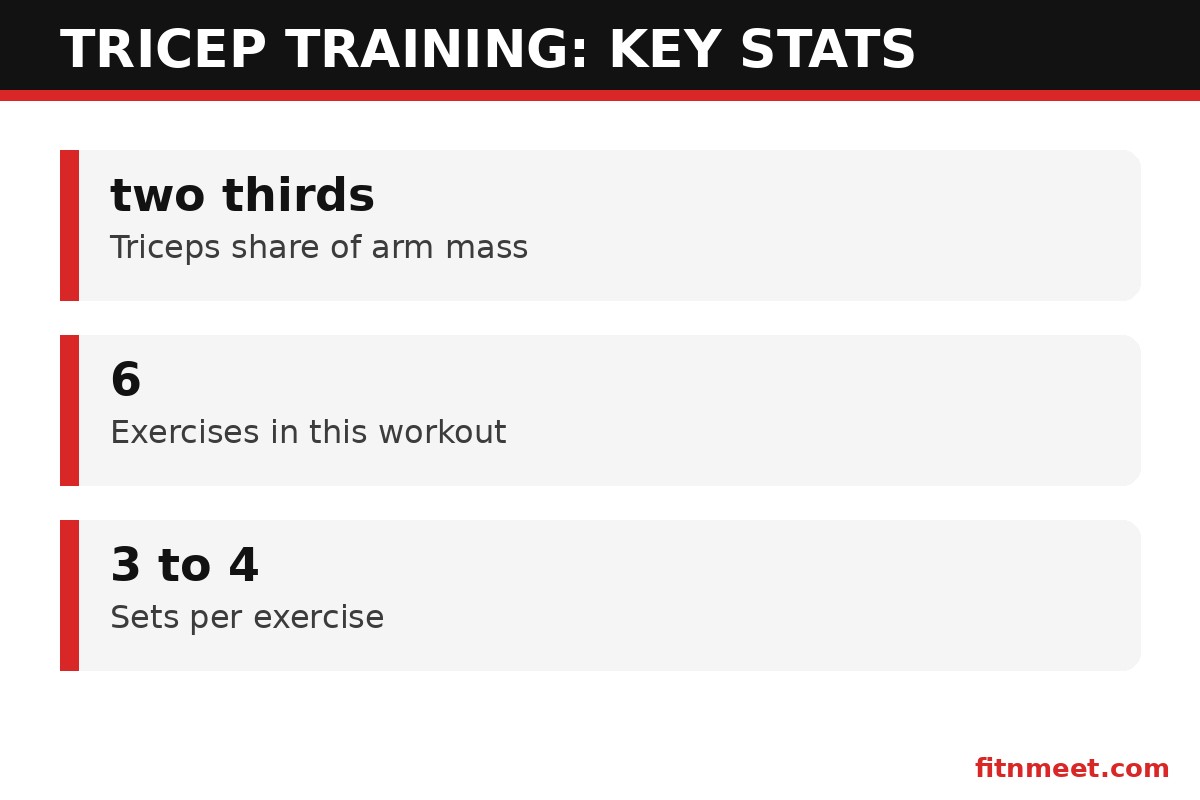
A tricep workout with dumbbells is a focused arm session using free-weight dumbbells to train the triceps brachii. The triceps has three heads — the long head, the lateral head, and the medial head — and together they make up roughly two-thirds of your upper arm’s muscle mass. That is the anatomical reason arm size responds more to tricep training than to endless bicep curls. You can read the full anatomy on Wikipedia’s triceps page.
Each head of the triceps responds best to slightly different arm positions. The long head crosses the shoulder joint, so it stretches — and works hardest — when your arms are overhead. The lateral head (the visible “horseshoe” on the outside of the arm) fires strongly in press-down style movements and presses. The medial head assists in everything. A well-designed tricep workout with dumbbells includes at least one overhead movement, one lying or kickback movement, and one pressing movement so no head gets neglected.
Dumbbells are uniquely suited to tricep training because each arm works independently. That independence fixes strength imbalances (most people have a dominant arm that takes over on barbell movements), allows a deeper stretch at the bottom of each rep, and lets your wrists rotate into whatever position feels best on your elbows — a meaningful advantage for lifters with cranky joints.
Did you know? Electromyography (EMG) studies consistently rank the overhead dumbbell triceps extension among the highest-activation tricep exercises, with the long head showing significantly greater activity in the overhead position than in pushdown-style movements.
Why Train Triceps With Dumbbells?
Beyond the anatomy, there are practical reasons a tricep workout with dumbbells beats the alternatives for most home and gym lifters. First, the equipment barrier is nearly zero: one pair of adjustable dumbbells covers every exercise in this guide, no cables or machines required. Second, dumbbells force stabilizer engagement — your shoulders and core work to control each independent weight, which builds the kind of usable arm strength that transfers to pressing movements like the bench press. (Weak triceps are the most common reason lifters stall on bench press lockout.) That transfer is exactly why a tricep workout with dumbbells is the default recommendation for home-gym arm training.
Third, dumbbells are joint-friendly when used correctly. The ability to rotate your grip — neutral, pronated, or anywhere between — lets you find the elbow position that avoids pain. Anyone who has felt cable pushdowns grind their elbows will appreciate this. Finally, progressive overload is simple: when you can complete all sets and reps with clean form, move up 2.5–5 lbs. That small, trackable jump is the engine of long-term arm growth — and it is the core advantage of structuring your arm day as a tricep workout with dumbbells rather than a random collection of cable movements.
Your Tricep Workout With Dumbbells: Step-by-Step Guide
Here is the complete tricep workout with dumbbells, in training order. Warm up first with 2–3 minutes of arm circles, band pull-aparts, or light push-ups to get blood into the elbows and shoulders.
Step 1 — Seated dumbbell overhead triceps extension
- Sets × reps: 4 × 10–12
- How: Sit on a bench, hold one dumbbell with both hands overhead, arms straight. Lower the weight slowly behind your head by bending only at the elbows until you feel a deep stretch, then extend back up without locking out hard.
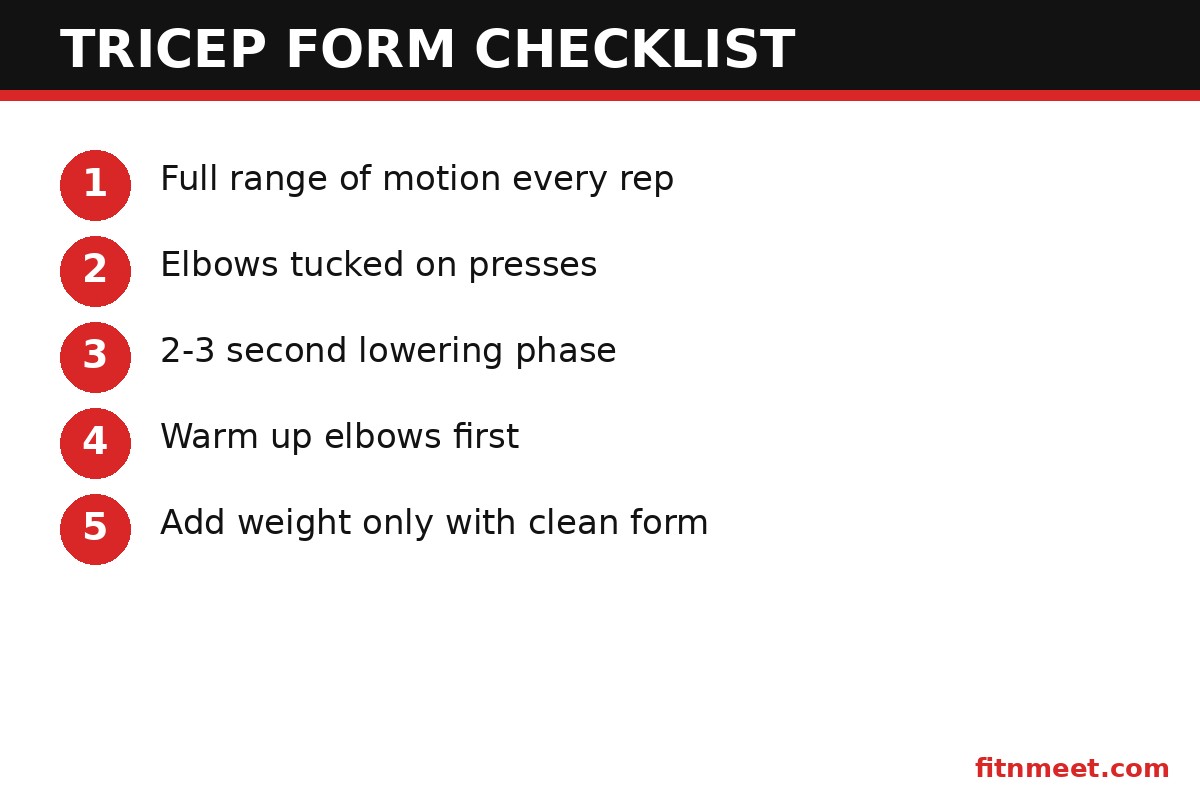
- Form cues: Keep your upper arms close to your head and pointing at the ceiling — don’t let the elbows flare. Move only the forearms. Lower for a full 2–3 second count.
- Why first: Targets the long head in its most stretched position, where growth stimulus is greatest.
Pro tip: If a single heavy dumbbell bothers your wrists, do this exercise one arm at a time with a lighter dumbbell. Unilateral work also exposes left-right imbalances hiding in your bilateral lifts.
Step 2 — Lying dumbbell triceps extension (“skull crusher”)
- Sets × reps: 3 × 8–10
- How: Lie on a bench holding a dumbbell in each hand, arms extended over your chest. Bend at the elbows to lower the weights toward your forehead or just behind your head, then press back up.
- Form cues: Keep the upper arms vertical and motionless — the most common error is letting the shoulders drift, which turns the movement into a pullover. Stop just short of full lockout to keep tension on the triceps.
- Elbow saver: Lower the dumbbells slightly behind your head rather than to your forehead; this keeps constant tension and is kinder on the elbow joint.
Step 3 — Dumbbell tricep kickbacks
- Sets × reps: 3 × 12–15 per arm
- How: Hinge at the hips with a flat back, one knee and hand braced on a bench. Hold a dumbbell with your upper arm parallel to the floor, then extend the forearm straight back until the arm is fully extended. Squeeze for one second.
- Form cues: The upper arm must stay pinned — if it swings, momentum is doing the work. Use a lighter weight than your ego wants; kickbacks reward strictness, not load.
- Why it works: The fully shortened position at the top gives a peak contraction that complements the stretched-position work from steps 1 and 2.
Did you know? The tricep kickback is often dismissed as a “light” exercise, but when performed with a strict 1-second squeeze at full extension, it produces lateral-head activation comparable to much heavier pressing movements — making it an ideal finisher, not a throwaway.
Step 4 — Close-grip dumbbell press
- Sets × reps: 3 × 8–10
- How: Lie on a bench with dumbbells held close together over your chest, palms facing each other. Lower under control to chest level, keeping the elbows tucked at roughly 45 degrees, then press up.
- Form cues: Think “elbows in, not out.” Flaring the elbows shifts the work to the chest and shoulders. Touch the dumbbells together lightly at the top without clanging them.
- Why it works: Lets you load the triceps heavier than isolation moves, driving the mechanical tension that underpins growth.
Step 5 — Tate press
- Sets × reps: 2–3 × 10–12
- How: Lie back with dumbbells over your chest, then flare the elbows out wide and lower the weights toward your chest by bending the elbows — the dumbbells should point toward each other. Press back up along the same path.
- Form cues: Start light; the flared-elbow position feels strange at first. Keep the movement slow and controlled — this is a lateral-head specialist, not a max-effort lift.
Step 6 — Single-arm overhead extension (finisher)
- Sets × reps: 2 × 12–15 per arm
- How: Standing or seated, press one dumbbell overhead and lower it behind your head with control, then extend. Use your free hand to gently brace the working upper arm if needed.
- Form cues: This is your burnout — pick a weight you can control for the full rep range and chase the pump, not the PR.
Pro tip: Run this tricep workout with dumbbells after chest or shoulder day, not before. Pre-fatigued triceps will cap your pressing performance; fresh triceps after pressing get the best of both worlds.
🛒 Your tricep workout with dumbbells shopping list:
- One pair of adjustable dumbbells (5–50 lbs covers most lifters for years)
- A flat or adjustable bench for lying movements
- Protein for recovery — browse FitnMeet’s shop for straightforward, no-nonsense options
- Optional: an elbow sleeve if your joints complain on skull crushers
Sets, Reps and Programming
How you program a tricep workout with dumbbells matters as much as the exercise selection. The evidence-based defaults: 10–20 hard sets per muscle group per week for growth, with most lifters landing best around 12–16 sets for triceps. This full session delivers 17–19 sets, so running it once per week is plenty; if you prefer twice-weekly frequency, split it into two shorter sessions of 3 exercises each. For complete program templates that include this tricep workout with dumbbells, browse the FitnMeet strength training category.
Rep ranges: 8–12 is the sweet spot for most dumbbell tricep work — heavy enough for mechanical tension, light enough for strict form and healthy elbows. Isolation finishers (kickbacks, single-arm extensions) can push to 12–15 reps. Rest 60–90 seconds between sets; triceps recover faster than large muscle groups, so marathon rest periods just cool you down. Progress by adding reps first (e.g., 8 → 12), then adding 2.5–5 lbs and dropping back to 8 reps — the classic double progression that works for years. Log every session of your tricep workout with dumbbells, because progressive overload only works when you know last week’s numbers.
Nutrition underpins all of it: lifters chasing arm growth should eat roughly 1.6–2.2 grams of protein per kilogram of bodyweight daily, per the NIH Office of Dietary Supplements protein fact sheet. FitnMeet’s fitness articles cover programming for the rest of your split.
Benefits of a Tricep Workout With Dumbbells
- Bigger arms, faster. Since the triceps are two-thirds of upper-arm mass, direct tricep work adds visible size more efficiently than any bicep routine.
- Stronger presses. The triceps finish every bench press, overhead press, and dip. Lifters who add dedicated tricep work typically see lockout strength improve within 6–8 weeks.
- Balanced development. Unilateral dumbbell work corrects the left-right imbalances that barbells hide, reducing compensation patterns that lead to shoulder and elbow pain.
- Elbow-friendly options. Adjustable grip angles and exercise variety let you train around cranky elbows instead of through them.
- Time efficiency. A full tricep workout with dumbbells takes 45–60 minutes — shorter than most gym commutes round-trip.
- Zero gym required. Every exercise in this tricep workout with dumbbells works in a living room with one pair of adjustable dumbbells and a bench — or even the floor for kickbacks and Tate presses.
Mistakes to Avoid in Your Tricep Workout With Dumbbells
These are the most common ways lifters sabotage an otherwise solid tricep workout with dumbbells — fix them and your progress compounds instead of stalling.
- Half reps. Stopping the overhead extension halfway down skips the stretched position where the long head grows most. Full range on every rep.
- Elbow flare on presses. Letting the elbows drift to 90 degrees on close-grip presses turns a tricep movement into a chest movement and stresses the shoulders.
- Too much weight, too soon. The triceps are small muscles with delicate tendons. Egos lift heavy on kickbacks; smart lifters go strict and feel the muscle work.
- Training triceps before chest or shoulders. Fatigued triceps cap your compound pressing, costing you strength gains on the big lifts.
- Skipping the warm-up. Cold elbows plus skull crushers is the classic recipe for tendon irritation. Two to three minutes of light arm work first, always.
- Only doing pushdowns. If your entire tricep workout with dumbbells history is one movement pattern, the long head stays underdeveloped. Variety across arm positions is non-negotiable.
Tricep Workout With Dumbbells vs Other Equipment
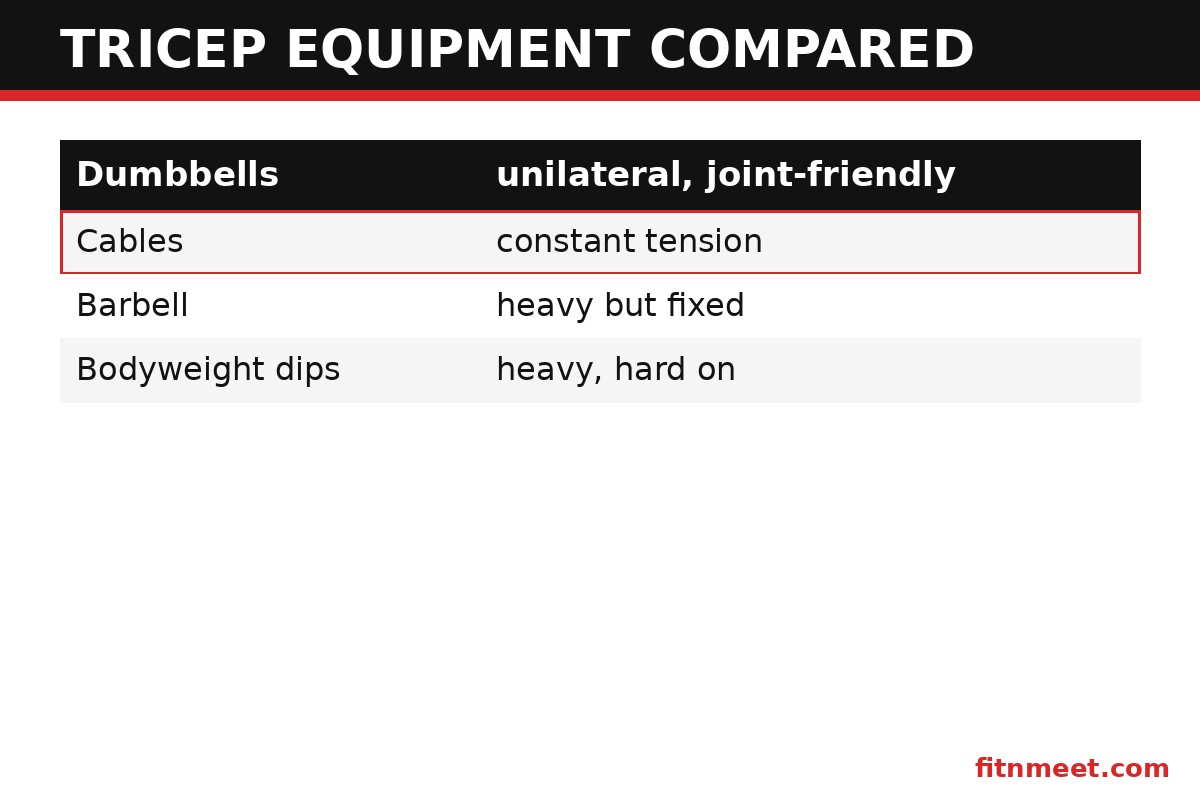
| Equipment | Best for | Imbalance correction | Home-friendly | Elbow comfort |
|---|---|---|---|---|
| Dumbbells | All-around tricep development | Excellent (unilateral) | Excellent | Excellent (free grip angle) |
| Cables | Constant tension, pushdowns | Good (single-arm possible) | Poor (needs machine) | Moderate |
| Barbell | Heavy skull crushers, JM press | Poor (bilateral) | Good | Poor (fixed grip) |
| Bodyweight (dips) | Heavy compound loading | Poor | Good (needs bars) | Poor for many |
| Resistance bands | Travel, rehab, finishers | Good | Excellent | Good |
The verdict: a tricep workout with dumbbells is the best default for most lifters — it combines the loading potential of free weights with unilateral balance and joint-friendly grip freedom. Cables are a fine complement for constant-tension finishers, and dips are great if your shoulders tolerate them, but dumbbells should be the foundation. For recovery between sessions, see FitnMeet’s workout recovery collection.
Safety and Side Effects
Tricep training is safe for healthy lifters, but elbows deserve respect. The most common issue is triceps tendon irritation from too much skull-crusher volume too soon — if the back of your elbow aches during or after extensions, cut volume by half for two weeks and favor kickbacks and presses, which load the tendon more gently. Never bounce out of the bottom of an overhead extension, and never train through sharp joint pain; muscle burn is fine, joint pain is a stop sign.
Most lifters can run a tricep workout with dumbbells pain-free for years by respecting the warm-up and volume rules above. General strength-training safety applies: warm up, use collars on adjustable dumbbells, and keep your lower back neutral on bent-over kickbacks — if your back rounds, the weight is too heavy. New lifters should start with 2–3 exercises rather than all six, adding one movement per week. For the science of progressive resistance exercise, see Wikipedia’s strength training overview.
Frequently Asked Questions
How many times per week should I do a tricep workout with dumbbells?
Once per week is enough if you do the full 6-exercise session (17-19 sets). Twice per week works better for most lifters if you split it into two shorter 3-exercise sessions, keeping total weekly sets in the 12-16 range. Leave at least 48 hours between direct tricep sessions.
Can I build big triceps with only dumbbells?
Absolutely. Dumbbells allow full range of motion, unilateral loading, and joint-friendly grip angles — everything triceps need to grow. The key drivers are progressive overload (adding weight or reps over time), training close to failure, and eating enough protein (1.6-2.2 g/kg/day), not the type of equipment.
What is the single best dumbbell tricep exercise?
The seated dumbbell overhead triceps extension. It loads the long head — the largest of the three tricep heads — in its most stretched position, and EMG research consistently ranks it among the highest-activation tricep movements. If you only have time for one exercise, make it this one.
Why do my elbows hurt during skull crushers?
Elbow pain during lying triceps extensions usually comes from too much volume too soon, a fixed grip angle that does not suit your joints, or lowering the weight to the forehead (which spikes tendon stress). Try lowering slightly behind the head, reduce volume for two weeks, and swap in kickbacks or close-grip presses, which are gentler on the elbows.
Should I train triceps with chest or on arm day?
Both work. After chest or shoulders is the most time-efficient option since the triceps are already warm from pressing. A dedicated arm day lets you hit triceps fresh with maximum focus and volume. Avoid training triceps the day before heavy pressing, since fatigue will limit your bench or overhead press performance.
How long until I see results from a tricep workout with dumbbells?
Strength gains typically appear within 3-4 weeks as your nervous system learns the movements. Visible size changes usually take 8-12 weeks of consistent training with progressive overload and adequate protein. Take a flexed arm measurement at the start so you can track the half-inch gains that photos miss.
Conclusion
A tricep workout with dumbbells is the highest-return arm training you can do: six exercises, one pair of dumbbells, all three heads covered. Start with overhead extensions for the long head, follow with lying extensions and kickbacks, finish with presses — 3–4 sets of 8–12 reps, strict form, progressive overload. Do that consistently for 8–12 weeks with enough protein, and your arms will look like they belong to a different person.
Ready to start? Grab your dumbbells, bookmark this tricep workout with dumbbells guide, and explore FitnMeet’s muscle development and shop pages for the recovery nutrition that turns today’s workout into tomorrow’s growth.
This article is for informational purposes only and is not medical advice. Stop any exercise that causes joint pain, and consult a healthcare professional or qualified coach if you have pre-existing elbow, shoulder, or wrist conditions.