
Vegetarian multivitamin supplements are daily multis formulated for people who avoid meat, with higher doses of the nutrients plant-based diets tend to lack: vitamin B12, iron, vitamin D3, zinc, iodine and omega-3s. Vegetarian multivitamin supplements use veggie capsules (no gelatin) and plant-sourced D3, filling predictable gaps without megadoses.
A Relatable Scenario
Priya has been vegetarian for three years. She eats well — lentils, vegetables, whole grains, dairy — and her energy was fine until about six months ago, when the afternoon slump started arriving at 2 p.m. sharp. Her doctor ran bloodwork: B12 borderline low, ferritin (iron stores) at the bottom of the range, vitamin D insufficient. Nothing dramatic. Just the slow, quiet drift that happens when a good diet has a few predictable holes.
Priya’s story is not unusual — it is the textbook case for vegetarian multivitamin supplements. Not because vegetarian diets are unhealthy (they are consistently linked to lower heart disease risk), but because a handful of nutrients are genuinely hard to get without meat. This guide walks through exactly which nutrients those are, how vegetarian multivitamin supplements address them, and how to choose one without falling for marketing.
What Are Vegetarian Multivitamin Supplements?
Vegetarian multivitamin supplements are daily multivitamins designed around the nutrient gaps of meat-free diets. Compared to standard multis, they typically contain more vitamin B12 (often 100–500% of daily value), iron in gentle chelated forms, plant-sourced vitamin D3 (from lichen rather than lanolin), extra zinc and iodine, and sometimes algae-based omega-3s. The capsules are vegetarian — usually pullulan or hypromellose — never gelatin, which is made from animal bones.
The “vegetarian” label on vegetarian multivitamin supplements is regulated loosely, so read the details. True vegetarian formulas exclude gelatin, carmine (a red insect-derived colorant) and lanolin-derived D3. Vegan formulas go further, excluding dairy-derived ingredients like whey. If you are strictly vegan, look for explicit vegan certification rather than assuming “vegetarian” covers it.
It is worth noting what vegetarian multivitamin supplements are not: they are not protein powders, not meal replacements and not a license to eat poorly. They supply micronutrients — vitamins and minerals measured in micrograms and milligrams. The macronutrients (protein, calories) still come from food. For the NIH’s overview of what multis do and do not do, see the NIH multivitamin fact sheet.
Why Vegetarian Multivitamin Supplements Matter
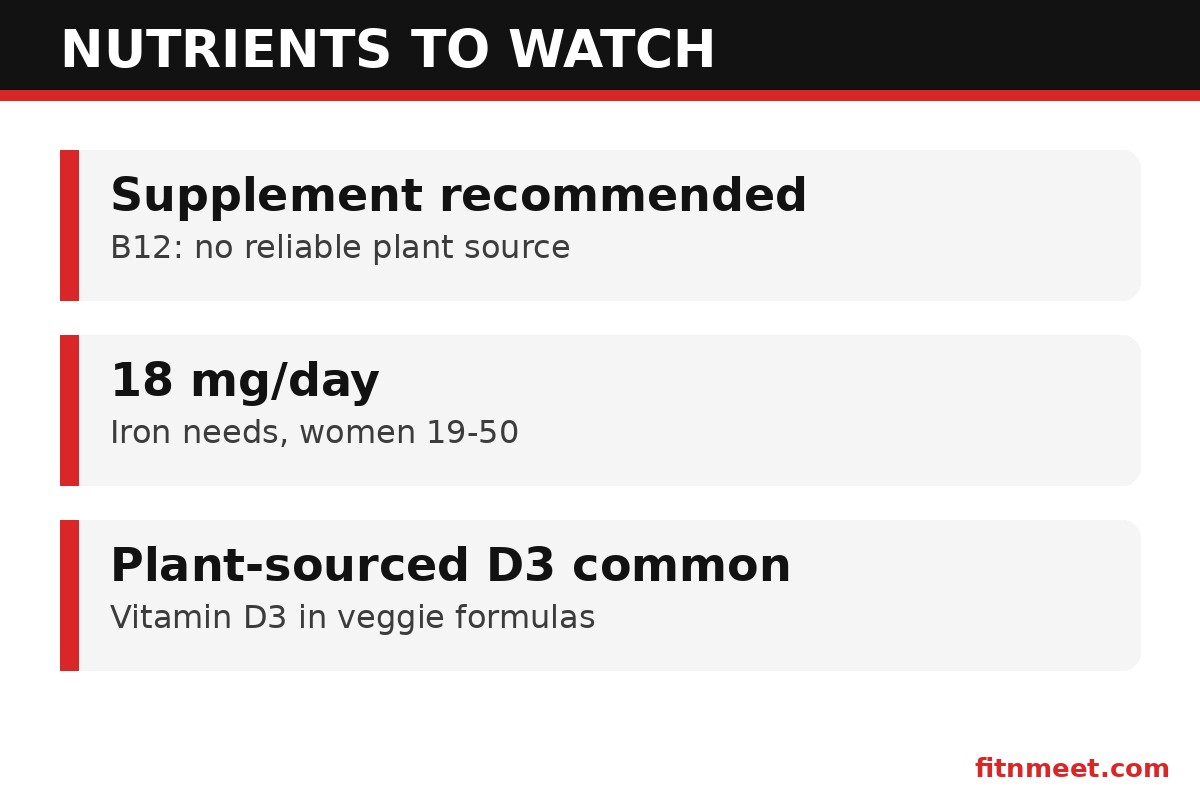
Four nutrients explain most of the story. Vitamin B12 has no reliable plant source — none. It is made by bacteria, and in modern food systems it reaches humans almost entirely through animal products or supplements. Studies of vegetarians find B12 deficiency rates of 30–50% without supplementation, and deficiency causes irreversible nerve damage if left untreated for years. This single nutrient justifies vegetarian multivitamin supplements on its own.
Iron exists in plants as non-heme iron, which the body absorbs at 2–10% efficiency versus 15–35% for heme iron from meat. Vegetarian women of childbearing age are the highest-risk group: the RDA is 18 mg/day, and plant-based diets often supply it in poorly absorbed form. Vitamin D is a shortfall for everyone in northern latitudes, but vegetarians miss the contribution from fatty fish and D-fortified dairy alternatives vary. Zinc absorption is inhibited by phytates in whole grains and legumes — the staples of vegetarian eating — raising requirements by an estimated 50%.
The pattern is consistent: vegetarian diets are rich in fiber, antioxidants, magnesium and folate, and structurally thin in B12, iron, D3, zinc and iodine. Vegetarian multivitamin supplements exist precisely because these gaps are predictable — you do not need bloodwork to know they are likely, though testing confirms the details. For more deep dives into plant-based nutrient gaps, explore the FitnMeet health articles.
Benefits of Vegetarian Multivitamin Supplements
- Reliable B12 status: The headline benefit. Daily B12 in vegetarian multivitamin supplements prevents the deficiency that 30–50% of unsupplemented vegetarians develop.
- Steadier energy: Correcting borderline iron and B12 shortfalls often resolves the afternoon fatigue that brings many vegetarians to supplements in the first place.
- Bone support: Vitamin D3 plus calcium and magnesium in quality vegetarian multivitamin supplements support bone density — relevant since some vegetarian diets run low on calcium too.
- Immune function: Zinc, D3 and B6 all play documented roles in immune cell function; covering shortfalls keeps the system running normally.
- Thyroid support: Iodine (often 75–150 mcg) matters for vegetarians who use non-iodized specialty salts — a small but real gap.
- Pregnancy safety net: Folate, B12, iron and iodine in vegetarian multivitamin supplements cover the nutrients most critical in vegetarian pregnancies (alongside a dedicated prenatal).
- Simplicity: One daily capsule replaces a cabinet of single-nutrient bottles — better adherence, lower cost, fewer decisions.
How to Use Vegetarian Multivitamin Supplements
Back to Priya: she bought a vegetarian multi with 200% DV B12, 18 mg iron as ferrous bisglycinate, 25 mcg lichen-based D3 and 11 mg zinc. She takes it with breakfast — the meal with the most fat, which aids absorption of the fat-soluble vitamins. Three months later, her B12 is mid-range and the 2 p.m. slump is gone. The routine that worked for her is the routine below.
- Take it with your largest meal. Vitamins A, D, E and K need dietary fat for absorption; taking vegetarian multivitamin supplements with breakfast or lunch (whichever has more fat) improves uptake.
- Separate iron from coffee and tea. Tannins cut non-heme iron absorption by 50% or more. Take your multi at least an hour away from coffee — breakfast coffee drinkers should use lunch.
- Pair iron with vitamin C. A glass of orange juice or bell peppers with the meal can double iron absorption. Many vegetarian multivitamin supplements include C for exactly this reason.
- Be consistent, not perfect. Missing a day changes nothing; missing a month does. Tie the habit to an existing routine — tooth-brushing, morning coffee, gym bag.
- Retest after 3 months. If you started because of low B12, iron or D, recheck bloodwork at 3 months to confirm the dose is working, then yearly.
Join Thousands of Smart Supplementers
Covering your bases is the foundation of any nutrition plan. Explore FitnMeet’s vitamins collection and the health support category, or browse the full FitnMeet shop.
Dosage: What’s Inside and How Much
A well-formulated vegetarian multi centers on the big four plus supporting players. B12: 25–100 mcg daily (1,000%+ DV looks alarming but B12 has no upper limit — absorption is capped around 1–2%, so high doses are how adequate uptake is ensured). Iron: 8–18 mg as ferrous bisglycinate or similar chelated form — gentler on the stomach than ferrous sulfate. Men and postmenopausal women need less (8 mg); menstruating women need the full 18 mg.
Vitamin D3: 25–50 mcg (1,000–2,000 IU) from lichen — the plant-sourced D3 that makes vegetarian multivitamin supplements genuinely vegetarian. Zinc: 8–15 mg as picolinate or citrate. Iodine: 75–150 mcg from kelp or potassium iodide. Folate: 400 mcg (as methylfolate in premium formulas). Supporting cast: vitamins A (as beta-carotene), E, K2, B6, and magnesium at modest doses.
What you should not see: megadoses across the board. A vegetarian multi with 5,000% DV of six B vitamins is marketing, not nutrition — water-soluble excess is simply excreted (expensive urine), and it signals a formula designed for label impressiveness rather than need. The Wikipedia overview of vegetarianism covers the dietary patterns these formulas are built to complement.
What to Watch For
- Hidden gelatin: Some “vegetarian” multis still use gelatin capsules. Confirm pullulan or hypromellose (HPMC) on the label.
- Lanolin-derived D3: Standard D3 comes from sheep’s wool lanolin. Vegetarian multivitamin supplements should specify lichen-sourced D3.
- Iron overload risk in men: Men who eat plenty of legumes and fortified foods may not need 18 mg iron. Excess iron accumulates — men should prefer formulas with 8 mg or get ferritin tested.
- Copper-zinc balance: High-dose zinc (above 40 mg/day) depletes copper. Quality vegetarian multivitamin supplements include 1–2 mg copper alongside zinc.
- Kelp iodine variability: Kelp-sourced iodine can vary wildly in dose. Potassium iodide is the more precise source — prefer it.
- Proprietary blends: “Veggie vitality blend 500 mg” tells you nothing. Every nutrient in vegetarian multivitamin supplements should list its exact dose.
- No third-party testing: NSF, USP or Informed Choice seals verify that the bottle contains what the label claims — non-negotiable for a daily supplement.
Vegetarian Multivitamin Supplements vs Standard Multis
| Feature | Vegetarian Multi | Standard Multi |
|---|---|---|
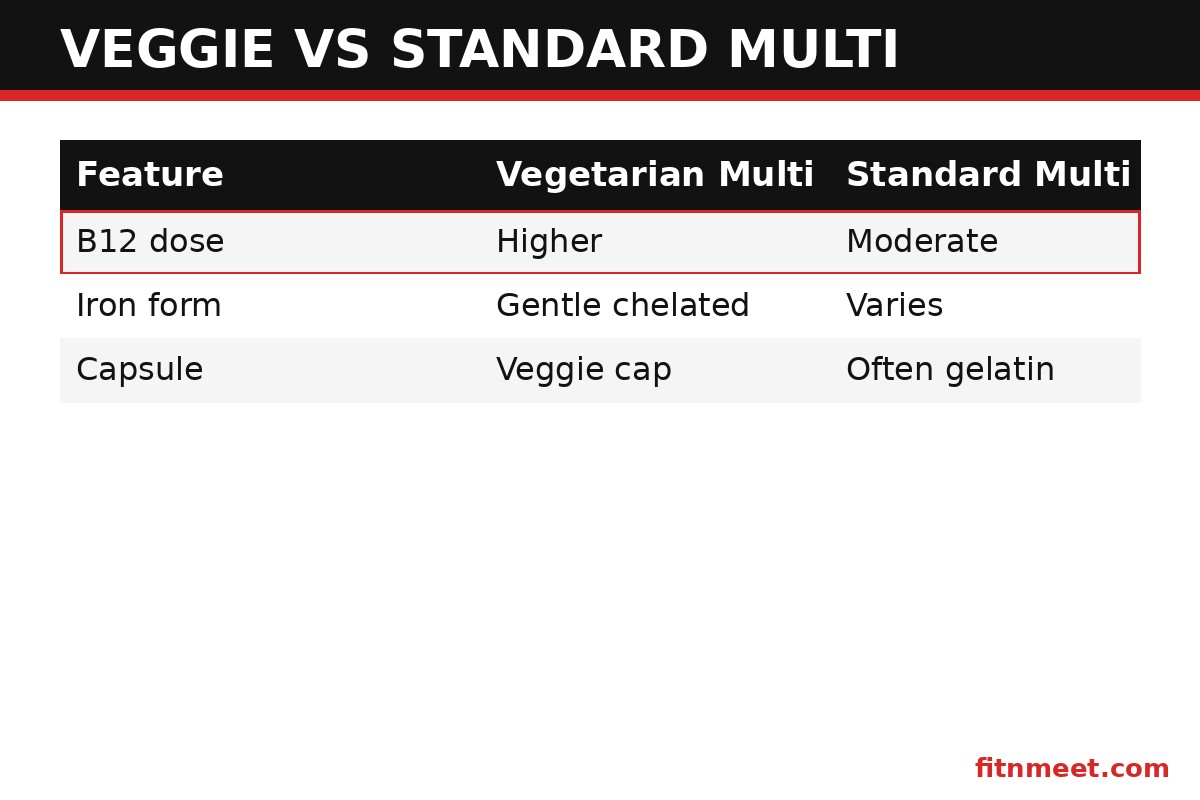
| B12 dose | High (100–500% DV) | Moderate (~100% DV) |
| Iron | Included, chelated forms | Often omitted (men’s formulas) |
| Vitamin D3 source | Lichen (plant) | Lanolin (sheep wool) |
| Capsule | Veggie (pullulan/HPMC) | Often gelatin |
| Zinc | Higher, phytate-adjusted | Standard |
| Omega-3s | Sometimes (algae) | Rarely |
| Best for | Vegetarians, vegans | Omnivores |
Meat-eaters can use vegetarian multivitamin supplements too — there is nothing in them that harms omnivores — but they may get more iron than needed. Conversely, vegetarians using standard multis miss the higher B12 and zinc they need and may swallow gelatin capsules unknowingly. Match the formula to the diet.
Frequently Asked Questions
Do vegetarians need multivitamin supplements?
Most vegetarians benefit from them. Vitamin B12 has no reliable plant source, and iron, vitamin D3, zinc and iodine are structurally harder to obtain without meat. Vegetarian multivitamin supplements fill these predictable gaps; they are not needed because vegetarian diets are unhealthy, but because a few nutrients are scarce in meat-free eating.
What should vegetarian multivitamin supplements contain?
The essentials are vitamin B12 (25 to 100 mcg), iron (8 to 18 mg in chelated form), vitamin D3 from lichen (25 to 50 mcg), zinc (8 to 15 mg), iodine (75 to 150 mcg) and folate (400 mcg). Look for veggie capsules, plant-sourced D3, exact doses for every nutrient, and third-party testing.
What is the difference between vegetarian and vegan multivitamins?
Vegetarian multivitamin supplements exclude meat and gelatin but may contain dairy-derived ingredients. Vegan multis exclude all animal-derived ingredients including dairy, eggs and lanolin-based D3. Strict vegans should choose explicitly vegan-certified products.
Can vegetarian multivitamin supplements cause side effects?
At labeled doses they are well tolerated. Iron can cause mild nausea or constipation in sensitive people — taking vegetarian multivitamin supplements with food and choosing chelated iron forms minimizes this. Men should avoid high-iron formulas unless deficient, since excess iron accumulates.
When should I take vegetarian multivitamin supplements?
Take vegetarian multivitamin supplements with your largest meal of the day — dietary fat improves absorption of vitamins A, D, E and K. Keep them at least an hour away from coffee or tea, since tannins sharply reduce iron absorption.
Can meat-eaters take vegetarian multivitamin supplements?
Yes. There is nothing in vegetarian multivitamin supplements that harms omnivores. The only consideration is iron: meat-eaters, especially men, should prefer lower-iron vegetarian formulas or get ferritin tested, since they already obtain heme iron from meat.
Conclusion
Priya’s story ends the way most of these stories end: not with a dramatic transformation, but with the quiet return of normal — steady energy, solid bloodwork, one less thing to think about. Vegetarian multivitamin supplements do exactly one job: they fill the handful of gaps that plant-based eating structurally creates. Pick a formula with real B12, chelated iron, lichen D3 and honest labeling, take it with food every day, and get on with your life.
Eating plant-based and training hard? Read FitnMeet’s nutrition guides and browse the vitamins collection to complete your routine.
This article is for informational purposes only and is not medical advice. Consult a healthcare professional before starting any supplement.