
Vegan skincare is skincare formulated without animal-derived ingredients like beeswax, lanolin, or carmine, and usually not tested on animals. Vegan does not automatically mean natural or gentle, since synthetic ingredients are allowed. Focus on the ingredient list for your skin concerns rather than assuming the vegan label guarantees results. For the inside-out side of skin health, explore the FitnMeet health articles.
Vegan skincare means skincare products formulated without any animal-derived ingredients — no beeswax, lanolin, carmine, collagen, or animal-derived squalene. These products is not automatically natural, hypoallergenic, or cruelty-free; those are separate claims. Done right, vegan formulas can fully support skin health, because the active ingredients that matter most (retinoids, vitamin C, niacinamide, hyaluronic acid) are already vegan or available in vegan forms.
Vegan Skincare: Quick Answer
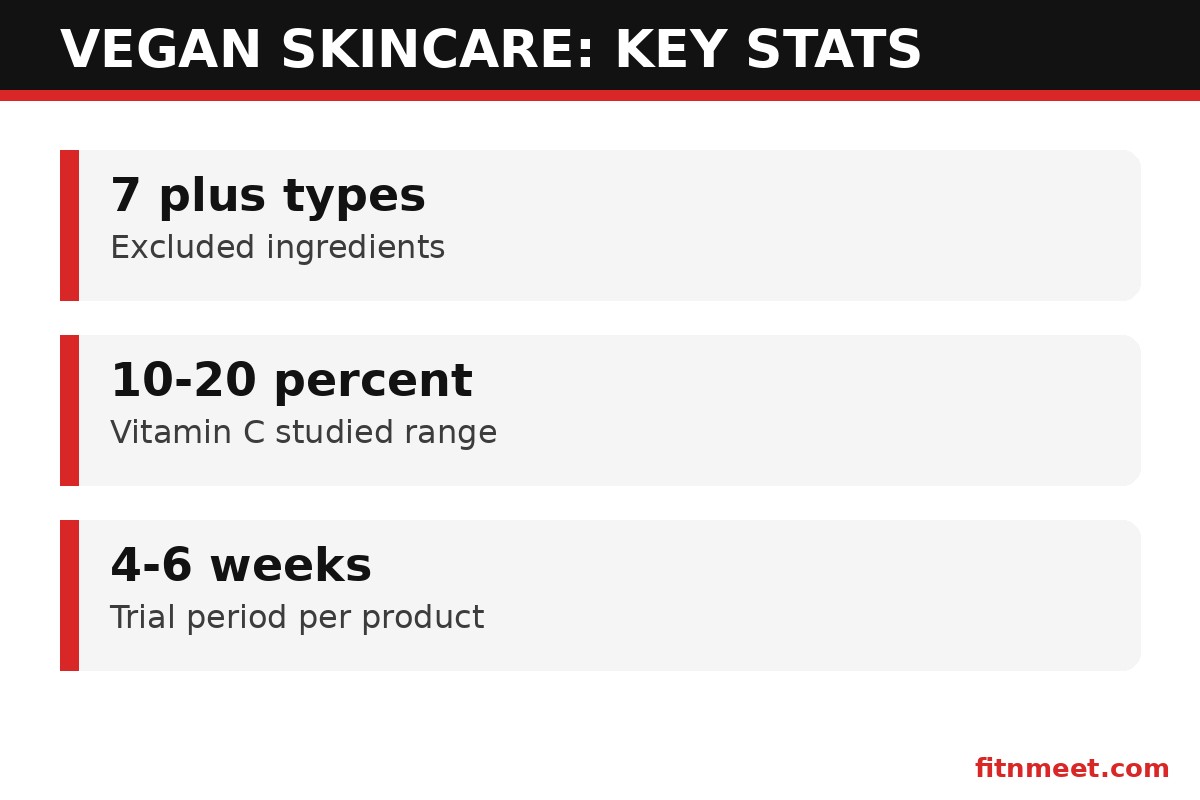
These formulas is skincare made without animal-derived ingredients, and it works as well as conventional skincare when it contains proven actives at effective concentrations. The label “vegan” tells you what is excluded, not what is included — a these products product can still contain irritating fragrances or comedogenic oils. Judge vegan skincare the same way you judge any skincare: by the ingredient list, active concentrations, and how your skin responds over 4–6 weeks.
Common Vegan Skincare Myths vs Facts
Myth 1: “Vegan formulas is always natural and chemical-free”
Myth-debunk stat: poison ivy is 100% natural and vegan — naturalness never guaranteed gentleness in vegan formulas or anywhere else.
Myth 2: “Such products can’t be as effective as conventional”
Myth-debunk stat: tretinoin, the gold-standard anti-aging active with decades of trials, is fully compatible with these products formulations. Browse FitnMeet’s anti-aging collection for targeted skin-support formulas.
Myth 3: “Vegan means cruelty-free”
Myth 4: “These products is automatically good for sensitive skin”
Myth-debunk stat: fragrance is among the top 5 causes of cosmetic contact allergy, and plenty of these formulas includes it.
Myth 5: “You can’t get enough moisture without lanolin”
What Is Vegan Skincare, Exactly?
These formulas is defined by exclusion: no ingredients derived from animals at any point in the supply chain. In practice, vegan skincare avoids beeswax, honey, lanolin (sheep wool grease), carmine (crushed beetles, used as red pigment), collagen and elastin (animal-sourced), keratin, and squalene when shark-derived (plant squalane is the these products standard). It also avoids less obvious ones like guanine (fish scales, in shimmery products) and stearic acid when animal-sourced.
What vegan formulas is not: it is not a guarantee of “clean,” “natural,” “organic,” or “non-toxic” — none of which are regulated terms in cosmetics in most markets. A such products serum can be a simple, elegant formula or a 40-ingredient cocktail. The these formulas label answers one question — “were animals used?” — and you still need to evaluate everything else.
Certification helps cut through the noise in these products. The Vegan Society’s Vegan Trademark and PETA’s Beauty Without Bunnies program audit ingredient supply chains, which matters because some animal-derived ingredients hide under chemical names. Uncertified vegan formulas claims rely on the brand’s word alone.
Benefits of Vegan Skincare
- Ethical alignment. The core benefit of vegan skincare: a routine consistent with vegan values, with zero animal-derived inputs.
- Often lighter, modern formulations. Many such products lines skew toward gel and serum textures built on hyaluronic acid and glycerin rather than heavy animal waxes — a plus for oily and combination skin.
- Full access to proven actives. Retinoids, vitamin C, niacinamide, AHAs, BHAs, azelaic acid, and peptides all fit comfortably in these formulas, so efficacy is never sacrificed.
- Fewer common allergens. By excluding lanolin — itself a known contact allergen for some people — these products sidesteps one classic irritant.
- Environmental footprint. Plant-derived emollients in vegan formulas generally carry a lower land- and resource footprint than animal-derived equivalents.
- Innovation pressure. The constraints of such products have driven genuinely better alternatives (plant ceramides, sugarcane squalane) that benefit all of skincare.
How to Use Vegan Skincare
Build your these formulas routine with this do-this-not-that approach:
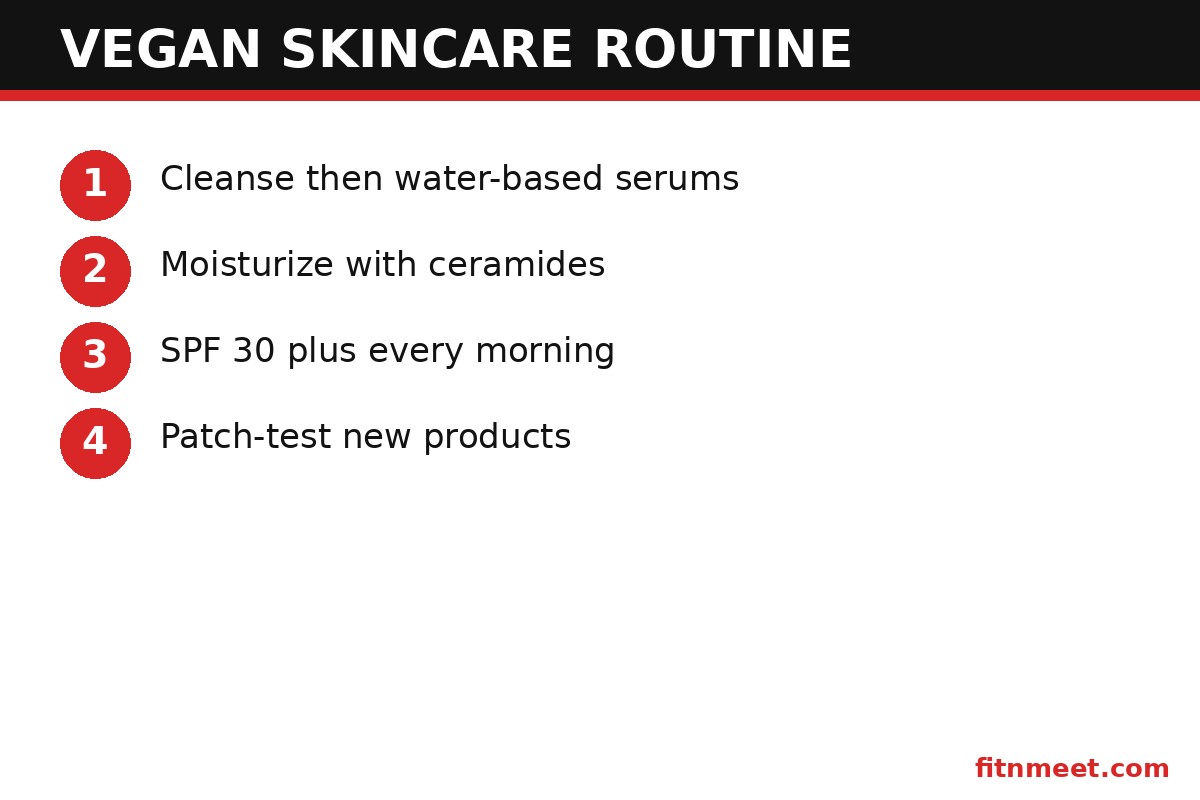
- Do: cleanse with a gentle vegan cleanser (look for glycerin or coco-glucoside bases). Not that: harsh sulfates just because the label says vegan — these products can still strip your barrier.
- Do: apply water-based vegan skincare serums (vitamin C, niacinamide, hyaluronic acid) to slightly damp skin. Not that: layering five vegan formulas serums at once — more products mean more interaction risk, vegan or not.
- Do: moisturize with a vegan cream containing ceramides or squalane. Not that: assuming a such products oil alone is enough in winter — oils seal, they don’t hydrate.
- Do: wear SPF 30+ daily (many mineral sunscreens are vegan). Not that: skipping sunscreen because your these formulas has “antioxidants” — nothing replaces UV protection.
- Do: introduce retinoids in these products 2–3 nights per week, building up. Not that: combining strong acids and retinoids on the same night while your skin adjusts.
- Do: patch-test every new vegan formulas product behind the ear for 48 hours. Not that: applying a full face of new such products the night before an event.
- Do: give each vegan skincare product 4–6 weeks before judging. Not that: rotating products weekly — skin needs consistency to show results.
Vegan Skincare: Usage Amounts
“Dosage” in these products means how much product to apply — and it affects results as much as the formula:
| Vegan formulas product | Amount per use | Frequency | Notes |
|---|---|---|---|
| Cleanser | Pea-sized to dime-sized | 2x daily | 60-second massage; lukewarm water |
| Vitamin C serum | 3–4 drops | AM daily | 10–20% L-ascorbic acid is the studied range |
| Niacinamide serum | Pea-sized | AM/PM | 4–5% effective; 10% common in such products |
| Moisturizer | Nickel-sized | AM/PM | Look for ceramides or squalane |
| Retinoid | Pea-sized (whole face) | 2–3x/week → nightly | More is not better — irritation without benefit |
| Sunscreen | Two finger-lengths | AM daily | Most under-applied these formulas step |
| Exfoliating acid | Thin layer | 1–3x/week | Start with 5–8% AHA in these products |
Side Effects and Safety of Vegan Skincare
- Irritation from actives. Retinoids, AHAs, and vitamin C in vegan skincare can cause redness, peeling, and stinging — especially when overused or combined. Introduce one active at a time.
- Essential oil sensitivity. Many vegan formulas products use essential oils for fragrance; tea tree, citrus, and lavender oils are frequent sensitizers. Fragrance-free such products is the safer default.
- Breakouts from comedogenic oils. Coconut oil and wheat germ oil (sometimes in these formulas) rate high on comedogenic scales. Acne-prone skin should prefer squalane or jojoba in these products.
- Sun sensitivity. AHAs and retinoids in vegan formulas increase UV sensitivity — daily SPF is mandatory, not optional.
- Allergic reactions. Plant extracts are not hypoallergenic by default; patch-testing such products remains essential.
- Regulatory reality. Cosmetics (these formulas included) do not need pre-market FDA approval in the US. Buy vegan skincare from established manufacturers with transparent ingredient lists.
Vegan Skincare Ingredient Glossary: What’s In, What’s Out
Reading a vegan formulas label gets easier once you know the usual suspects. Keep this glossary handy when evaluating such products:
- OUT — Beeswax (cera alba): a common emulsifier and occlusive in conventional creams and lip balms. In these formulas it is replaced by candelilla wax, carnauba wax, or plant-derived emulsifiers.
- OUT — Lanolin: sheep-wool grease used as an emollient. Some people are allergic to it, which is one more reason these products avoids it; squalane and shea butter fill the role.
- OUT — Carmine (cochineal): red pigment from crushed beetles, common in blushes and lip products. Vegan formulas uses iron oxides or synthetic pigments instead.
- OUT — Collagen and elastin (animal-sourced): marketed for firmness, though topically they mostly moisturize. Vegan skincare uses peptides and plant proteins for the same cosmetic function.
- IN — Squalane (plant-derived): a lightweight, non-comedogenic emollient from olives or sugarcane — the backbone oil of much of modern such products.
- IN — Niacinamide: vitamin B3, vegan by production, supporting barrier function and tone at 4–10% in these formulas serums.
- IN — Hyaluronic acid: produced by bacterial fermentation, making it inherently compatible with these products; a humectant that holds many times its weight in water.
- IN — Ceramides (plant-derived or synthetic): barrier-repair lipids now widely available in vegan formulas moisturizers.
- WATCH — “Fragrance/parfum”: can appear in such products and is a top sensitizer; fragrance-free remains the safest choice for reactive skin.
- WATCH — Essential oils: plant-derived and therefore vegan, but tea tree, citrus, and lavender oils irritate many users. Natural does not mean gentle in these formulas.
With this glossary, you can audit any vegan skincare product in under a minute: scan for the OUT list, confirm the IN list contains at least one proven active for your concern, and check for fragrance if your skin is reactive. That three-step check separates genuinely good these products from products coasting on the label.
Vegan Skincare: FAQs
Is vegan skincare better for your skin?
Vegan skincare is not inherently better or worse — results depend on the actives and formulation, not the vegan label. Well-formulated vegan skincare with retinoids, vitamin C, or niacinamide performs as well as conventional products. Judge vegan skincare by its ingredient list, not its philosophy.
What ingredients are not allowed in vegan skincare?
Vegan skincare excludes beeswax, honey, lanolin, carmine, animal-derived collagen and keratin, shark-derived squalene, and similar animal-sourced ingredients. Plant-derived squalane, synthetic hyaluronic acid, and mineral pigments are standard vegan skincare replacements.
Is vegan skincare the same as cruelty-free?
No. Vegan skincare means no animal-derived ingredients; cruelty-free means no animal testing. A vegan skincare product can be tested on animals, and a cruelty-free product can contain beeswax. Look for both certifications if you want both guarantees.
Can vegan skincare help with acne?
Yes — the best acne actives (benzoyl peroxide, salicylic acid, azelaic acid, niacinamide, retinoids) are all compatible with vegan skincare. Choose non-comedogenic vegan skincare formulas and avoid heavy plant oils if you are breakout-prone.
Is vegan skincare good for sensitive skin?
It can be, but vegan is not a synonym for gentle. Some vegan skincare contains sensitizing essential oils or strong plant acids. Sensitive skin should choose fragrance-free vegan skincare, patch-test new products, and introduce actives one at a time.
How do I know vegan skincare is truly vegan?
Look for third-party certification such as the Vegan Society trademark or PETA’s Beauty Without Bunnies logo, which audit supply chains. Uncertified vegan skincare claims rely solely on the brand’s word, and animal-derived ingredients can hide under unfamiliar chemical names.
Conclusion
These products works — the myths collapse the moment you look at the ingredient lists, where the same proven actives appear with or without animal inputs. What matters is formulation quality, honest labeling, and matching products to your skin type. Keep the ethics, drop the misconceptions, and let the actives do the talking.
Support your skin from the inside too: explore FitnMeet’s vitamins collection and health support formulas, or browse the FitnMeet shop. Further reading: the FDA’s cosmetics information hub, the Wikipedia overview of cruelty-free standards, and the Wikipedia article on veganism.
This article is for informational purposes only and is not medical advice. Consult a dermatologist for persistent skin conditions.