
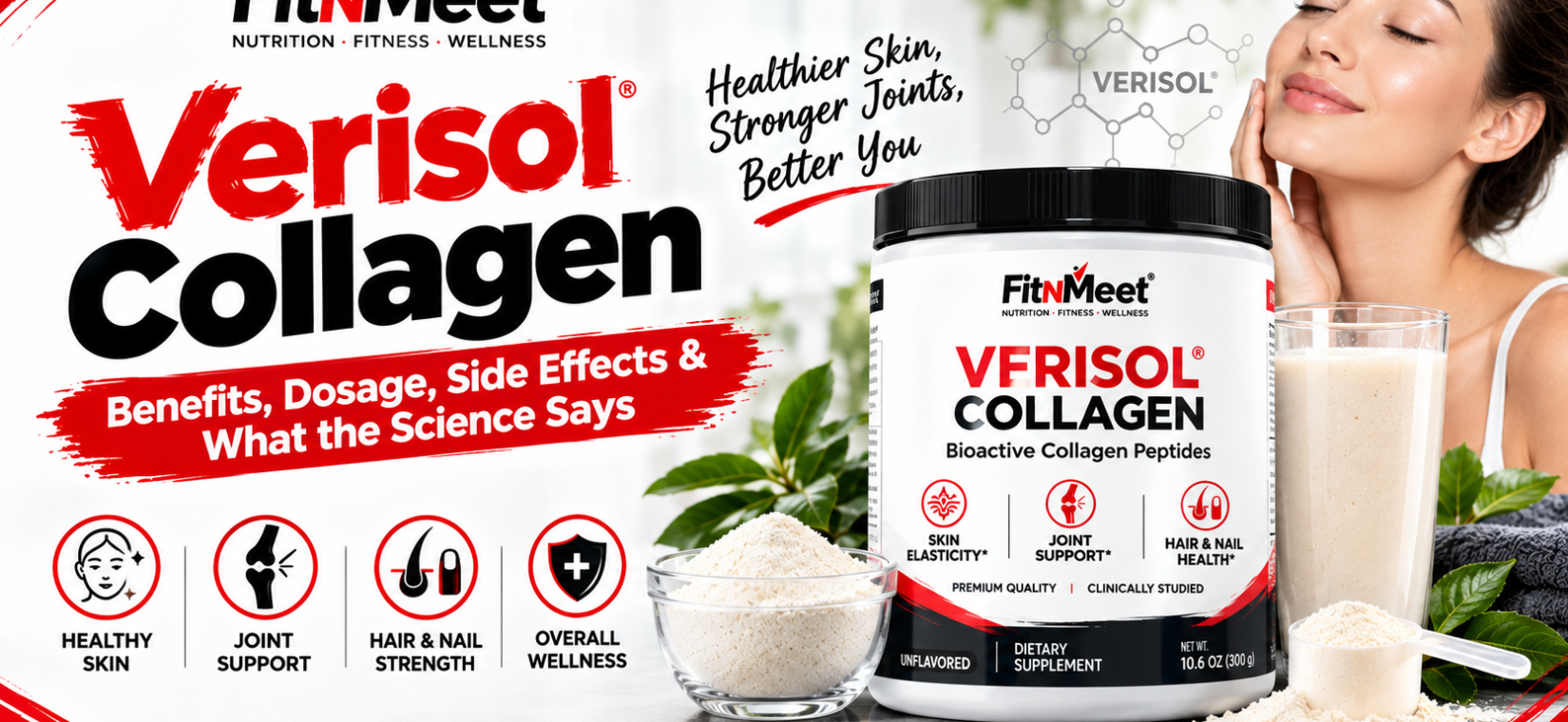
Verisol collagen is a branded form of bioactive collagen peptides made from type I collagen and studied in human trials for skin health. The most researched dose is 2.5 grams per day, which in clinical studies improved skin elasticity and reduced wrinkle volume over 4 to 8 weeks of daily use.
Quick definition: Verisol collagen refers to specific bioactive collagen peptides (average molecular weight around 2 kDa) produced by enzymatic hydrolysis of type I collagen. Unlike generic collagen powder, it has a defined peptide profile that has been tested in randomized, placebo-controlled human trials for effects on skin, and in some studies on cellulite appearance and nail growth.
What Is Verisol Collagen?
Verisol collagen is a specific, trademarked preparation of bioactive collagen peptides derived from type I collagen — the same collagen type that makes up roughly 80 to 90 percent of the collagen in human skin. It is produced through enzymatic hydrolysis, a process that breaks long collagen protein chains into short peptides with an average molecular weight of about 2 kilodaltons (kDa). This small size matters because short peptides are more readily absorbed in the digestive tract than intact collagen protein.
What separates verisol collagen from the generic collagen powder on store shelves is standardization. Generic “collagen peptides” can come from many sources (bovine hides, fish skin, chicken sternum), with widely varying peptide profiles and molecular weights. Verisol collagen, by contrast, is manufactured to a defined specification with particular bioactive peptide sequences that have been used consistently across the published clinical trials. That consistency is exactly what allows researchers — and consumers — to connect the study results to the product. When a trial reports that it improved skin elasticity, you know precisely which peptide preparation was tested.
To understand how it works, it helps to know what collagen itself does. Collagen is the most abundant protein in the human body, forming the structural scaffold of skin, tendons, ligaments, cartilage, and bones. In skin, collagen fibers in the dermis provide firmness and tensile strength, while elastin provides snap-back elasticity and hyaluronic acid holds moisture. Fibroblasts — the skin’s manufacturing cells — produce all three. The central idea behind this supplementation is that its bioactive peptides survive digestion, enter the bloodstream, accumulate in skin tissue, and stimulate fibroblasts to produce more of the skin’s own collagen, elastin, and hyaluronic acid.
This is not just a theory. Researchers have detected collagen-derived peptides such as Pro-Hyp (proline-hydroxyproline) in human blood after oral ingestion of collagen peptides, and cell studies show these peptides can stimulate fibroblast activity. So the proposed mechanism — absorb, distribute to skin, stimulate fibroblasts — has support at each step, even if the full picture of how much ends up in skin versus other tissues is still being mapped.
Why Verisol Collagen Matters: Skin Aging and Collagen Loss
Skin aging has two drivers: intrinsic aging (the clock) and extrinsic aging (mostly sun exposure). Both converge on the same problem — the gradual breakdown of the skin’s collagen matrix. Research estimates that after about age 25 to 30, the skin’s collagen content declines by roughly 1 percent per year, and the remaining collagen becomes increasingly fragmented and disorganized. By the time most people reach their 40s and 50s, measurable losses in dermal collagen density translate into the visible signs everyone recognizes: fine lines, deeper wrinkles, sagging, and thinner, drier skin.
Ultraviolet radiation accelerates this process dramatically. UV exposure activates enzymes called matrix metalloproteinases (MMPs) that chew up collagen fibers, while simultaneously suppressing new collagen synthesis. Dermatologists estimate that up to 80 percent of visible facial aging is attributable to sun exposure rather than the passage of time alone. No supplement — this one included — replaces sunscreen, but supporting the skin’s collagen from the inside is a logical complement to protecting it from the outside.
This is the context in which it earned its reputation. Most collagen supplements on the market make skin claims based on general collagen research or no research at all. It is unusual in that its specific preparation has been tested in randomized, double-blind, placebo-controlled trials measuring objective skin outcomes: wrinkle volume (measured with 3D skin imaging), skin elasticity (measured with a cutometer device), and dermal collagen density (measured with ultrasound). For a category full of marketing claims, that level of evidence is the reason it keeps appearing in conversations about skin supplements.
Verisol Collagen Benefits: What the Research Shows
Below are the best-studied potential benefits, separated by strength of evidence. Every claim here traces back to a published human trial using this preparation specifically — not generic collagen studies borrowed for marketing.
Reduced wrinkle volume and improved skin elasticity
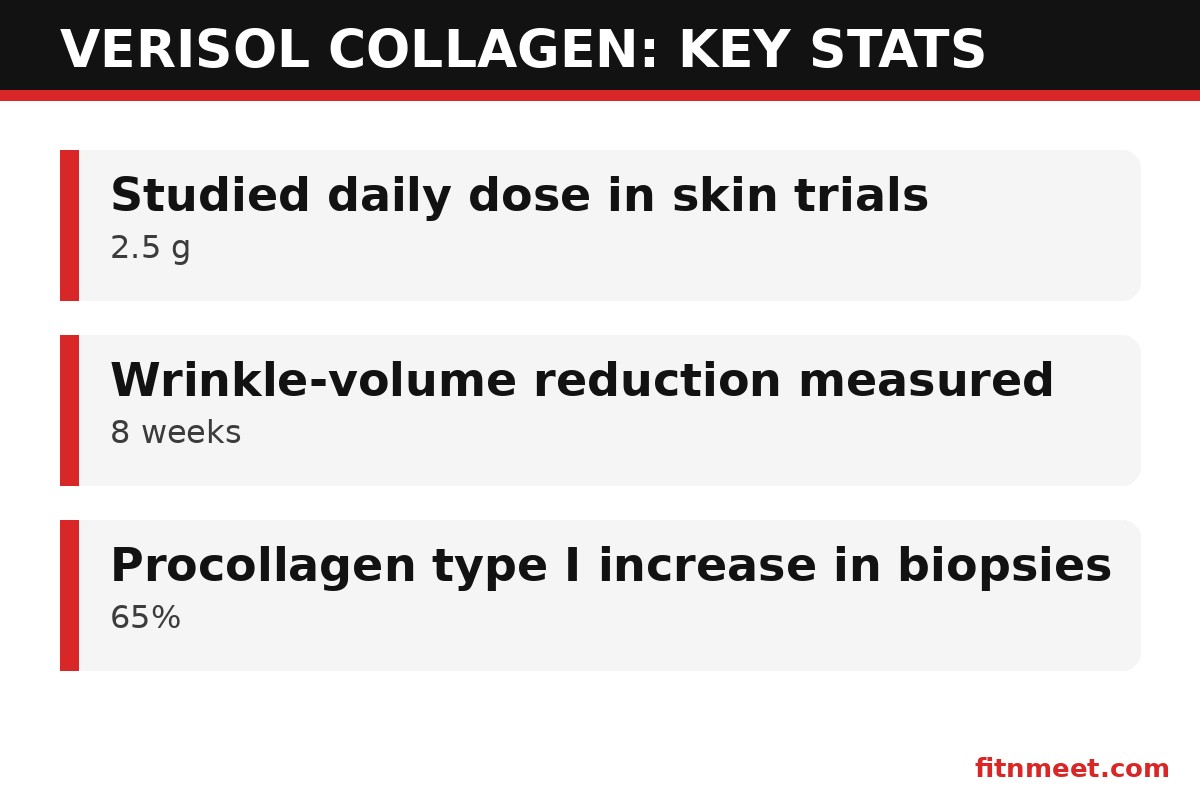
The flagship study is Proksch et al. (2014), published in Skin Pharmacology and Physiology: 114 women aged 45 to 65 took 2.5 grams of the peptides or placebo daily for 8 weeks. Eye wrinkle volume decreased significantly in the active group compared with placebo, and the effect persisted 4 weeks after supplementation stopped. Skin biopsies in a subgroup showed increased procollagen type I (up 65 percent) and elastin (up 18 percent) — direct evidence that the peptides were stimulating the skin’s own structural proteins, not just masking wrinkles.
Increased skin elasticity in a second trial
Hexsel et al. (2017) in the Journal of Cosmetic Dermatology tested 2.5 grams daily in women aged 35 to 55. After 4 weeks, skin elasticity improved significantly versus placebo, with the improvement maintained through the 8-week study period. An 8-week follow-up suggested lasting effects. Two independent trials finding the same outcome at the same dose is a meaningful signal in supplement research.
Improved cellulite appearance
Schunck et al. (2015) in the Journal of Medicinal Food gave 105 women aged 24 to 50 either 2.5 grams of the peptides or placebo daily for 6 months. The active group showed a statistically significant improvement in the degree of cellulite and reduced skin waviness on the thighs. The proposed mechanism: it strengthens the dermal connective tissue that, when weakened, allows fat lobules to push through and create the dimpled appearance.
Stronger, faster-growing nails
The same research group (Hexsel et al., 2017) studied the peptides at 2.5 grams daily for 24 weeks in women with brittle nails. Nail growth rate increased by 12 percent, and the frequency of broken nails decreased by 42 percent. Most participants rated the treatment positively. Nails are made of keratin, not collagen, so the effect is thought to come from improved nail-matrix health rather than direct collagen deposition.
What it has NOT been proven to do
Honesty matters here. It has not been shown in published trials to regrow hair, heal joints, or build muscle — those claims belong to other collagen preparations or to marketing imagination. The evidence is skin-focused: wrinkles, elasticity, cellulite appearance, and nails. If joint support is your goal, look at collagen types II or undenatured type II instead, and browse FitnMeet’s joint support collection for options formulated for that purpose.
How to Use Verisol Collagen (Step-by-Step)
Getting results is mostly about consistency and correct dosing. Follow these steps:
- Confirm the product actually contains it. Look for “Verisol” (sometimes listed as “bioactive collagen peptides Verisol”) on the supplement facts panel or ingredient list, not just “collagen peptides.” Only products using the studied preparation can legitimately lean on the trial results.
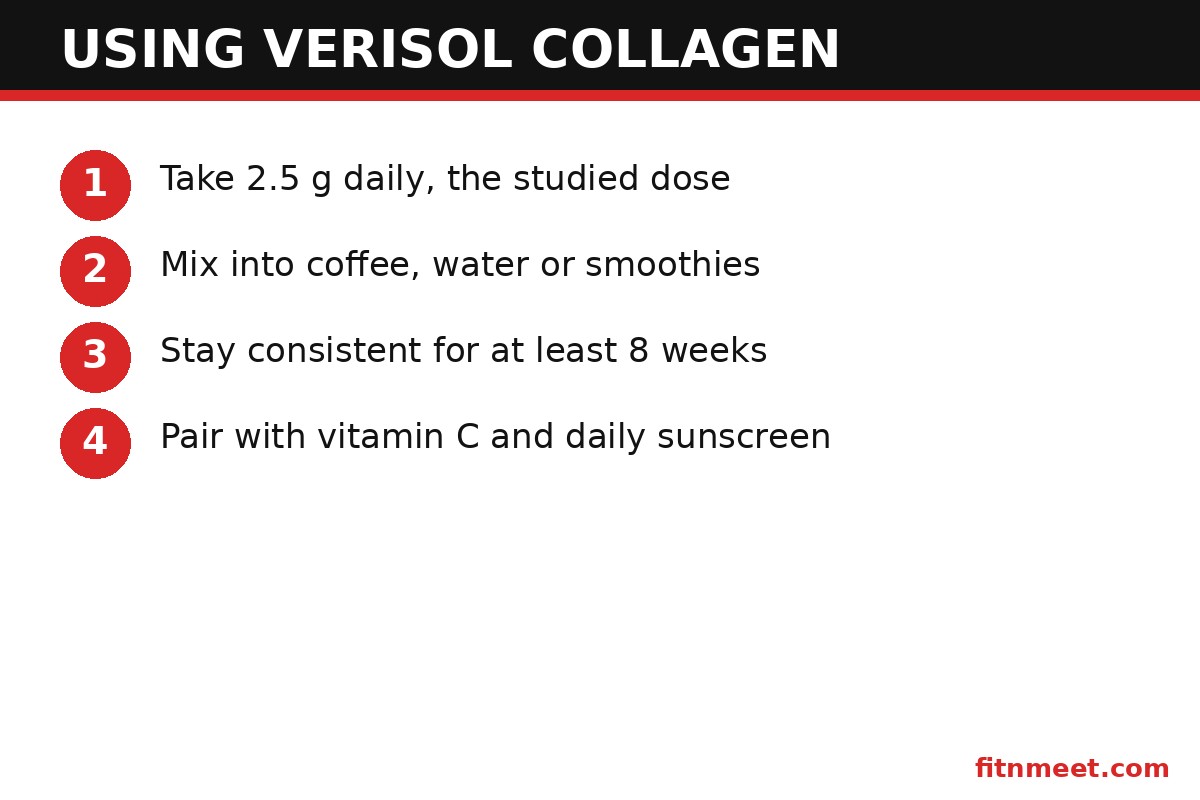
- Take 2.5 grams daily. This is the dose used in every major skin trial of these peptides. Measure with the provided scoop or count capsules to hit the dose — under-dosing is the most common reason people see no results.
- Pick a consistent time. Morning in coffee, water, or a smoothie works for most people. These peptides are heat-stable and dissolve well in hot or cold liquids, and they are essentially tasteless, so timing is about habit, not chemistry.
- Pair it with vitamin C. Vitamin C is a required cofactor for collagen synthesis in the body. The NIH Office of Dietary Supplements notes its essential role in collagen formation. Taking it alongside vitamin C-rich food or a vitamin supplement is sensible nutritional support.
- Commit to at least 8 weeks. Trials measured significant changes at 4 weeks (elasticity) and 8 weeks (wrinkles). Skin remodels slowly — judging it after 10 days is like judging a workout program after two sessions.
- Protect the investment. Daily sunscreen and avoiding smoking do more for skin collagen than any supplement. Think of it as one layer of a skin-health stack, not a standalone fix.
Verisol Collagen Dosage
The evidence-based dosage is 2.5 grams per day — the amount used in the wrinkle, elasticity, cellulite, and nail trials. A few studies have tested 5 grams daily with similar or slightly larger effects, but 2.5 grams is the sweet spot where efficacy is proven and cost per serving stays reasonable.
It has no established upper limit from toxicity data because collagen peptides are essentially digested protein — your body treats them like food. That said, more is not automatically better: no trial has shown that 10 grams outperforms 2.5 grams for skin outcomes. If you are also taking generic collagen for protein intake, keep this dose separate in your mind — it is a functional dose for skin, not a protein serving.
Practical tip: most powders provide 2.5 grams in a single small scoop (roughly half a tablespoon), far less than the heaping scoops of generic collagen. Check the label math so you are actually getting the studied dose and not just a dusting inside a proprietary blend.
Verisol Collagen Side Effects and Safety
It has an excellent safety profile in the published trials — no serious adverse events were attributed to it in the skin, cellulite, or nail studies. Collagen peptides have GRAS (Generally Recognized As Safe) status with the U.S. FDA for use in foods, and it is simply a standardized subset of these peptides.
The most commonly reported minor issues with collagen peptides generally are mild digestive complaints — a feeling of fullness or occasional bloating — particularly when people start with large doses. At the small 2.5-gram dose, even these are uncommon. People with allergies to the source material (it is bovine-derived) should avoid it, and anyone who is pregnant, breastfeeding, or managing a medical condition should check with a clinician first, as trials excluded these groups.
One quality note: because it is a branded ingredient, reputable manufacturers license it and list it by name. Be wary of products that claim “verisol collagen results” while listing only generic “collagen peptides” — the trial evidence attaches to the specific preparation, not the word collagen.
Verisol Collagen vs Other Collagen Types
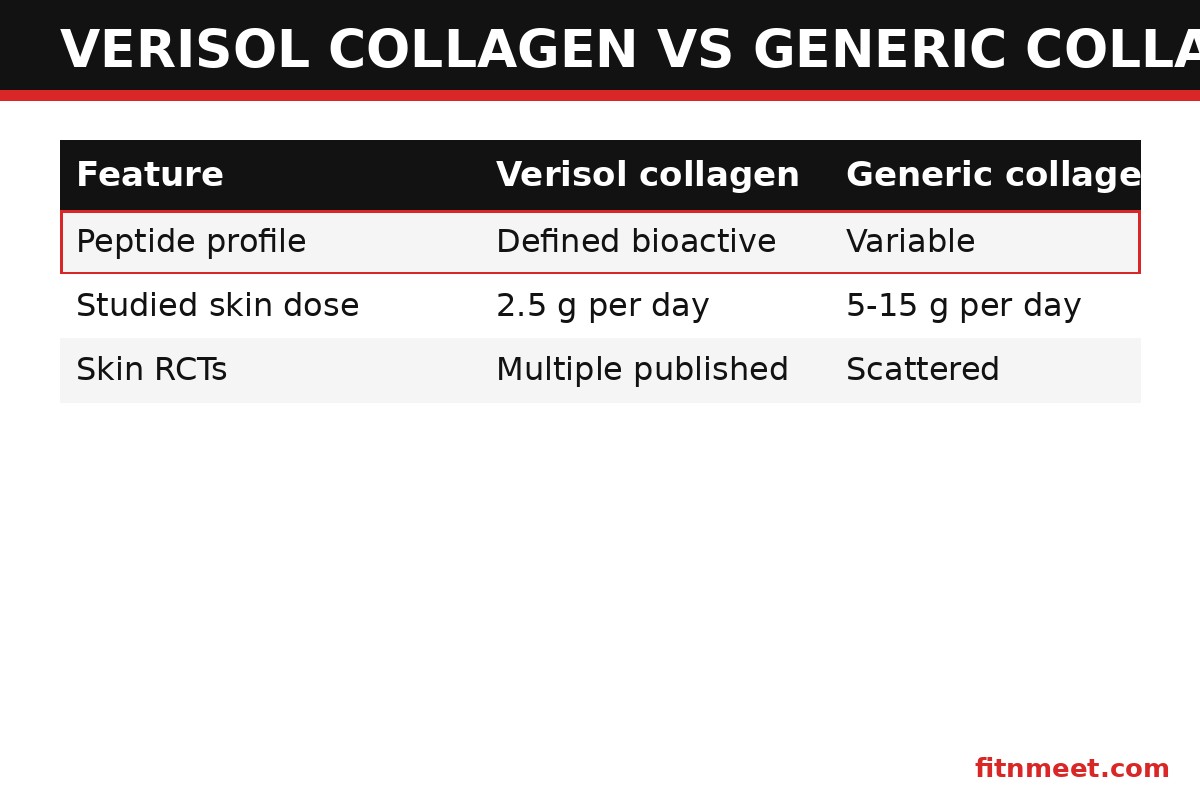
| Feature | Verisol collagen | Generic collagen peptides | Gelatin |
|---|---|---|---|
| Peptide profile | Defined bioactive peptides, ~2 kDa average | Variable, often 3–6 kDa | Large, partially hydrolyzed protein |
| Source | Type I bovine collagen, standardized | Mixed sources and types | Bovine or porcine |
| Studied skin dose | 2.5 g/day in multiple RCTs | 5–15 g/day in scattered trials | Rarely studied for skin |
| Wrinkle evidence | 2 RCTs showing reduced wrinkle volume | Mixed, preparation-dependent | Minimal |
| Elasticity evidence | RCT: improved at 4 and 8 weeks | Some positive trials | Little data |
| Cellulite data | 6-month RCT showing improvement | Virtually none | None |
| Taste/solubility | Neutral, dissolves in hot/cold liquids | Usually neutral | Gels when cooled |
| Typical cost per month | Moderate (small daily dose) | Low to moderate | Low |
The takeaway: if your goal is specifically skin — wrinkles, elasticity, firmness — it has the most targeted evidence per gram. If your goal is general protein intake or joint support, other collagen preparations may make more sense. For broader skin-health nutrition, pair it with the fundamentals in FitnMeet’s anti-aging collection.
Alternatives to Verisol Collagen
- Marine collagen peptides: type I collagen from fish skin; some skin trials exist, and it suits those avoiding bovine products.
- Generic bovine collagen peptides: cheaper per gram; reasonable if you want higher-dose general collagen intake rather than the targeted skin protocol.
- Vitamin C + protein: since your body synthesizes its own collagen from amino acids plus vitamin C, adequate protein and vitamin C cover the basics. Explore protein options and vitamins at FitnMeet.
- Topical retinoids and sunscreen: for wrinkles specifically, these have the strongest evidence of any intervention — supplements complement, not replace, them.
- Hyaluronic acid (oral): some trials show skin-hydration benefits; a different mechanism that can be stacked.
Frequently Asked Questions About Verisol Collagen
What is verisol collagen made from?
Verisol collagen is made from type I bovine collagen that is enzymatically hydrolyzed into short bioactive peptides with an average molecular weight of about 2 kDa. It is a standardized, branded peptide preparation — not the same as generic collagen powder.
How much verisol collagen should I take per day?
The studied dosage is 2.5 grams per day, used in the wrinkle, elasticity, cellulite, and nail trials. Some studies tested 5 grams daily, but 2.5 grams is the proven effective dose.
How long does verisol collagen take to work?
Trials measured improved skin elasticity at 4 weeks and reduced wrinkle volume at 8 weeks of daily verisol collagen use. Nail and cellulite studies ran 24 weeks and 6 months respectively. Plan on at least 8 weeks of consistent use.
Is verisol collagen better than regular collagen powder?
For skin outcomes specifically, verisol collagen has stronger targeted evidence: its exact preparation was tested in multiple randomized trials. Generic collagen peptides vary widely in peptide profile and dose, so results are less predictable.
Does verisol collagen have side effects?
In published trials, it was well tolerated with no serious adverse events. Mild digestive fullness is occasionally reported with collagen peptides generally. Avoid it if you are allergic to bovine products.
Can I take verisol collagen with vitamin C?
Yes, and it is sensible to do so. Vitamin C is an essential cofactor for your body’s own collagen synthesis, so pairing it with vitamin C supports the same skin-structure pathway from two angles.
Conclusion
Verisol collagen stands out in a crowded supplement category for a simple reason: the exact product tested is the product you buy, and the tests were rigorous — randomized, placebo-controlled trials measuring wrinkle volume, elasticity, and dermal collagen with instruments, not selfies. At 2.5 grams a day, it improved skin elasticity in 4 weeks and reduced wrinkles in 8, with bonus evidence for cellulite appearance and nail strength.
Keep expectations honest: it supports skin structure from the inside, but sunscreen, sleep, and not smoking still matter more. If you want to add an evidence-backed skin supplement to that foundation, explore FitnMeet’s anti-aging collection and the everyday essentials in the FitnMeet shop.
Disclaimer: This article is for informational purposes only and is not medical advice. Consult a qualified healthcare professional before starting it or any new supplement, especially if you are pregnant, breastfeeding, managing a medical condition, or taking medication.