
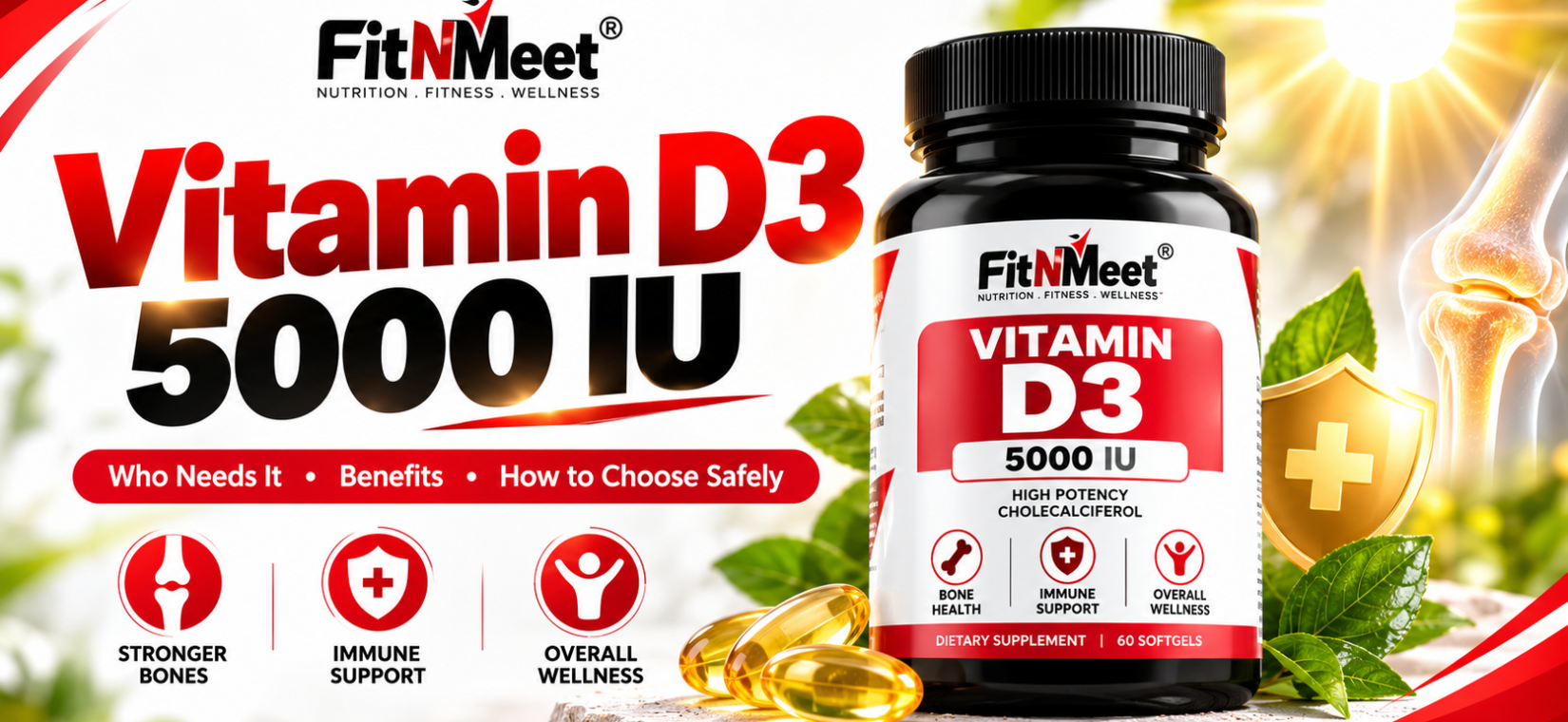
Vitamin D3 5000 IU is a high-dose vitamin D supplement providing 5,000 international units of cholecalciferol per capsule. It is used to correct deficiency faster than standard 1,000 to 2,000 IU doses. Because vitamin D is fat-soluble and can accumulate, get blood levels tested and use high doses under medical guidance rather than indefinitely.
Vitamin D3 5000 IU: Quick Verdict
✅ Our pick if: your blood test shows deficiency (under 20 ng/mL), you get minimal sun, you have darker skin or higher body weight, or a clinician advised repletion. Vitamin D3 5000 IU corrects low levels faster than standard doses — most people reach sufficiency in 8–12 weeks.
🚫 Skip if: your levels are already sufficient (30–50 ng/mL), you get abundant midday sun, you take other D-containing supplements (multivitamin + D3 can stack), or you have a condition causing high calcium (your doctor should dose you, not a blog).
The short version: vitamin D3 5000 IU is a repletion dose, not a forever dose. Use it to fix a documented shortfall, retest in 2–3 months, then step down to a maintenance dose. That strategy captures the benefits while respecting the upper limits.
What Is Vitamin D3 5000 IU?
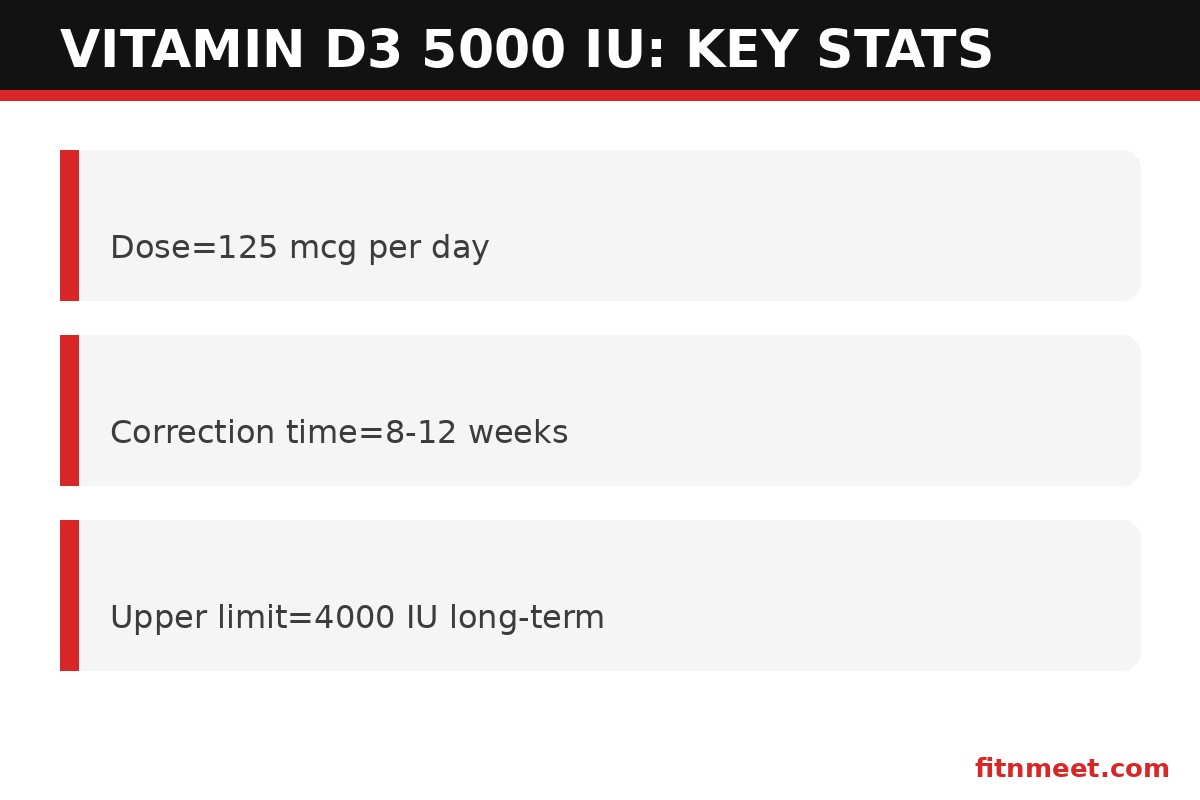
Vitamin D3 (cholecalciferol) is the same molecule your skin synthesizes when UVB sunlight hits it. “5000 IU” means 5,000 International Units, equal to 125 micrograms — roughly 6–8 times the standard adult daily recommendation of 600–800 IU set by the Institute of Medicine. It is sold as softgels, tablets, and drops, usually suspended in oil (olive, MCT, or safflower) because vitamin D is fat-soluble and absorbs far better with dietary fat — studies show absorption can be 30–50% higher taken with a fat-containing meal versus on an empty stomach.
Why does such a high dose exist? Because deficiency is remarkably common. The CDC estimates about 35% of U.S. adults are vitamin D deficient, with rates climbing above 70% in some groups — people with darker skin (melanin blocks UVB), those living above ~37° latitude in winter, night-shift workers, the elderly, and people with obesity (vitamin D gets sequestered in fat tissue, so larger bodies need larger doses to raise blood levels). For these groups, 600 IU barely moves the needle; vitamin D3 5000 IU is the dose clinicians commonly reach for to actually fix the number.
A note on units: you will also see doses in micrograms. The conversion is simple — 1 mcg = 40 IU, so 5000 IU = 125 mcg. European labels often show only micrograms, which confuses shoppers comparing products. For the full biochemical background, Wikipedia’s vitamin D article covers synthesis, metabolism, and the D2/D3 distinction thoroughly.
Head-to-Head Comparisons
Vitamin D3 5000 IU vs Lower Doses
| Daily dose | Best for | Time to correct deficiency | Risk profile |
|---|---|---|---|
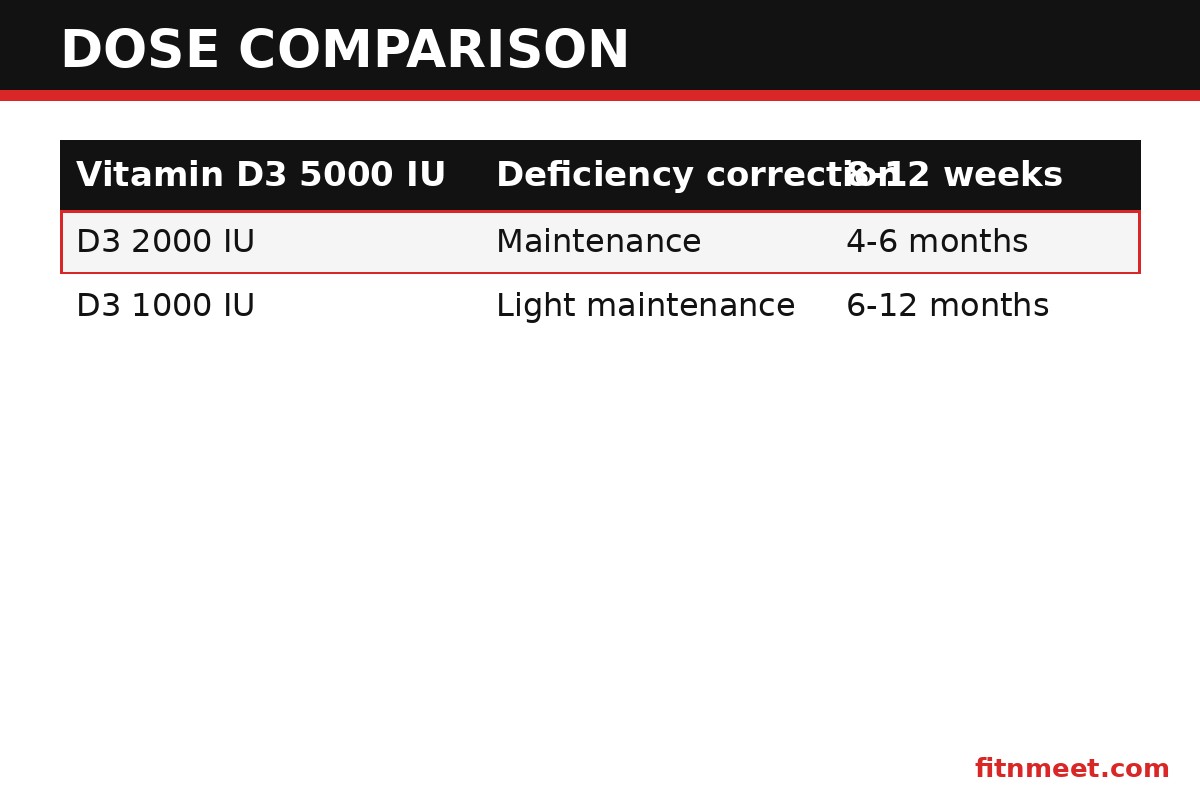
| Vitamin D3 5000 IU | Documented deficiency, minimal sun, higher body weight | 8–12 weeks | Low short-term; retest recommended |
| D3 2000 IU | Maintenance after correction, moderate sun | 4–6 months | Very low |
| D3 1000 IU | General maintenance, some sun exposure | 6–12 months | Negligible |
| D3 600–800 IU (RDA) | Meeting baseline needs with adequate sun/diet | May never correct true deficiency | Negligible |
The pattern is clear: this high-strength D3 dose is roughly 3–5× faster at correcting deficiency than 1000 IU, because blood-level response to supplementation is dose-dependent but with diminishing returns. Someone at 15 ng/mL taking 1000 IU might crawl to 22 ng/mL in six months; vitamin D3 5000 IU typically gets the same person to 35–45 ng/mL in two to three months.
Vitamin D3 vs Vitamin D2
| Factor | Vitamin D3 (cholecalciferol) | Vitamin D2 (ergocalciferol) |
|---|---|---|
| Source | Lanolin, fish oil, lichen (vegan) | Yeast, mushrooms |
| Potency at raising blood levels | ~1.7× more effective than D2 in meta-analyses | Less effective, shorter half-life |
| Typical high dose | Vitamin D3 5000 IU daily | 50,000 IU weekly (prescription) |
| Best for | Almost everyone | Vegans avoiding lichen D3 (rare now) |
D3 wins this comparison decisively for daily supplementation. The only reason D2 persists is prescription tradition and a few vegan formulations — but vegan lichen-based D3 now exists, removing even that niche. If you are choosing a high dose, make it vitamin D3 5000 IU, not D2.
Vitamin D3 5000 IU vs D3 + K2 Combos
| Option | What you get | Evidence for the combo | Verdict |
|---|---|---|---|
| Vitamin D3 5000 IU alone | 125 mcg D3 | Strong for D repletion itself | Best for simple deficiency correction |
| D3 5000 IU + K2 (MK-7) | 125 mcg D3 + 100–200 mcg K2 | Theoretical (calcium routing); human data limited | Reasonable if your diet is low in K2 (little fermented food/cheese) |
| D3 + calcium combo | D3 plus 500–1000 mg calcium | Useful only if dietary calcium is low | Usually unnecessary; get calcium from food |
The K2 pairing is popular but the human evidence is thinner than marketing suggests. It is not harmful at typical doses, so if the combo costs the same, take it; but do not pay a big premium or delay starting plain vitamin D3 5000 IU while hunting for the “perfect” formula.
Benefits of Correcting Vitamin D Levels
To be precise: the benefits below come from fixing deficiency, not from megadosing beyond sufficiency. Once your blood level is in the 30–50 ng/mL range, more vitamin D3 5000 IU does not add more benefit — the curve flattens. That said, moving from deficient to sufficient is associated with:
- Bone strength. Vitamin D enables calcium absorption — without enough D, you absorb only 10–15% of dietary calcium versus 30–40% when sufficient. Correcting deficiency is first-line defense against osteomalacia and a contributor to osteoporosis prevention.
- Muscle function and fall risk. Meta-analyses link deficiency correction to improved muscle strength and a ~20% reduction in fall risk among deficient older adults — a big deal for independence.
- Immune support. Vitamin D receptors sit on immune cells, and deficiency correlates with higher respiratory-infection rates. Supplementation trials show modest reductions in infection risk, strongest in the severely deficient.
- Mood. Low vitamin D correlates with low mood in observational studies; small trials of repletion show modest mood improvements, though this is not a depression treatment.
- Athletic performance. Deficient athletes who correct levels often report better recovery and fewer stress injuries. For training-focused nutrition reading, see FitnMeet’s nutrition articles. The NIH Office of Dietary Supplements vitamin D fact sheet grades the evidence across these outcomes in detail.
✅ Our pick if: you train indoors through winter, feel the classic deficiency pattern (fatigue, low mood in dark months, frequent colds), and a blood test confirms low levels. Vitamin D3 5000 IU for 8–12 weeks is the efficient fix.
How to Choose Your Dose: Decision Steps
Answer these questions in order — they form a decision tree that lands most people on the right dose: For answers to common supplement questions, check the FitnMeet FAQ.
- Do you know your blood level?
- No → get a 25-hydroxyvitamin D test first (cheap, widely available). Guessing with vitamin D3 5000 IU is common but testing is better.
- Yes, under 20 ng/mL → vitamin D3 5000 IU daily for 8–12 weeks, then retest.
- Yes, 20–29 ng/mL → 2000–3000 IU daily, or vitamin D3 5000 IU every other day.
- Yes, 30–50 ng/mL → maintain with 1000–2000 IU; you do not need 5000 IU.
- How much sun do you get? Midday sun on arms and legs for 15–30 minutes, several times weekly (lighter skin less, darker skin more), can produce 10,000+ IU naturally. If that describes you year-round, you likely need less than this high-strength D3 dose.
- What is your body weight? People with obesity typically need 2–3× the dose of lean individuals to raise blood levels equivalently. Higher body weight is a legitimate reason to choose vitamin D3 5000 IU over 2000 IU.
- Do you take other vitamin D sources? Add up your multivitamin, fortified foods, and any combo products. Total daily intake is what counts toward the 4000 IU tolerable upper limit for long-term unsupervised use.
- Any medical complications? Kidney disease, granulomatous diseases (like sarcoidosis), or hypercalcemia history mean dosing must be clinician-guided — skip self-directed vitamin D3 5000 IU.
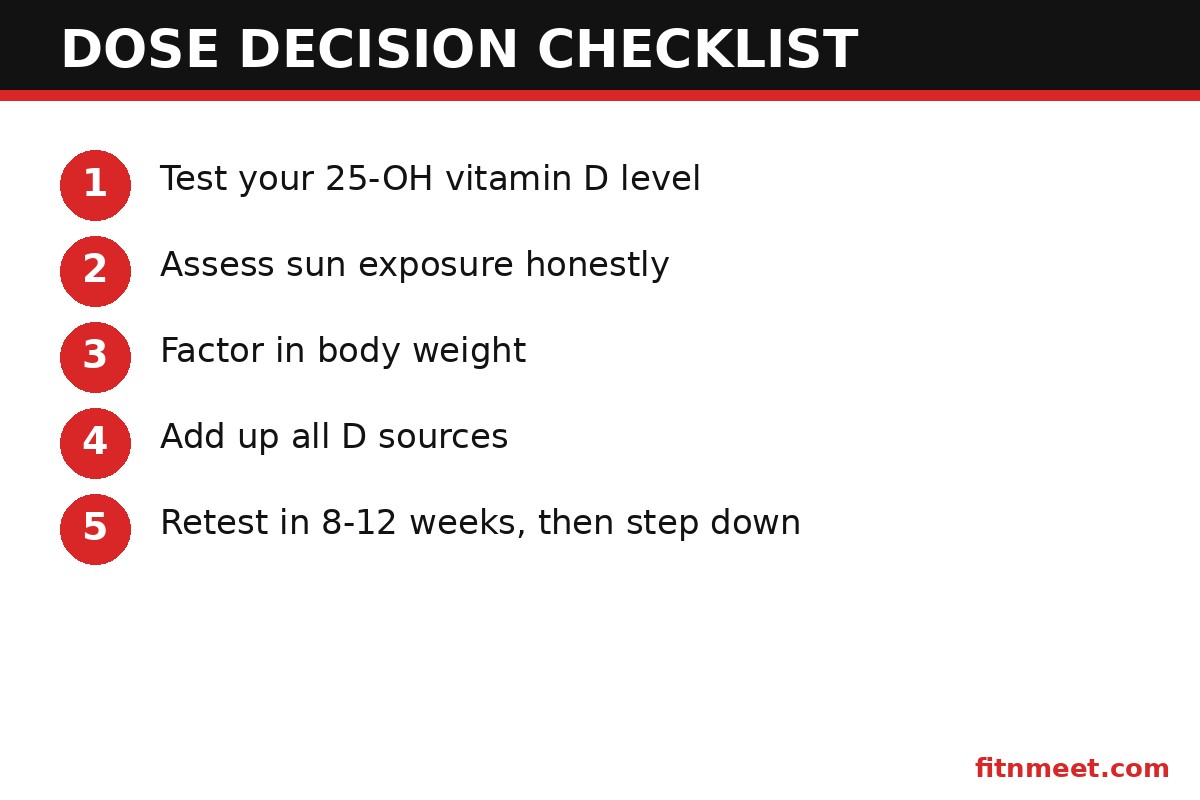
When in doubt, the conservative path is: test → vitamin D3 5000 IU for 8–12 weeks if deficient → retest → step down to 1000–2000 IU maintenance. This is the protocol most evidence-based clinicians follow.
Dosage Details and Timing
The practical details that make vitamin D3 5000 IU work better:
- Timing: take it with your largest meal of the day — the one containing the most fat. Morning is popular simply because it pairs with breakfast and becomes a habit.
- Form: oil-based softgels absorb best; dry tablets are fine but slightly less efficient; drops allow flexible dosing (useful for stepping down later).
- Consistency beats precision: vitamin D has a half-life of ~15 days in the body, so missing a day barely matters. Daily, every-other-day, or even weekly equivalents (35,000 IU/week ≈ 5000 IU/day) all work.
- Step-down plan: after 8–12 weeks of vitamin D3 5000 IU and a confirmatory test in the 30–50 ng/mL range, drop to 1000–2000 IU daily for maintenance. Staying on 5000 IU indefinitely without retesting is the most common misuse.
- Stacking awareness: if you also take a multivitamin (typically 400–1000 IU D3) plus vitamin D3 5000 IU, your total is 5400–6000 IU — above the 4000 IU long-term upper limit. Count everything.
Pair your D3 habit with the fundamentals: adequate dietary calcium (1000–1200 mg/day from food), regular weight-bearing exercise, and the rest of your micronutrient bases covered. Browse FitnMeet’s vitamins collection to build a complete daily stack around your vitamin D3 5000 IU routine. For more on the fundamentals behind immune and bone health, explore the FitnMeet health articles.
Safety, Upper Limits, and Side Effects
Vitamin D toxicity is real but rare — it essentially requires sustained high intake plus no monitoring. The facts:
- Tolerable upper limit: 4000 IU/day for long-term unsupervised use (Institute of Medicine). Vitamin D3 5000 IU exceeds this, which is why it is framed as a time-limited repletion dose, not a permanent one.
- Toxicity threshold: problems (hypercalcemia — high blood calcium) typically appear only with blood levels above 150 ng/mL, which usually requires 10,000+ IU daily for months. Vitamin D3 5000 IU for 8–12 weeks essentially never gets anyone there.
- Symptoms of excess: nausea, vomiting, weakness, frequent urination, and kidney stones from hypercalcemia. These are your signal to stop and test, not to push through.
- Drug interactions: thiazide diuretics + high-dose D can raise calcium; steroids and some weight-loss drugs lower D absorption; digoxin patients need medical supervision. The FDA’s dietary supplement guidance reminds consumers that “natural” does not mean “risk-free at any dose.”
- Who must not self-dose: anyone with kidney stones history, hyperparathyroidism, sarcoidosis, or lymphoma-related calcium issues should only use vitamin D3 5000 IU under direct medical supervision.
🚫 Skip if: you are already sufficient, pregnant (use clinician-dosed amounts), or stacking multiple D sources without adding up the total. More is not better past sufficiency — the benefit curve is flat and the risk curve is not.
Vitamin D3 5000 IU FAQs
Is vitamin D3 5000 IU safe to take daily?
For most healthy adults, vitamin D3 5000 IU daily for 8–12 weeks is considered safe for correcting deficiency, though it exceeds the 4000 IU long-term upper limit. Use it as a time-limited repletion dose, retest your levels, then step down to 1000–2000 IU for maintenance.
How long does vitamin D3 5000 IU take to work?
Blood levels typically rise into the sufficient range (30–50 ng/mL) within 8–12 weeks of daily vitamin D3 5000 IU in deficient adults. Noticeable effects on energy or mood, if deficiency was the cause, often follow over the same period. Retest at 2–3 months to confirm.
Should I take vitamin D3 5000 IU or 2000 IU?
Choose vitamin D3 5000 IU if you are deficient (under 20 ng/mL), get little sun, or have higher body weight — it corrects levels 3–5x faster. Choose 2000 IU for maintenance after correction or for mild insufficiency. When in doubt, test your levels first.
What is the difference between vitamin D3 5000 IU and vitamin D2?
D3 (cholecalciferol) is the form your skin makes and is about 1.7x more effective than D2 at raising blood levels in meta-analyses. For daily supplementation, vitamin D3 5000 IU is the better choice; D2 is mainly used in high-dose weekly prescriptions.
When is the best time to take vitamin D3 5000 IU?
With your largest, fattiest meal of the day — absorption is 30–50% higher with dietary fat than on an empty stomach. Morning with breakfast is popular for habit-building, but any consistent timing works since vitamin D has a ~15-day half-life.
Can vitamin D3 5000 IU cause side effects?
At this dose for 8–12 weeks, side effects are uncommon. Toxicity (hypercalcemia: nausea, weakness, frequent urination, kidney stones) typically requires 10,000+ IU daily for months and blood levels above 150 ng/mL. People with kidney disease or calcium disorders should only dose under medical supervision.
Do I need vitamin K2 with vitamin D3 5000 IU?
Not necessarily. K2 is theorized to help direct calcium to bones rather than arteries, but human evidence is limited. It is safe at typical doses (100–200 mcg), so a combo is reasonable if the price is similar — but plain vitamin D3 5000 IU works fine for correcting deficiency on its own.
Conclusion: The Comparison Winner
After comparing doses, forms, and combos, the verdict is clear: this high-strength D3 dose wins for correcting deficiency — it is the fastest practical daily dose, D3 beats D2 on potency, and plain D3 beats fancy combos on value. The winning protocol is simple: test, take vitamin D3 5000 IU with your fattiest meal for 8–12 weeks, retest, then step down to maintenance. Respect the upper limits, count your total intake, and let blood work — not guesswork — guide the dose.
Ready to fix your levels? Explore FitnMeet’s shop for vitamin D3 5000 IU and the rest of your daily foundational stack.
This article is for informational purposes only and is not medical advice. Consult a healthcare professional before starting any supplement.