
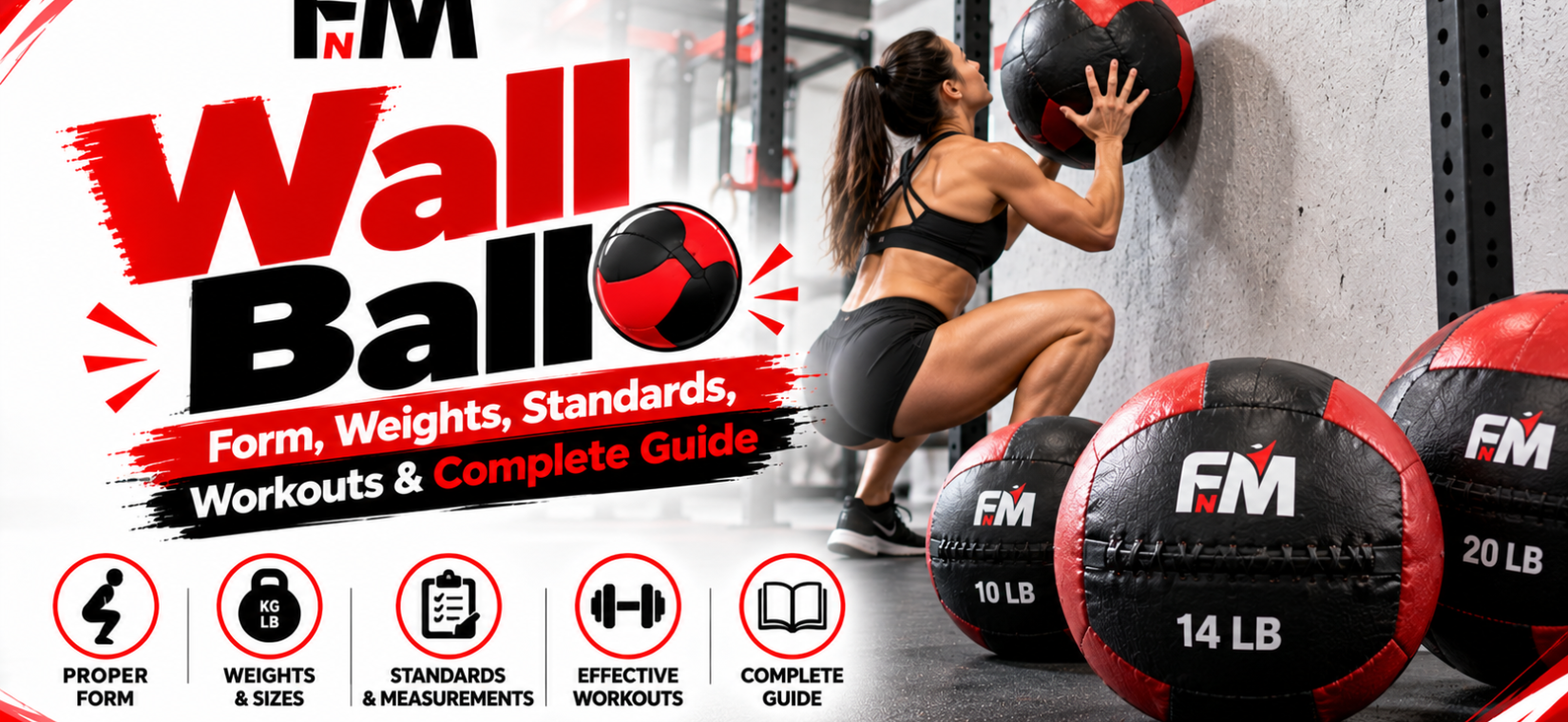
Wall ball is a CrossFit staple exercise performed with a heavy medicine ball thrown against a wall. The athlete squats with the ball at chest height, stands explosively, and tosses it to a target 9 or 10 feet high. It builds full-body power and conditioning, with common ball weights of 14, 20, and 30 pounds.
Wall Ball: Quick Answer
The wall ball shot is simple: squat with the ball, throw it at the target, catch it, repeat. But the details decide whether it builds fitness or just builds frustration. Use a 20 lb ball to a 10 ft target (men’s Rx) or a 14 lb ball to a 9 ft target (women’s Rx). Stand about an arm’s length from the wall, keep the ball at chest height throughout, and let your legs — not your arms — do the throwing. Most beginners should start with a 10–14 lb wall ball and master the rhythm before chasing Rx weights or high-rep workouts like Karen (150 wall balls for time).
1Pro tip: Your wall ball set should look like a metronome — squat, throw, catch, squat. If you are pausing between reps to rest the ball on your chest, the weight is too heavy or you are standing too far from the wall.
What Is a Wall Ball?
A wall ball is both a piece of equipment and the exercise performed with it. The wall ball itself is a large, soft medicine ball — typically around 14 inches in diameter — with a textured vinyl or leather shell designed to be thrown against a wall and caught repeatedly. Unlike hard rubber medicine balls or slam balls, a wall ball is built to absorb impact and stay catchable, rep after rep.
The wall ball shot (the exercise) combines a front squat with an overhead push-press throw. You hold the wall ball at chest height, descend into a full squat, then drive upward explosively, using the momentum of your hips and legs to launch the ball toward a marked target on the wall. You catch the rebounding wall ball at chest height and ride it straight into the next squat — no pause, no resetting. Done well, it is one continuous, rhythmic movement.
The wall ball became famous through CrossFit, where it appears in benchmark workouts and the CrossFit Games. The Rx standards — 20 lb to 10 ft for men, 14 lb to 9 ft for women — are the same standards used in competition, which makes the wall ball one of the few exercises with truly universal loading. The general background on this equipment family is covered on Wikipedia’s medicine ball page, and the sport that popularized it on Wikipedia’s CrossFit page.
Did you know? The benchmark workout “Karen” is 150 wall ball shots for time — elite athletes finish in under 6 minutes, which is a wall ball every 2.4 seconds including the squat, throw, and catch.
Why the Wall Ball Belongs in Your Training
The wall ball earns its place because it trains qualities that rarely appear together in one movement. The squat portion loads the quads, glutes, and core; the throw demands explosive hip extension and shoulder endurance; and the catch-and-repeat rhythm hammers cardiovascular conditioning. A set of 20 unbroken wall ball shots will elevate your heart rate into the 150–170 bpm range for most trained adults — conditioning work disguised as a strength movement.
For athletes, the wall ball builds transferable power: the triple extension of ankles, knees, and hips mirrors jumping, sprinting, and Olympic lifting. For general fitness, it is one of the most time-efficient full-body exercises available — a 10-minute wall ball interval session delivers a training stimulus that would take 25 minutes of isolated exercises to match. And because the wall ball is low-skill compared to a barbell snatch, beginners can train hard with it safely within a single session of coaching.
2Pro tip: Program the wall ball as a conditioning tool (intervals, EMOMs, chipper workouts) rather than a max-strength lift. Its value is repeatable power output, not single-rep load.
Wall Ball Step-by-Step Technique Guide
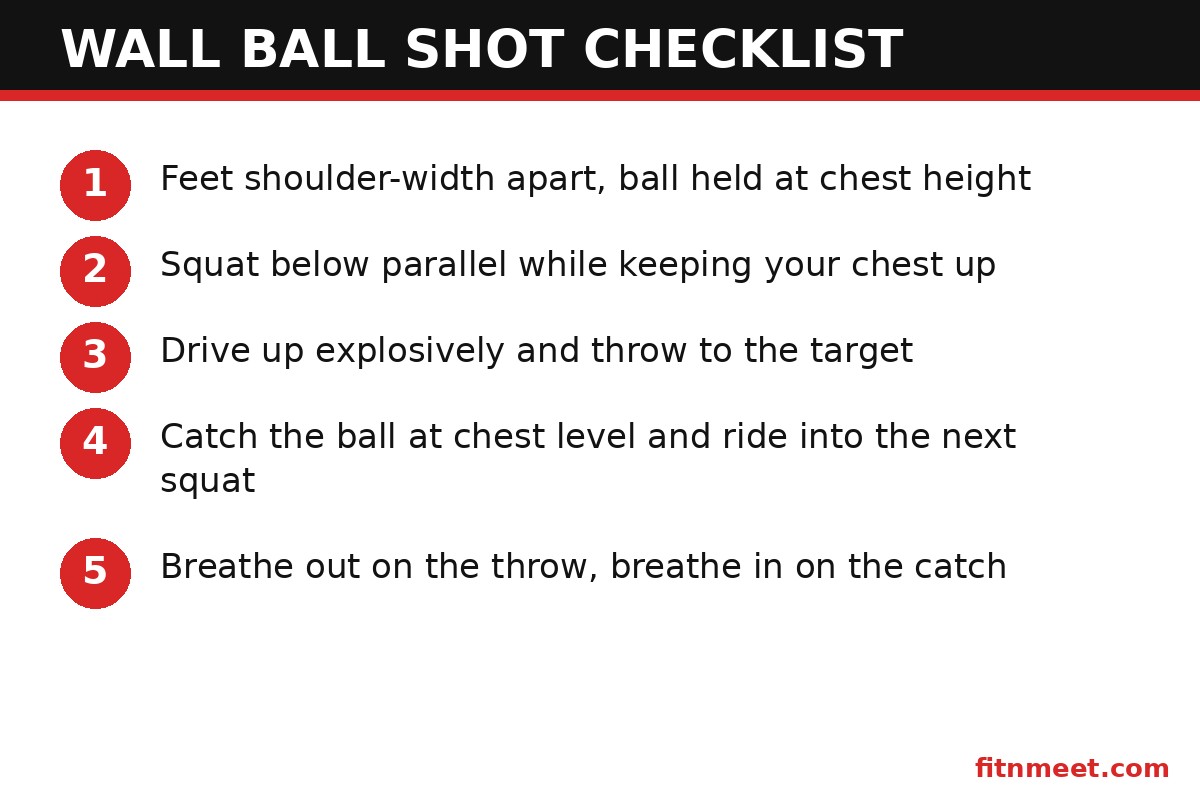
Follow this wall ball progression exactly, in order. Each step builds on the previous one.
- Set your stance and distance.
- Stand facing the wall, feet shoulder-width apart, toes slightly out.
- Position yourself about one arm’s length from the wall — close enough that the ball hits the target without you reaching.
- Hold the medicine ball at chest height with both hands on the sides of the ball, elbows slightly down.
- Descend into the squat.
- Push your hips back and down, keeping your chest up and the ball glued to your chest.
- Descend until hip crease is below parallel — the same depth standard as an air squat.
- Keep your weight mid-foot; do not let your heels lift or your knees collapse inward.
- Drive and throw.
- Explode upward by driving through your heels and extending hips and knees.
- As your hips extend, press this movement upward and slightly forward toward the target — your legs generate the power, your arms just guide it.
- Finish tall on your toes if needed to reach the 10 ft / 9 ft target line.
- Catch and cycle.
- Watch the exercise rebound and catch it at chest height with soft hands — do not let it crash into your face or chest.
- Absorb the catch by riding it directly into the next squat. There should be no pause between catch and descent.
- Exhale on the throw, inhale as you catch and squat. Establish this breathing rhythm from rep one.
- Break sets strategically.
- In workouts, plan breaks before you fail — for example, 150 the shots as 15 sets of 10 with 15 seconds rest beats one heroic set of 40 followed by collapse.
- Drop the medicine ball to the ground (do not throw it down at your feet) during rest, then pick it up and resume.
The exercise Weight, Reps & Programming
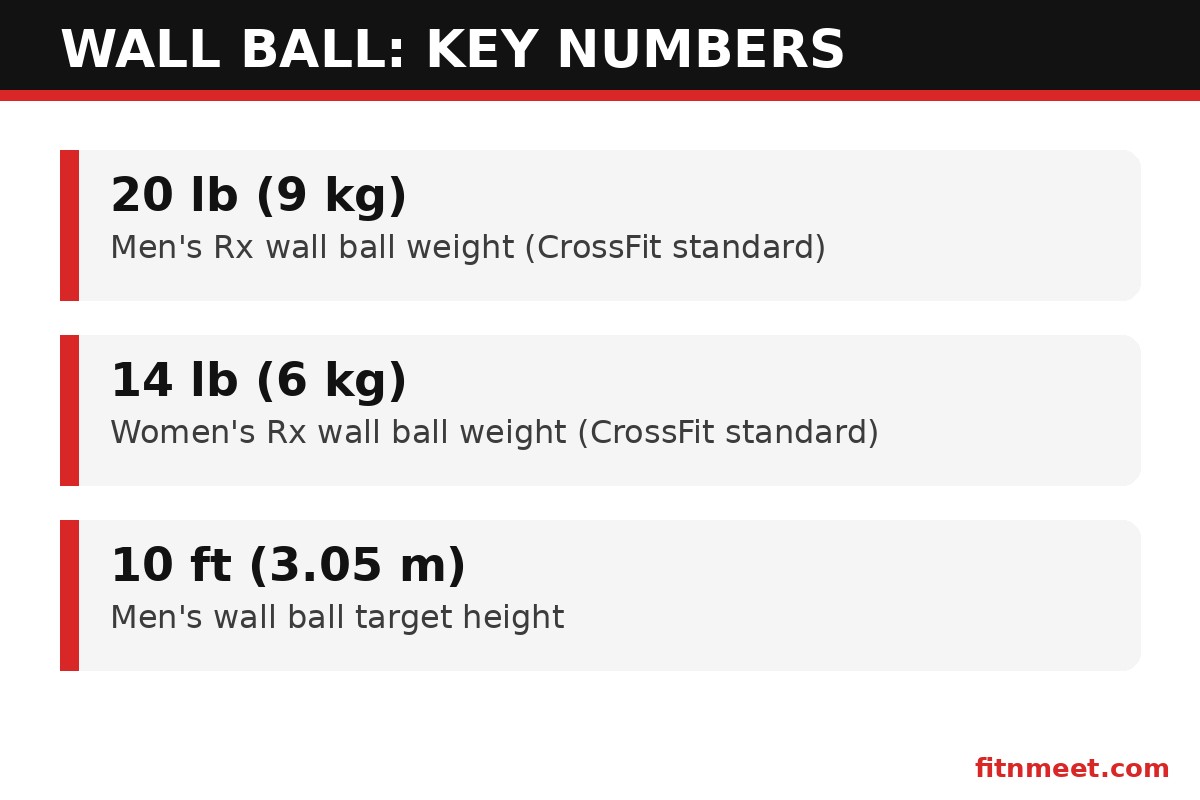
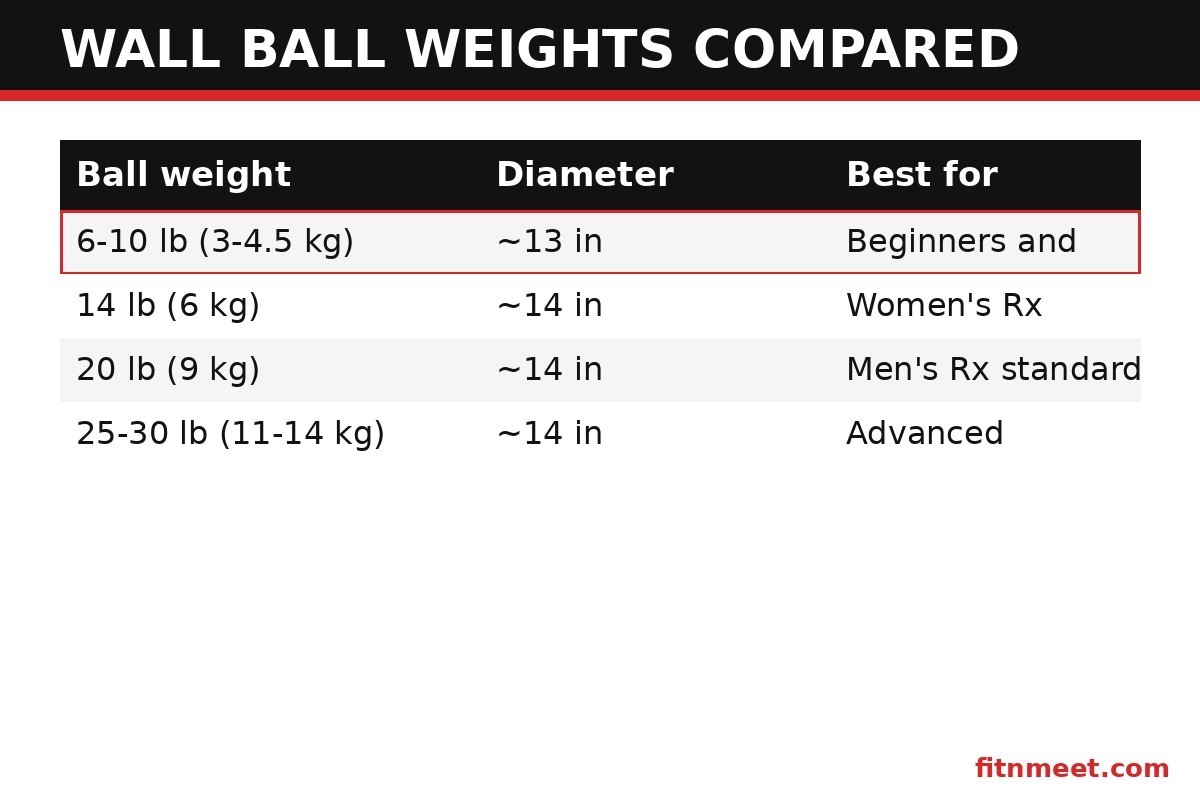
Think of the shot “dosage” as three variables: ball weight, target height, and rep scheme. The Rx standards are 20 lb / 10 ft (men) and 14 lb / 9 ft (women), but scaling is smart, not shameful.
| Level | The medicine ball weight | Target | Typical workout |
|---|---|---|---|
| Beginner | 6–10 lb | 8–9 ft | 5 × 10 reps, 90 sec rest |
| Intermediate | 14 lb | 9–10 ft | EMOM 12 min × 12 reps |
| Rx / Advanced | 20 lb | 10 ft | “Karen”: 150 for time |
| Strength focus | 25–30 lb | 9–10 ft | 5 × 8 reps, heavy, full rest |
For conditioning, the sweet spot is sets of 10–25 reps with short rests — the ball punishes both going too heavy (form breaks, pace dies) and going too light (no training effect). A classic introduction is an EMOM (every minute on the minute): at the top of each minute, perform 10–15 this movement shots, resting the remainder of the minute, for 10–12 minutes. As fitness improves, raise reps per minute before raising ball weight.
Frequency: 1–2 the exercise sessions per week is plenty alongside squatting and pressing. The movement is demanding on shoulders and quads, so avoid programming heavy the shot volume the day before heavy squats or overhead work. Support high-rep the medicine ball training with adequate protein and electrolytes from the FitnMeet sports nutrition collection.
The ball Benefits
- Full-body power. This movement trains the entire kinetic chain — ankles, knees, hips, core, shoulders — in one coordinated expression of power, closely mimicking athletic jumping mechanics.
- Cardiovascular conditioning. High-rep the exercise sets sustain heart rates in the 150–170 bpm zone, delivering VO2-style conditioning without running.
- Muscular endurance. Sets of 20+ reps build quad, glute, and shoulder endurance that transfers to sports with repeated efforts — think wrestling, rowing, and martial arts.
- Coordination and timing. The catch-into-squat rhythm develops coordination under fatigue, a skill that separates good athletes from merely strong ones.
- Low equipment needs. One the shot and a marked wall is a complete conditioning station — ideal for home gyms and crowded boxes.
- Scalable for everyone. From a 6 lb beginner ball to a 30 lb advanced ball, the medicine ball scales across the entire fitness spectrum.
- Mental toughness. There is a reason “Karen” is dreaded: 150 the ball shots teach pacing, pain management, and the discipline of planned breaks.
Did you know? A 20 lb this movement thrown to a 10 ft target travels roughly 12–14 feet per rep. Over 150 reps of “Karen,” that is more than a third of a mile of ball travel — powered entirely by your legs.
Your exercise training shopping list
- A shot in your working weight (14 lb or 20 lb for most)
- A marked target at 9 ft or 10 ft (tape works fine)
- Protein for recovery — FitnMeet protein
- Joint and muscle recovery support — FitnMeet workout recovery
The medicine ball Mistakes to Avoid
- Standing too far from the wall. This is mistake number one. Too far means you reach and throw with your arms instead of driving with your legs — exhausting and weak. Fix: start one arm’s length away and adjust until the ball hits the target at the top of your natural throw.
- Throwing with the arms. If your shoulders burn out by rep 15 while your legs feel fresh, you are arm-throwing this movement. Fix: think “squat hard, throw late” — the legs launch the ball, the arms just steer it.
- Pausing between reps. Resting the exercise on your chest between reps kills the stretch-shortening cycle and doubles the effort. Fix: catch and descend in one motion; plan rest as full breaks with the ball on the floor.
- Shallow squats. Quarter-squatting the shot removes the leg drive that powers the throw. Fix: hit below-parallel depth every rep, even when tired — reduce weight before reducing depth.
- Looking at the target too long. Staring up at the target throws your neck and balance off. Fix: glance at the target during the drive, then watch the medicine ball come down for the catch.
- Going Rx too soon. A 20 lb the ball with bad form teaches bad patterns under fatigue. Fix: earn the heavier this movement — own 50 smooth reps with the lighter ball first.
The medicine ball vs Similar Exercises
| Exercise | Equipment | Main stimulus | The ball advantage |
|---|---|---|---|
| This movement shot | The exercise + target | Full-body power + conditioning | — |
| Thruster | Barbell/dumbbells | Strength + conditioning | The shot is lower-skill, easier to learn |
| Medicine ball slam | Slam ball | Power, core | The medicine ball adds the squat and is cyclical |
| Push press | Barbell | Overhead strength | The ball trains legs and conditioning more |
| Box jump | Box | Lower-body power | This movement adds upper-body and object handling |
The exercise’s unique value is the throw-and-catch cycle: unlike a thruster, you release the load and must re-acquire it, which trains timing and coordination no barbell movement replicates. For pure strength, barbells win; for repeatable full-body power under fatigue, the shot is nearly unmatched. More conditioning concepts are covered in the FitnMeet fitness article archive.
The medicine ball Safety
The ball is one of the safer high-intensity exercises, but respect these points. Warm up shoulders, hips, and ankles for 5–10 minutes before high-rep sets — cold shoulders plus 100 throws is a recipe for impingement. Keep the workout area clear: a rebounding this movement can travel several feet, so train away from other people and equipment. Inspect your exercise regularly; a split seam can burst mid-throw and send filler everywhere.
Stop the set if you feel sharp shoulder or lower-back pain — muscle burn is normal, joint pain is not. People with shoulder impingement, labrum issues, or disc problems should get clearance before heavy the shot volume. And hydrate: a 15-minute the medicine ball workout in a warm gym can cost 0.5–1 liter of sweat. This is general fitness information, not medical advice — when in doubt, consult a qualified coach or clinician.
Frequently Asked Questions
What weight the ball should I use?
Most men should work toward the 20 lb (9 kg) Rx this movement and most women toward the 14 lb (6 kg) Rx the exercise, thrown to 10 ft and 9 ft targets respectively. Beginners should start with a 6 to 10 lb the shot and master technique before moving up. Advanced athletes sometimes use 25 to 30 lb balls for strength-focused sets.
How high is the the medicine ball target?
The standard the ball target height is 10 feet (3.05 m) for men and 9 feet (2.74 m) for women in CrossFit competition and most gym programming. Home gyms can mark the target with tape at the appropriate height.
What muscles does the this movement work?
The the exercise works the quadriceps, glutes, hamstrings, core, shoulders, chest, and triceps. The squat portion loads the lower body, the explosive drive trains hip power, and the throw and catch challenge the shoulders and core, making it a true full-body movement.
How far should I stand from the wall for the shot shots?
Stand about one arm’s length from the wall for the medicine ball shots. Too far forces you to throw with your arms instead of your legs; too close and the rebounding ball crowds you. Adjust until the ball hits the target at the top of your natural throwing motion.
Is the the ball good for beginners?
Yes, the this movement is excellent for beginners because it is lower-skill than barbell lifts while still training full-body power and conditioning. Start with a light 6 to 10 lb the exercise, focus on squat depth and rhythm, and add weight only after you can perform 50 smooth reps.
What is the Karen workout?
Karen is a CrossFit benchmark workout consisting of 150 the shot shots for time: 20 lb to a 10 ft target for men, 14 lb to a 9 ft target for women. Elite times are under 6 minutes. Break the 150 reps into planned sets, such as 15 sets of 10, rather than going unbroken and collapsing.
Can I do the medicine ball workouts at home?
Yes. You need a the ball, a sturdy wall or outdoor surface, and a marked target at 9 or 10 feet. Garages and driveways work well. Avoid drywall interiors, since repeated this movement impacts will damage standard interior walls.
Conclusion
The medicine ball looks simple and humbles everyone. Master the sequence — stance, deep squat, explosive drive, throw, catch, repeat — at a weight you own, then chase the Rx standards of 20 lb / 10 ft and 14 lb / 9 ft. Program it once or twice a week for conditioning, break big sets before you fail, and let your legs do the throwing. Do that consistently and the ball will build the kind of repeatable full-body power that shows up everywhere else in your training.
Fuel your this movement sessions right: shop FitnMeet’s training nutrition for the protein, electrolytes, and recovery formulas that keep high-rep conditioning productive instead of destructive.