
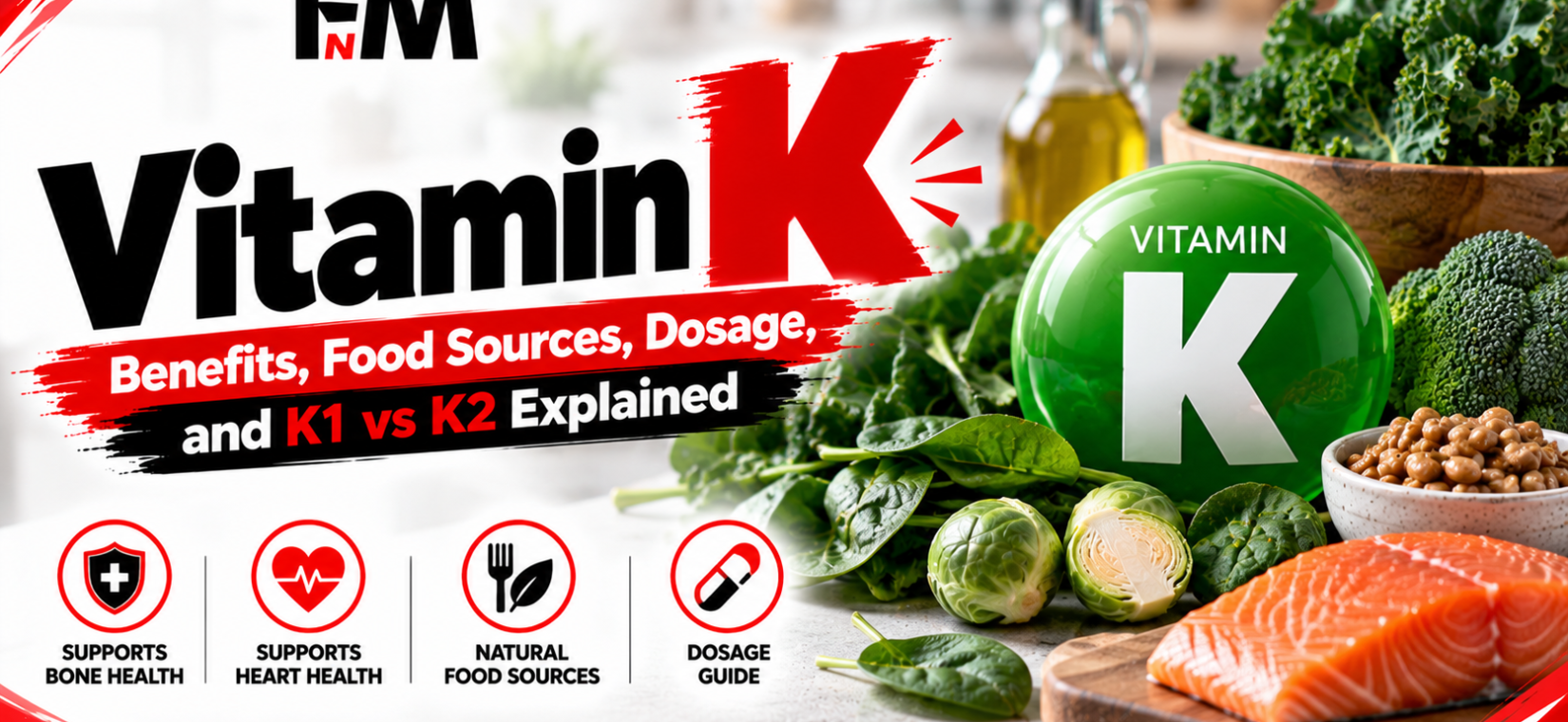
Vitamin K is a fat-soluble vitamin essential for blood clotting and bone health, acting as a cofactor that activates clotting proteins and bone-building osteocalcin. The two main forms are k1 (phylloquinone) from leafy greens and k2 (menaquinone) from fermented foods. Most adults need 90–120 micrograms daily.
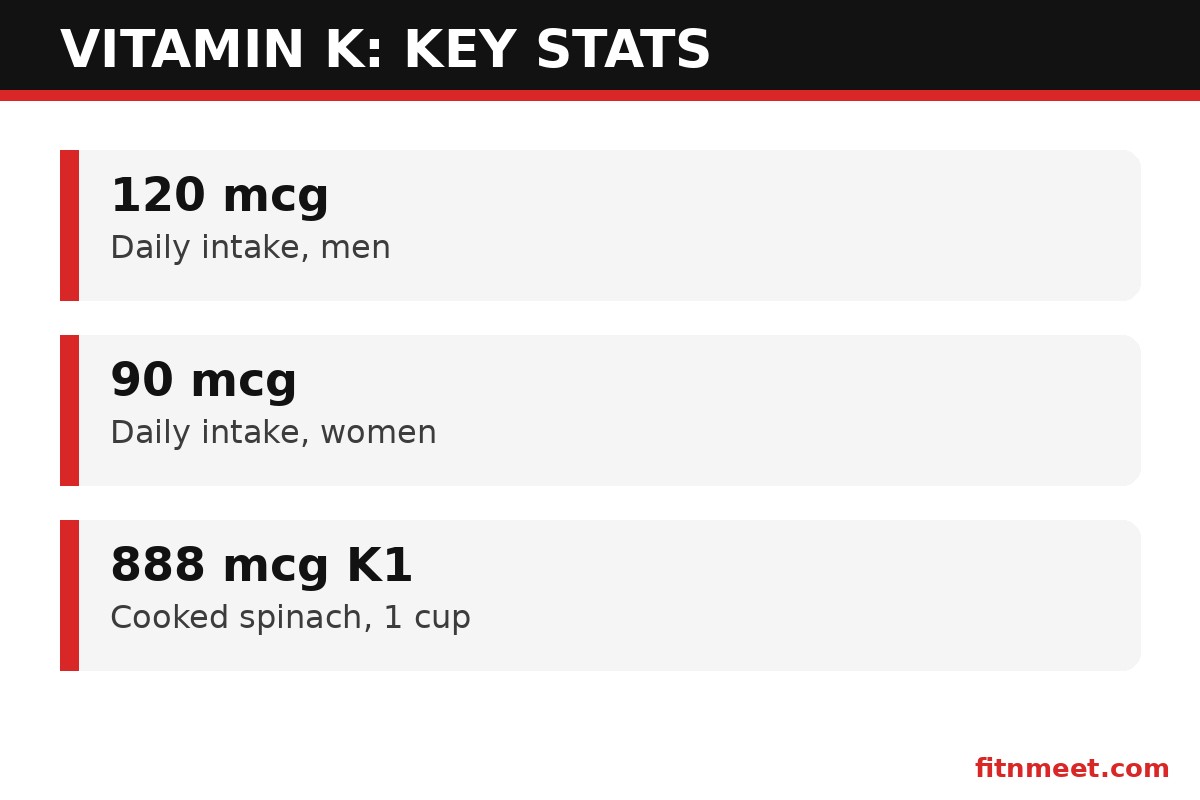
120 mcg — adequate vitamin K intake for adult men · 90 mcg — for adult women · ~50% — lower arterial calcification risk linked to high K2 intake in the Rotterdam Study · 1 cup cooked spinach — about 888 mcg of k1, nearly 10× the daily need
this nutrient: Key Stats Snapshot
Before diving deep, here are the headline numbers on vitamin K:
90-120 mcg
The adequate daily intake of this nutrient set by the NIH Office of Dietary Supplements: 120 micrograms for men, 90 micrograms for women.
1929
The year Danish scientist Henrik Dam discovered vitamin K while studying cholesterol in chickens — “K” comes from the Danish/German word “koagulation.” Dam won the Nobel Prize in 1943 for the discovery.
888 mcg
K1 in a single cup of cooked spinach — roughly 7 to 10 times the daily requirement in one serving. Leafy greens are overwhelmingly the richest sources of k1.
180 mcg/day
The k2 (MK-7) dose used in a 3-year randomized trial that significantly improved arterial stiffness in postmenopausal women (Knapen et al., 2015).
What Is this nutrient?
Vitamin K is a fat-soluble vitamin — a group of compounds sharing a 2-methyl-1,4-naphthoquinone ring structure — required for the blood to clot and for bones to mineralize properly. Unlike water-soluble vitamins, this nutrient is stored in the liver and fatty tissues, and it is absorbed along with dietary fat, which means very low-fat diets can impair vitamin K absorption.
This nutrient family has two natural forms that matter for human nutrition. K1 (phylloquinone) is the plant form, concentrated in green leafy vegetables — spinach, kale, collard greens, broccoli, and Brussels sprouts. It accounts for about 75-90% of total vitamin K intake in most Western diets. K2 (menaquinone) is a family of compounds designated MK-4 through MK-13, produced by bacteria and found in fermented foods (notably natto, the Japanese fermented soybean dish), aged cheeses, egg yolks, and meat. Gut bacteria also produce some k2, though how much humans actually absorb from this source is debated.
There is also a synthetic form, vitamin K3 (menadione), which is used in animal feed and is not a recommended human supplement. When people say “this nutrient” in a nutrition context, they almost always mean K1 or K2.
Vitamin K Benefits (With the Numbers)
The benefits of this nutrient center on two systems: blood and bone. Here is what the evidence shows:
- Blood clotting: Vitamin K is the essential cofactor for gamma-glutamyl carboxylase, the enzyme that activates clotting factors II (prothrombin), VII, IX, and X, plus regulatory proteins C and S. Without enough this nutrient, the liver produces inactive clotting factors and bleeding risk rises. This is not theoretical — vitamin K deficiency bleeding in newborns is exactly why infants receive a this nutrient shot at birth.
- Arterial health: Vitamin K activates matrix Gla protein (MGP), the body’s strongest known inhibitor of arterial calcification. In the Rotterdam Study (4,800+ adults followed for 7-10 years), the highest third of menaquinone (k2) intake had roughly 50% lower risk of arterial calcification, 50% lower cardiovascular mortality, and 25% lower all-cause mortality than the lowest third. Phylloquinone (K1) intake showed no such association in that study.
- Bone strength: this nutrient carboxylates osteocalcin, the protein that binds calcium into the bone matrix. Meta-analyses of randomized trials find that k2 supplementation improves bone mineral density and reduces fracture risk, particularly in postmenopausal women. In Japan, high-dose menatetrenone (k2 as MK-4, 45 mg/day) is an approved treatment for osteoporosis.
- Arterial stiffness: In a 3-year double-blind trial, 180 mcg/day of k2 (MK-7) significantly reduced arterial stiffness in healthy postmenopausal women compared to placebo, with benefits growing over the full 3 years (Knapen et al., Thrombosis and Haemostasis, 2015).
- Brain and cognitive support: Early research links higher vitamin K status to better cognitive performance in older adults, possibly through sphingolipid metabolism in the brain. This is an emerging area — promising, but not yet proven.
A pattern worth noting: for arterial and bone outcomes, the strongest human data cluster around k2 rather than k1. That does not make k1 unimportant — it remains the primary dietary form and fully supports clotting — but it explains why K2 has become the focus of supplementation research. Learn more about bone-supporting nutrition in our FitnMeet health articles.
How Vitamin K Works in the Body
this nutrient works through a single elegant mechanism: it enables the carboxylation of glutamate residues on specific proteins, converting them from inactive to active form. The best-understood targets are the clotting factors made in the liver. When vitamin K is present, an enzyme adds a carboxyl group to these proteins, which lets them bind calcium — and calcium binding is what allows the clotting cascade to assemble on cell surfaces and stop bleeding.
The same carboxylation chemistry applies outside the liver. Osteocalcin, made by bone-building osteoblasts, needs this nutrient-dependent carboxylation to grip calcium and deposit it into bone mineral. Matrix Gla protein, produced in blood vessel walls, needs the same activation to sweep calcium out of soft tissue and prevent it from hardening arteries. This is why vitamin K sits at the intersection of bleeding risk, bone fractures, and arterial calcification: one mechanism, three systems.
Absorption and transport complete the picture. this nutrient is absorbed in the small intestine along with dietary fat, packaged into chylomicrons, and delivered to the liver. K1 is cleared from the blood relatively quickly (half-life of hours), while the long-chain k2 forms like MK-7 circulate for days — one reason MK-7 reaches extra-hepatic tissues (bone, arteries) more effectively and why researchers favor it for supplementation studies.
Vitamin K Dosage and Food Sources
Getting enough this nutrient from food is easy; getting meaningful k2 is harder. Here is the practical breakdown:
Recommended intake. The adequate intake for vitamin K is 120 mcg/day for men and 90 mcg/day for women (the FDA Daily Value is 120 mcg). No upper limit has been set because no toxicity from food or supplements has been established in humans. Therapeutic K2 doses used in trials (100-200 mcg/day of MK-7) are far above the adequate intake and have shown good safety profiles.
Top k1 food sources (micrograms per serving):
- Cooked spinach, 1 cup — ~888 mcg
- Cooked kale, 1 cup — ~530 mcg
- Collard greens, 1 cup cooked — ~770 mcg
- Broccoli, 1/2 cup cooked — ~110 mcg
- Brussels sprouts, 1/2 cup cooked — ~110 mcg
- Soybean oil, 1 tablespoon — ~28 mcg
Top k2 food sources (micrograms per serving):
- Natto (fermented soybeans), 1 oz — ~240-300 mcg (mostly MK-7)
- Hard cheeses (e.g., aged gouda), 1 oz — ~10-20 mcg
- Egg yolk, 1 large — ~6 mcg (mostly MK-4)
- Chicken, 3 oz — ~8-10 mcg
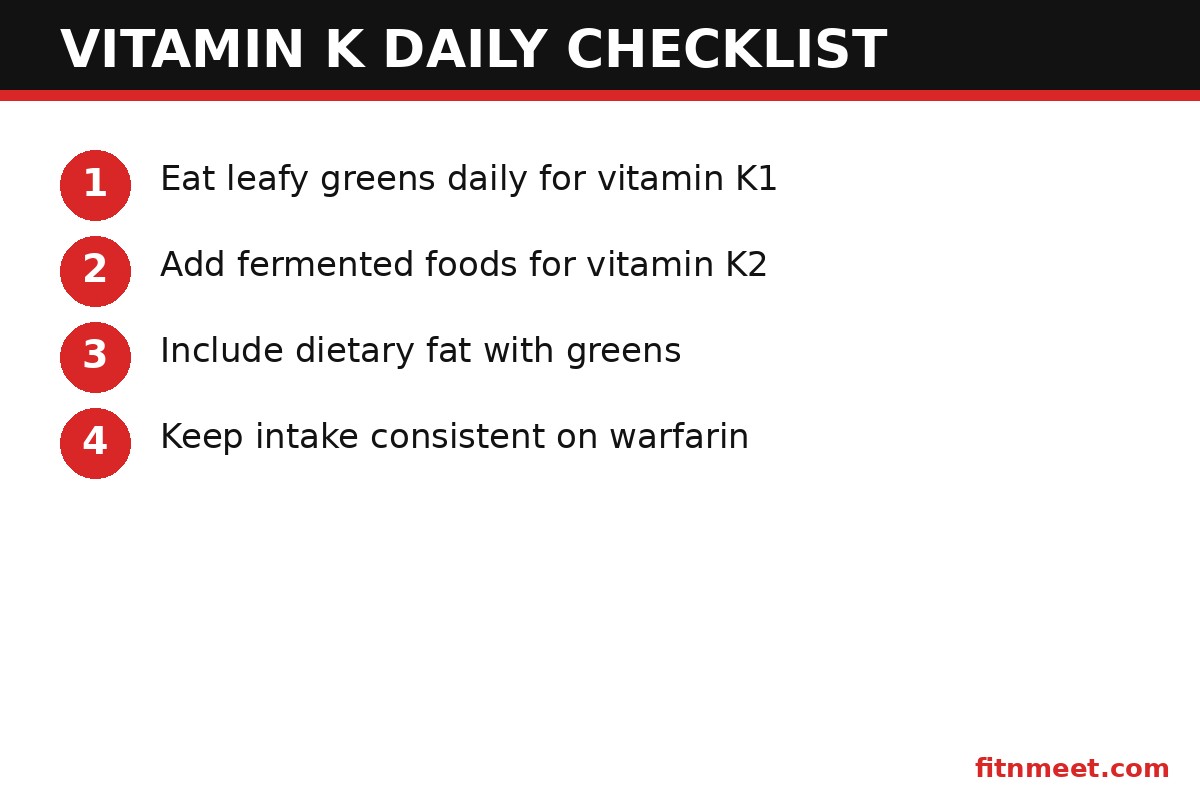
How to hit your target — a checklist:
- ☐ Eat one large serving of leafy greens daily (a spinach salad or cooked greens covers k1 several times over)
- ☐ Add fermented foods a few times per week (natto if you can handle it; aged cheese otherwise) for k2
- ☐ Include some dietary fat with greens — this nutrient is fat-soluble and absorbs poorly from fat-free meals
- ☐ If supplementing, consider 100-200 mcg/day of k2 as MK-7, the form with the longest half-life
- ☐ If you take warfarin, keep vitamin K intake CONSISTENT day to day and coordinate any change with your doctor
Fuel your training with the right nutrients. Pair smart micronutrient habits with quality protein — browse FitnMeet’s vitamin collection and the quality protein sources to cover your bases.
K1 vs K2: Head-to-Head
K1 and k2 share the core mechanism but differ in sources, distribution, and evidence:
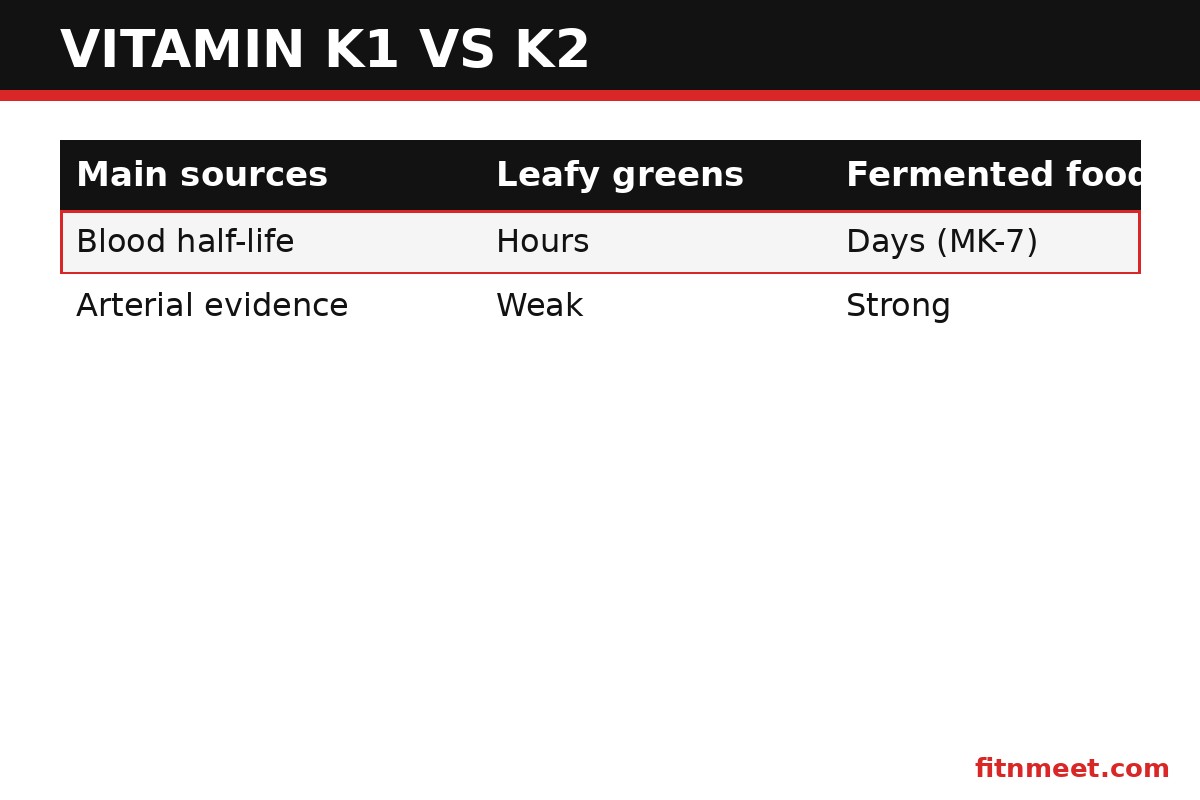
| Factor | K1 (phylloquinone) | K2 (menaquinone) |
|---|---|---|
| Main sources | Leafy greens, broccoli, vegetable oils | Natto, aged cheese, egg yolks, meat |
| Share of typical intake | ~75-90% | ~10-25% |
| Blood half-life | A few hours | Days (MK-7: ~3 days) |
| Tissue reach | Mostly liver (clotting) | Liver + bone + arteries |
| Arterial calcification evidence | Weak/absent (Rotterdam) | Strong (Rotterdam: ~50% lower risk) |
| Bone evidence | Modest | Strong (BMD + fracture trials) |
| Best for | Daily baseline from food | Targeted supplementation (MK-7) |
Practical takeaway: eat your greens for k1 — that covers clotting and baseline needs — and treat k2 as the form worth paying attention to for long-term arterial and bone health, especially after age 40. The Wikipedia overview of this nutrient covers the chemistry and history in detail if you want to go deeper.
Vitamin K Side Effects and Safety
this nutrient has one of the best safety profiles of any micronutrient. No adverse effects have been reported from high intakes of k1 or K2 from food or supplements, and no tolerable upper intake level has been established. The single critical interaction is with warfarin (and related vitamin K antagonist blood thinners): these drugs work by blocking this nutrient recycling, so sudden large changes in vitamin K intake can destabilize INR and clotting control. The medical guidance is not to avoid this nutrient but to keep intake steady — and to tell your doctor before starting a k2 supplement.
People on direct oral anticoagulants (DOACs such as apixaban or rivaroxaban) do not have this interaction, since those drugs target clotting factors directly rather than the vitamin K cycle. Even so, anyone on any blood thinner should check with their clinician before supplementing.
One more caution: this nutrient supplements can theoretically reduce the effectiveness of vitamin K antagonists used in rare cases of rodenticide poisoning treatment — an edge case, but a reminder that “natural” does not mean “inert.” For everyone else, this nutrient from food and standard supplement doses is considered safe.
Alternatives and Related Nutrients
Vitamin K does not work alone. Calcium and vitamin D partner with it in bone metabolism — vitamin D increases calcium absorption while this nutrient directs calcium into bone (via osteocalcin) rather than arteries (via MGP). This is why K2 + D3 combinations are popular in bone-health formulas; the pairing is mechanistically sensible, though head-to-head trials of the combo are still limited.
Magnesium is another cofactor worth mentioning: it participates in vitamin D activation and bone mineralization. If your goal is a complete bone-and-artery stack, the evidence-backed core is adequate calcium from food, sufficient vitamin D (get tested; deficiency is common), magnesium from nuts/seeds/greens, and 100-200 mcg of k2 as MK-7 — plus resistance training, which remains the single most powerful stimulus for bone density. Our strength training guides cover the exercise side of the equation.
Frequently Asked Questions
What is this nutrient good for?
Vitamin K is essential for blood clotting and bone health. It activates clotting factors II, VII, IX, and X, plus osteocalcin (which binds calcium into bone) and matrix Gla protein (which prevents calcium buildup in arteries). Research links higher vitamin K2 intake to better arterial and bone outcomes.
What is the difference between vitamin K1 and K2?
Vitamin K1 (phylloquinone) comes from leafy green vegetables and mainly supports blood clotting in the liver. Vitamin K2 (menaquinone, MK-4 to MK-13) comes from fermented foods and animal products, circulates longer in the blood, and reaches bone and arteries — where the strongest research benefits have been observed.
How much this nutrient do I need per day?
The adequate intake is 120 mcg daily for men and 90 mcg for women. One cup of cooked spinach provides about 888 mcg of vitamin K1, so food easily covers the baseline. Trials of vitamin K2 for arterial health have used 100-200 mcg/day of MK-7.
Can I take vitamin K with warfarin?
Only with your doctor’s involvement. Warfarin works by blocking the this nutrient cycle, so changes in vitamin K intake can destabilize blood-thinning control. The guidance is to keep this nutrient intake consistent rather than avoid it — and to coordinate any supplement with your prescribing clinician.
What are the best food sources of vitamin K?
For vitamin K1: cooked spinach (~888 mcg/cup), collard greens (~770 mcg/cup), kale (~530 mcg/cup), and broccoli (~110 mcg per half cup). For vitamin K2: natto (~240-300 mcg/oz), aged hard cheeses, egg yolks, and chicken.
Is vitamin K2 better than K1 for bones and arteries?
The human evidence favors K2 for these outcomes. In the Rotterdam Study, high menaquinone (K2) intake was linked to roughly 50% lower arterial calcification and cardiovascular mortality, while K1 showed no association. K2 trials have also shown improved bone mineral density and reduced arterial stiffness.
Can you take too much this nutrient?
No toxicity has been established for vitamin K1 or K2 from food or supplements, and no upper intake level exists. The one exception is the interaction with warfarin-type blood thinners, where large intake changes — not the vitamin itself — create risk.
Conclusion
this nutrient is the quiet workhorse of the fat-soluble vitamins: indispensable for clotting, increasingly compelling for bones and arteries. Cover your k1 baseline with daily leafy greens, give k2 (from fermented foods or a 100-200 mcg MK-7 supplement) serious consideration after 40, and keep intake consistent if you take warfarin. Want to build the full foundation? Browse FitnMeet’s shop for quality nutrition support and check our blog for more evidence-based guides.
This article is for informational purposes only and is not medical advice. Consult a healthcare professional before starting any supplement, especially if you take blood-thinning medication.