
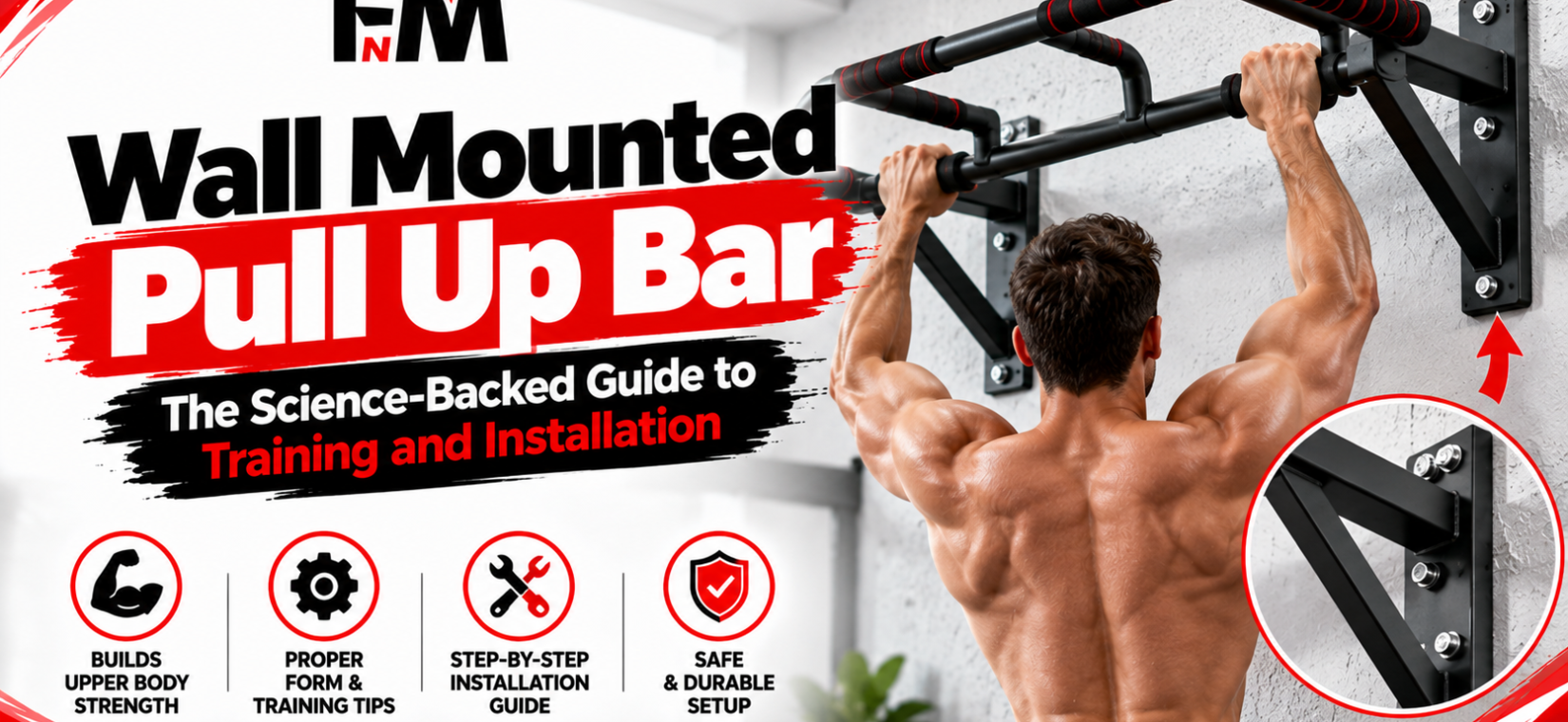
A wall mounted pull up bar is a fixed bar bolted into wall studs or masonry for pull-ups, chin-ups, and hanging exercises. Unlike friction-based doorway bars, it anchors into structural material, supporting 300–600 lb with zero slip risk. Research ranks pull-ups among the highest-activation upper-body exercises ever measured.
What Is a Wall Mounted Pull Up Bar? (With Mechanism)
A wall mounted pull up bar is a steel bar fixed to a wall via brackets bolted into studs, concrete, or brick. The mechanism is straightforward: lag bolts or expansion anchors transfer your bodyweight directly into the building’s structure, which is why a properly installed wall mounted pull up bar holds 300–600 lb — roughly double the rating of most doorway bars. Typical designs project 18–24 inches from the wall, providing clearance for the head and chest at the top of the movement, and many include multiple grip positions (wide, neutral, close).
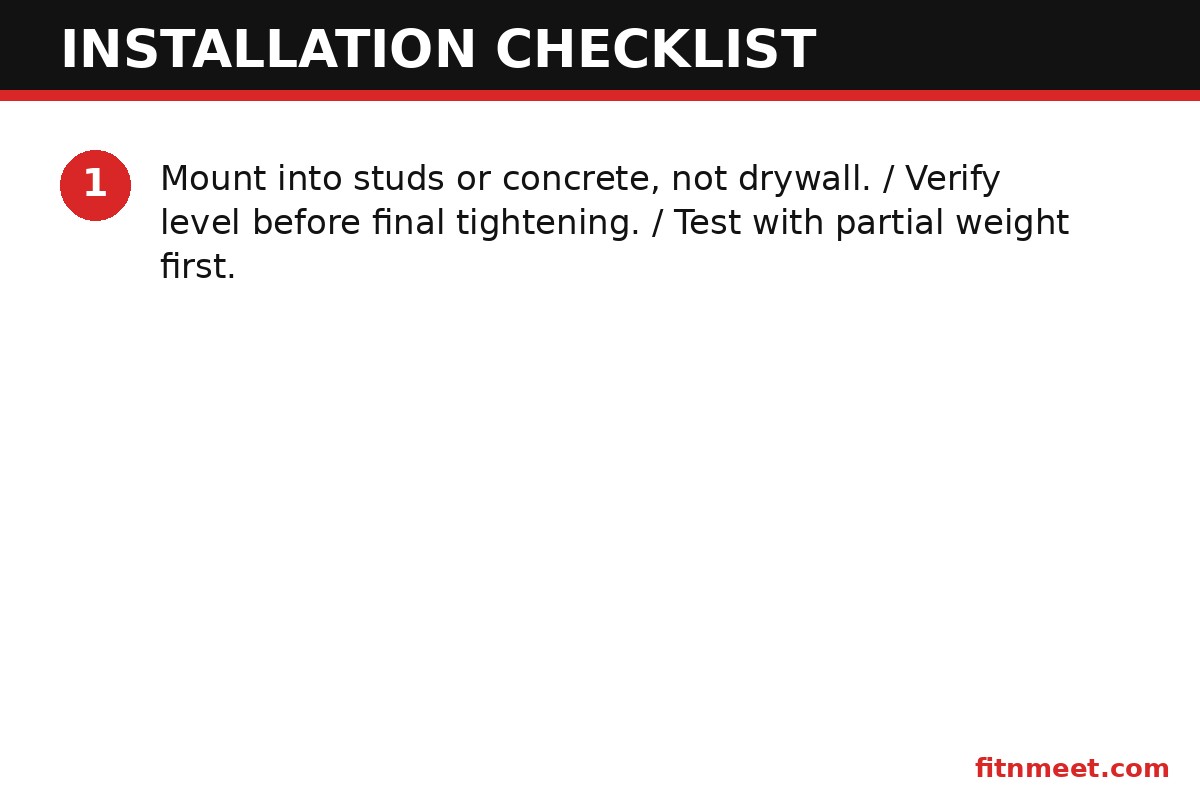
Installation is the critical variable. Wood studs (2×4 or larger) accept 3/8-inch lag bolts at least 2.5 inches deep; concrete and brick need sleeve or wedge anchors. Drywall alone holds essentially nothing — every wall mounted pull up bar failure story begins with anchors in drywall. A stud finder, a level, and 30 minutes are the full toolkit (Wikipedia: Pull-up exercise).
What the Research Says
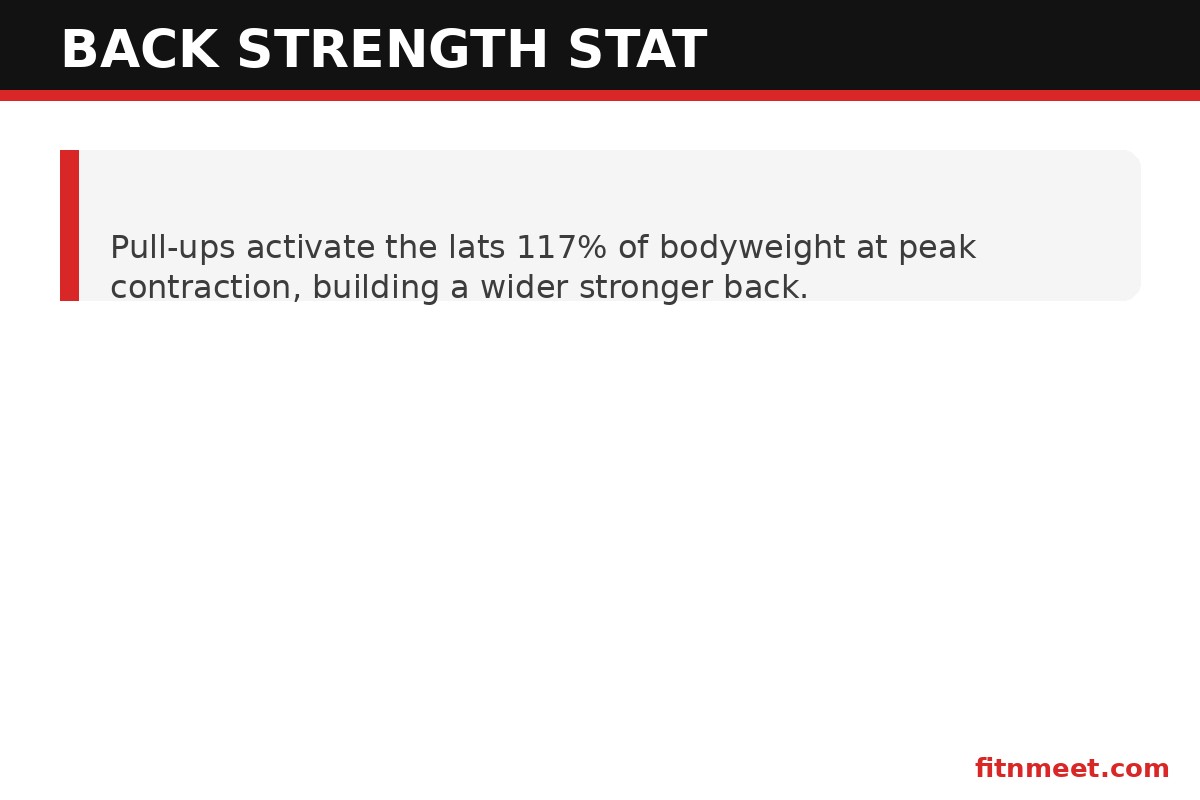
Electromyography research consistently ranks the pull-up — the core exercise of any wall mounted pull up bar — at the top of upper-body movements. The latissimus dorsi fires at near-maximal levels, the lower trapezius and rhomboids stabilize the scapula through a full range of motion, and the core braces isometrically against the hanging load. One analysis estimated peak lat activation equivalent to lifting well over bodyweight when momentum is removed.
Beyond muscle, hanging from a wall mounted pull up bar decompresses the spine: the hanging position creates gentle spinal traction that many lifters find relieves lower-back tightness after heavy squat and deadlift days. Grip strength also improves measurably — dead hangs of 30–60 seconds build the forearm endurance that carries over to every pulling exercise. The evidence base is unusually consistent for such simple equipment: the pull-up works, and a stable bar is the prerequisite. It also sits at the heart of calisthenics, the bodyweight-training discipline whose practitioners build remarkable upper-body mass with little more than a bar and a floor.
Benefits of a Wall Mounted Pull Up Bar
The benefits of training on a wall mounted pull up bar flow from two facts: the exercise is elite, and the equipment removes every excuse. A bar that is always there, always stable, and rated far beyond your bodyweight gets used — doorway bars that shift and creak do not inspire heavy training. Pair your pull-up bar with more bodyweight training ideas from the FitnMeet fitness articles.
- Maximum back development: No machine matches the pull-up’s lat activation per EMG studies.
- Stability confidence: A 400+ lb rating means kipping, weighted pull-ups, and muscle-ups are all on the table.
- Space efficiency: The bar projects 2 feet from the wall — zero floor footprint.
- Cost: $50–$120 buys a lifetime tool; compare with $1,000+ cable machines.
- Versatility: Pull-ups, chin-ups, hanging leg raises, dead hangs, and suspension-trainer anchor point.
- Durability: Powder-coated steel bolted to structure outlasts every friction-fit alternative.
- Posture correction: Hours of desk work round the shoulders forward; regular pulling rebalances the musculature and visibly improves posture within weeks.
There is also a psychological benefit worth naming: the pull-up is a universally respected strength benchmark. Going from zero to ten strict reps is one of the most satisfying progressions in training, and having the bar permanently mounted removes the setup friction that kills consistency. Many lifters report that a hallway bar doubles their weekly pulling volume simply because it is always within reach.
How It Works in the Body
When you hang from a wall mounted pull up bar, gravity loads the entire upper-body kinetic chain. The lats — the broad muscles of the back — perform shoulder adduction and extension to lift the body; the biceps and brachialis flex the elbow; the lower traps depress and retract the scapula; the abdominals and glutes brace to prevent swinging. Because the hands are fixed and the body moves, the pull-up is a closed-chain exercise, which research associates with better joint stability adaptations than open-chain machine equivalents.
Scapular mechanics deserve special attention. During the hang, the shoulder blades elevate and protract; as you pull, they depress and retract — a full cycle of scapular motion that strengthens the often-neglected lower trapezius and serratus anterior. These muscles are key stabilizers of the shoulder joint, and their weakness underlies many cases of shoulder impingement in lifters who only press and never pull. Regular hanging and pulling restores the balance, which is one reason physical therapists prescribe pull-up progressions for shoulder rehab patients.
Neurologically, the pull-up demands high motor-unit recruitment: most trainees cannot cheat the movement the way they can a lat pulldown, so the nervous system learns to fire large muscle groups synchronously. This is why pull-up strength transfers so well to climbing, grappling, rowing, and every other pulling sport. Training on a wall mounted pull up bar 2–3 times weekly produces measurable strength gains within 6–8 weeks even in beginners using band assistance.
Training Dosage and Protocols
Follow this protocol structure for a wall mounted pull up bar program:
- Protocol A — Beginner (0–3 pull-ups): 3 sessions/week. 5 sets of band-assisted pull-ups, 5–8 reps, 90 seconds rest. Reduce band thickness every 2 weeks.
- Protocol B — Intermediate (4–10 pull-ups): 3 sessions/week. 5×5 bodyweight pull-ups, 2 minutes rest. Add one rep per week to one set.
- Protocol C — Advanced (10+ pull-ups): 2–3 sessions/week. Weighted 5×3–5 with 10–45 lb, plus one high-rep bodyweight day (3 sets to near-failure).
- Protocol D — Grease the groove: 5–8 submaximal sets spread through the day, never to failure. Ideal for a home wall mounted pull up bar you pass constantly.
- Dead-hang finisher: End each session with 2–3 dead hangs of 30–60 seconds for grip and spinal decompression.
Volume landmarks: 25–50 total pull-up reps per week drives progress for most intermediates. Rest 48 hours between hard sessions — the lats recover like any large muscle group. Pair training with adequate protein (1.6–2.2 g/kg/day) and explore FitnMeet’s protein range to support recovery.
Side Effects and Safety
- Installation failure is the main risk of a wall mounted pull up bar: anchors in drywall, missed studs, or undersized bolts can pull out under load. Test with partial bodyweight before full hangs.
- Shoulder impingement: Wide-grip pull-ups behind the neck stress the shoulder; keep the bar in front and use a grip 1–1.5× shoulder width.
- Elbow tendinopathy: Sudden high-volume chin-up programs inflame the elbow tendons — progress volume gradually.
- Kipping: Dynamic kipping pull-ups multiply shoulder forces; master strict reps first.
- Children: A wall mounted pull up bar invites climbing — supervise kids and consider the bar’s height.
- Overuse: Daily max-effort sets without rest days inflame tendons; the 48-hour rule between hard sessions exists for a reason.
One final safety note: inspect the mounting hardware every six months. Houses settle, wood shrinks, and bolts loosen — a quick check with a wrench takes two minutes and keeps a multi-hundred-pound load rating trustworthy for years.
Wall Mounted Pull Up Bar vs Alternatives
| Option | Load rating | Stability | Cost | Best for |
|---|---|---|---|---|
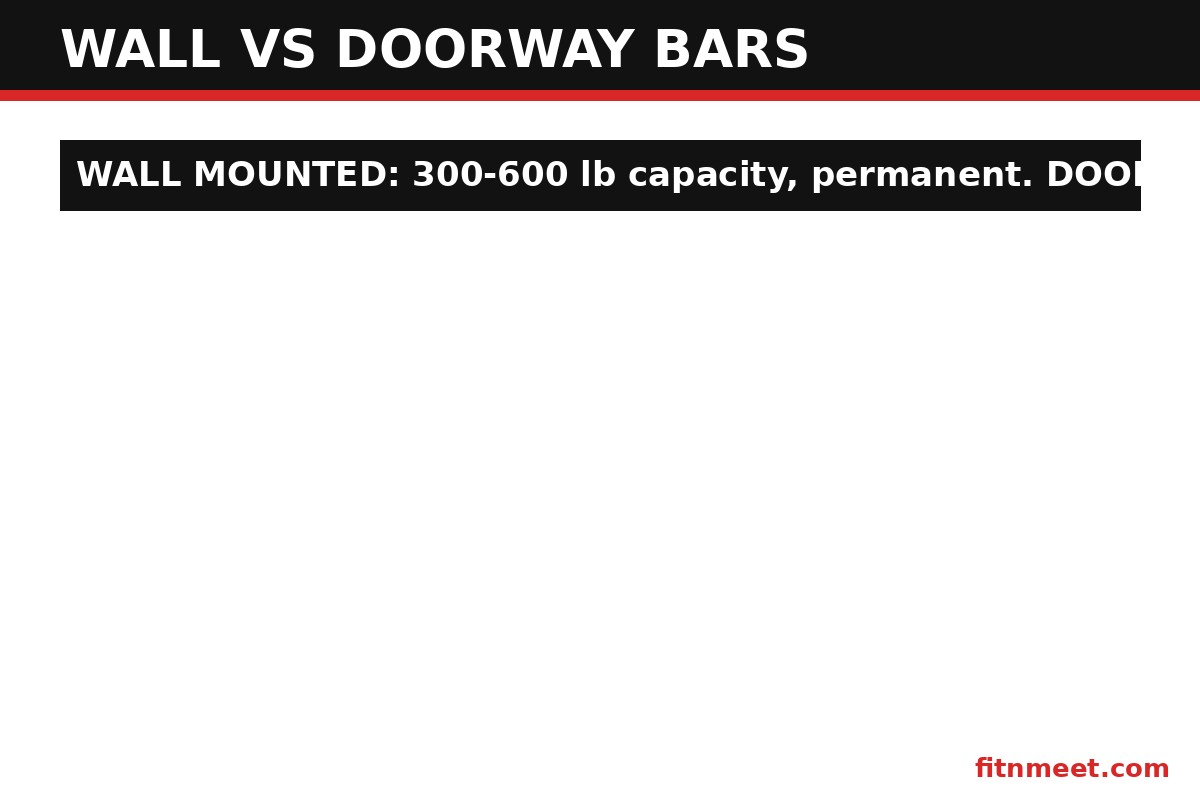
| Wall mounted pull up bar | 300–600 lb | Excellent | $50–$120 | Permanent home gyms |
| Doorway friction bar | 200–300 lb | Moderate | $25–$50 | Renters, light use |
| Power tower | 250–400 lb | Good | $150–$300 | Dips + pull-ups combo |
| Ceiling-mounted bar | 300–500 lb | Excellent | $60–$130 | Garages with joists |
| Lat pulldown machine | 200–300 lb stack | Excellent | $400–$1,500 | Precise loading, rehab |
A wall mounted pull up bar wins on the stability-per-dollar ratio for anyone who can drill into structure. Renters should choose doorway bars or freestanding towers; trainees needing precise sub-bodyweight loading (rehab, elderly) may prefer a lat pulldown.
One more comparison worth making: the wall-mounted bar versus doing nothing. Lifters without any pull-up option tend to over-rely on rows and pulldowns, which are fine exercises but do not replicate the hanging decompression or the full-body tension of a real pull-up. Even a basic doorway bar beats no bar — but if your housing allows it, the wall-mounted version’s stability unlocks weighted work and high-frequency grease-the-groove training that temporary bars cannot safely support.
For programming ideas across all options, see FitnMeet’s training guides. For full programming frameworks built around compound lifts, browse the FitnMeet strength training category.
Frequently Asked Questions
Is a wall mounted pull up bar safe?
Yes, when installed correctly. A wall mounted pull up bar bolted into wood studs or masonry with proper anchors holds 300-600 lb. The main risk is poor installation — never anchor into drywall alone, and test with partial bodyweight first.
How much weight can a wall mounted pull up bar hold?
Most quality models are rated 300-600 lb, far above any single user’s bodyweight. This margin covers dynamic forces from kipping and the added load of weighted pull-ups with a dip belt.
Can I install a wall mounted pull up bar on drywall?
No. Drywall cannot support bodyweight loads. A wall mounted pull up bar must anchor into wood studs, concrete, or brick using lag bolts or expansion anchors sized for the load.
Wall mounted pull up bar vs doorway bar: which is better?
A wall mounted pull up bar is more stable, holds more weight, and allows weighted and kipping work. Doorway bars are cheaper and renter-friendly but limited to about 200-300 lb and can damage door frames.
How often should I train on a wall mounted pull up bar?
2-3 sessions per week with 48 hours between hard sessions works for most trainees. Beginners can use daily submaximal grease-the-groove sets. Aim for 25-50 total reps weekly as an intermediate.
Do pull-ups build muscle?
Yes. EMG research shows pull-ups produce near-maximal lat activation plus heavy biceps, trap, and core involvement. Progressive overload — adding reps, then weight — builds significant upper-body muscle over 8-12 weeks.
Conclusion
The research case for a wall mounted pull up bar is unusually clean: the pull-up is among the highest-activation upper-body exercises ever measured, the equipment costs under $120, and a proper installation lasts decades. Bolt it into structure, follow a sensible protocol, and you own one of the most effective training tools in existence. Ten years from now you will still be using it every single week without fail — very few fitness purchases can claim that longevity. Fuel the work with quality protein from FitnMeet’s shop.
This article is for informational purposes only and is not medical advice. Consult a healthcare professional before starting any new training routine.