
If you’re wondering when to start taking prenatals, here’s the short version: begin 1 to 3 months before you try to conceive, and keep taking them through pregnancy and breastfeeding. This guide explains exactly why that window matters, what to look for on the label, and what to do if you’re starting late — no judgment, no jargon.
When to Start Taking Prenatals: The Quick Answer
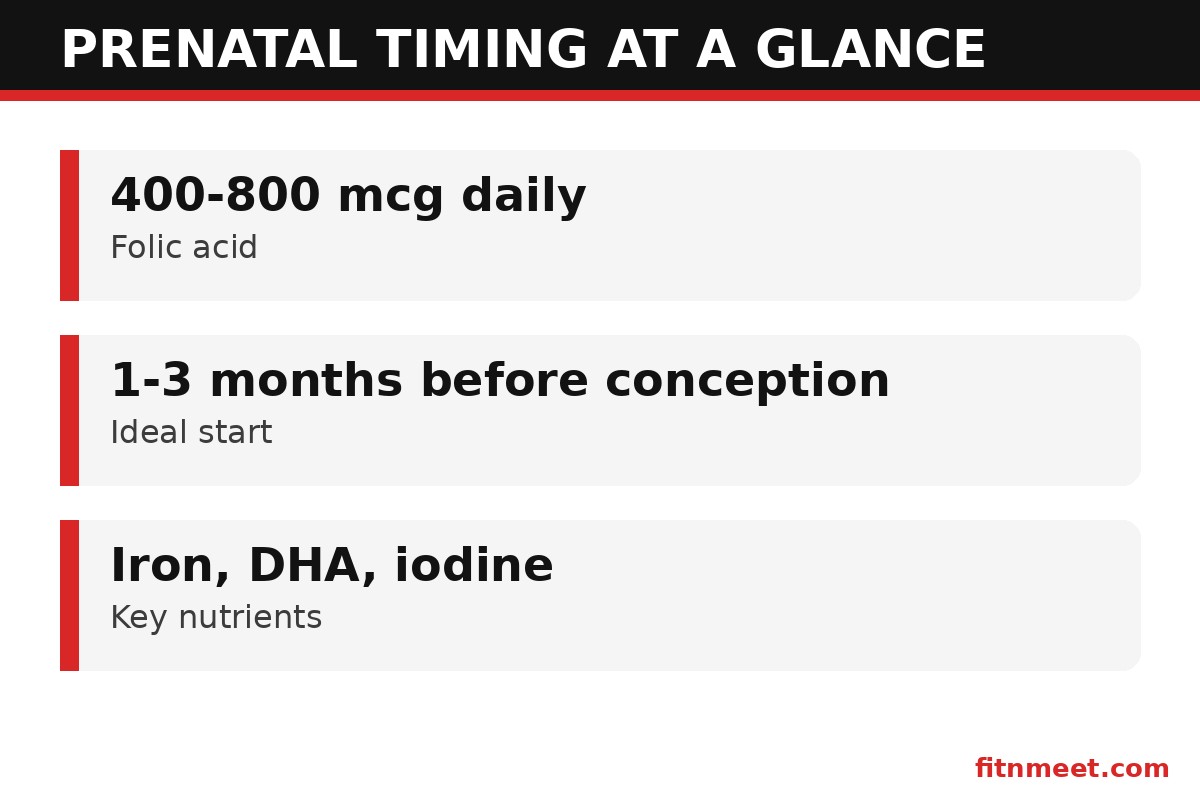
Here’s the full answer to when to start taking prenatals: start 1 to 3 months before conception (the preconception window), continue daily through all three trimesters, and keep going while breastfeeding. The single most important nutrient is folic acid — 400 to 800 mcg daily — because it must be in your system before conception to protect against neural tube defects. If you’re already pregnant and haven’t started, begin today; late is far better than never. One more reassurance up front: if this feels overwhelming, you’re not behind — most women start prenatals after a positive test, and that still helps enormously.
Start Here: When to Start Taking Prenatals
New to all of this? Start with this simple timeline — everything else in this guide is detail around it.
- 3 months before trying: ideal start. Begin your prenatal now so folate, iron and vitamin D levels build up. This is the gold-standard answer to when to start taking prenatals.
- 1 month before trying: still excellent. One full month of folic acid covers the critical preconception window for most women.
- The month you start trying: start now. Don’t wait for a positive test — conception happens 1–2 weeks before a test turns positive.
- Already pregnant, not taking anything: start today. The benefits continue throughout pregnancy even without the preconception head start.
- Not planning, but could become pregnant: any sexually active woman of childbearing age not using reliable contraception is advised to take 400 mcg folic acid daily — about half of pregnancies are unplanned.
So when to start taking prenatals, exactly? The earlier within that 1–3 month window, the better — but “today” beats “the perfect date” every time. If cost or confusion has delayed you, remember: all advice about when to start taking prenatals boils down to the same two words — start today. Pick up a bottle this week and take the first one with breakfast tomorrow. That’s the whole starting ritual.
Why When to Start Taking Prenatals Matters So Much
Here’s the thing most guides bury: the baby’s neural tube — the structure that becomes the brain and spinal cord — closes by day 28 after conception. That’s roughly two weeks after a missed period, often before a woman knows she’s pregnant. Folic acid taken before conception reduces the risk of neural tube defects like spina bifida by 50–70%. Folic acid started at week 6 arrives after the critical window has closed.
That’s the entire reason the question of when to start taking prenatals matters so much. It’s not about being a perfect planner — it’s about one specific biological deadline that doesn’t wait for a positive test. Researchers studying neural tube defects found the protective effect only when folate status was adequate around conception, which is precisely why guidance on when to start taking prenatals emphasizes the preconception window. Iron matters too: pregnancy demands about 27 mg of iron daily (versus 18 mg for non-pregnant women), and entering pregnancy iron-replete prevents the exhaustion of first-trimester anemia. Vitamin D, choline, iodine and DHA all play supporting roles in fetal development that begin in those invisible early weeks.
How Prenatals Work: The Mechanism (In Plain English)
Think of a prenatal as a nutritional safety net, not a magic pill. In plain terms: your body needs extra raw materials to build a placenta, expand blood volume by ~50%, and grow a human. Food covers most of it, but a few nutrients are hard to get reliably from diet alone at pregnancy-level doses.
Folate/folic acid (the headline nutrient): your cells use it to copy DNA every time they divide — and early pregnancy is the fastest cell-division event of your life. Without enough, the neural tube may not close properly. Iron: builds hemoglobin for your expanded blood supply and the baby’s; deficiency causes fatigue and raises preterm risks. Choline: supports brain development; most women get far less than the 450 mg/day pregnancy target from food. DHA (an omega-3): a structural component of the fetal brain and eyes. Iodine: needed for thyroid hormone that drives fetal brain development. Vitamin D and calcium: build the baby’s skeleton without draining yours.
None of these work like caffeine — there’s no feeling when they “kick in.” They work by keeping your nutrient stores topped up so development never hits a shortage. Once you understand this mechanism, the guidance on when to start taking prenatals stops feeling arbitrary: you’re stocking the pantry before the busiest cooking season of your life. For the official nutrient-by-nutrient breakdown, see the NIH Office of Dietary Supplements prenatal fact sheet.
Benefits of Starting Prenatals Early
- Neural tube defect protection. The big one: adequate folate before conception cuts risk by 50–70%. This benefit is exclusive to early starters.
- Anemia prevention. Entering pregnancy with full iron stores prevents the crushing fatigue of first-trimester anemia.
- Healthier birth weight. Consistent prenatal use is associated with better fetal growth and fewer low-birth-weight outcomes.
- Nausea reduction. Counterintuitive but real: women who start prenatals before conception report less pregnancy nausea, possibly because B6 levels are already steady.
- Nutrient insurance. Morning sickness can wreck your diet for weeks; prenatals keep the essentials covered when food won’t stay down.
- Postpartum recovery. Continuing through breastfeeding supports your own recovery and milk nutrient content.
Doctors emphasize when to start taking prenatals early because every week of preconception coverage compounds these benefits — folate accumulates in red blood cells over weeks, so the woman who starts 3 months out has deeper reserves than the one who starts at the positive test.
How to Start Taking Prenatals: Your Exact Timing Rules
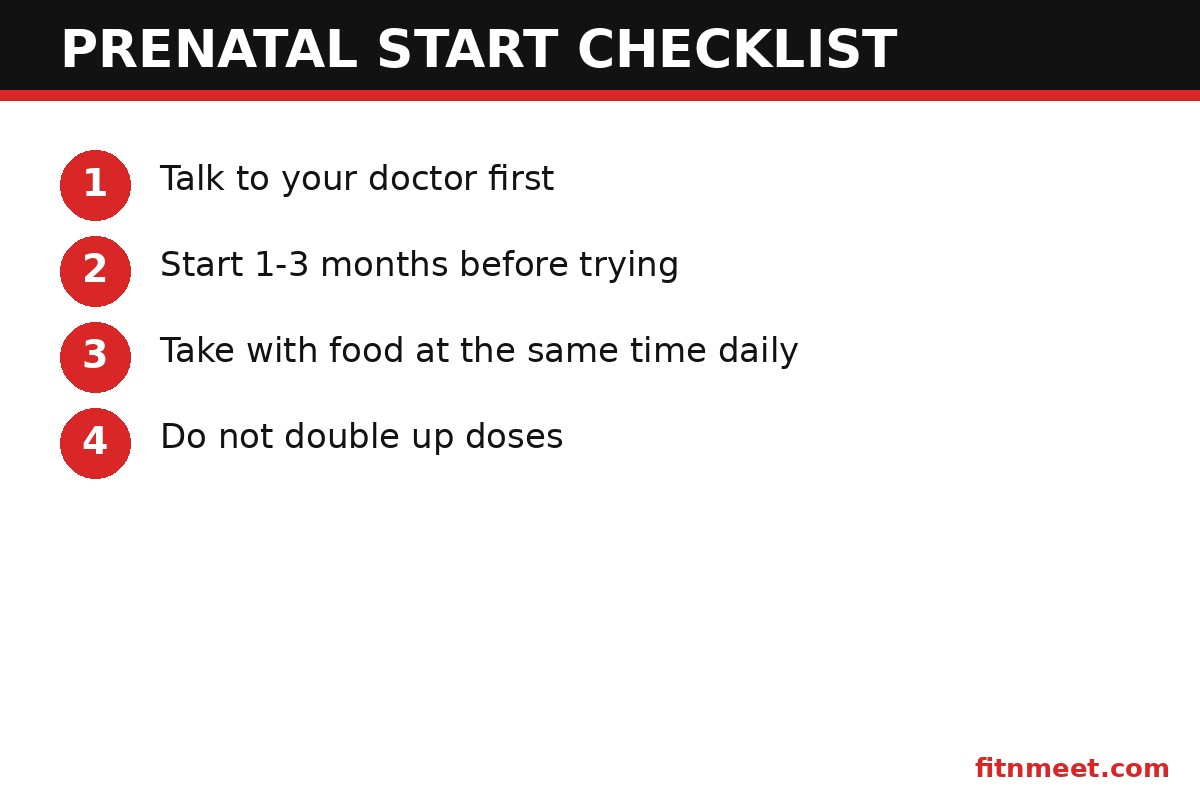
Rule 1 — Start 1–3 months before trying. Put “buy prenatals” on the same list as “stop birth control.” Take one daily with breakfast.
Rule 2 — Take it at the same time daily. Consistency beats perfection. Link it to an existing habit: morning coffee, brushing teeth, lunch.
Rule 3 — Take with food, not on an empty stomach. Iron causes nausea on empty stomachs. A small meal or snack fixes it for most women.
Rule 4 — Pair with vitamin C, separate from coffee/tea. Vitamin C boosts iron absorption; coffee and tea (tannins) block it. Keep a 1–2 hour gap from your morning brew.
Rule 5 — If you miss a day, just resume. Don’t double up. One missed day changes nothing; a week of missed days is worth mentioning to your provider.
Rule 6 — Already pregnant and just starting? If you’re wondering when to start taking prenatals and you just got a positive test, the answer is: today, with your next meal. You missed the preconception window, but months of benefit remain.
Rule 7 — Keep going through breastfeeding. Nutrient demands stay elevated while nursing; most providers say continue until you wean.
What to Look For on the Label
When you’re deciding when to start taking prenatals and which bottle to buy, prioritize these label items: 400–800 mcg folic acid (or methylfolate if you prefer — both count); ~27 mg iron; 150 mcg iodine (often missing — check); 200–300 mg DHA (sometimes a separate softgel); 600 IU vitamin D; and choline (rarely adequate in prenatals — eggs help). Avoid mega-doses: more is not better, especially vitamin A (as retinol — choose beta-carotene forms) which can be harmful in excess. Third-party testing seals (USP, NSF) signal quality. Gummies taste better but usually lack iron — fine if you get iron from food or a separate supplement. Compare solid options in FitnMeet’s vitamins collection or FitnMeet’s shop.
Mistakes to Avoid When Starting Prenatals
Most of these mistakes come down to timing rather than product choice — which is why understanding when to start taking prenatals matters more than finding the perfect brand.
- Waiting for the positive test. The most common timing error isn’t about which brand — it’s treating prenatals as a pregnancy product instead of a preconception one. The neural tube closes before most tests turn positive.
- Stopping because of nausea. Iron-related queasiness makes many women quit in week 8 — right when nutrients matter most. Switch to taking it at night, try gummies plus separate iron, or ask your provider about lower-iron formulas.
- Doubling up after a missed day. Extra iron in one dose worsens nausea and constipation without benefit. Just resume normally.
- Taking it with coffee. Your morning latte can halve iron absorption. Separate by an hour or two.
- Assuming “gummy = complete.” Most prenatal gummies skip iron entirely. If you choose gummies, confirm how you’re covering iron.
- Stopping at birth. Breastfeeding keeps nutrient demands high. Continue until weaning unless your provider says otherwise.
Prenatal Comparisons
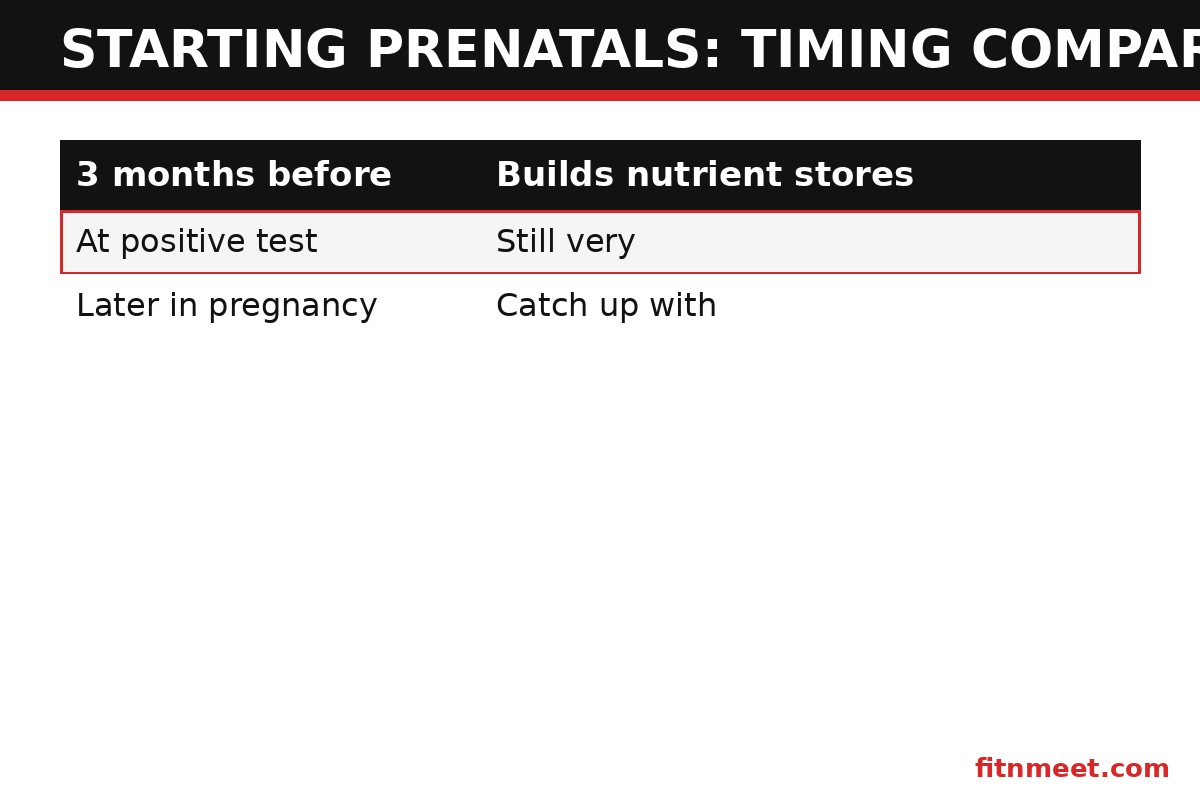
| Factor | Prenatal vitamin | Regular multivitamin | Folic acid alone |
|---|---|---|---|
| Folic acid | 400–800 mcg | ~400 mcg | 400–800 mcg |
| Iron | ~27 mg | ~18 mg | None |
| DHA/choline | Often included | Rarely | None |
| Iodine | Often 150 mcg | Sometimes | None |
| Best for | Trying/pregnant/nursing | General adults | Budget preconception |
Can I take a regular multivitamin instead of prenatals? In a pinch, yes — a regular multi with 400 mcg folic acid beats nothing. But it has less iron (18 vs 27 mg) and usually no DHA or choline. If cost is the only barrier, start the regular multi now while you save for prenatals — timing matters more than brand, and the guidance on when to start taking prenatals applies to any folic-acid-containing supplement. If you are weighing a regular multi against prenatals, the FitnMeet health articles cover general wellness nutrition — but when to start taking prenatals is still 1 to 3 months before trying.
What if I can’t afford prenatals? Plain folic acid tablets (400–800 mcg) cost pennies and cover the most critical nutrient. Many clinics and pharmacies offer them free — ask. A budget folic acid tablet started 3 months before conception outperforms an expensive prenatal started at week 8.
Safety Notes
Prenatals are among the most studied supplements in existence and are safe for the vast majority of women at recommended doses. Real cautions: don’t exceed the labeled dose (excess vitamin A as retinol is the main risk — check that yours uses beta-carotene); iron can cause constipation — fiber, water and gentle movement help; and tell your provider about all supplements at your first prenatal visit. If side effects make you want to quit, talk to your provider before stopping — and remember that guidance on when to start taking prenatals assumes consistent daily use, so troubleshooting side effects beats abandoning the bottle. The FDA’s supplement guidance explains how to read labels and report problems.
This article is for informational purposes only and is not medical advice. Consult a healthcare professional before starting any supplement.
Frequently Asked Questions
How early should I start taking prenatals before pregnancy?
Start 1 to 3 months before trying to conceive. This is the standard answer to when to start taking prenatals, and it gives folic acid time to build up in your red blood cells before the neural tube closes around day 28 after conception.
Is it too late to start prenatals at 8 weeks pregnant?
No. Starting at 8 weeks misses the neural tube window but still provides months of iron, DHA, choline and iodine during critical brain and body development. Start today rather than skipping them entirely.
Can I take prenatals if I’m not trying to conceive?
Yes. Any sexually active woman of childbearing age who could become pregnant is advised to get 400 mcg of folic acid daily, since about half of pregnancies are unplanned. A standard prenatal or folic acid tablet both qualify.
Do prenatals help you get pregnant?
Prenatals don’t directly boost fertility, but correcting deficiencies (especially iron and vitamin D) supports overall reproductive health. Think of them as preparing the environment, not speeding up conception.
I just found out I’m pregnant — when should I start prenatals now?
Today. This is the most common version of the when to start taking prenatals question we hear: positive test in hand, no prenatal yet. Take your first one with your next meal and don’t look back.
Should I keep taking prenatals while breastfeeding?
Yes, most providers recommend continuing through breastfeeding, since nutrient demands stay elevated. This is the often-forgotten second half of the practical answer to when to start taking prenatals — starting early and continuing through weaning.
Conclusion: You’ve Got This
Now you know exactly when to start taking prenatals: 1 to 3 months before trying, daily through pregnancy, and on through breastfeeding — with 400 to 800 mcg of folic acid as the non-negotiable core. The question of when to start taking prenatals feels huge when you’re standing in the supplement aisle, but the actual action is small: buy a bottle this week, take one with breakfast tomorrow, and keep going. If you’re starting late, let go of the guilt — the best time was three months ago, the second-best time is today. And if nausea, cost or confusion ever make you want to quit, talk to your provider before stopping; there’s almost always a formulation or timing tweak that works. For trusted options, browse FitnMeet’s health-support collection or the FitnMeet blog’s supplement guides — and give yourself credit for researching this at all. That’s already good parenting.