

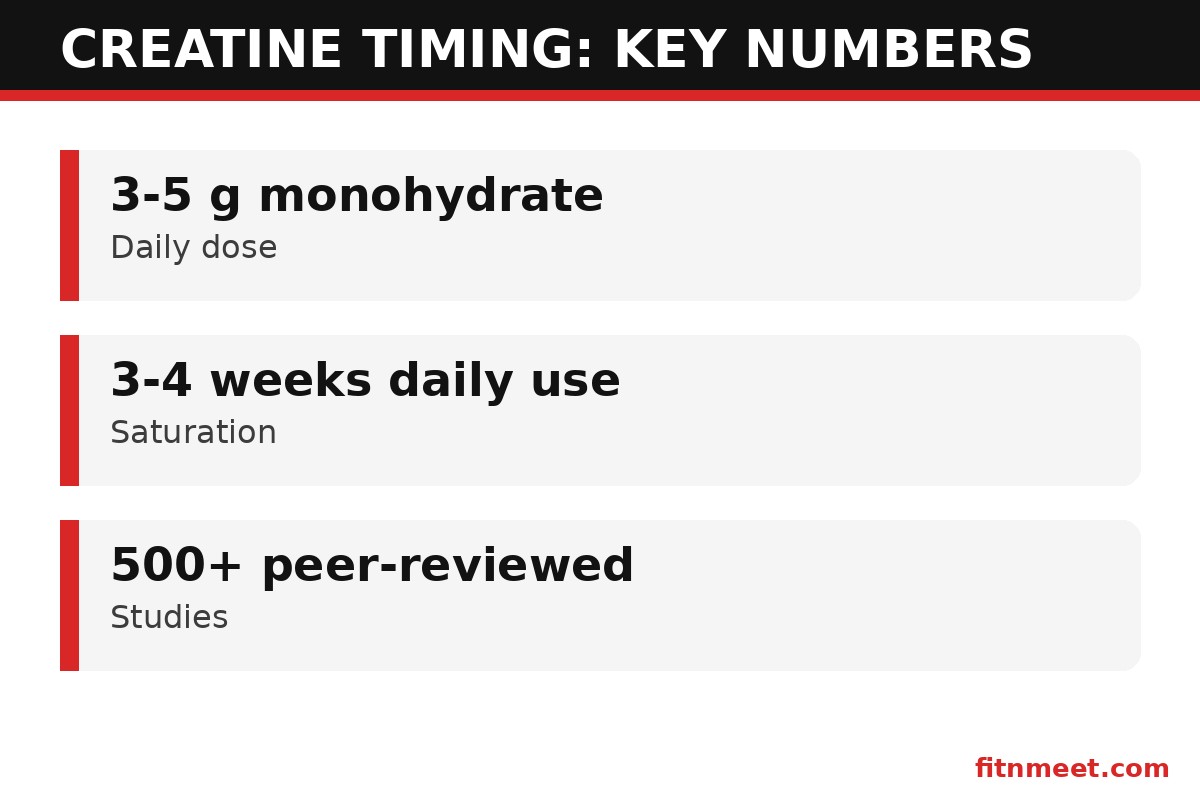
When do you take creatine for the best results? Take 3–5 g of creatine monohydrate once daily, at whatever time you will remember consistently — timing matters far less than daily consistency. Research shows a small edge for post-workout timing over pre-workout, but the difference is minor compared to simply taking it every day, including rest days.
When Do You Take Creatine, Explained Simply
Start here: Think of creatine like filling a bathtub. Your muscles hold a “tank” of creatine, and daily 3–5 g doses slowly fill it over 3–4 weeks. Once the tank is full, it stays full as long as you keep topping it up daily. When you pour the water in during the day barely matters — what matters is that you pour it in every single day. That is the entire answer to “when do you take creatine”: daily, at a time you will not forget.
If you are new to supplements, here is the one-paragraph version: when do you take creatine? Once a day, every day, 3–5 grams, mixed in water or your protein shake, at the same time that fits your routine — morning, post-workout, or evening all work. Take it on rest days too. Skip the loading phase unless you are impatient. That is genuinely all there is to it; the rest of this guide is the why behind each of those sentences.
What Creatine Does (The 60-Second Version)
Creatine is a compound your body makes from amino acids and stores mostly in muscle as phosphocreatine — a rapid backup battery for short, intense efforts. When you sprint, jump, or grind out a heavy set of 5, your muscles burn through ATP (energy currency) in seconds; phosphocreatine donates its phosphate to rebuild ATP instantly. More stored creatine = a slightly bigger backup battery = 1–2 extra reps on heavy sets, set after set, workout after workout.
That small per-set edge compounds. Over 8–12 weeks, lifters taking creatine gain measurably more strength and lean mass than placebo groups in trial after trial — it is the most studied sports supplement in existence, with 500+ peer-reviewed studies. The Wikipedia creatine page summarizes the biochemistry, and phosphocreatine’s Wikipedia entry covers the energy system it fuels. Lifters wondering when do you take creatine as part of a mass-building stack can explore the FitnMeet muscle development collection for supporting formulas.
Why timing became a debate at all
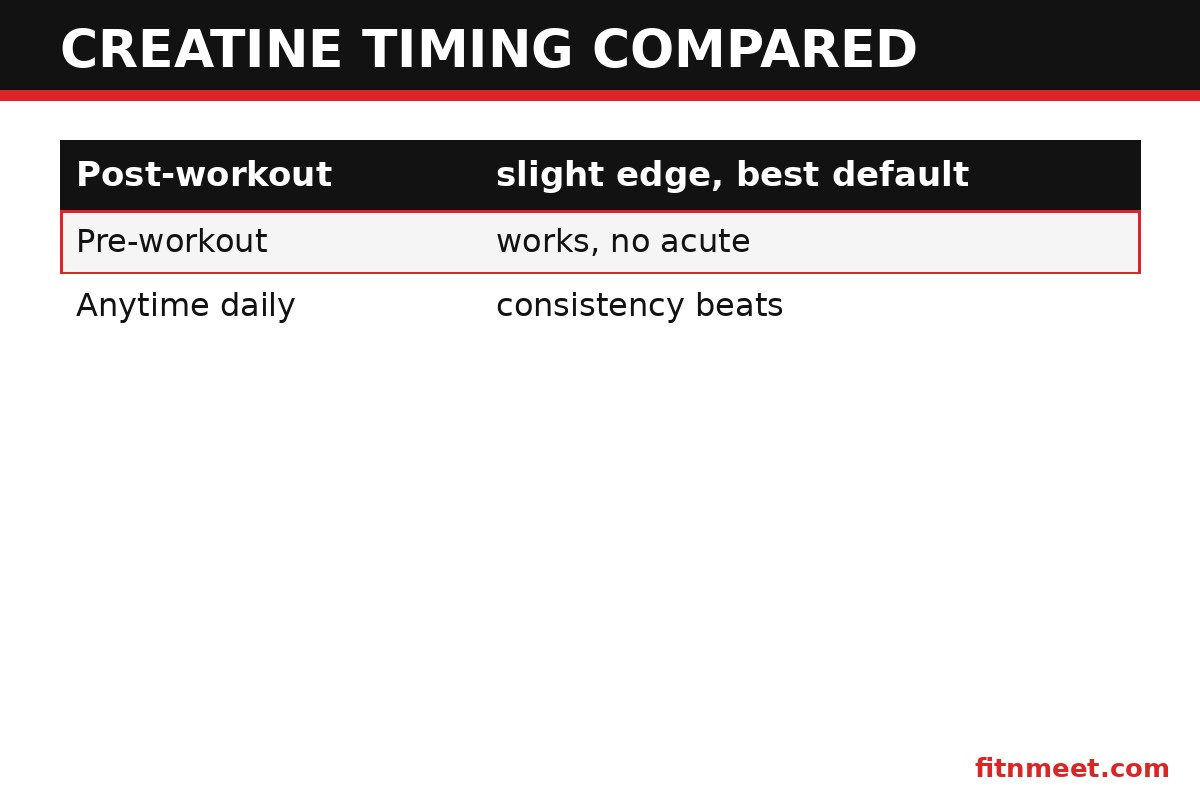
Because creatine uptake into muscle is slightly improved by insulin, researchers wondered whether taking it around workouts (when blood flow and nutrient delivery peak) beats random timing. A 2013 study comparing pre- vs post-workout creatine found the post-workout group gained more lean mass over 4 weeks. Interesting — but the effect was small, the study was short, and later research has been mixed. The honest summary: when do you take creatine matters a little, but consistency matters enormously more.
Why Beginners Care About Creatine Timing
Beginners obsess over “when do you take creatine” for three understandable reasons:
- It is their first supplement. Creatine is the gateway — the first thing most lifters buy — so every detail feels high-stakes. It is not; creatine is forgiving.
- The internet is noisy. One influencer says pre-workout, another says post, a third says before bed. The disagreement exists because the differences are tiny — if timing mattered hugely, there would be no debate.
- They want it to “kick in.” Beginners expect a pre-workout-style feeling. Creatine has none — it works silently over weeks. Understanding that when do you take creatine is about saturation, not stimulation, resets expectations correctly.
One stat to anchor you: muscle creatine stores rise about 20–40% above baseline with daily supplementation, and that elevation — not the clock time of your dose — drives the performance benefit.
Getting Started: Your 5-Step Creatine Plan
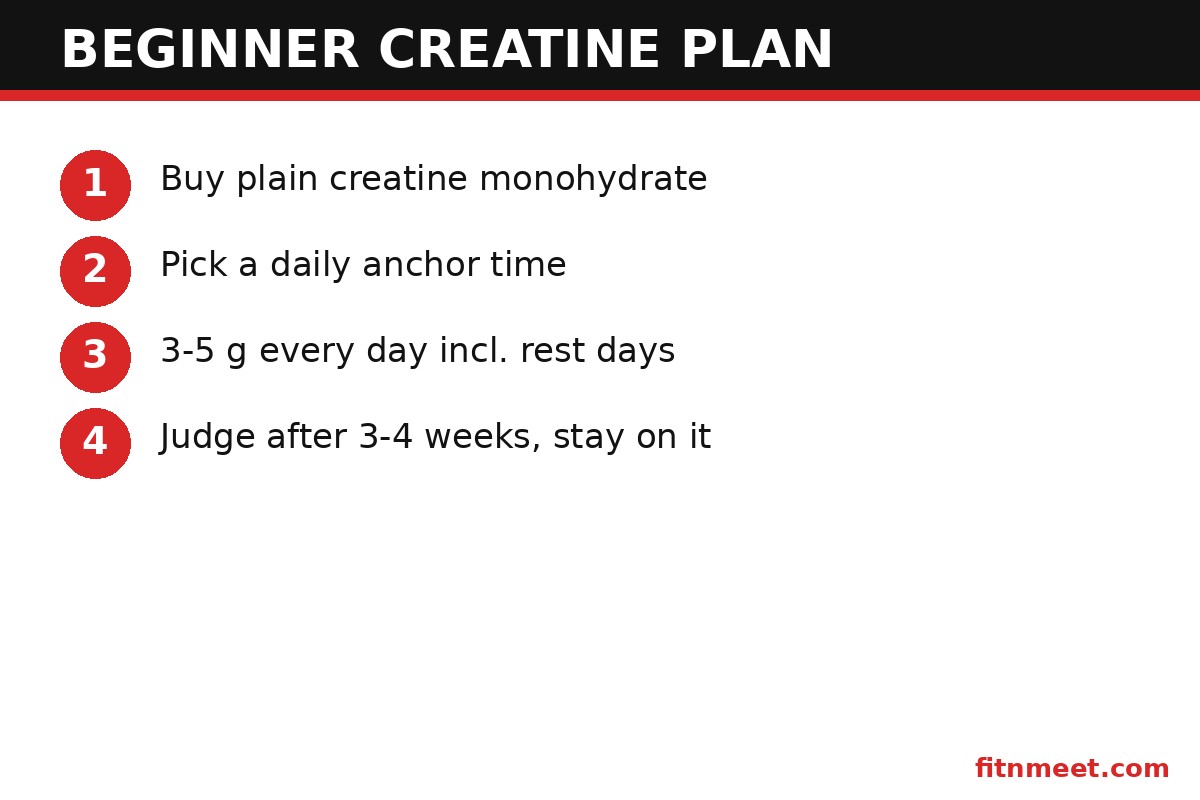
Step 1 — Buy creatine monohydrate, plain. Not ethyl ester, not buffered, not a “matrix.” Plain creatine monohydrate is the studied form, the cheapest, and the one behind all 500+ trials. A 500 g tub lasts 100+ days at 5 g/day.
Step 2 — Pick your daily anchor time. When do you take creatine? Attach it to something you already do daily: breakfast, your post-workout shake, or brushing your teeth at night. The best time is the time you will not skip. For most lifters, post-workout with your protein shake is the natural anchor — and the timing research mildly favors it.
Step 3 — Take 3–5 g every day, including rest days. The tank drains slowly without top-ups, so rest days count. Scoop, stir into water or shake, drink. Thirty seconds, done.
Step 4 — Wait 3–4 weeks before judging. Without a loading phase, full saturation takes about a month. Do not increase the dose because “it is not working yet” in week two — it is working, silently.
Step 5 — Stay on it. Creatine is a long-game supplement. Benefits accrue over months of training. There is no need to cycle off; long-term studies up to 5 years show no adverse effects in healthy people.
Benefits of Daily Creatine
Strength and muscle
Meta-analyses consistently show creatine users gain more lean mass and strength than placebo groups — roughly 1–2 kg extra lean mass over 8–12 week training programs. This is the benefit everything else orbits. Pair that edge with solid programming from the FitnMeet strength training category — and remember, when do you take creatine matters far less than daily consistency.
High-intensity performance
Sprinters, team-sport athletes, and lifters doing repeated hard efforts see improved performance in efforts under ~30 seconds. The phosphocreatine system is exactly the energy pathway those efforts use.
Recovery between sets
Faster ATP replenishment means slightly better performance on sets 3, 4, and 5 — the sets where placebo groups fade. When do you take creatine influences none of this acutely; saturation does it all.
Brain and aging research (bonus)
Emerging trials suggest possible cognitive benefits under sleep deprivation or mental fatigue, and older adults combining creatine with resistance training gain more muscle than training alone. Preliminary but promising.
For the training that creatine amplifies, FitnMeet’s sports nutrition collection and workout recovery range cover the supporting cast.
Common Timing Mistakes
Mistake 1 — Only taking it on training days. The most common beginner error. When do you take creatine? Every day. Skipping rest days lets saturation decay and restarts the slow fill every week.
Mistake 2 — Taking it pre-workout expecting energy. Creatine is not a stimulant. Taking it 30 minutes before training does nothing acute — the benefit comes from weeks of saturation, not the dose you just drank.
Mistake 3 — Megadosing to “speed it up.” Beyond ~5 g/day, extra creatine is excreted, not stored. Ten grams does not fill the tank twice as fast; it just makes expensive urine. (The formal loading protocol is 20 g/day split into 4 doses for 5–7 days — the one exception, and still optional.)
Mistake 4 — Timing it with nothing. Taking creatine with a meal or shake containing carbs/protein modestly improves uptake via insulin. Dry-scooping it alone on an empty stomach works, just slightly less efficiently.
Mistake 5 — Quitting after 2 weeks. “When do you take creatine and when does it work” are different questions. Saturation takes 3–4 weeks without loading; judging it at day 10 is like judging a garden the day after planting.
Mistake 6 — Cycling off unnecessarily. There is no evidence-based reason to cycle creatine. Your body keeps making its own ~1–2 g/day regardless; supplementation just tops up the tank. Stay on it.
Dosage Basics
The standard protocol (recommended)
3–5 g once daily, every day. That is the entire protocol. When do you take creatine within the day? Whenever fits your routine — post-workout with food is the evidence-favored default.
The loading protocol (optional)
20 g/day (4 × 5 g doses) for 5–7 days, then 3–5 g/day maintenance. Fills the tank in a week instead of a month. Downsides: more stomach discomfort, more cost, and no better long-term result. Worth it only if you want full saturation fast — e.g., starting right before a training block.
How much do you need?
- Under 70 kg: 3 g/day is plenty.
- 70–100 kg: 5 g/day is the standard.
- Over 100 kg / very muscular: up to 7–10 g/day is reasonable.
- Vegetarians: lower baseline stores (no meat intake), so you may respond slightly more — 3–5 g/day still correct.
What to mix it with
Water works. A protein shake or juice works slightly better (carbs/protein aid uptake). Hot liquids are fine — creatine degrades to creatinine only after prolonged boiling, not in warm water. Caffeine alongside is fine too; the old “caffeine cancels creatine” claim came from one small study and has not held up.
Safety
Creatine monohydrate is the most safety-studied sports supplement in history, and the record is clean:
- Kidneys: the “creatine damages kidneys” myth comes from misread creatinine blood markers — creatine raises creatinine as a lab value because that is its breakdown product, not because kidneys are harmed. Studies up to 5 years show no kidney damage in healthy people.
- Dehydration/cramps: actually, trials show creatine users cramp less, likely because better-hydrated muscle cells. Drink normal amounts of water; no need to force gallons.
- Hair loss: one small 2009 study noted a DHT increase; it has never been replicated and no hair-loss link has been established.
One honest footnote: creatine causes 1–2 kg of water-weight gain inside the muscles in the first weeks. That is intracellular water — it makes muscles look fuller, not bloated — but the scale will move, so do not confuse it with fat gain. Teens, pregnant women, and anyone with kidney disease should check with a clinician first, as with any supplement.
Frequently Asked Questions
When do you take creatine — before or after a workout?
After, by a small margin. One study found post-workout creatine beat pre-workout for lean mass gains, likely due to better nutrient delivery. But the difference is minor — daily consistency matters far more than pre vs post. If you can only remember one, take it post-workout with your shake.
When do you take creatine on rest days?
At the same time you take it on training days — creatine is a daily saturation supplement, not a workout-day supplement. Skipping rest days lets muscle creatine levels decay. Anchor it to a daily habit like breakfast so rest days are automatic.
When do you take creatine for the first time — should I load?
Loading (20 g/day for 5–7 days) fills muscles in a week instead of 3–4 weeks, but the long-term result is identical to just taking 3–5 g daily from the start. Beginners should skip loading: it costs more, upsets some stomachs, and adds nothing to the final outcome.
Can I take creatine in the morning?
Yes — morning is a perfectly good answer to when do you take creatine, especially if breakfast is your most consistent meal. Creatine uptake is slightly improved with food, so morning with breakfast works well. Evening works too; there is no wrong time, only forgotten doses.
When do you take creatine if you train fasted?
Take it after the session with your first meal. Fasted training does not change the creatine protocol — daily saturation is what matters. Post-workout with food is both convenient and the timing the research mildly favors.
How long after starting do you feel creatine working?
Without loading, muscles reach full saturation in about 3–4 weeks of daily 3–5 g doses. You will not feel a kick — instead you will notice an extra rep or two on heavy sets and slightly better recovery between sets, compounding over the following months.
When do you take creatine — with food or on an empty stomach?
With food is slightly better. Carbohydrates and protein raise insulin, which modestly improves creatine uptake into muscle. Mixing it into your post-workout shake or taking it with a meal is ideal; on an empty stomach it still works, just a touch less efficiently.
Do I need to cycle creatine?
No. There is no evidence-based reason to cycle off creatine — long-term studies up to 5 years show continued safety in healthy adults, and your body’s own production is unaffected long-term. When do you take creatine becomes a permanent daily habit, like brushing your teeth.
Conclusion
So — when do you take creatine? Every day, 3–5 grams, at the time you will actually remember, ideally post-workout with food. Still wondering when do you take creatine on rest days? Same time, every day — the tank does not know it is Sunday. That is the whole protocol. Do not overthink the clock; underthink it, and over-deliver on consistency. Three months from now, the lifters who gained the most will not be the ones with the cleverest timing — they will be the ones who never missed a day.
Ready to start? Grab plain creatine monohydrate from FitnMeet’s shop, pair it with solid training fuel from the sports nutrition collection, and give it the month it deserves. Your future self — one rep stronger, every set — says thanks.
This article is for informational purposes only and is not medical advice. Consult a healthcare professional before starting any supplement.