
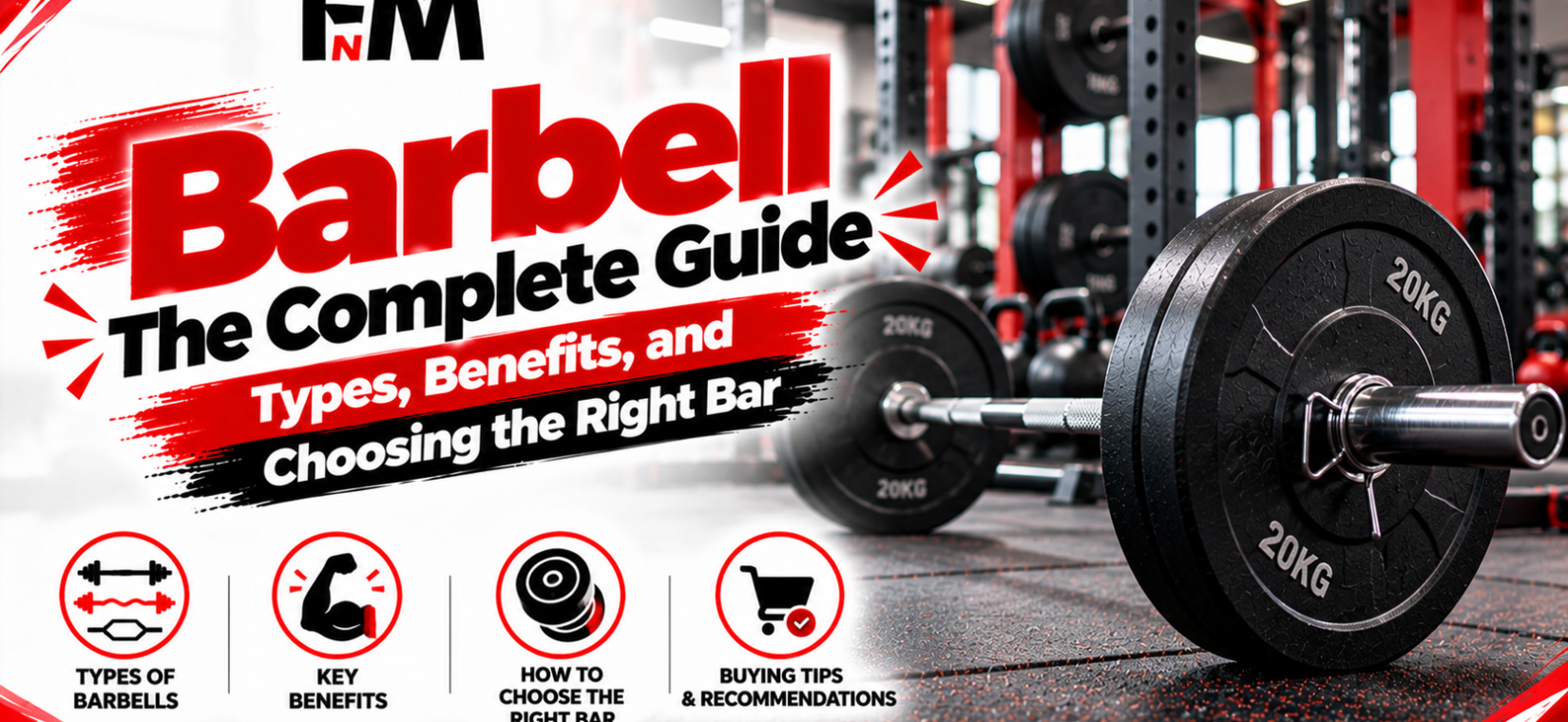
A barbell is the single most versatile piece of strength equipment ever made. This long steel bar, loaded with weight plates on each end, has built more muscle and strength than any other tool in the gym. Whether you train in a commercial facility or at home, understanding the different types, key specifications, and proper selection will transform your results.
This guide covers everything: the 7 main types, the specifications that actually matter, proven benefits, how to choose the right bar, essential exercises, finishes compared, real-world pricing, maintenance, the barbell vs dumbbells debate, must-have accessories, beginner mistakes to avoid, and answers to common questions.
What Is a Barbell?
It is a long metal bar, typically 4 to 8 feet in length, designed to hold weight plates on rotating sleeves at each end. Lifters grip the central shaft to perform compound exercises like squats, deadlifts, bench presses, and overhead presses. Unlike dumbbells, this tool lets you load heavier weights symmetrically, making it the foundation of powerlifting, Olympic weightlifting, and general strength training.
A standard Olympic bar weighs 45 pounds (20 kg), though specialty bars range from 15 to 55+ pounds. The combination of a rigid shaft, a textured grip surface called knurling, and smooth-spinning sleeves defines a quality bar.
7 Barbell Types Explained
Not every bar is built for the same job. Here are the seven main types you will find in gyms:
1. Olympic: The all-around standard. A men’s Olympic bar weighs 45 lb (20 kg), measures 7.2 feet long, and has a 28mm shaft diameter. Women’s bars weigh 33 lb (15 kg) with a 25mm shaft. They feature moderate knurling and free-spinning sleeves for the Olympic lifts.
2. Powerlifting: Built for the squat, bench press, and deadlift. It has a thicker 29mm shaft, aggressive knurling with a center knurl for squats, and minimal whip for maximum stiffness under heavy loads.
3. Deadlift: Longer and thinner with a 27mm shaft and extra whip, which helps lifters break heavy weight off the floor. The aggressive knurling improves grip during maximal pulls.
4. Squat: Extra-thick (32mm+) and extremely stiff with virtually no whip, designed to sit stable on your back during heavy squats. A deep center knurl keeps the bar locked in place.
5. Swiss (Multi-Grip): Features multiple neutral-grip handles that reduce shoulder strain during pressing movements. An excellent option for lifters with shoulder issues.
6. Trap (Hex): A hexagonal frame you stand inside, with handles at your sides. It allows a more upright deadlift position that is easier on the lower back than a straight bar.
7. EZ Curl: A shorter bar with angled zigzag grips that reduce wrist strain during bicep curls and triceps extensions.
Key Barbell Specifications to Understand
These specs determine whether a bar suits your training:
Length and weight: Full-size bars run 7+ feet and 45 lb. Shorter bars suit home gyms with limited space.
Shaft diameter: Thinner shafts (28mm) flex more and suit Olympic lifting; thicker shafts (29-32mm) stay rigid for powerlifting.
Knurling: The diamond-pattern etching on the shaft. Deeper knurling grips better but can tear up your hands; milder knurling suits beginners and high-rep training.
Whip: The bar’s elastic flex under load. More whip helps Olympic lifters; powerlifters prefer a stiff bar with minimal whip.
Tensile strength: Measured in PSI, this indicates how much stress the steel handles before permanently bending. A quality bar rates 190,000+ PSI.
Sleeve rotation: Bushings offer durable, controlled spin; needle bearings spin faster and smoother for Olympic lifts but cost more.
Weight capacity: Check the static load rating. A good bar handles 1,000 lb or more.
5 Proven Benefits of Barbell Training
1. Maximum strength gains: This equipment allows heavier loading than any other free-weight tool, driving progressive overload — the primary driver of strength. Research comparing barbell back squat training with bodyweight training found significant improvements in lower-body strength and muscle hypertrophy (PubMed, 2023).
2. Full-body muscle building: Compound lifts like squats and deadlifts recruit dozens of muscles at once, producing a greater growth stimulus than isolation exercises. Pair training with enough protein — our muscle-building nutrition guide covers the eating side.
3. Simple progressive overload: Adding 2.5 to 5 lb per session is easy, letting you track and sustain progress for years.
4. Stronger bones and joints: Heavy axial loading from squats and presses stimulates bone mineral density, supporting long-term skeletal health.
5. Unmatched versatility: One bar enables hundreds of exercises, from heavy deadlifts to overhead presses, making it the best value in strength equipment.
How to Choose the Right Barbell
Match the bar to your training style. Powerlifters should prioritize a stiff 29mm bar with a center knurl; Olympic lifters need a 28mm bar with quality bearings and moderate whip; general fitness lifters do well with a versatile multi-purpose Olympic bar.
Consider space and budget too. A Body-Solid Olympic 7-foot bar is a proven all-rounder for home gyms, while fixed-weight straight barbells are perfect for quick curls, presses, and high-rep accessory work without loading plates.
Before buying, check the warranty, the finish (chrome, zinc, or cerakote for corrosion resistance), and the verified load rating.
Barbell Finishes Compared: Chrome vs Zinc vs Cerakote vs Bare Steel
The finish affects corrosion resistance, grip feel, maintenance, and price. Here is what each offers:
Chrome: The classic shiny finish. Decent corrosion resistance, slick feel that some lifters love, and affordable. The downside: chrome can flake over years of heavy use, and the slickness reduces grip slightly compared to rougher finishes.
Zinc (black or bright): Good corrosion resistance at a budget price. Black zinc looks great new but wears to show silver underneath at contact points — cosmetic, not structural. A solid value choice for garage gyms.
Cerakote: A ceramic-based coating borrowed from the firearms industry. Excellent corrosion resistance, available in colors, and a slightly textured feel most lifters like. The premium option — expect to pay $50 to $100 more for it.
Bare steel: No coating at all. The rawest grip feel — knurling bites hardest on bare steel — but it rusts if you look at it wrong. Only for lifters who will oil the bar regularly and train in dry environments. High maintenance, unbeatable feel.
Stainless steel: The best of both worlds: corrosion resistance near cerakote with a raw-steel grip feel. Also the most expensive. Worth it for humid climates or lifters who want zero maintenance.
For most home gym buyers, zinc or chrome hits the sweet spot. Choose cerakote or stainless if you train in a humid garage or simply never want to think about rust.
How Much Does a Good Barbell Cost?
Bar pricing is refreshingly straightforward:
- Budget ($100–$200): Basic chrome or zinc bars, 130k–165k PSI steel, bushings. Fine for beginners and general fitness, but they will develop whip quirks and sleeve issues under serious loads.
- Mid-range ($200–$350): The sweet spot. 190k+ PSI steel, good knurling, reliable bushings or entry bearings, solid warranties. This is where most lifters should buy — a $250 bar serves 95% of trainees for life.
- Premium ($350–$600): Cerakote or stainless finishes, needle bearings, refined knurling, lifetime warranties. For dedicated lifters, competitors, or anyone who wants the last bar they will ever buy.
- Specialty ($200–$800+): Deadlift, squat, Swiss, and trap bars priced by complexity. A good trap bar runs $250–$400; a competition deadlift bar $400+.
The price-to-quality curve flattens fast above $300. A $250 bar is dramatically better than a $120 bar; a $500 bar is only marginally better than a $250 one for most lifters.
Barbell Maintenance: Keep Your Bar Spinning for Decades
A quality bar lasts a lifetime with minimal care:
- Brush the knurling with a nylon brush after sessions to remove chalk, sweat, and dead skin. A clean knurl grips better and corrodes slower.
- Wipe down the shaft with a lightly oiled cloth every few weeks (3-in-1 oil works). This is the single most effective rust prevention for any finish.
- Oil the sleeves a few drops every couple of months where they meet the shaft, then spin them to work it in. This keeps rotation smooth and prevents the grinding that kills bushings.
- Store horizontally on a rack, never leaning in a corner — vertical storage bends bars over time. Never drop an empty bar or a bar with uneven loading.
- Control humidity. A damp garage is the number one bar killer. A dehumidifier or even good airflow makes a bigger difference than any coating.
- Chalk, don’t tape. Chalk improves grip and absorbs moisture; tape and gloves trap sweat against the steel and accelerate corrosion.
Thirty minutes of maintenance per year. That is the entire cost of owning a bar for decades.
Barbell vs Dumbbells: Which Should You Buy First?
The eternal home-gym question. The honest answer depends on your training:
Choose the barbell first if: your goal is maximum strength — squats, deadlifts, and presses with progressive loading. No dumbbell setup matches a bar for heavy bilateral loading, and a bar plus plates plus a rack is the complete strength system.
Choose dumbbells first if: space is extremely tight, you train mostly upper body and circuits, or you are a beginner who wants movement variety with a lower learning curve. Dumbbells are also the better single purchase for renters who cannot install a rack.
The real answer for most lifters: both, eventually. They complement rather than replace each other — barbells for heavy compounds, dumbbells for unilateral work, accessories, and pressing variety. If budget forces one choice, pick the tool that matches the training you will actually do consistently for the next year.
Essential Barbell Accessories
The bar is the star, but these supporting pieces complete the setup:
Weight plates: Bumper plates (rubber, droppable) for Olympic lifts and deadlifts; iron plates for everything else on a budget. Buy in pairs as you get stronger rather than a full set upfront.
Collars: Non-negotiable safety gear. Spring collars work; lockjaw-style collars are faster and more secure. Never lift without them.
A rack: A power rack with safety arms unlocks squats, bench press, and overhead press at home — safely. This is the purchase that makes home barbell training viable.
A bench: An adjustable weight bench paired with your bar unlocks the full pressing menu: flat, incline, and decline bench, plus supported rows and step-ups.
Chalk: Liquid chalk for shared spaces, block chalk for home gyms. The cheapest performance upgrade in strength training.
Mats or platform: Protect your floor and your plates. Horse stall mats are the budget king; a full platform is the dream.
5 Essential Barbell Exercises
Back squat: The king of lower-body lifts. Bar across the upper back, sit between your heels, drive up. Builds quads, glutes, and core strength like nothing else.
Deadlift: Bar over mid-foot, hinge at the hips, grip and stand tall. Develops the entire posterior chain — hamstrings, glutes, and back — and builds more total-body strength than any other single lift.
Bench press: The foundational upper-body push. Five points of contact (head, shoulders, glutes, both feet), controlled descent to the chest, explosive press. Builds chest, shoulders, and triceps.
Overhead press: Standing, bar at collarbone, press to full lockout overhead. Builds powerful shoulders and a rock-solid core — and exposes weak links fast.
Bent-over row: Hinge to near-parallel, pull the bar to your lower ribs. Thickens the back, improves posture, and balances all that pressing.
Master these five and you have a complete strength program. Everything else is accessory work.
Training Tips for Beginners
Start with an empty bar to master form before adding weight. Film your sets or work with a coach to check technique. Prioritize the big compound lifts, train each movement pattern two to three times per week, and add small increments consistently. Always use collars to secure plates, and learn to bail safely on squats or use safety arms in a power rack.
With the right equipment and smart programming, you will build strength that carries into every part of life. Choose a quality bar, train consistently, and the results will follow.
7 Mistakes to Avoid With Your First Barbell
1. Buying a no-name bar with no specs
If the listing does not publish tensile strength, shaft diameter, and weight capacity, it is hiding something. Reputable bars publish everything.
2. Getting the wrong bar for your training
A powerlifting bar for Olympic lifts (or vice versa) is a daily frustration. Match whip, knurling, and diameter to your actual program.
3. Skipping the rack
A bar without a rack is a deadlift-only tool. Budget for safeties — they are what make heavy home training responsible.
4. Ignoring the finish for your climate
Bare steel in a humid garage is a rust sculpture within a year. Match the coating to your environment.
5. Loading unevenly
Always load plates symmetrically and collar them. Uneven loading bends bars and creates dangerous imbalances.
6. Dropping a bar it was not built for
Bumper plates on a platform: fine. Iron plates on concrete with a budget bar: a bent bar. Know your equipment’s limits.
7. Never maintaining it
Five minutes with a brush and oily rag every month prevents 99% of bar problems. Neglect is the only reason quality bars die young.
Barbell FAQs
How much does an Olympic barbell weigh?
A men’s Olympic bar weighs 45 lb (20 kg); a women’s bar weighs 33 lb (15 kg). Specialty bars range from 15 to 55+ lb — always check before calculating your loaded weight.
What is the best barbell for a home gym?
A versatile multi-purpose Olympic bar (28.5–29mm shaft, 190k+ PSI, moderate knurling) covers 95% of home training. Add specialty bars only when your program demands them.
How long should a barbell last?
Decades. With basic maintenance — brushing, occasional oiling, proper storage — a quality bar is a lifetime purchase. Warranties of 5+ years signal manufacturer confidence.
Can I deadlift with a regular Olympic bar?
Absolutely. A dedicated deadlift bar (longer, thinner, more whip) helps at maximal loads, but a standard Olympic bar deadlifts perfectly well into advanced strength levels.
Do I need a power rack?
For squats and bench press at home, yes — or at minimum squat stands with safety arms. The safeties are what separate responsible home training from risky training.
What knurling should beginners choose?
Moderate, dual-mark knurling without an overly aggressive center knurl. You want secure grip without shredded hands while technique is still developing.
Is a 7-foot bar too long for my space?
You need roughly 8–9 feet of clear width for a 7.2-foot bar with plates loaded. Measure your space before buying — shorter 6-foot bars exist for tight home gyms.