
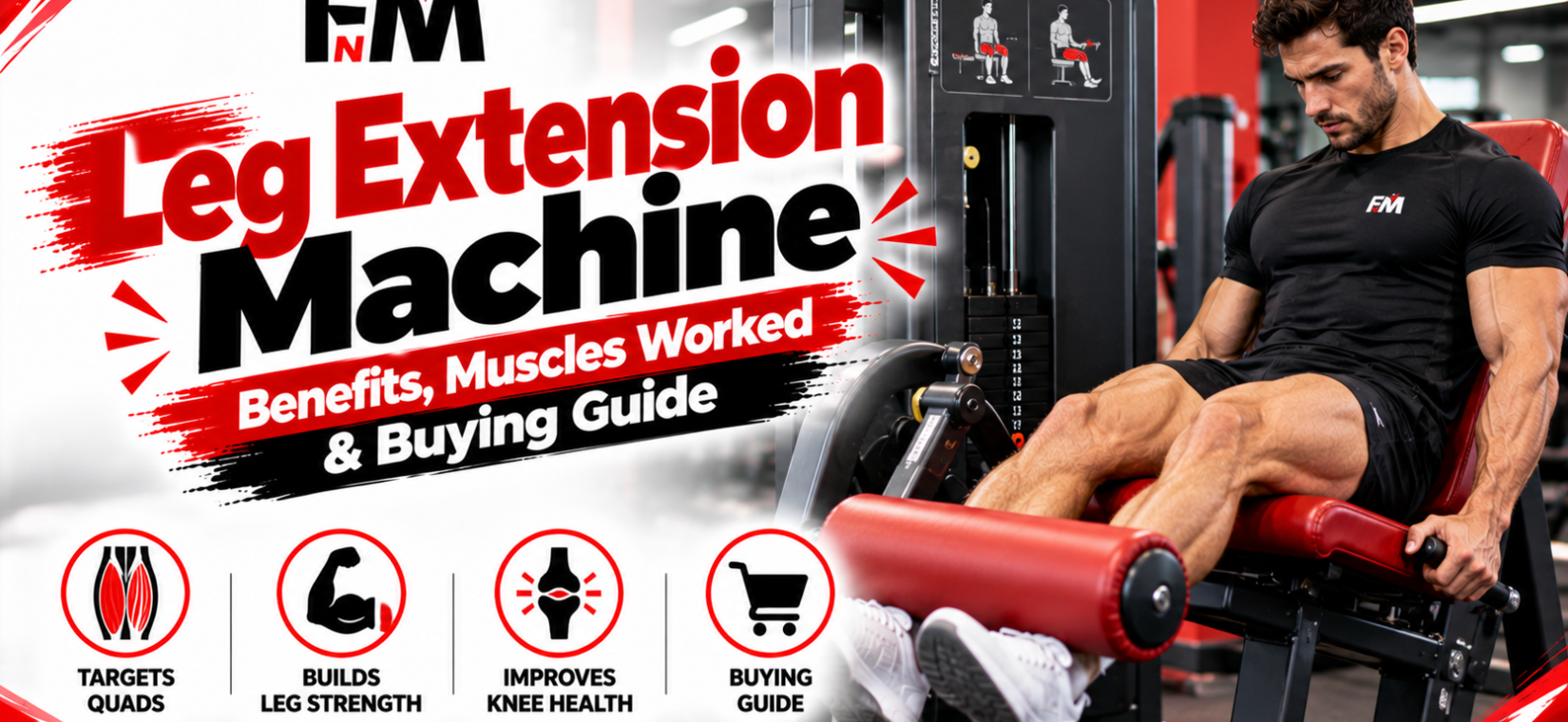
The leg extension machine is the gold standard for isolating and building the quadriceps. Found in nearly every commercial gym and many home gyms, this machine lets you target the front of your thighs with precision that free weights cannot match. Whether you want bigger quads, stronger knees, or better athletic performance, mastering the leg extension machine is essential.
This guide covers everything: how the machine works, the muscles it trains, 5 proven benefits, proper form, the knee-safety debate, machine types compared, advanced growth techniques, common mistakes, pricing, sample workouts, buying advice, and answers to frequently asked questions.
What Is a Leg Extension Machine?
A leg extension machine is a seated resistance machine that isolates knee extension. You sit on a padded seat with your back against the backrest, place your shins behind a padded lever arm, and extend your knees to lift the weight. The movement trains the quadriceps through a full range of motion with constant tension.
Most machines use a weight stack with a selector pin, though plate-loaded versions exist. Adjustable backrests, seats, and ankle pads let you fit the equipment to your body for safe, effective reps.
Muscles Worked by the Leg Extension Machine
The primary movers are the four quadriceps muscles: rectus femoris, vastus lateralis, vastus medialis, and vastus intermedius. Unlike squats, which distribute load across the glutes and hamstrings, this exercise isolates the quads, making it ideal for targeted hypertrophy and fixing side-to-side imbalances.
The rectus femoris, the central quad muscle, is especially active because the seated position stretches it across the hip joint. Research on leg extension training shows that setup variables like hip angle significantly affect quadriceps muscle growth (PubMed, 2025) — a reminder that even small form adjustments change the training effect.
5 Key Benefits of Leg Extension Machine Training
1. Targeted quad hypertrophy: If your quads lag behind, isolated knee extensions let you add volume without fatiguing your lower back or glutes.
2. Knee strength and resilience: Strengthening the quads, especially the vastus medialis, supports proper patellar tracking and knee stability, which benefits runners, lifters, and anyone with achy knees.
3. Safe to push to failure: Unlike barbell squats, you can take a set to true muscular failure without worrying about getting pinned under a bar.
4. Rehabilitation friendly: Physical therapists often prescribe controlled knee extensions to rebuild quad strength after injury, since the load is easy to dose precisely.
5. Beginner friendly: The fixed movement path makes this one of the easiest machines to learn in the gym.
Leg Extension Machine Types Compared
Not all machines are built the same. The three main designs:
Selectorized (weight stack): The commercial gym standard. A pin selects the weight from a stack, changes take seconds, and the feel is smooth. Best for shared gyms and anyone who values fast weight changes during supersets. The downside is size, weight, and cost.
Plate-loaded: You load Olympic plates onto pegs. More affordable, compact, and common in home gyms. The tradeoff: loading and unloading plates between sets is slower, and resistance curves can feel less even than a well-designed stack machine.
Dual-function (extension/curl combos): One machine that does both leg extensions and lying/seated leg curls by flipping the lever or seat. The TAG Seat Leg Extension / Leg Curl is a versatile two-in-one option that covers both quad and hamstring training in a single footprint — ideal for home gyms where space is the limiting factor.
For home buyers, dual-function or plate-loaded units make the most sense. Commercial facilities should invest in selectorized machines with biomechanically correct pivot alignment for heavy daily use.
How to Use a Leg Extension Machine with Proper Form
Adjust the seat so your knees align with the machine’s pivot point — this single adjustment matters more than any other. Position the ankle pad just above your feet, not on your shins. Grip the side handles, keep your back flat against the pad, and extend your knees smoothly until your legs are straight, without snapping hard into lockout. Lower under control over two to three seconds. Avoid using momentum, swinging the weight up, or lifting your hips off the seat.
Start with a moderate weight for three sets of 10 to 15 reps, squeezing the quads hard at the top of each rep. If you feel pain (not effort) behind the kneecap, reduce the weight and shorten the range slightly.
The Knee Safety Debate: Are Leg Extensions Bad for Your Knees?
This is the most controversial question about the exercise, so let us address it directly. The concern comes from biomechanics: the leg extension creates shear force at the knee, and early research flagged high shear near full extension under heavy loads.
Here is what the evidence actually says for healthy lifters: when performed with proper form and sensible loads, knee extensions are safe. The shear forces are well within what healthy knee structures handle, and the exercise strengthens the very muscles (especially the vastus medialis) that stabilize the patella. Physical therapists routinely prescribe controlled knee extensions in rehab settings — they would not do so for a inherently dangerous movement.
Sensible precautions: do not pile on maximal weight for low reps — this is a hypertrophy and prehab tool, best in the 8 to 20 rep range. Avoid ballistic, bouncing reps. If you have an existing knee condition (meniscus issues, advanced arthritis, recent surgery), get clearance and guidance from a physiotherapist before loading the movement. For everyone else, the leg extension is a safe, joint-friendly quad builder.
Leg Extension vs Leg Curl: Why You Need Both
Quads and hamstrings are opposing muscle groups, and training only one invites imbalances that affect knee health and athletic performance. The leg extension isolates the quadriceps (knee extensors); the leg curl isolates the hamstrings (knee flexors).
A balanced lower-body program trains both. This is exactly why dual-function machines exist — pairing extensions with curls in the same session keeps the front and back of the thigh developing together. If your gym time is limited, superset the two: a set of extensions immediately followed by a set of curls trains the full thigh efficiently.
Advanced Techniques to Grow Quads Faster
Once the basics are solid, these intensity techniques break plateaus:
Drop sets: Take a set to failure, immediately reduce the weight by 30 to 40 percent, and continue to failure again. The machine’s pin or plate setup makes drops fast — ideal for a brutal finisher.
Partial reps in the lengthened range: Research increasingly shows the stretched position drives growth. Try sets where you work only the bottom half of the range, keeping constant tension on the quads without locking out.
Slow eccentrics: Lower over 4 to 5 seconds. The controlled negative increases time under tension and muscle damage — both growth signals — without needing heavier weight.
Single-leg extensions: One leg at a time exposes and fixes side-to-side imbalances while doubling the stabilizer demand. Start at half your bilateral weight.
Rest-pause sets: Go to failure, rest 15 seconds, go to failure again, repeat 2 to 3 times. An efficient way to accumulate high-effort volume in minimal time.
Toe direction variations: Slight inward or outward toe angles shift emphasis subtly between the quad heads. Keep changes small — extreme angles stress the knee without added benefit.
6 Common Leg Extension Mistakes
1. Misaligned knees: If your knees sit behind or ahead of the pivot point, the resistance curve fights your joints instead of your muscles. Adjust the seat every session — seats drift.
2. Using momentum: Swinging the weight up with a hip thrust turns a quad isolation into a full-body heave. If your hips leave the seat, the weight is too heavy.
3. Slamming into lockout: Snapping the knees straight under load irritates the joint. Extend fully but smoothly — think “squeeze,” not “snap.”
4. Going too heavy: Ego loading on an isolation machine is all risk, no reward. The quads respond best to controlled 8 to 20 rep sets, not grinding singles.
5. Half reps by default: While partials have their place as a technique, habitually cutting the range short leaves growth on the table. Earn the right to do partials by mastering full range first.
6. Skipping warm-ups: Cold knees and heavy extensions are a bad combination. Do 5 minutes of light cycling or bodyweight squats first, then a light warm-up set.
Leg Extension Machine vs. Squats: Do You Need Both?
Squats build overall lower-body strength and athleticism, but they do not maximally isolate the quads. Knee extensions fill that gap. For complete quad development, combine heavy compound lifts like squats and leg presses with two to four sets of extensions per week. This pairing delivers both strength and size — compounds for the foundation, isolation for the detail.
How to Choose the Best Leg Extension Machine
For home gyms, look for a compact unit with smooth bearings, multiple seat adjustments, and a solid weight stack or plate-loading capacity. Commercial buyers should prioritize durability and biomechanically correct pivot alignment.
The TAG Seat Leg Extension / Leg Curl is a versatile two-in-one option that covers both quad and hamstring training in a single footprint, ideal for home gyms. To round out a leg-focused setup, the YORK Aspire 120 bench with leg curl attachment adds even more lower-body versatility.
Check the maximum user weight, warranty, and footprint before buying. A quality machine should feel rock-solid with no wobble at full extension. Test the pivot alignment if possible — your knees should track the machine’s arc naturally, without forcing.
Leg Extension Machine Price Guide
- Budget home units ($200–$600): Plate-loaded or basic stack designs. Functional for beginners, but check weld quality and pivot smoothness — cheap machines feel cheap.
- Mid-range ($600–$1,500): The home-gym sweet spot. Smooth bearings, good adjustability, solid stacks. Dual-function units live here and offer the best value per square foot.
- Commercial ($1,500–$4,000+): Built for all-day gym use with heavy stacks, premium upholstery, and biomechanically refined cams. Overkill for home use but indestructible.
Buy for your actual use case. A $400 plate-loaded unit serves a home lifter for years; a commercial facility needs the $2,500 tank.
3 Quad Workouts Featuring Leg Extensions
Workout 1 — Strength focus: Barbell back squat (4×6), leg press (3×8), leg extensions (3×10) as a finisher. Rest 2–3 minutes on compounds, 60–90 seconds on extensions.
Workout 2 — Hypertrophy focus: Front squat (3×10), walking lunges (3×12 each leg), leg extensions (4×12–15) with a drop set on the last set. Rest 90 seconds between sets. Fuel the session with enough protein — see how much protein you need per day and our muscle-building nutrition guide.
Workout 3 — Home minimal: Goblet squats (4×12), Bulgarian split squats (3×10 each leg), single-leg extensions on your machine (3×12 each leg). Minimal equipment, maximum quad burn.
Leg Extension FAQs
Are leg extensions bad for your knees? When performed with proper form and sensible loads, they are safe for most healthy lifters. Those with existing knee issues should consult a professional and start light. See the knee safety section above for the full evidence.
How often should I do leg extensions? One to two times per week, for 2–4 sets of 10–15 reps, is plenty for most lifters alongside compound leg work.
Can I build big quads with just this machine? You will build size, but the fastest quad growth comes from combining heavy compound lifts with focused isolation work.
Should I lock out my knees at the top? Extend fully and squeeze, but do not snap aggressively into lockout under heavy load. A firm, controlled finish is the goal.
Leg extensions or sissy squats — which is better? Both isolate the quads effectively. The machine offers precise loading and safety; sissy squats need no equipment but are harder to load progressively. Use whichever fits your setup.
How do I adjust the machine for my height? Set the seat so your knees align with the pivot axis, the backrest so your lower back is supported without rounding, and the ankle pad just above the feet. Re-check these every session.
Can leg extensions help with runner’s knee? Strengthening the quads — particularly the vastus medialis — is a cornerstone of patellofemoral pain rehab programs. But get a proper diagnosis first; “runner’s knee” has multiple causes.
What is a good starting weight? Start light enough to complete 15 clean reps with perfect form — for most beginners, 20–40 lb on the stack. Add weight when you can do 15 reps with two reps in reserve.