
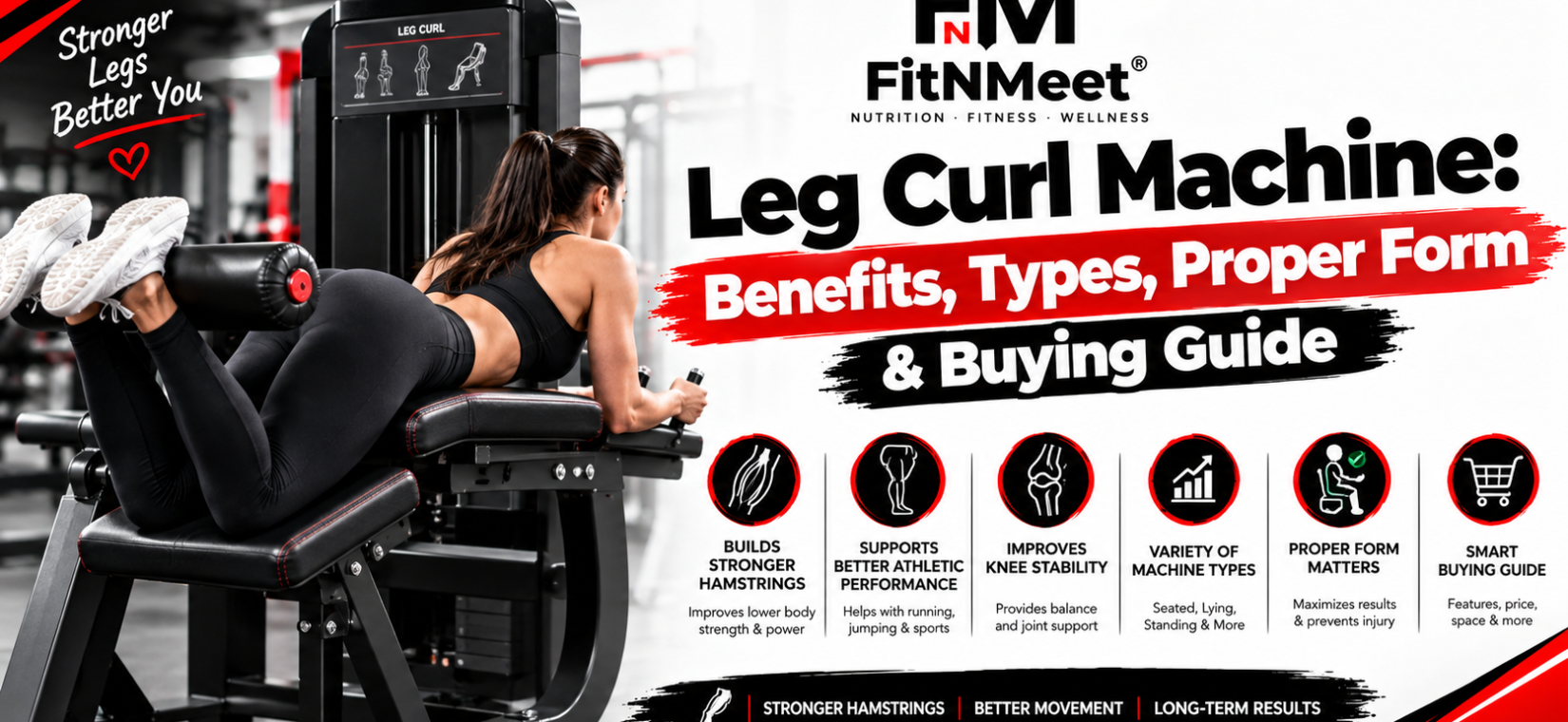
The leg curl machine is the most effective tool for isolating and strengthening the hamstrings. These often-neglected muscles power sprinting, protect your knees, and balance the quadriceps. Whether you train for sports performance, injury prevention, or bigger legs, the leg curl machine deserves a staple spot in your lower-body routine.
This complete guide covers what a leg curl machine is, the muscles it trains, 6 proven benefits, the science of seated vs lying vs standing variations, proper form for each type, common mistakes, how it compares to free-weight alternatives, programming guidelines, sample workouts, buying advice, and answers to frequently asked questions.
What Is a Leg Curl Machine?
A leg curl machine is a resistance machine that isolates knee flexion, bending your knee against resistance to target the hamstrings. The three main types are seated, lying (prone), and standing. In each, you position your legs against a padded lever arm and curl the weight by flexing your knees, training the hamstrings through a focused range of motion.
Unlike compound lower-body lifts that distribute load across many muscles, the leg curl machine directs nearly all the tension to the hamstrings. That isolation is its superpower: it lets you train the hamstrings hard without fatiguing your back, grip, or quads first.
Why Hamstrings Are Often Neglected (and Why It Matters)
Most lifters build their leg training around squats, leg presses, and quad-dominant movements. The hamstrings get leftover attention — a few token sets if time permits. Over years, this creates a quad-dominant athlete: strong in front, weak behind.
The consequences are real. Weak hamstrings relative to quads increase ACL injury risk, raise hamstring strain likelihood during sprinting, and contribute to knee pain. The hamstrings also play a crucial role in hip extension power for deadlifts and sprinting. A dedicated leg curl machine in your routine is the simplest way to close this gap.
Muscles Worked by the Leg Curl Machine
The primary movers are the hamstring group: biceps femoris, semitendinosus, and semimembranosus. These muscles run along the back of your thigh from hip to knee. Unlike deadlifts, which train the hamstrings at the hip, the leg curl machine isolates knee flexion, hitting the hamstrings in a way compound lifts cannot fully replicate.
The calves (gastrocnemius) assist as secondary movers during the curl. The glutes stabilize but are not prime movers — which is exactly why the leg curl complements rather than replaces hip-hinge movements.
Hamstring Anatomy: Two Functions, One Muscle Group
The hamstrings cross two joints: they extend the hip and flex the knee. Most compound lifts (deadlifts, good mornings) train only hip extension. The leg curl machine trains the other function — knee flexion. For complete hamstring development, you need both. This is why even elite powerlifters who deadlift heavy still do leg curls.
6 Proven Benefits of Leg Curl Machine Training
1. Stronger hamstrings: Direct isolation builds hamstring strength that carries over to sprinting, jumping, and deadlifts. Stronger hamstrings mean more powerful hip extension when it counts.
2. Injury prevention: A balanced quadriceps-to-hamstring strength ratio protects the ACL and reduces hamstring strain risk, which is critical for athletes in field and court sports.
3. Targeted hypertrophy: Research comparing seated versus lying leg curl training found both build hamstring muscle, with seated variations showing an edge for growth, highlighting the value of machine-based curl work (PubMed, 2021).
4. Knee joint health: Strong hamstrings stabilize the knee and support healthy joint function. They act as dynamic stabilizers, reducing shear forces on the joint during movement.
5. Fixes imbalances: Most lifters overdevelop their quads. Curls restore balance for better posture, performance, and aesthetics — complete legs, not just big quads.
6. Safe and simple: The fixed movement path makes it easy to train hamstrings hard without technical complexity or spinal loading. Ideal for beginners, older lifters, and anyone managing back issues.
Seated vs. Lying vs. Standing Leg Curl: The Science
Seated leg curl: You sit upright with hips flexed. Research suggests this position, which stretches the hamstrings at the hip, may produce slightly greater hypertrophy. The 2021 study found seated training produced greater hamstring growth than prone (lying) training, likely because the long muscle length position enhances tension.
Lying (prone) leg curl: You lie face down and curl. A classic bodybuilding staple that allows heavy loading and a strong peak contraction. Many lifters feel this variation most intensely.
Standing leg curl: Single-leg standing curls that challenge balance and correct side-to-side imbalances. Excellent for athletes rehabbing or addressing asymmetries.
All three build the hamstrings effectively. If you have access to multiple types, prioritize the seated leg curl machine for growth, but rotate variations for complete development.
How to Use a Leg Curl Machine with Proper Form
Adjust the machine so the pivot aligns with your knees and the ankle pad sits just above your heels. Keep your hips pressed into the pad and do not let them lift. Curl the weight by flexing your knees through a full range, squeeze the hamstrings for a second, then lower under control over two to three seconds. Avoid jerking the weight or cutting reps short.
Start with three sets of 10 to 15 reps using a weight that challenges you without breaking form. The last two reps of each set should feel difficult but achievable with clean technique.
Form Cues for Each Type
Seated: Sit tall, chest up. Do not round your lower back to generate momentum. Keep the movement in the knees, not the hips.
Lying: Keep your hips pressed down. If your butt lifts, the weight is too heavy. Grip the handles for stability but do not pull yourself forward.
Standing: Hold the support for balance, but do not lean. Curl through a full range without swinging the working leg.
5 Common Leg Curl Mistakes
1. Using momentum: Jerking the weight up with a hip thrust removes tension from the hamstrings. If you cannot pause at the top, reduce the weight.
2. Partial range of motion: Short, bouncy reps build egos, not hamstrings. Full stretch to full contraction on every rep.
3. Lifting the hips: On lying and seated machines, rising hips indicate excessive weight. Your pelvis should stay anchored.
4. Neglecting the negative: The lowering phase builds significant muscle. Take 2–3 seconds to lower; do not just drop the weight.
5. Only training one variation: The hamstrings respond to variety. If your gym has seated and lying machines, use both across the week.
Leg Curl Machine vs. Romanian Deadlift
Romanian deadlifts train the hamstrings at the hip through hip extension, while leg curls train them at the knee through knee flexion. For complete hamstring development, you need both functions. Pair heavy Romanian deadlifts with two to four sets of leg curls per week for full development and injury resilience.
Think of it this way: the Romanian deadlift builds the hamstrings’ power; the leg curl machine builds their size and knee-joint function. Neither fully replaces the other.
Leg Curl Machine vs. Free-Weight Alternatives
Nordic hamstring curls: A brutal bodyweight exercise with excellent injury-prevention research. Harder to scale for beginners; the machine is more accessible.
Glute-ham raises: Outstanding, but require specific equipment and significant strength. The leg curl machine is easier to load progressively.
Swiss ball leg curls: Good for home use, but limited loading potential. Fine for beginners, insufficient for advanced lifters.
The machine’s advantage is precise, scalable loading through a fixed path — ideal for progressive overload and training to failure safely.
Programming: Sets, Reps, and Frequency
For hypertrophy: 3–4 sets of 10–15 reps, 1–2 times per week. For strength: 3–5 sets of 6–10 reps with heavier loads. For endurance or rehab: 2–3 sets of 15–20 reps with lighter weights.
Place leg curls after your main compound lift (squat or deadlift) when hamstrings are warm but not exhausted. Alternatively, dedicate a second lower-body day to hamstring focus. Allow 48 hours between hard hamstring sessions.
Fuel your training properly — our muscle-building nutrition guide covers protein targets and meal timing, and our protein intake guide helps you dial in daily amounts for recovery.
How to Choose the Best Leg Curl Machine
For home gyms, a compact seated or lying leg curl with smooth bearings and adjustable pads is ideal. Look for sturdy construction, comfortable padding, and a weight capacity that matches your strength level. Plate-loaded machines are affordable and compact; selectorized (pin-loaded) machines offer faster weight changes.
The TAG Seat
How to Keep Progressing on the Leg Curl Machine
Plateaus happen when the body adapts to a familiar stimulus. To keep your hamstrings growing on the leg curl machine, rotate your progression methods every 4 to 6 weeks. Start with simple linear progression: add 2.5 to 5 lb whenever you hit the top of your rep range with clean form across all sets. Small, consistent jumps compound into major strength gains over a year.
When linear gains stall, manipulate tempo instead of load. Slow the eccentric to 4 seconds and add a 2-second pause at peak contraction. This increases time under tension without heavier weights, sparking new growth through a novel stimulus. Another powerful tool is the rest-pause set: perform a set to near failure, rest 15 seconds, then squeeze out 3 to 4 more reps. One rest-pause set delivers nearly the stimulus of two straight sets in half the time.
Finally, cycle your variation. Spend 4 weeks prioritizing the seated leg curl machine, then switch to lying for 4 weeks. The slightly different strength curve and stretch position keeps adaptation coming. Track every session in a training log — weights, reps, and how each set felt. What gets measured gets improved, and the log reveals plateaus before they cost you months.
Leg Extension / Leg Curl combines both quad and hamstring training in one space-saving unit, perfect for home gyms. For a bench-based option, the YORK Aspire 120 bench with leg curl attachment adds hamstring work to your pressing setup.
3 Hamstring Workout Templates
Template 1 — Strength focus: Romanian deadlift 4×6-8, lying leg curl 4×8-10, glute-ham raise 3×8, standing calf raise 3×12.
Template 2 — Hypertrophy focus: Seated leg curl 4×12-15, Romanian deadlift 3×10-12, lying leg curl 3×12-15, back extension 3×15.
Template 3 — Home gym minimal: Dumbbell Romanian deadlift 4×10, machine leg curl 4×12-15, single-leg standing curl 2×12 each, bodyweight glute bridge 3×20.
Who Should Use (and Avoid) the Leg Curl Machine
Use it if: you want bigger, stronger hamstrings; you play sports involving sprinting; you have quad-dominant development; you need knee-friendly hamstring training; or you are returning from a back injury and need spinal-friendly leg work.
Be cautious if: you have an acute hamstring strain (wait for clearance); you experience sharp knee pain during the movement (check setup and load); or you have had recent knee surgery (follow your physio’s protocol). When in doubt, start very light and consult a professional.
Leg Curl Machine FAQs
Are leg curls bad for your knees? With proper setup and sensible loads, machine leg curls are safe for healthy knees. Start light and prioritize form. The key is aligning the machine pivot with your knee joint.
How often should I do leg curls? One to two times per week for three to four sets is plenty alongside hip-hinge movements like deadlifts.
Seated or lying: which leg curl is better? Both work well. Seated may offer a slight hypertrophy edge according to research, but the best choice is the variation you will perform consistently.
Do leg curls build glutes? Minimally. The glutes assist but are not prime movers. For glute growth, prioritize hip thrusts, squats, and deadlifts.
Can beginners use the leg curl machine? Absolutely. It is one of the most beginner-friendly machines — the fixed path guides the movement, and you can start very light.
Why do my calves cramp during leg curls? Calf cramping usually means your foot position is off or you are pointing your toes excessively. Keep ankles neutral and ensure the pad sits above your heels, not on your calves.
How much weight should I use? Choose a weight that lets you complete your target reps with 1–2 reps in reserve. If form breaks down, it is too heavy. Progressive overload over weeks matters more than any single session’s load.