
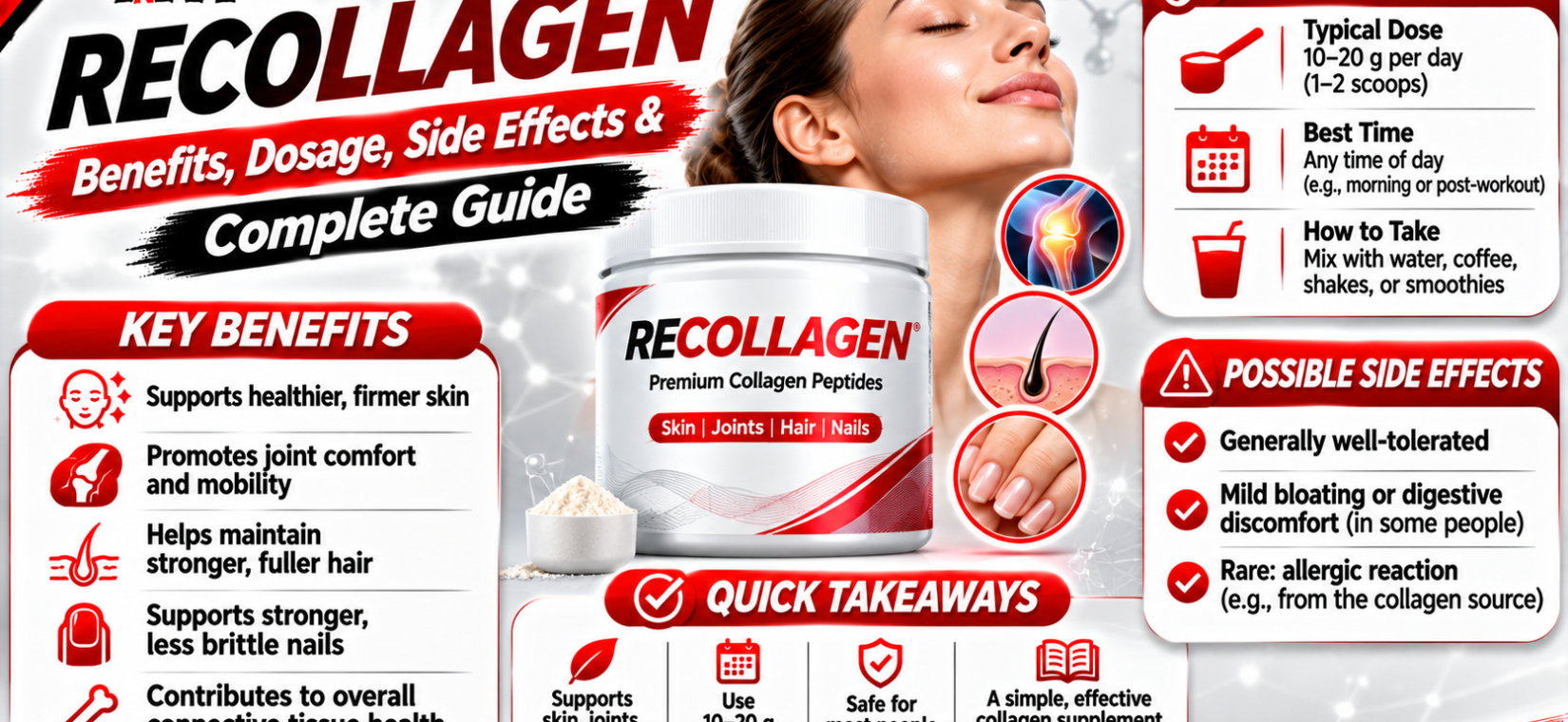
Recollagen is the search term most shoppers use for recombinant collagen — collagen protein produced by engineered yeast or bacteria rather than extracted from animal hides, bones, or fish. Like conventional collagen peptides, it supplies the amino acids glycine, proline, and hydroxyproline, and it is marketed for skin, joint, and connective-tissue support in a lab-made, animal-free form.
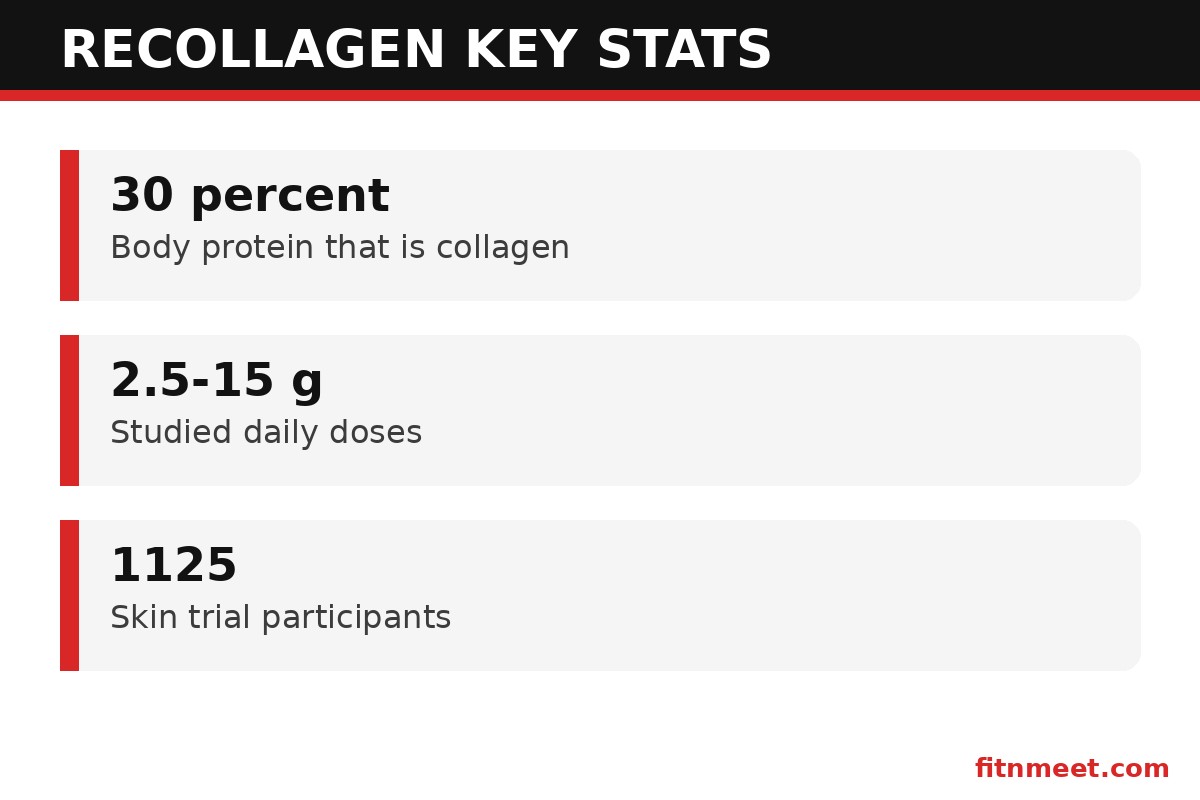
of the body’s protein is collagen
daily doses studied in trials
joint trial with athletes
Recollagen: Key Stats Snapshot
Before diving into the details, here are the numbers that frame the recombinant-collagen conversation:
30% — share of total body protein made of collagen
Collagen is the most abundant protein in the human body, forming the structural scaffolding of skin, tendons, ligaments, cartilage, and bone. Any supplement in this category — recombinant collagen included — is trying to supply the raw materials for tissue the body is constantly remodeling. Read the structural biology on Wikipedia’s collagen page.
2.5–15 g — daily dose range used in human trials
Human studies on collagen peptides (the closest evidence base to recombinant collagen) have tested doses from 2.5 g per day for skin outcomes up to 15 g per day for joint and body-composition outcomes. Most recombinant-collagen products land in the 5–10 g per serving range.
1,125 — participants across 19 skin trials in a 2021 meta-analysis
A 2021 meta-analysis in Nutrients (de Miranda et al.) pooled 19 randomized trials with 1,125 participants and found that hydrolyzed collagen supplementation improved skin hydration and elasticity versus placebo. Recombinant-collagen-specific human trials are still scarce — this is the evidence the category borrows.
147 — athletes in the landmark 24-week joint trial
Clark et al. (2008) gave 147 athletes with activity-related joint pain either 10 g of collagen hydrolysate or placebo daily for 24 weeks. The collagen group reported significantly greater improvements in joint comfort. This remains the most cited joint trial in the collagen literature.
What Is Recollagen?
Recombinant collagen — the product behind the search term — is best understood as a marketing label for lab-made collagen: collagen protein manufactured through biotechnology rather than harvested from animals. Conventional collagen peptides come from bovine hides, porcine skin, fish scales, or chicken cartilage, processed with heat and enzymes into short, soluble peptide chains. It takes a different route — the human collagen gene sequence is inserted into a host organism (typically engineered yeast such as Pichia pastoris, bacteria, or even plants), which then produces collagen protein that is purified and processed into a supplement.
The appeal is straightforward. First, it is animal-free, which matters to vegetarians, people with certain dietary restrictions, and consumers concerned about the sourcing of animal-derived ingredients. Second, recombinant production is highly controlled: every batch has a defined, consistent amino acid sequence, whereas animal-derived collagen varies with the source animal’s age, diet, and tissue. Third, it sidesteps concerns about contaminants sometimes associated with animal sourcing, such as heavy metals in marine collagen from polluted waters.
It is important to be honest about where recombinant collagen stands scientifically. Recombinant human collagen itself is not new — it has been produced for medical and cosmetic applications (wound dressings, tissue scaffolds) for years. What is new is its appearance as an oral supplement. The human clinical trials that support collagen supplementation — the skin, joint, and muscle studies cited throughout this guide — were conducted with animal-derived hydrolyzed collagen peptides, not recombinant collagen specifically. The reasonable inference is that it, which delivers the same key amino acids (glycine, proline, hydroxyproline) in peptide form, should behave similarly in the body — but strictly speaking, large-scale recombinant-collagen trials have not been published yet.
From a regulatory standpoint, it is sold as a dietary supplement, which means it falls under the same framework as other supplements in the United States: manufacturers are responsible for safety and label accuracy, and the FDA does not pre-approve these products before sale. The FDA’s dietary supplements Q&A explains this framework clearly, and it applies to recombinant collagen exactly as it does to conventional collagen.
Recollagen Benefits: What the Research Shows
Because dedicated recombinant-collagen trials are limited, the benefits below are drawn from the broader collagen-peptide evidence base, with the assumption — reasonable but worth stating — that its amino acid profile delivers comparable effects. Here is what the research shows:
- Skin hydration and elasticity. The strongest evidence cluster. The 2021 Nutrients meta-analysis (19 trials, 1,125 participants) found significant improvements in skin hydration and elasticity with hydrolyzed collagen at 2.5–5 g/day over 8–12 weeks. A frequently cited trial (Proksch et al., 2014) gave 69 women aged 35–55 either 2.5 g or 5 g of collagen peptides daily for 8 weeks; both doses improved skin elasticity versus placebo, with effects persisting after supplementation stopped. If recombinant collagen behaves like the peptides studied, skin is its best-supported benefit.
- Joint comfort and cartilage support. The Clark et al. 2008 trial (147 athletes, 10 g/day, 24 weeks) showed improved joint comfort scores. A 2017 review in the Journal of the American College of Nutrition concluded collagen supplementation shows promise for osteoarthritis-related joint pain, while calling for larger trials. Users with creaky knees are targeting this mechanism: supplying glycine and proline, the rate-limiting building blocks of cartilage collagen.
- Tendon and ligament resilience. A notable 2017 study (Shaw et al., American Journal of Clinical Nutrition) found that 15 g of gelatin plus vitamin C taken one hour before jumping-rope exercise doubled collagen synthesis markers in 8 young men. Tendons and ligaments are over 70% collagen by dry weight, so athletes in high-impact sports use recombinant-collagen products for connective-tissue support.
- Muscle mass support in older adults. A 2015 trial (Zdzieblik et al., British Journal of Nutrition) gave 53 older men with sarcopenia either 15 g of collagen peptides or placebo daily alongside resistance training for 12 weeks; the collagen group gained significantly more fat-free mass. The mechanism is debated — collagen is low in leucine, the key muscle-building amino acid — but the outcome data exists.
- Hair and nail strength. Evidence here is thinner: small open-label trials and user reports suggest reduced nail brittleness, but no large randomized trial has confirmed it. Treat this as a plausible bonus, not a primary reason to buy it.
- Gut lining support. Marketers frequently claim collagen “heals the gut.” The honest status: there is no robust human trial demonstrating that oral collagen peptides repair intestinal permeability. Glycine does play roles in gut tissue, but the leap to clinical gut benefits is unproven — for recombinant or any other collagen.
Shopping for connective-tissue support? Compare recombinant-collagen options with the joint and recovery formulas in FitnMeet’s joints collection — and see how they stack against the anti-aging range for skin-focused goals.
How Recollagen Works in the Body
Understanding recombinant collagen means understanding collagen turnover. Your body is constantly breaking down old collagen and synthesizing new collagen — in skin, this remodeling cycle takes roughly 4–12 weeks, which is why skin trials run 8–12 weeks before measuring results. Collagen synthesis requires three things: the amino acid building blocks (especially glycine, proline, and hydroxyproline), vitamin C as a cofactor for the enzymes that cross-link collagen fibers, and a physiological signal that new collagen is needed (mechanical loading for tendons, UV repair demand for skin).
When you consume it, digestive enzymes break its peptide chains into di- and tri-peptides and free amino acids, which enter the bloodstream. Blood levels of collagen-specific peptides (notably prolyl-hydroxyproline) peak roughly 1–2 hours after ingestion. These peptides appear to do two things: supply substrate for new collagen synthesis, and — according to cell-culture research — act as signaling molecules that stimulate fibroblasts (the cells that manufacture collagen) to increase production. This dual action is why researchers believe collagen peptides do more than just “add protein” — though the signaling effects in living humans are still being mapped.
Vitamin C deserves special emphasis because it is the cofactor without which collagen synthesis stalls. The enzymes prolyl hydroxylase and lysyl hydroxylase, which stabilize the collagen triple helix, cannot function without vitamin C — this is why scurvy (vitamin C deficiency) manifests as bleeding gums and wounds that will not heal: it is literally a collagen-synthesis failure. Anyone taking it should ensure adequate vitamin C intake (75–90 mg/day minimum from diet or a supplement) or the building blocks arrive without the construction crew. FitnMeet’s vitamins collection covers the cofactor side of the equation.
One more mechanism worth knowing: the body’s own collagen production declines with age — often cited at roughly 1% per year after age 20, alongside reduced fibroblast activity. Supplemental recombinant collagen does not restart youthful production rates; it ensures substrate is never the limiting factor while your existing (slower) machinery does its work. That is a modest, honest framing — and it is why consistent daily use over months, not days, is the pattern behind every positive trial.
Recollagen Dosage and Usage
There is no official recommended intake for recombinant collagen, so dosing guidance comes from the collagen-peptide trials. Use this checklist to get it right:
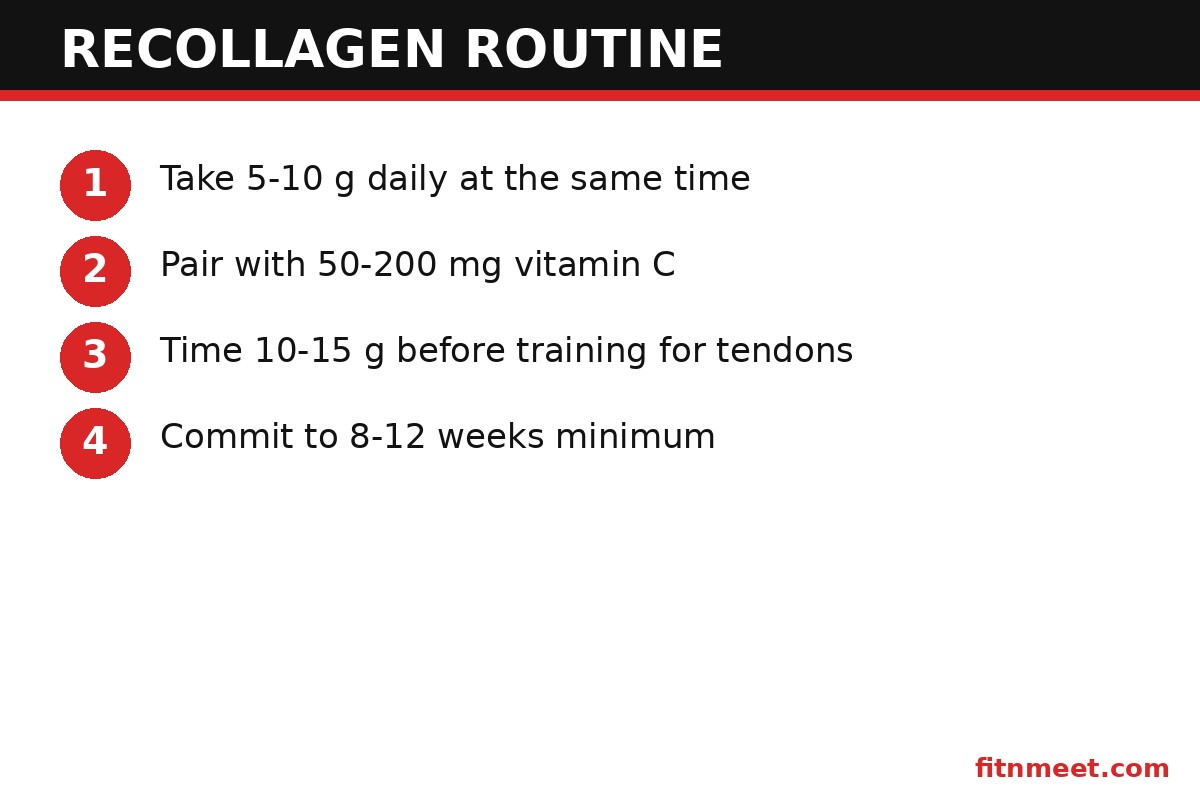
- ☐ Start with 5–10 g per day. This is the sweet spot where most recombinant-collagen products are formulated and where the majority of positive trials land. Skin-focused users can start at the lower end (2.5–5 g); joint-focused users should aim higher (10 g).
- ☐ Take it at the same time daily. Collagen remodeling is a slow, continuous process — consistency over weeks matters far more than precise timing. Morning coffee, post-workout shake, or bedtime drink all work.
- ☐ For tendons: time it before training. Following the Shaw et al. protocol, take 10–15 g with 50 mg of vitamin C about 60 minutes before the session that loads the target tendon, then train. This is the one timing strategy with direct evidence.
- ☐ Pair with vitamin C. 50–200 mg of vitamin C alongside it ensures the hydroxylation enzymes have their cofactor. Many formulas include it; if yours does not, add a small vitamin C source.
- ☐ Mix into anything. Quality recombinant-collagen peptides dissolve in hot or cold liquid with minimal taste — coffee, smoothies, oatmeal, or plain water. Heat does not destroy the amino acids.
- ☐ Commit to 8–12 weeks minimum. Every positive skin trial ran at least 8 weeks; the joint trial ran 24. Judging it after two weeks is like judging a training program after two sessions.
- ☐ Track something measurable. Skin: photos in consistent lighting. Joints: a 1–10 pain score during a standard activity. Nails: breakage frequency. Without a baseline, placebo and real effects are indistinguishable.
Recollagen vs Regular Collagen: Comparison
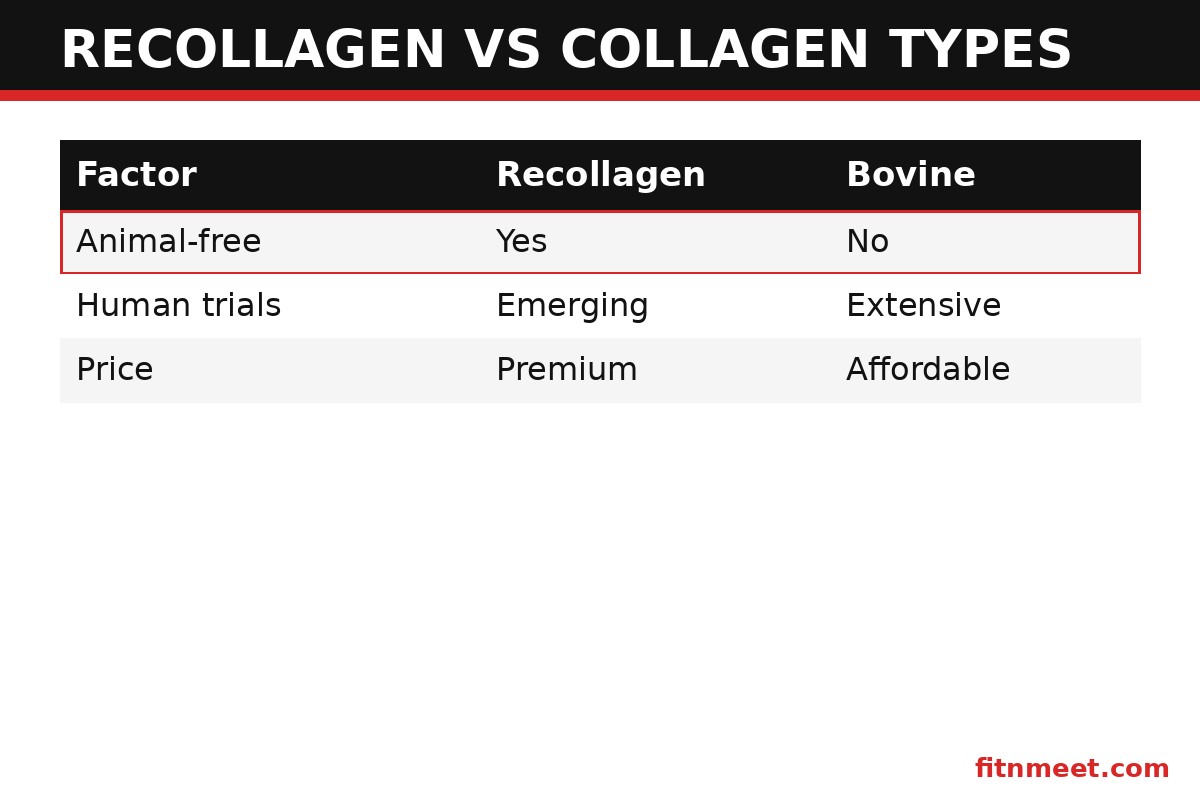
How does recombinant collagen stack up against the established collagen options? The table below compares the main choices on the factors buyers actually care about.
| Factor | Recollagen (recombinant) | Bovine collagen peptides | Marine collagen |
|---|---|---|---|
| Source | Engineered yeast/bacteria | Cattle hides and bones | Fish skin and scales |
| Animal-free | Yes | No | No |
| Batch consistency | Very high (defined sequence) | Good (varies by source) | Good (varies by source) |
| Human trial evidence | Limited (emerging) | Extensive (most trials) | Moderate |
| Typical dose | 5–10 g/day | 5–15 g/day | 5–10 g/day |
| Allergen concerns | Very low | Low (beef allergy rare) | Fish/shellfish allergy risk |
| Price | Premium | Most affordable | Mid-range |
| Dissolvability | Excellent | Excellent | Good |
The honest summary: bovine collagen peptides have the deepest evidence base and the lowest price — they are the rational default for most buyers today. Its advantages are ethical and qualitative (animal-free, ultra-consistent) rather than proven-superior outcomes. If avoiding animal products matters to you, it is the only true collagen option; if it does not, conventional peptides deliver the same amino acids with more published human data behind them. Marine collagen sits between: valued for its type I collagen content and skin-focused marketing, but carrying fish-allergy risk and potential heavy-metal concerns from poorly sourced products.
One more comparison worth making: recombinant collagen versus gelatin. Gelatin is partially hydrolyzed collagen that gels in cold liquid — great for homemade gummies and desserts, and the Shaw tendon study actually used gelatin. Recombinant collagen and standard peptides are fully hydrolyzed (they dissolve clear and do not gel), making them better for daily drinks. Same amino acids, different functionality.
Recollagen Side Effects and Safety
It has a favorable safety profile, consistent with what is known about collagen peptides generally:
- Digestive mildness. The most common complaints are mild: a feeling of fullness, occasional bloating, or mild nausea at doses above 10 g — usually resolved by splitting the dose or taking it with food. Its purity may make it slightly gentler than animal-derived options, though this has not been tested head-to-head.
- Allergy risk is low but not zero. Recombinant production removes animal allergens, but individuals with yeast sensitivities should check the production organism on the label. This is a theoretical concern more than a reported problem.
- Heavy metals and contaminants. One of its genuine advantages: controlled fermentation avoids the ocean-pollutant concerns (mercury, microplastics) occasionally raised about marine collagen. Still, choose products with third-party testing for label accuracy.
- Kidney considerations. Like any protein supplement, it adds to total daily protein load. Healthy kidneys handle this fine, but people with chronic kidney disease should count supplemental protein toward their prescribed limits and consult their physician.
- Pregnancy and breastfeeding. Safety data for recombinant collagen in pregnancy is lacking, as with most supplements. The conservative medical advice is to avoid non-essential supplements during pregnancy unless a clinician approves.
- Drug interactions. None significant are documented for collagen peptides or recombinant collagen. It is essentially food protein in peptide form.
The NIH’s Office of Dietary Supplements is the authoritative U.S. resource for evaluating supplement safety claims generally — worth bookmarking before buying any product in this category, recombinant collagen included. Our health support collection has more daily-use formulas to compare.
Alternatives to Recollagen
Recombinant collagen is one route to connective-tissue support, but not the only one. Depending on your priorities, consider:
- Bovine collagen peptides: the evidence leader — same core amino acids, most human trials, lowest cost. The pragmatic choice if animal sourcing is not a concern.
- Vitamin C + protein: since collagen synthesis needs both substrate and cofactor, adequate total protein (1.6–2.2 g/kg/day for active adults) plus vitamin C covers the fundamentals. Whole-food first, supplement second.
- Glucosamine and chondroitin: for joint-specific goals, these cartilage components have their own (mixed but real) trial literature and are often stacked with collagen.
- Resistance training: the most potent stimulus for tendon and muscle collagen remodeling is mechanical loading itself. No collagen-peptide dose replaces progressive training — it only supplies the bricks.
- Bone broth: the whole-food source of gelatin/collagen (roughly 5–7 g protein per cup). Less concentrated and less consistent than recombinant collagen, but a food-first option.
Frequently Asked Questions
What is recollagen made from?
Recollagen is recombinant collagen: the human collagen gene is expressed in engineered yeast or bacteria, which produce collagen protein that is purified into a supplement. Unlike regular collagen peptides, it involves no animal hides, bones, or fish — it is entirely lab-made and animal-free.
Is recollagen better than regular collagen peptides?
Not proven. Its advantages are being animal-free and having ultra-consistent batch quality. But the large human trials on skin, joints, and muscle were done with animal-derived collagen peptides, so conventional collagen currently has the deeper evidence base. Choose it if avoiding animal products matters to you.
How much recollagen should I take per day?
5–10 g per day is the sensible range, matching the doses used in most collagen trials. Skin-focused users can use 2.5–5 g; joint-focused users should aim for 10 g. Take it daily for at least 8–12 weeks before judging results, and pair it with vitamin C.
How long does recollagen take to work?
Skin trials show measurable improvements in hydration and elasticity at 8–12 weeks; the landmark joint trial ran 24 weeks. Collagen remodeling is slow — expect nothing visible before 4 weeks, and commit to 2–3 months of daily use for a fair assessment.
Does recollagen have side effects?
Recollagen is well tolerated. The most common issues are mild digestive fullness or bloating at higher doses. Allergy risk is very low since it is animal-free, though people with yeast sensitivities should check the label. Those with kidney disease should count it toward their protein limits.
Is recollagen vegan?
Recollagen is animal-free since it is produced by engineered microorganisms rather than extracted from animals. Whether it qualifies as strictly vegan depends on the production and purification process — check with the manufacturer if this matters to you, as definitions and certifications vary.
Conclusion
Recollagen is an intriguing evolution of the collagen category: the same skin, joint, and connective-tissue amino acids, produced by biotechnology instead of extracted from animals. The honest assessment is that recollagen’s concept is excellent — animal-free, ultra-pure, consistent — while its dedicated human trial record is still catching up to conventional collagen peptides. If avoiding animal products is a priority, recollagen is the most direct way to get collagen nutrition without compromise; if it is not, standard peptides offer the same building blocks with deeper published evidence and lower prices.
Whichever route you choose, the formula for results is the same: 5–10 g daily, vitamin C alongside, 8–12 weeks of consistency, and real training to give your connective tissue a reason to remodel. Explore FitnMeet’s joints collection and the full FitnMeet shop to build your skin-and-joint stack on evidence, not hype.
This article is for informational purposes only and is not medical advice. Consult a healthcare professional before starting any supplement, especially if you are pregnant, nursing, taking medication, or managing a medical condition.