

A Roman chair is gym equipment that anchors your legs and hips for back extensions, reverse hyperextensions, and sit-ups on the chair. The classic Roman chair exercise, the 45-degree back extension, strengthens the spinal erectors, glutes, and hamstrings. Three sets of 12 to 15 reps twice weekly builds a resilient lower back.
The Scenario: Meet Your Lower Back’s New Best Friend
It is 6 PM. You have been folded into an office chair for nine hours, and your lower back aches with that familiar dull throb. You head to the gym, and in the corner — half-hidden behind the cable station — sits a strange padded contraption you have walked past for months. That is the Roman chair. Tonight, you finally try it. Three sets of controlled back extensions later, something surprising happens: the ache is gone, replaced by a warm, worked feeling across your entire posterior chain. You wonder why nobody told you about this sooner.
That story plays out in gyms every day. The chair is the most underused valuable machine in most facilities — a simple frame that builds the exact muscles modern life weakens: the spinal erectors, glutes, and hamstrings. This guide tells you what it is, how to use it, and how to program it, with the evidence behind every claim.
Takeaway: If you sit all day and train hard, the chair addresses your two biggest weak links — lower-back endurance and posterior-chain strength — in about ten minutes per session.
What Is a Roman Chair?
A Roman chair is a strength-training apparatus consisting of padded supports for the thighs/hips and ankle rollers or pads that anchor the lower legs, positioning your torso to hinge freely at the hips. The classic design holds you at roughly 45 degrees; flat “hyper” benches hold you horizontal. Despite the ancient-sounding name (a nod to old-school physical culture, not actual Roman furniture), the Roman chair is a thoroughly modern posterior-chain tool.
The signature The chair exercise is the back extension (often called the hyperextension): you hinge forward at the hips until your torso hangs toward the floor, then extend back up until your body forms a straight line. Done correctly, it trains spinal extension through the erector spinae while the glutes and hamstrings assist — essentially the inverse pattern of a sit-up, and the perfect antidote to a day of spinal flexion at a desk. The movement is detailed on Wikipedia’s hyperextension exercise page.
But the Roman chair does more than back extensions. Flip your orientation and it becomes a station for reverse hyperextensions (legs lift while torso stays anchored — a favorite for glute and lower-back health), Chair sit-ups (anchored decline sit-ups for the abs and hip flexors), and side bends for the obliques. One simple frame, four movement patterns, nearly the entire trunk covered.
Takeaway: Think of the Roman chair as a “hinge station” — any exercise where the torso or legs pivot around anchored hips. Master the back extension first; the variations come later.
Why the Roman Chair Matters
Back in our scenario, you are two weeks into using the chair twice a week. Your deadlift lockout feels stronger. The end-of-day back ache has faded. Your posture in the office chair is noticeably better — you catch yourself sitting tall without thinking about it.
Here is why that happens. The muscles the Roman chair trains — spinal erectors, glutes, hamstrings — are the posterior chain, the engine of every athletic movement and the scaffolding of spinal health. Modern life systematically detrains them: sitting shortens hip flexors, switches off glutes (“glute amnesia”), and leaves the erectors weak. Meanwhile, most gym programs overemphasize “mirror muscles” — chest, biceps, front delts — and undertrain the back of the body. The The chair directly corrects both imbalances.
The evidence for training these muscles is strong. Strong, enduring spinal erectors correlate with lower incidence of back pain episodes; glute strength predicts knee health and sprint performance; hamstring strength (especially eccentric, which the chair’s lowering phase provides) is among the best-studied protectors against hamstring strains in sport. The Roman chair delivers all three in one movement, with almost no spinal compression — the load is your torso weight, not a barbell on your back.
Takeaway: The chair matters because it trains what sitting destroys and what mirror-muscle programs neglect — and it does so with bodyweight-level joint stress.
Benefits of Roman Chair Training
Week six. You have added a 10 kg plate to your back extensions. Your training partner asks what changed — your deadlift is up 10 kg and you stopped complaining about your back.
- Lower-back resilience: The erector spinae respond beautifully to the chair’s high-rep, controlled loading — endurance in these muscles is more protective than maximal strength.
- Glute and hamstring development: Squeezing the glutes at the top of each back extension builds the mind-muscle connection that carries into squats and deadlifts.
- Deadlift and squat carryover: A stronger lockout and a more rigid torso under load — the two most common weak points — both improve with Roman chair work.
- Posture: Strong extensors counteract the flexed posture of desk work; many users report standing taller within weeks.
- Low joint stress: Bodyweight loading means the chair is usable far more frequently than heavy barbell hinges, and it is gentle enough for most lifters managing minor back sensitivity (with professional guidance).
- Core completeness: Add The chair sit-ups and side bends and you have trained spinal extension, flexion, and lateral flexion — the full trunk menu.
Takeaway: The Roman chair is a “boring but effective” investment — no glamour, just the posterior-chain strength that makes everything else work better. Support that training with solid programming from FitnMeet’s strength training guides.

How to Use the Roman Chair: Story-Framed Steps
You approach the Roman chair. Here is exactly what to do, as if a coach were standing beside you:
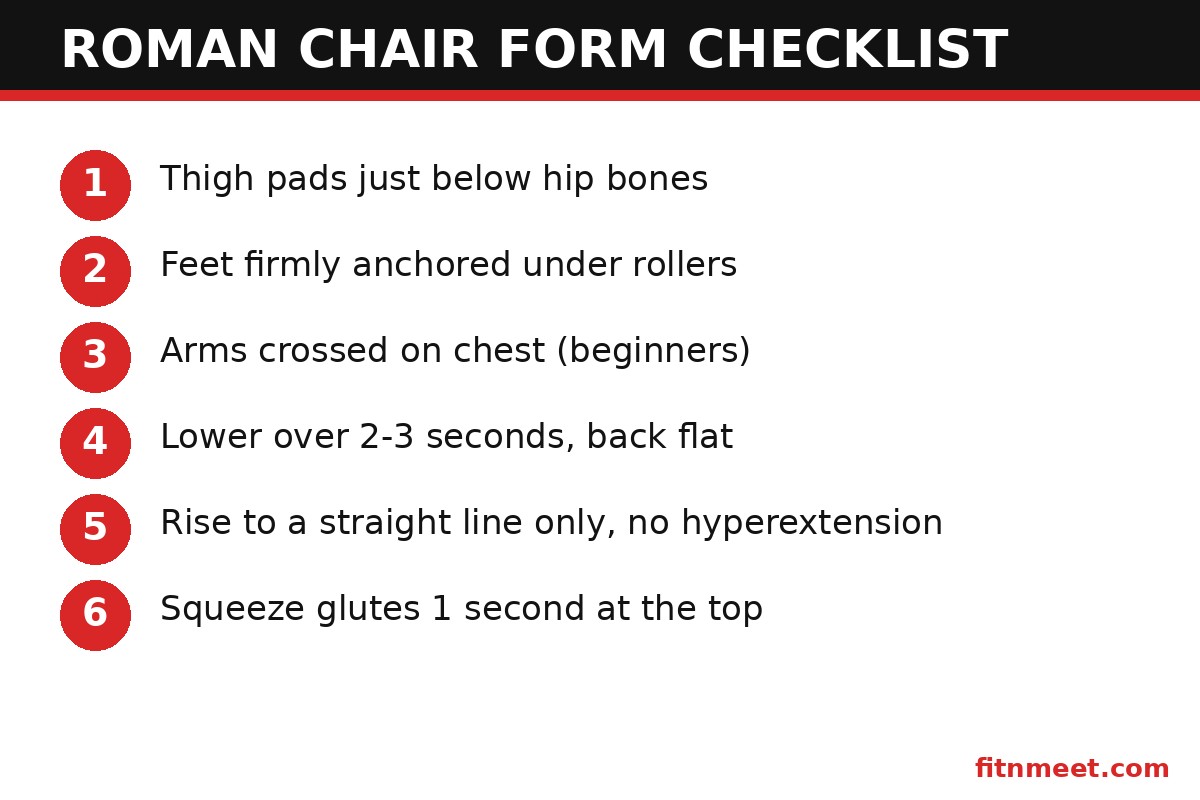
- Set the pad height. “Adjust the thigh pads so they sit just below your hip bones — on the upper thighs, not on your stomach.” Too high and you cannot hinge; too low and the pads dig into your quads.
- Anchor your feet. “Slide your heels under the ankle rollers and press your feet flat against the footplate.” Your legs should feel locked in — you will be trusting this anchor with your full bodyweight.
- Cross your arms. “Fold your arms across your chest for your first sessions.” Hands behind the head is fine later, but it tempts beginners to yank the neck. A plate held at the chest comes later still.
- Hinge forward slowly. “Lower your torso toward the floor over 2–3 seconds, keeping a flat back.” Go until you feel a deep hamstring stretch — usually when the torso is near 45 degrees below horizontal. Do not round the lower back at the bottom.
- Extend with control. “Drive your hips into the pads and lift your torso until your body forms a straight line.” Squeeze the glutes hard at the top for one second. Do not hyperextend past straight — that arches the lumbar spine under no benefit.
- Repeat for reps. “Twelve to fifteen smooth reps. When fifteen feels easy, hug a plate to your chest.”
Takeaway: The entire Roman chair back extension is a hip hinge with anchored legs — flat back down, straight line up, glutes squeezed at the top. If your lower back does all the work and your glutes feel nothing, lighten up and relearn the hinge. Pair the approach above with options from our muscle development range.
The chair Programming: Sets, Reps & Frequency
| Goal | Exercise | Sets × reps | Frequency |
|---|---|---|---|
| Back health / prehab | Bodyweight back extension | 2–3 × 15–20 | 2–3x/week |
| Strength & hypertrophy | Weighted back extension | 3–4 × 10–15 | 2x/week |
| Glute emphasis | Reverse hyperextension | 3 × 12–15 | 1–2x/week |
| Abdominal work | Roman chair sit-up | 3 × 10–15 | 1–2x/week |
Your month on the Roman chair might look like this: Weeks 1–2 — bodyweight back extensions, 3×15, twice weekly, learning the hinge. Weeks 3–4 — add a 5 kg plate, 3×12. Weeks 5–8 — progress to 10 kg, 4×12, and add reverse hypers once weekly. That is a complete posterior-chain specialization block built on one machine.
Place The chair work at the end of lower-body or back sessions — fatigued erectors before heavy deadlifts are a safety issue, not a toughness badge. And progress load conservatively: the lower back responds better to patient volume than to ego lifting.
Takeaway: Start with bodyweight for two weeks, add load in small jumps, train it 2x weekly after main lifts — that simple formula covers 90% of lifters’ Roman chair needs.
What to Watch For: Roman Chair Mistakes & Safety
Three months in, you are a Roman chair regular. Here is what to keep watching so the good habit stays a good habit:
- Hyperextending at the top. The classic error — arching past a straight body line. It loads the lumbar facet joints for zero extra muscle benefit. Stop at straight.
- Rounding at the bottom. Collapsing into lumbar flexion under stretch, rep after rep, is exactly the pattern linked to disc issues. Keep the back flat; reduce range if needed.
- Using momentum. Bouncing out of the bottom turns a strength exercise into a ballistic one. Two seconds down, one second up, one second squeeze.
- Wrong pad height. Pads on the stomach instead of the thighs block the hinge and jam the movement into the lower back. Check it every session — gym settings get changed.
- Adding weight too fast. The erectors adapt slower than enthusiasm. Jump plate sizes monthly, not weekly.
- Ignoring pain signals. Muscle burn in the glutes, hamstrings, and mid-back is correct; sharp, shooting, or radiating pain is not — stop and get assessed.
Lifters with herniated discs, spondylolisthesis, or recent back surgery should get professional clearance before Roman chair work — the extension pattern is therapeutic for many backs but contraindicated for some. General safe-training guidance is available through Wikipedia’s strength training overview.
Takeaway: The chair is joint-friendly by design, but form discipline — flat back, no hyperextension, controlled tempo — is what keeps it that way.
Roman Chair vs Alternatives: Comparison
| The chair (45°) | GHD | Floor back extension | Good morning | |
|---|---|---|---|---|
| Loading | Bodyweight + plates | Bodyweight + plates | Bodyweight only | Barbell (heavy) |
| Difficulty | Beginner-friendly | Advanced | Beginner | Intermediate+ |
| Spinal load | Low | Low–moderate | Minimal | High |
| Glute emphasis | Moderate–high | Very high | Low | High |
| Availability | Most gyms | Fewer gyms | Anywhere | Needs barbell |
| Best for | Everyone, daily driver | Advanced posterior work | Beginners, warm-ups | Heavy hinge strength |

The verdict from our story’s perspective: the Roman chair wins on accessibility and sustainability — it is in nearly every gym, easy to learn, and gentle enough for twice-weekly use forever. The GHD is the graduate school (harder, rarer); good mornings are the heavy artillery (effective but demanding). Most lifters should build their base on the Roman chair and add the others as needed.
Takeaway: You do not need the fanciest posterior-chain tool — you need the one you will actually use twice a week for years. For most people, that is the Roman chair.
This article is for informational purposes only and is not medical advice. Consult a healthcare professional before starting any supplement or exercise program.
Frequently Asked Questions
What is a Roman chair used for?
The chair is used for back extensions (hyperextensions), reverse hyperextensions, Roman chair sit-ups, and side bends. Its main purpose is strengthening the posterior chain — spinal erectors, glutes, and hamstrings — through controlled hip-hinge movements with the legs anchored. It’s one of the best tools for lower-back resilience and deadlift lockout strength.
Are Roman chair back extensions safe?
Yes, when done correctly — they’re among the joint-friendliest posterior-chain exercises because loading is limited to bodyweight plus small plates. Keep your back flat (no rounding at the bottom), stop at a straight body line (no hyperextending past neutral), and use a controlled tempo. People with herniated discs or spondylolisthesis should get professional clearance first.
How many reps should I do on the chair?
For back health and endurance: 2-3 sets of 15-20 reps with bodyweight, 2-3 times per week. For strength and muscle: 3-4 sets of 10-15 reps with added weight (plate at chest), twice weekly. Start with bodyweight for two weeks to learn the hinge before adding load.
Does the Roman chair work abs?
The standard back extension doesn’t target abs, but the chair absolutely can: sit-ups on the chair (anchored decline sit-ups) train the rectus abdominis and hip flexors, and side bends off the chair hit the obliques. It’s a complete trunk station — extension, flexion, and lateral flexion are all covered.
Roman chair vs GHD — what’s the difference?
The chair (typically 45-degree) is easier, more common in gyms, and ideal for back extensions and general posterior-chain work. A GHD (glute-ham developer) is horizontal, harder, and better for glute-ham raises and advanced work. Beginners and most intermediates should master the chair first; the GHD is graduate school.
Why does my lower back hurt on the Roman chair?
Usually one of three form errors: hyperextending past a straight line at the top (arches the lumbar spine), rounding the lower back at the bottom, or setting the thigh pads too high (on the stomach instead of the thighs). Fix these and the work should shift to your glutes and hamstrings. Sharp or radiating pain is different — stop and get assessed.
Conclusion
And so our story ends where it began — except now you do not walk past the Roman chair. You head straight for it, twice a week, ten focused minutes that keep your back resilient, your deadlift climbing, and your posture tall through the longest workdays. The most underused machine in the gym turned out to be the one you needed most.
Every lifter has a weak link the mirror does not show. Find yours, train it with the same consistency you bring to everything else, and the whole system gets stronger. That is the real lesson of the Roman chair — and of training in general.
Takeaway: Ten minutes, twice a week, on the chair: the highest-ROI habit most lifters are not doing. Start tonight.
Join lifters training smarter: fuel your sessions from FitnMeet’s shop, recover with the workout recovery collection, and share your own Roman chair story on the FitnMeet blog community.