

A small barbell is a shorter, lighter barbell weighing 10-25 lbs, designed for beginners, youth lifters, smaller athletes, and technique practice. Unlike the standard 45 lb Olympic bar, a small barbell lets new lifters learn proper form with manageable weight before progressing to full-size bars.
New to lifting? It is the training wheels of barbell training: light enough to learn on, real enough to build real strength with. This guide explains every type, who each one is for, and how to pick yours.
Small Barbell Explained Simply
Think of it like a student driver car: same controls as the real thing, but sized so a beginner can actually use it safely. A standard Olympic barbell weighs 45 lbs and stretches over 7 feet long. For a 12-year-old, a smaller adult, or anyone rehabbing an injury, 45 lbs can be too much for learning the movements. A small barbell solves this by shrinking both the weight (10-25 lbs) and the length (4-6 feet), so the lifter practices real barbell technique with a load their body can handle.
The key insight: it is not a toy. It is a real barbell with real knurling (the textured grip pattern), real sleeves for plates, and real training value. The only things that changed are the dimensions. When a beginner masters the squat, press, and deadlift patterns with a small barbell, transitioning to the 45 lb Olympic bar is a small step, not a leap.
One stat to remember: the jump from a 15 lb technique bar to a 45 lb Olympic bar is a 30 lb increase, roughly the same as adding a plate per side. Lifters who learn on a small barbell arrive at that jump with ingrained technique instead of shaky improvisation. More training explainers live in our fitness section.
What Is a Small Barbell?
It is any barbell significantly shorter and lighter than the standard 45 lb, 7.2-foot Olympic bar. Several distinct types share the name:
Technique bars (10-15 lbs)
The lightest true barbells, usually 5-6 feet long with aluminum or light steel construction. Technique bars exist for one purpose: drilling Olympic lift and powerlift form with near-zero load. CrossFit-style gyms keep them by the platform for warm-ups and skill work. A 10 lb small barbell like this lets a beginner rehearse a snatch 50 times without the fatigue a heavier bar would cause.
Junior and youth bars (15-20 lbs)
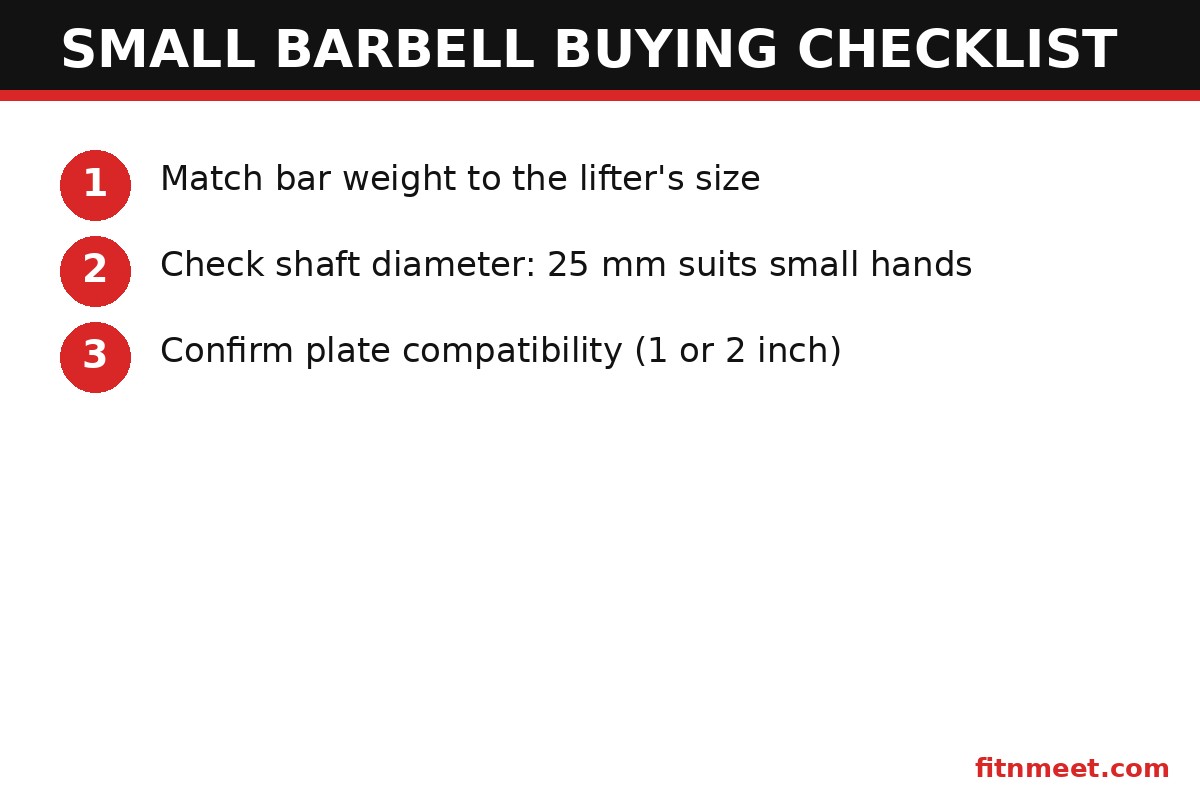
Scaled-down bars, typically 5-6 feet long with a thinner 25 mm shaft (versus 28-29 mm on a standard bar), designed for kids and teens. The thinner shaft matters as much as the weight: small hands cannot grip a 29 mm bar securely, and grip is the foundation of every lift. A junior small barbell teaches young lifters to hold the bar correctly from day one.
Shorty and stubby bars (20-35 lbs)
Compact bars around 4-5 feet long for home gyms with low ceilings or tight spaces. A shorty bar fits where a 7-foot bar cannot, making it the practical choice for garage gyms, basement setups, and apartment corners. Sleeve space is limited, so check plate capacity before buying.
Women’s Olympic bars (33 lbs)
Technically a full Olympic bar at 6.6 feet, but 12 lbs lighter than the men’s bar with a 25 mm shaft. Many smaller adults, regardless of gender, find the 33 lb bar a better fit than the 45 lb standard. It sits at the boundary between “small barbell” and standard equipment.
Fixed-weight barbells (20-110 lbs)
Pre-loaded straight bars, common in commercial gyms, starting as light as 20 lbs. These are the bars most beginners actually meet first: grab the 20 or 30 lb fixed bar for curls, presses, and rows without loading plates at all.

Start here: the 30-second version
They weigh 10-25 lbs and measure 4-6 feet. Pick a technique bar for form practice, a junior bar for kids, a shorty bar for tight spaces, or a fixed-weight bar for simplicity. All of them teach the same movement patterns as the big bar.
Why Beginners Care About the Small Barbell
Beginners care about it for one reason above all: it lets them practice the movement before fighting the weight. Learning a deadlift with 45 lbs on the bar means the beginner’s attention splits between “am I doing this right?” and “this is heavy.” With a 15 lb small barbell, the second question disappears, and all attention goes to technique. That focus compounds: 100 technically clean reps with a light bar build better motor patterns than 20 shaky reps with a heavy one.
There is also a confidence factor. Walking up to a 7-foot, 45 lb bar is intimidating when you have never lifted. It looks approachable, which means beginners actually pick it up, actually practice, and actually come back. The best barbell for a beginner is the one they will use, and approachability drives consistency.
One stat to remember: beginners who spend their first 4-6 weeks on technique-focused light-bar work report fewer form-related stalls later, because the movement patterns were grooved before loads got serious.
Getting Started: Your 5-Step Beginner Plan
Your first month with one, in five steps:
Step 1: Get the right bar (Week 1)
Choose one in the 10-20 lb range with a shaft diameter that fits your hands (25 mm for smaller hands, 28 mm for average). If you train at a commercial gym, find the fixed-weight bars or the technique bars near the platforms. If you are buying, a 15 lb technique bar is the most versatile first purchase.
Step 2: Learn three movements (Weeks 1-2)
Master the deadlift, the overhead press, and the bent-over row with the empty bar. Do 3 sets of 10 reps of each, 2-3 times per week, focusing on smooth, controlled motion. Film yourself from the side; your phone is the best coach you own.
Step 3: Add the squat and bench patterns (Weeks 2-3)
Add goblet-style squats (holding the bar at the chest) and floor presses. Keep the same 3×10 scheme. By now the bar should feel light, which is exactly the point: you are building skill, not testing strength.
Step 4: Start adding weight (Weeks 3-4)
Add 2.5-5 lbs per side per session using small plates or by moving to a heavier fixed bar. The rule: only add weight when all reps of the current weight look clean on video. A small barbell with a few plates still teaches; a heavy bar with bad form only injures.
Step 5: Graduate when ready (Week 4+)
When you can perform all five movements with 30-40 lbs total (bar plus plates) with solid form, you are ready for the standard 45 lb bar or the 33 lb women’s bar. The transition will feel natural because the patterns are already yours.
Benefits of a Small Barbell
The case for starting with one, in plain terms:
- Technique first. Light loads let beginners focus 100% of their attention on form. Good form learned early prevents the plateaus and injuries that bad habits cause later.
- Fits small hands. A 25 mm shaft on a junior bar matches smaller grips; a standard 29 mm bar forces a compromised grip that leaks into every lift.
- Fits small spaces. A 5-foot bar needs roughly 30% less floor space than a 7-foot Olympic bar, opening up garage and apartment training.
- Gentle progression. Moving from a 15 lb bar to a 20 lb fixed bar to a 33 lb women’s bar creates smooth 5-15 lb steps, instead of the intimidating 45 lb jump from empty hands to an Olympic bar.
- Rehab-friendly. After injury, it allows reloading movement patterns at trivial weights under professional guidance, rebuilding confidence alongside tissue.
- Warm-up tool for life. Even advanced lifters keep a light bar for warm-up sets and technique refreshers. It never becomes useless.
One stat to remember: a lifter who progresses from a 15 lb bar to a 135 lb squat has added 120 lbs through patient steps, the same destination as everyone else, reached with fewer detours.
Common Mistakes with a Small Barbell
Avoid these beginner errors and your bar will serve you well:
- Staying too light too long. It is a starting point, not a destination. If every set feels easy for 2+ weeks, add weight. Technique practice without progressive overload builds skill but not strength.
- Buying a bar with the wrong sleeves. A 1-inch standard bar cannot use Olympic 2-inch plates, and vice versa. Match the bar to the plates you own or plan to buy; this is the #1 purchasing mistake.
- Ignoring shaft diameter. A thick 28 mm shaft on a “small” bar defeats the purpose for small hands. Check the spec: 25 mm for youth and small hands, 28 mm for general use.
- Skipping collars. Light bars tip easily when plates slide. Collars on a light bar matter more than on a heavy bar, not less, because the bar’s own weight cannot stabilize shifting plates.
- Comparing your numbers to others’. Your 65 lb small-barbell squat in week 3 is not “less than” someone’s 135 lb squat; it is the correct load for your stage. Log the bar weight honestly (a 15 lb bar + 50 lbs of plates = 65 lbs) and progress from there.
- Graduating before form is solid. The test is video, not ego: if your reps look clean from the side at the current weight, move up. If they do not, the light bar still has teaching to do.
Weight Basics: Choosing the Right Small Barbell
Use this simple framework to pick your bar’s weight:
- Kids under 12: 10 lb technique bar. Focus is entirely on movement patterns and fun, not load.
- Teens and smaller adults: 15-20 lb junior bar with a 25 mm shaft. Enough weight to feel real, light enough to learn.
- Adult beginners: 15 lb technique bar or 20-30 lb fixed-weight bars. Start here for 4-6 weeks, then reassess.
- Home gym, tight space: shorty bar, 20-35 lbs, 4-5 feet. Measure your ceiling and floor space first; the bar must fit loaded.
- Rehab (with professional guidance): the lightest bar available, often 10 lbs, progressing only as cleared.
When comparing options, check four specs in order: weight (10-25 lbs for a true small barbell), length (4-6 feet), shaft diameter (25 or 28 mm), and sleeve type (1-inch standard or 2-inch Olympic). Any listing missing these numbers is not worth your money. The strength training guides cover what to do once you have the bar, and the muscle development collection covers the fuel.

Safety
A light bar is forgiving, but iron is iron:
- Use collars always. As noted above, light bars are more prone to plate-shift tipping, not less.
- Check the weight rating. Cheap ones may rate for only 100-200 lbs total. Do not exceed it; the bar can bend permanently.
- Lift in a clear space. Even a 5-foot bar needs 8-10 feet of clear floor for safe loading and movement.
- Learn to bail. Practice setting the bar down safely from a squat and press before weights get challenging. With a light bar, bailing practice is easy and painless.
- Supervise young lifters. Kids using a junior bar need an adult present, a clear floor, and instruction. The bar is light; the plates still demand respect.
- Inspect regularly. Check sleeves for smooth rotation and the shaft for bends every few months. A bent bar teaches crooked patterns.
This article is for informational purposes only and is not medical advice. Consult a healthcare professional before starting any supplement or exercise program.
Frequently Asked Questions
How much does a small barbell weigh?
They typically weigh 10 to 25 lbs, compared with 45 lbs for a standard Olympic barbell. Technique bars run 10 to 15 lbs, junior bars 15 to 20 lbs, and shorty bars 20 to 35 lbs. Always check the product specs, since weights vary by manufacturer.
What is a small barbell good for?
It is best for learning barbell technique, youth training, rehab work under professional guidance, and home gyms with limited space. It lets beginners practice squats, presses, deadlifts, and rows with manageable weight before progressing to a standard 45 lb bar.
Can adults use a small barbell?
Absolutely. Many adults start with a 15 lb technique bar or 20 to 30 lb fixed-weight bars for their first month of training. Smaller adults may prefer the 33 lb women’s Olympic bar long-term. It is a legitimate training tool at any age; it is the load and the programming that determine results, not the bar’s size.
What is the difference between a small barbell and a standard barbell?
The differences are weight (10 to 25 lbs vs 45 lbs), length (4 to 6 feet vs 7.2 feet), and often shaft diameter (25 mm vs 28 to 29 mm). It may also have shorter sleeves that fit fewer plates. The movement patterns you train are identical; only the dimensions change.
When should I switch from a small barbell to a regular barbell?
Switch when you can perform your main lifts with 30 to 40 lbs total (bar plus plates) with clean form confirmed on video, usually after 4 to 6 weeks of consistent training. The transition to a 45 lb standard bar or 33 lb women’s bar should feel like a small step, not a leap.
Do I need Olympic plates for a small barbell?
Only if your small barbell has 2-inch Olympic sleeves. Many small barbells use 1-inch standard sleeves that need standard plates. Check the sleeve diameter before buying plates; mismatched plates and sleeves are the most common purchasing mistake with one.
Conclusion
A small barbell is the smartest first barbell you can own: light enough to learn on, real enough to build strength with, and useful forever as a warm-up and technique tool. Pick a 10-20 lb bar that fits your hands and your space, run the 5-step beginner plan, add weight when your form earns it, and graduate to the big bar when you are ready. Every strong lifter started with a first rep; make yours a good one.
Ready to start? Explore beginner-friendly training in the strength training section on FitnMeet, or browse the shop for your first equipment.
Sources: Barbell — Wikipedia · Strength training — Wikipedia