
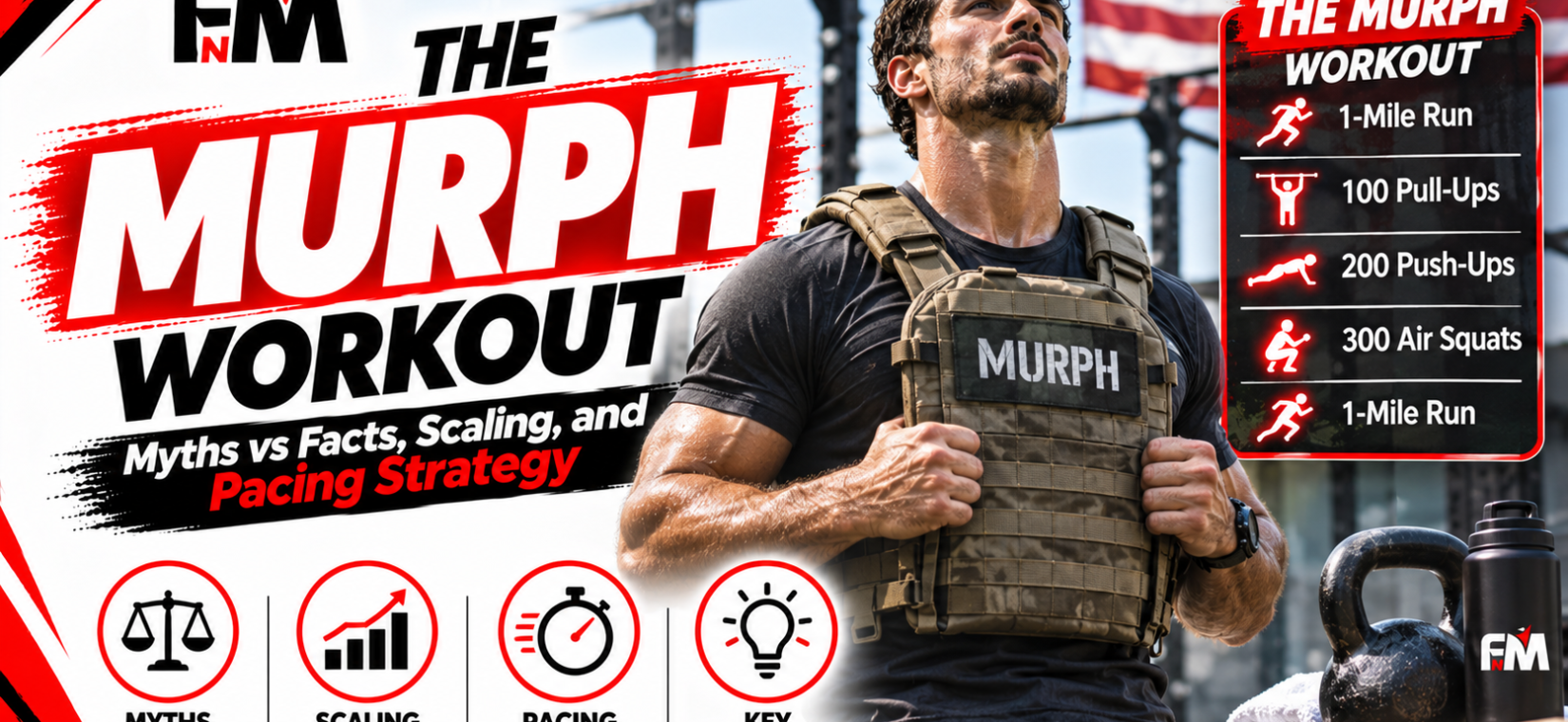
The Murph workout is a bodyweight endurance workout honoring Navy SEAL Lt. Michael P. Murphy: a 1-mile run, 100 pull-ups, 200 push-ups, 300 air squats, and a final 1-mile run, optionally with a 20 lb weighted vest. This workout can be completed straight through or partitioned, and it is famous for testing muscular endurance, pacing, and mental toughness.
Quick Answer
This challenge is one of the most famous workouts in functional fitness — and one of the most misunderstood. At face value it is simple: run a mile, do 100 pull-ups, 200 push-ups, and 300 air squats, then run another mile. But the details of how this workout should be performed, who it is for, and how to scale it are where myths run wild. This guide separates the myths from the facts so you can tackle the Murph workout safely and finish strong.
The workout: Myths vs Facts
Before we get into the details of the Murph workout, let us clear the air. Half of what people believe about this workout is wrong, and those wrong beliefs cause the most injuries and failed attempts. Here are the most common myths — busted.
Myth 1: You must do all the reps in order, unpartitioned, to count it as Murph.
✗ Myth: 100 pull-ups, then 200 push-ups, then 300 squats — all straight through. If you break it up, it does not count.
✓ Fact: The original write-up of the Murph workout allows the middle movements to be partitioned however you like. Most people do 20 rounds of 5 pull-ups, 10 push-ups, 15 squats.
The standard way this challenge is performed worldwide is partitioned: 20 rounds of 5 pull-ups, 10 push-ups, and 15 air squats. Doing all 100 pull-ups before touching a single push-up is an advanced, unpartitioned variant — a self-imposed challenge, not a requirement. Partitioning this workout keeps movement quality higher, reduces localized fatigue, and dramatically lowers the risk of overuse injury.
Myth 2: You have to wear the 20 lb vest, or it is not the real Murph workout.
✗ Myth: The vest is mandatory. Doing the Murph workout without a vest is cheating.
✓ Fact: The vest is optional (“if available”). Most first-timers should do the workout unvested — it is still an enormous challenge.
The official description of the Murph workout says the vest is worn if available. Adding 20 lb (9 kg) to 600 bodyweight reps is a massive multiplier — it typically adds 10 to 20 minutes to finish times. Unvested, Murph remains one of the toughest tests in fitness. Earn the vest by finishing without it first.
Myth 3: The Murph workout is only for advanced athletes.
✗ Myth: Unless you can do 20 strict pull-ups, do not even attempt this challenge.
✓ Fact: This workout scales beautifully — half Murph, partner Murph, band-assisted pull-ups, box push-ups, and row substitutions all work.
The scaling section below lays out exact options. The spirit of the Murph workout — honoring sacrifice through shared effort — is preserved in every scaled version.
Myth 4: Kipping pull-ups are not allowed in the workout.
✗ Myth: Only strict pull-ups count. Kipping is cheating the Murph workout.
✓ Fact: The workout as written does not specify strict pull-ups. Choose strict, kipping, or jumping pull-ups based on your capacity and joint health.
Strict pull-ups are the gold standard for strength, but 100 strict pull-ups is an elite-level feat. Most finishers of Murph use kipping or a mix. What matters is full range of motion: chin over the bar, arms straight at the bottom.
Myth 5: You should do this challenge every week for best results.
✗ Myth: Doing the Murph workout weekly builds toughness and conditioning fast.
✓ Fact: This workout is a high-volume stress event — 600 loaded reps. Treat it as an occasional test (a few times per year), not a weekly habit.
Repeating 100 pull-ups and 300 squats weekly is a recipe for elbow tendinopathy, shoulder impingement, and rhabdomyolysis in unprepared athletes. The Murph workout is a test, not a training program. Train for it with progressive volume; test it occasionally.
What Is the workout?
The Murph workout is a memorial workout named for U.S. Navy SEAL Lieutenant Michael P. Murphy, who was killed in action in Afghanistan in June 2005 and posthumously received the Medal of Honor. His story is documented on Wikipedia. The workout was one of his favorites — he called it “body armor” because he did it wearing his ballistic vest.
The exact prescription of Murph is:
- Run 1 mile
- 100 pull-ups
- 200 push-ups
- 300 air squats
- Run 1 mile
Optionally, wear a 20 lb (9 kg) weighted vest throughout. The middle three movements of this challenge may be partitioned as desired; the runs bookend the workout and are not partitioned.
The Murph workout belongs to the family of “hero workouts” in functional fitness — named memorial workouts done in community, most famously every Memorial Day. What makes this workout unique is its combination of a running sandwich (aerobic engine) and high-rep calisthenics (muscular endurance): roughly 2 miles of running and 600 total reps, typically taking 35 to 70 minutes.

Benefits of the workout
Why has the Murph workout become an annual ritual for hundreds of thousands of people? The benefits are real — but narrower and more specific than the hype suggests.
- Muscular endurance, tested head to toe. Murph demands sustained force output from the lats, chest, shoulders, quads, and glutes. Few workouts test pulling endurance (100 pull-ups), pushing endurance (200 push-ups), and lower-body endurance (300 squats) in one session.
- Aerobic capacity under fatigue. The opening mile is easy; the closing mile — run on legs that have done 300 squats — is where this challenge reveals your engine. Athletes who pace the calisthenics well typically run the final mile within a minute of their opening mile.
- Pacing and strategy skills. Few workouts punish bad pacing like the Murph workout. Going out too hard on push-ups turns rounds 12–20 into grinding singles. It teaches rep-management and effort distribution better than almost any session.
- Mental toughness — but the useful kind. The middle of this workout (roughly rounds 8–16) is genuinely uncomfortable. Practicing composed effort in discomfort transfers to competition and life — but only if you stay safe, which brings us to the cautions.
- Benchmarking over years. Because the Murph workout is standardized, you can compare times year to year. Improving from 58 to 47 minutes is a tangible, motivating measure of progress.
What the workout is not: a muscle-building program (volume without progressive overload does not build size efficiently), a fat-loss plan (one workout burns roughly 500–800 calories — meaningful, but weekly habits drive fat loss), or a daily driver. Think of Murph as a yearly physical exam for your engine, not a prescription you take weekly.
Recovery nutrition matters after a session this size. Explore FitnMeet’s workout recovery collection and sports nutrition collection for post-workout protein options, and read more training guides in our fitness articles.
How to Do the Murph Workout (Do This, Not That)
Here is a practical, field-tested way to approach this challenge. Read it as a “do this, not that” list — the left column keeps you fast and safe; the right column is how people end up on the floor in round 9.
- DO partition into 20 rounds of 5-10-15. Small, repeatable sets keep movement quality high and transitions quick. Do NOT try 100 straight pull-ups unless you are an elite-level athlete — you will stall and your total time will be worse.
- DO break push-ups early. Start with sets of 10–15, or even 5s, from round one. Do NOT chase big early sets; push-up failure cascades into the squats and the final run.
- DO run the first mile at a controlled pace — roughly 15–20 seconds per mile slower than your fresh mile pace. Do NOT race it; the Murph workout is won or lost in the calisthenics middle.
- DO chalk your hands and manage grip. The pull-up bar volume wrecks grip; shake out between sets. Do NOT death-grip every rep from round one.
- DO scale honestly. Band-assisted pull-ups, box or knee push-ups, and air squats to a target are legitimate. Do NOT perform 200 ugly half-rep push-ups just to say you finished this workout Rx.
- DO hydrate before and during. A 45–70 minute effort with 600 reps generates enormous heat. Do NOT attempt the Murph workout in midday heat without water and shade available.
- DO warm up 10 minutes: easy jog, band pull-aparts, scapular pull-ups, air squats, and a few practice rounds of the 5-10-15 partition. Do NOT start cold.
Pacing and Scaling Guide
One of the most common questions about Murph is not what it is but how fast you should go — and what to do if the full version is beyond your current level. Here is the honest guide.
Partitioning options for the Murph workout
- Standard partition: 20 rounds of 5 pull-ups / 10 push-ups / 15 squats. The most popular way to do this challenge.
- Push-up-sparing partition: 20 rounds of 5 pull-ups / 5 push-ups / 15 squats / 5 push-ups. Push-ups are the usual bottleneck, so splitting them per round keeps sets fresh.
- Mini-rounds: 33 rounds of 3 pull-ups / 6 push-ups / 9 squats (approximate). Tiny sets, minimal failure, steady clock.
- Unpartitioned: all 100 pull-ups, then all 200 push-ups, then all 300 squats. Only for advanced athletes; expect a much longer grind.
Scaling options for the Murph workout
- Half Murph: 800 m run, 50 pull-ups, 100 push-ups, 150 squats, 800 m run. The perfect first taste of this workout.
- Partner Murph: split all reps with a partner — same stimulus, half the volume each. The most social version of the Murph workout.
- Movement substitutions: band-assisted or jumping pull-ups, knee or box push-ups, squats to a box, or rowing in place of the runs if injured.
- Time cap: set a 45–60 minute cap; complete as much quality work as possible. The workout done safely within a cap beats a sloppy full finish.
- No vest: skip the vest entirely your first time. The unvested Murph workout is already a serious test.
Time benchmarks
Rough benchmarks for the full, partitioned Murph workout: under 40 minutes is excellent (vested, sub-40 is elite); 40–55 minutes is solid for a trained athlete; 55–75 minutes is a respectable finish for most people; over 75 minutes usually means you should have scaled — remember the time cap. Whatever your time, the real comparison for Murph is your own previous attempt.

Safety and Recovery
This challenge deserves a frank safety section, because its injury profile is specific and well known.
- Rhabdomyolysis risk. Extremely high-rep eccentric work (especially pull-ups and push-ups) in unaccustomed athletes can cause rhabdomyolysis — muscle breakdown that floods the kidneys. Warning signs: extreme soreness out of proportion to the effort, swelling, and dark/cola-colored urine. This is a medical emergency. If you are new to high-volume training, scale the Murph workout and build volume over weeks, not days.
- Tendon and joint overload. 100 pull-ups can inflame elbows (golfer’s elbow) and shoulders; 200 push-ups stress wrists and anterior shoulders. Stop if sharp pain appears — this workout is a test, not worth a six-month injury.
- Hand tears. High pull-up volume tears calluses. File calluses down beforehand, use chalk, and consider grips.
- Heat illness. Memorial Day Murph workout events often run in heat. Hydrate, and do not wear the vest in extreme heat.
After the workout, expect 2–4 days of significant soreness. Walk the next day, sleep well, eat protein at roughly 1.6–2.2 g/kg/day, and avoid hard training for 48–72 hours. Our muscle development collection and blog have more on structured recovery.
Safety disclaimer: This article is for informational purposes only and is not medical advice. The Murph workout is an advanced high-volume session. Consult a qualified coach or healthcare professional before attempting it, especially if you have cardiovascular, joint, or metabolic conditions. Stop immediately and seek care if you experience chest pain, dizziness, or dark urine.
What is the Murph workout exactly?
The Murph workout is a memorial workout honoring Navy SEAL Lt. Michael P. Murphy: a 1-mile run, 100 pull-ups, 200 push-ups, 300 air squats, and a final 1-mile run, optionally wearing a 20 lb weighted vest. The middle movements can be partitioned, most commonly as 20 rounds of 5 pull-ups, 10 push-ups, and 15 squats.
Do you have to wear a vest for the Murph workout?
No. The vest is optional in the Murph workout prescription (‘if available’). Most first-timers should do it unvested. The 20 lb vest typically adds 10 to 20 minutes and greatly increases difficulty. Finish the Murph workout without a vest before attempting it with one.
Can the Murph workout be partitioned?
Yes. The Murph workout explicitly allows the 100 pull-ups, 200 push-ups, and 300 squats to be partitioned however you like. The standard partition is 20 rounds of 5 pull-ups, 10 push-ups, and 15 air squats. Only the two 1-mile runs must be done straight through, at the start and end.
How long does the Murph workout take?
The Murph workout typically takes 35 to 70 minutes. Under 40 minutes is excellent; 40 to 55 minutes is solid for trained athletes; 55 to 75 minutes is a respectable finish. Vested attempts run longer. Set a 45 to 60 minute time cap if you are scaling.
How should beginners scale the Murph workout?
Beginners can do a half Murph (half the reps and distance), a partner Murph splitting reps, band-assisted or jumping pull-ups, knee or box push-ups, squats to a box, or rowing instead of running. A time cap of 45 to 60 minutes keeps the Murph workout safe while preserving the stimulus.
Is the Murph workout dangerous?
The Murph workout carries real risks if done unprepared: rhabdomyolysis from extreme high-rep volume, elbow and shoulder tendon overload, hand tears, and heat illness. Scale the volume, build up over weeks, stay hydrated, and stop for sharp pain or dark urine. It is a test to prepare for, not a casual workout.
What should I eat after the Murph workout?
After the Murph workout, eat a protein-rich meal with 30 to 50 g of protein plus carbohydrates within a few hours, rehydrate with water and electrolytes, and aim for 1.6 to 2.2 g of protein per kg of body weight daily for the next 2 to 3 days while soreness resolves.
Conclusion
The Murph workout earns its legend honestly: a mile run, 100 pull-ups, 200 push-ups, 300 squats, and a closing mile, all in honor of Lt. Michael P. Murphy. But the legend also breeds myths — that the vest is mandatory, that partitioning disqualifies you, that only elites should try it. Now you know the facts: partition the middle, scale honestly, pace the calisthenics, and treat this challenge as an occasional test you earn through preparation. Do that, and you will finish stronger and safer — and you will have a benchmark worth beating next year.