
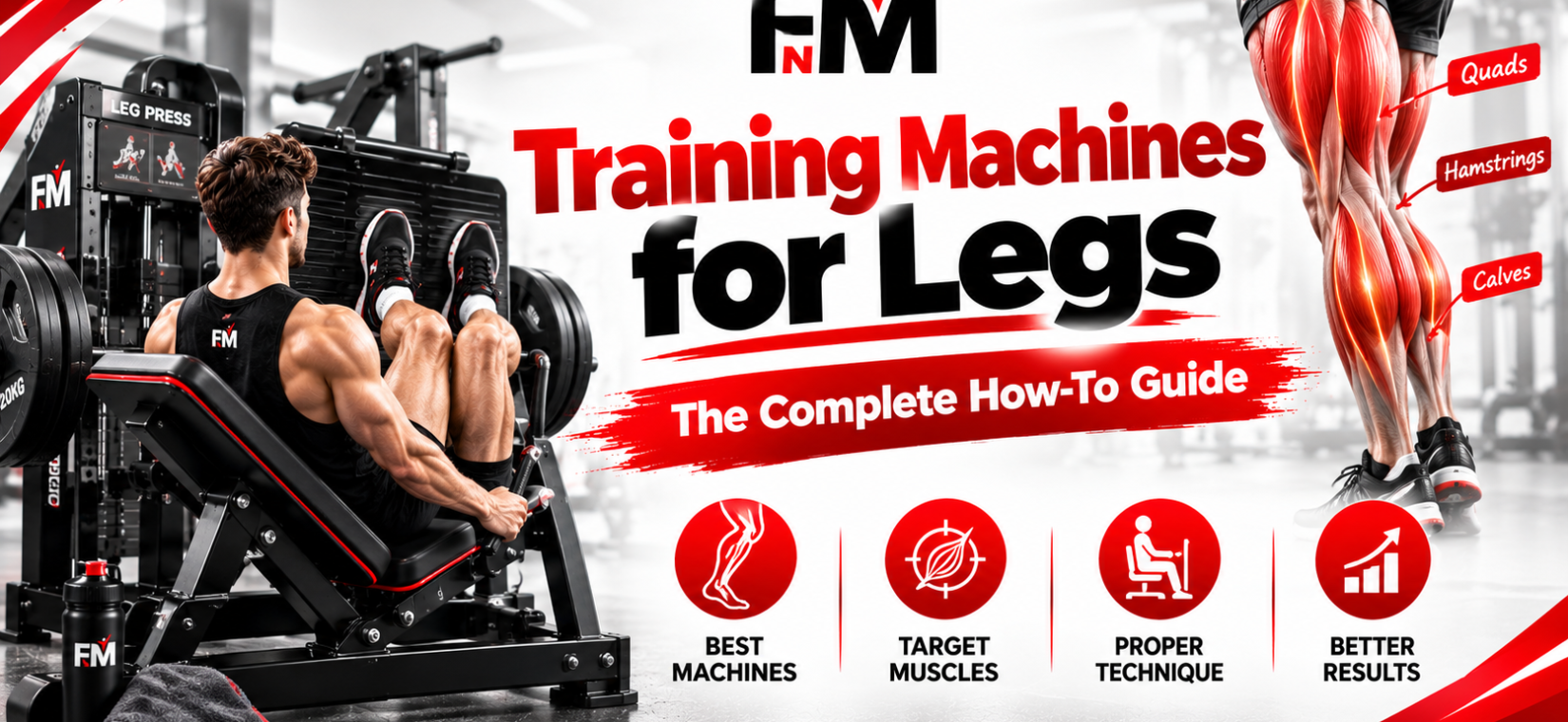
Training machines for legs are gym machines that target the lower body, including leg presses, leg curls, leg extensions, hack squats, and calf machines. They guide the movement path, making them beginner-friendly and useful for training around injuries. Free weights build more stabilizer strength, but machines allow safe, heavy isolation work.
Quick Answer: Which Leg Machines Matter Most?
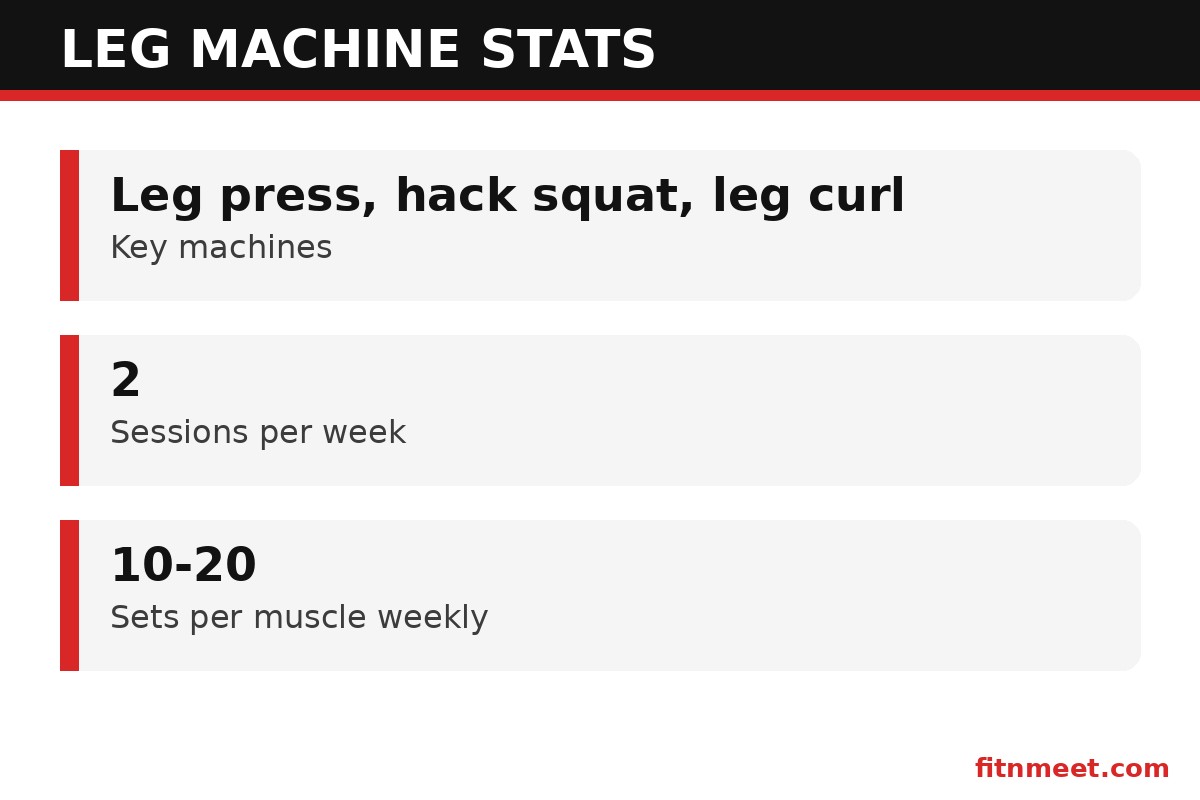
If your gym time is limited, prioritize these four training machines for legs in this order: leg press (overall quad/glute mass), hack squat (quad emphasis with back support), seated or lying leg curl (hamstrings — the most commonly undertrained leg muscle), and leg extension (isolated quad work, great finishers). Add a standing or seated calf raise and you have covered every major lower-body muscle. Everything else — adductor, abductor, glute kickback stations — is useful accessory work, not the foundation.
What Are Training Machines for Legs?
Training machines for legs are selectorized or plate-loaded stations that move along a fixed path, isolating lower-body muscles while the machine handles balance and stabilization. The main categories:
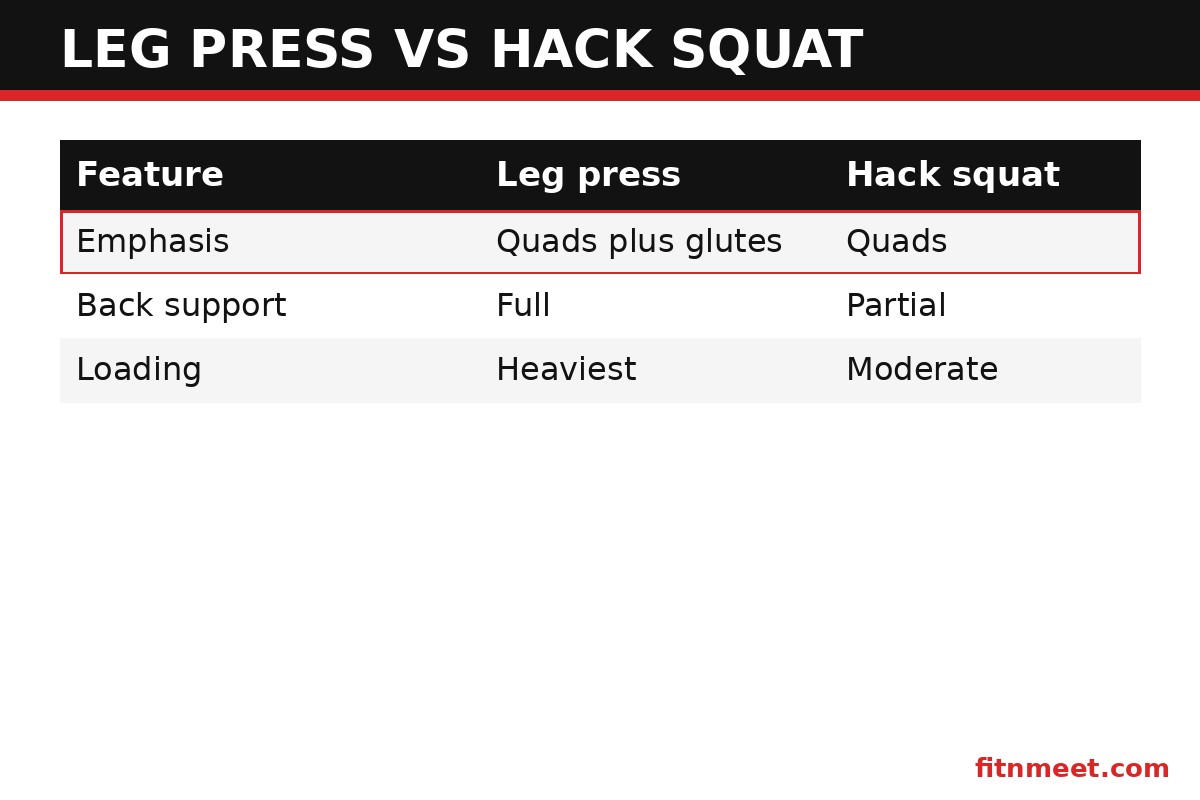
- Leg press (45° or horizontal): the workhorse — you push a loaded sled away with your feet on a large platform. Loads quads, glutes, and adductors with the back fully supported.
- Hack squat machine: a sled on rails angled behind you; you squat against it with shoulder pads. Hits quads hard with less spinal loading than a barbell squat.
- Leg extension: seated knee extension against a padded lever — pure quadriceps isolation, especially the rectus femoris and vastus muscles.
- Leg curl (seated, lying, standing): knee flexion against resistance — the primary machine for hamstrings. Research shows seated leg curls, which stretch the hamstrings at the hip, may grow the hamstrings better than lying versions.
- Calf raise (standing/seated): standing targets the gastrocnemius; seated (knees bent) shifts emphasis to the soleus.
- Hip adductor/abductor: inner and outer thigh work — useful for knee stability and glute medius development.
- Belt squat / pendulum squat: found in better-equipped gyms; load the legs with minimal spinal compression.
Why Use Machines Instead of (or With) Free Weights?
Free weights build coordination and stabilizer strength; training machines for legs build muscle with precision and safety. The honest answer is that most strong legs are built with both. Machines earn their place because:
- Beginners learn faster. No bar path to master, no balance to fight — you can focus 100% on feeling the target muscle work.
- Failure is safe. Grinding out the last reps on a leg press or hack squat to true muscular failure is far safer than doing it under a barbell.
- Volume is easier to accumulate. Drop sets, rest-pause sets, and high-rep finishers are simple on machines — the fixed path keeps form honest when you are exhausted.
- Injuries are easier to train around. Back, shoulder, or wrist issues that rule out barbell squats often leave leg press and belt squat completely viable.
- Isolation is precise. Nothing isolates the hamstrings like a leg curl or the quads like a leg extension; compound free-weight moves always share the load.
For lifters building a home setup around machines, pairing training machines for legs with proper strength training programming knowledge multiplies results. And if you ever train where machines are unavailable, the training guides on the FitnMeet blog cover effective free-weight alternatives.
Step-by-Step Guide: How to Use Each Leg Machine
Step 1 — Leg Press: Setup and Execution
- Sit with your back flat against the pad and head on the headrest — no gap at the lower back.
- Place feet shoulder-width on the platform; lower foot placement biases quads, higher placement biases glutes and hamstrings.
- Release the safeties, lower the sled until knees reach roughly 90°, keeping heels planted — never let knees cave inward.
- Press through the full foot without locking knees hard at the top.
- Never let your lower back round off the pad at the bottom (“butt wink” under load is how backs get hurt on this machine).
Step 2 — Hack Squat: Setup and Execution
- Shoulders under the pads, back flat against the backrest, feet slightly forward on the platform.
- Unlock the safeties, descend until thighs are parallel or slightly below — knees tracking over toes.
- Drive up through mid-foot; keep the back glued to the pad throughout.
- Start light: the fixed path feels unnatural at first, and knees take the load directly.
Step 3 — Leg Extension: Setup and Execution
- Adjust the seat so your knees align exactly with the machine’s pivot point — this single adjustment prevents most knee discomfort.
- Pad rests on the lower shin, just above the ankle — not on top of the foot.
- Extend smoothly to near-full lockout, squeeze the quads for 1 second, lower over 2–3 seconds.
- Keep your butt in the seat; rocking the torso means the weight is too heavy.
Step 4 — Seated Leg Curl: Setup and Execution
- Adjust the thigh pad to pin your legs firmly; align knees with the pivot.
- Curl the pad down and under until heels approach your glutes, squeezing hamstrings hard.
- Lower slowly over 3 seconds — the eccentric (lowering) phase drives hamstring growth.
- Prefer the seated version when available: with hips flexed, hamstrings work at longer lengths, which research links to better hypertrophy.
Step 5 — Calf Raise: Setup and Execution
- Balls of feet on the platform edge, heels hanging free.
- Lower until you feel a deep stretch (2-second pause), then rise as high as possible (1-second squeeze).
- Do both straight-knee (gastrocnemius) and bent-knee (soleus) variations across the week.
- Calves respond to frequency: 2–3 sessions per week beats one marathon session.
Programming: Sets, Reps & Frequency
Training machines for legs respond to the same programming principles as free weights. Use this framework:
| Machine | Primary muscle | Sets × Reps | Notes |
|---|---|---|---|
| Leg press | Quads, glutes | 3–4 × 8–15 | Main compound; load heavy |
| Hack squat | Quads | 3 × 8–12 | Quad-dominant; keep back on pad |
| Leg extension | Quads | 2–3 × 12–20 | Finisher; full range of motion |
| Seated leg curl | Hamstrings | 3–4 × 10–15 | Slow eccentrics; don’t skip |
| Calf raise | Calves | 3–4 × 12–20 | 2–3× per week |
Weekly structure: train legs 2 times per week for most lifters — for example, one quad-dominant day (hack squat + leg press + extension) and one posterior day (leg press high-foot + leg curl + calves). Total weekly volume of 10–20 hard sets per muscle group sits in the evidence-backed hypertrophy range. Rest 2–3 minutes between heavy compound sets, 60–90 seconds for isolation work.
Progression: add 2.5–5 kg when you hit the top of the rep range with clean form on all sets. Machines make micro-loading easy — take advantage of it rather than jumping weight.
Benefits of Training Machines for Legs
- Joint-friendly loading: back-supported machines let lifters with spinal issues train legs hard — the leg press removes axial spinal loading almost entirely.
- Targeted hypertrophy: isolation machines let you bring up lagging muscles (often hamstrings and calves) with surgical precision.
- Beginner confidence: new lifters can train to real effort on training machines for legs within their first session, building the habit before tackling barbell technique.
- Rehab and return-to-training: controlled, fixed-path loading is the standard tool in post-injury leg rehab progressions.
- Time efficiency: no setup, no spotters, no plate math debates — selectorized training machines for legs let you move through a full leg session in 45–60 minutes.
Mistakes to Avoid
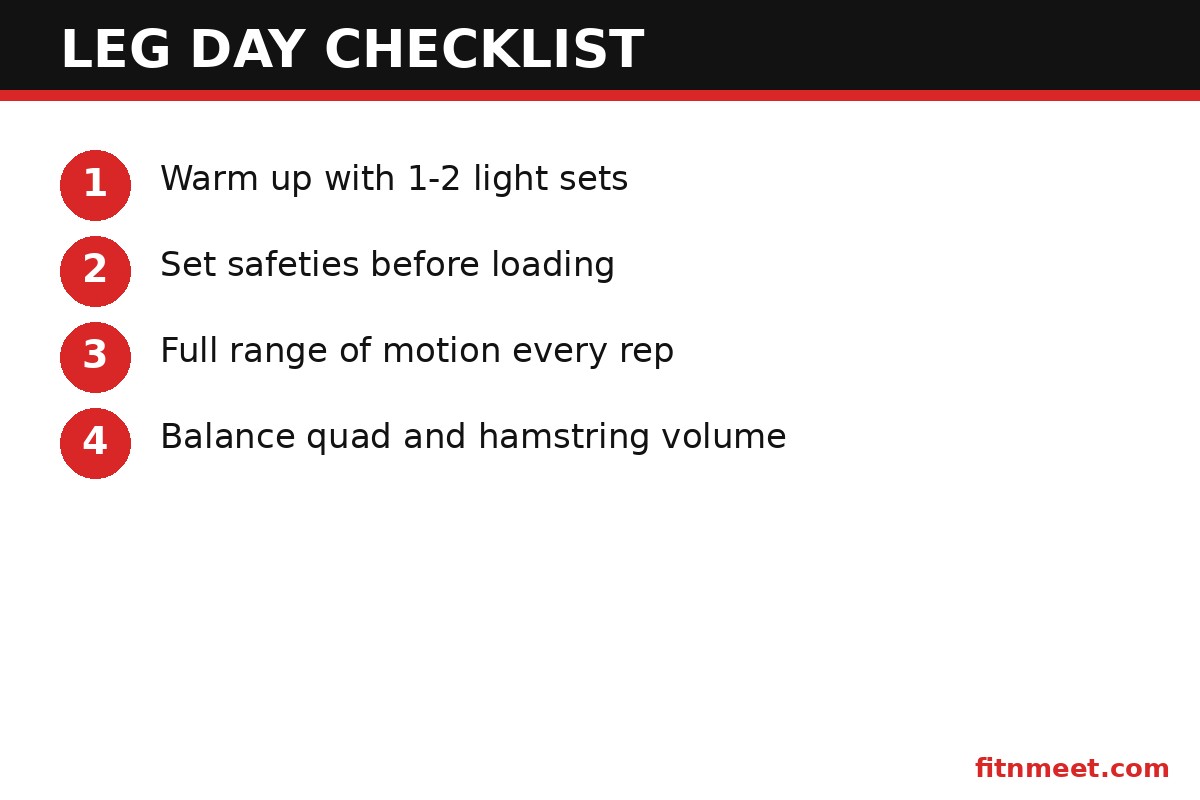
- Skipping hamstrings. The most common leg-day sin: all press, no curl. Aim for roughly equal quad and hamstring volume to protect the knees.
- Partial reps on the leg press. Quarter-reps with massive loads inflate the ego and the injury risk in equal measure. Full, controlled range wins.
- Knees caving inward. On every one of the training machines for legs, knees should track over toes. If they collapse, the weight is too heavy.
- Locking out hard under load. On leg press and hack squat, stop just short of full lockout to keep tension on the muscle and pressure off the knee joint.
- Ignoring calves. Two to three short calf sessions weekly take 10 minutes and transform lower-leg development.
- Only training legs once a week. One weekly session maintains; two builds. Frequency is the simplest lever most lifters ignore.
Leg Machines vs Free Weights: Comparison
| Factor | Training machines for legs | Free weights (squat, lunge, RDL) |
|---|---|---|
| Muscle growth (volume matched) | Equal | Equal |
| Balance & coordination | Low demand | High demand — extra benefit |
| Safety at failure | Excellent — built-in safeties | Requires spotters/safety bars |
| Learning curve | Minutes | Weeks to months |
| Isolation precision | Excellent | Limited — compounds share load |
| Spinal loading | Minimal (leg press, belt squat) | Significant (squat, deadlift) |
| Space & cost (home gym) | Large, expensive | Compact, affordable |
The practical conclusion: use training machines for legs for safe volume and isolation, free weights for coordination and overall athleticism. Programs that combine both consistently outperform either approach alone in long-term adherence studies. Support your leg-day progress on training machines for legs with staples from the FitnMeet muscle development collection.
Safety Notes
- Always set and test the safety stops before loading a leg press or hack squat — every session, not just the first.
- Warm up with 1–2 light sets of 15–20 reps before heavy work; cold knees and heavy loads are a bad combination.
- Stop if you feel sharp joint pain (as opposed to muscle burn) — machines should never hurt joints when set up correctly.
- Keep hands off the weight stack and moving sled parts; use the handles provided.
- People with knee replacements, severe osteoarthritis, or recent surgery should get clearance and form coaching from a physiotherapist before using training machines for legs.
This article is for informational purposes only and is not medical advice. Consult a healthcare professional before starting any supplement or exercise program.
Frequently Asked Questions
What are the best training machines for legs for beginners?
Start with the leg press, seated leg curl, and leg extension. These three training machines for legs are the easiest to set up, the safest to take to failure, and together they cover quads, hamstrings, and glutes. Add the hack squat once you are comfortable bracing under load.
Can you build big legs with only training machines for legs?
Yes. Research shows muscle growth is equivalent between machines and free weights when training volume is matched. A program built on leg press, hack squat, leg curl, leg extension, and calf work — done twice weekly with progressive overload — builds substantial leg mass without a single barbell.
How many times per week should you use training machines for legs?
Twice per week is the sweet spot for most lifters — for example, a quad-focused day and a hamstring/glute-focused day. Beginners can start with once weekly; advanced lifters chasing lagging legs sometimes use three shorter sessions. Allow at least 48 hours between hard sessions for the same muscle.
Are training machines for legs bad for knees?
No — when set up correctly, training machines for legs are among the knee-friendliest ways to train. Align the machine pivots with your knee joints, use full but controlled range of motion, avoid hard lockout under heavy load, and keep knees tracking over toes. Sharp joint pain means the setup is wrong, not that the machine is bad.
Leg press vs hack squat — which is better?
The hack squat emphasizes the quadriceps more because of the upright torso and forward foot position; the leg press distributes load across quads, glutes, and adductors and allows heavier loading with back support. Use the hack squat for quad development and the leg press for overall leg mass — they complement rather than replace each other.
Do training machines for legs help with weight loss?
Indirectly but meaningfully. Legs are the body’s largest muscle group, so hard leg sessions burn significant calories and the added muscle raises resting metabolism. Pair training machines for legs with a calorie deficit and adequate protein (1.6–2.2 g/kg/day) for the best fat-loss results.
Conclusion
Training machines for legs — leg press, hack squat, leg curl, leg extension, and calf raise — give you everything needed to build powerful legs: safe loading, precise isolation, and easy progression. Program them twice weekly, balance quad and hamstring volume, use full range of motion, and add weight when you own the rep range. Whether machines are your whole program or the accessory half of a barbell routine, they deliver results the research backs. Explore FitnMeet’s fitness guides and shop for the nutrition that powers leg day.
External references: strength training on Wikipedia · NIH-indexed research on resistance training adaptations