
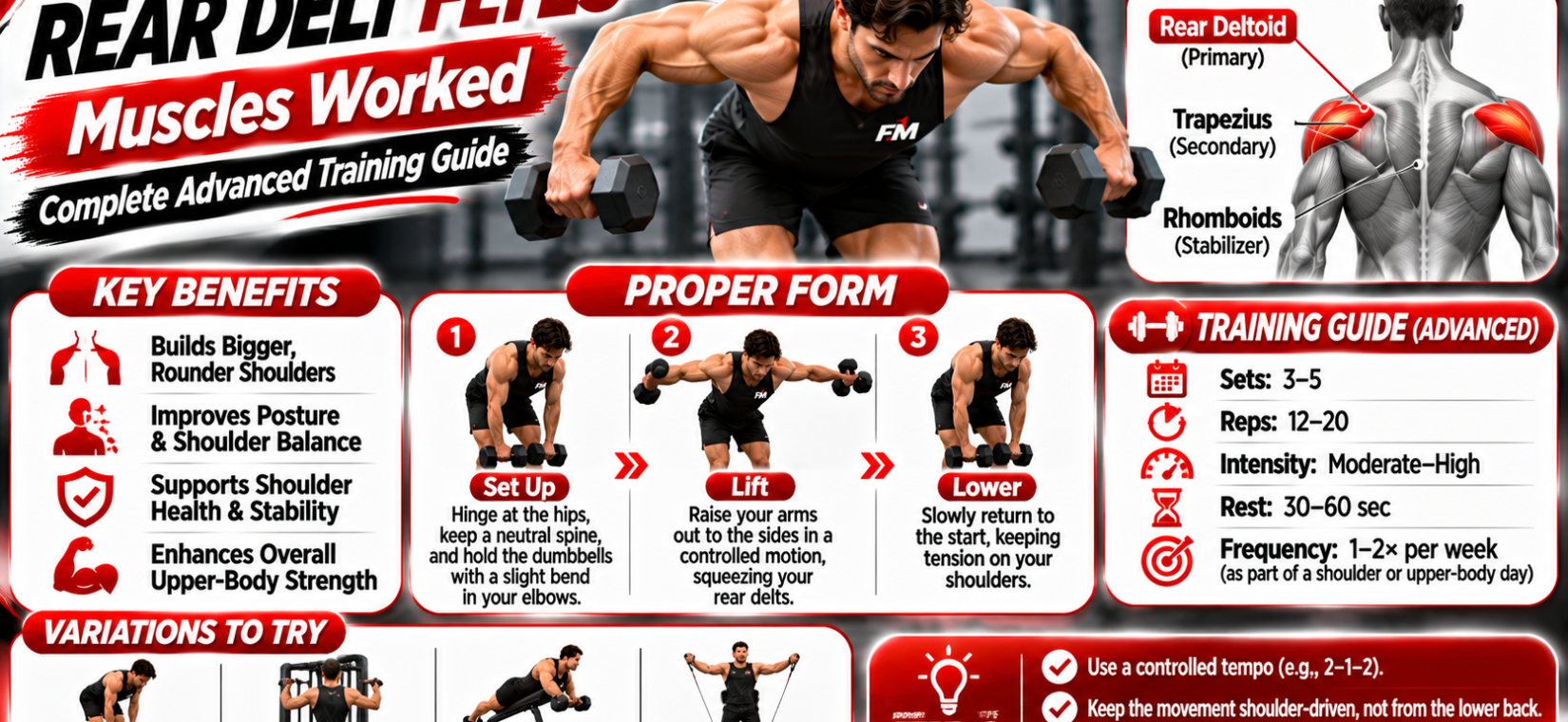
Rear delt flyes muscles worked are led by the posterior deltoid — the rear head of the shoulder — with the rhomboids, middle trapezius, and infraspinatus assisting. Performed as a bent-over or chest-supported reverse fly with light dumbbells for 12–20 reps, this isolation movement is the highest-EMG rear-delt exercise available to most lifters.
Rear Delt Flyes Muscles: Quick Answer
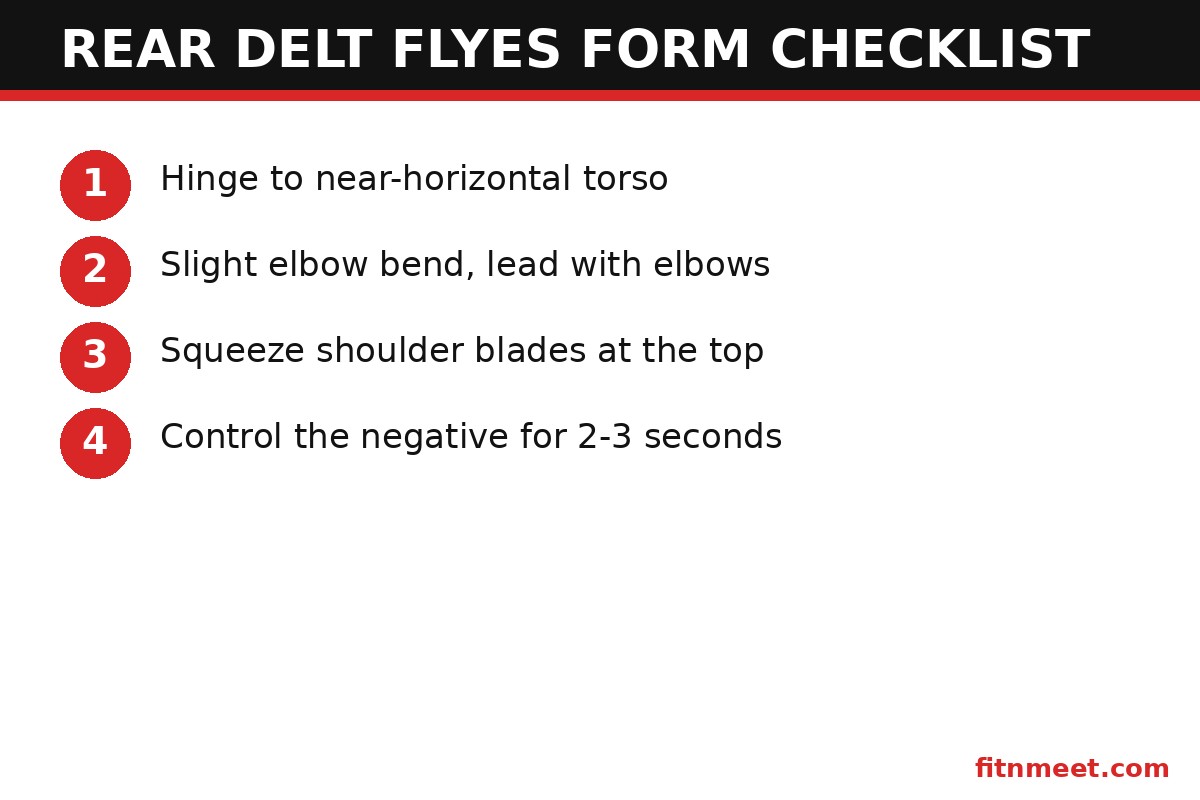
Rear delt flyes muscles worked = posterior deltoid (primary mover), rhomboids and mid-traps (scapular retractors), infraspinatus and teres minor (rotator cuff stabilizers). Hinge to near-horizontal, use a slight elbow bend, raise the weights out to the sides until arms are parallel to the floor, squeeze the shoulder blades, and lower over 2–3 seconds. Train them 2–3 times weekly for 6–12 total sets — they recover fast and respond to frequency.
Mechanisms: How Rear Delt Flyes Work
The posterior deltoid’s job is horizontal abduction — moving the arm outward and backward in the transverse plane — plus external rotation assistance. Rear delt flyes muscles are loaded through exactly this pattern: with the torso horizontal, gravity resists the arms’ arc from hanging position to parallel, placing peak tension on the posterior deltoid at the top of the rep, where the muscle is shortened. Shortened-position peak tension is somewhat unusual (most exercises peak in the lengthened position), which is one reason rear delt flyes complement pressing and rowing so well.
EMG research consistently ranks the reverse fly among the highest-activating exercises for the posterior deltoid, typically showing 80–90%+ of maximal voluntary contraction in trained lifters — outperforming rows and face pulls for pure rear-delt isolation, though those movements load more total muscle. The assisting rear delt flyes muscles matter too: the rhomboids and middle trapezius retract the scapulae at the top (the “squeeze”), and the infraspinatus stabilizes the humeral head, which is why the movement doubles as shoulder-health work. Anatomy background is on Wikipedia’s deltoid muscle page.
Why do rear delts lag in most lifters? Pressing volume (bench, overhead press) hammers the anterior deltoid 2–3× weekly while the posterior head gets whatever scraps rows provide — and rows are lat-dominant. The result is the classic front-heavy shoulder: rounded posture, weak external rotation, stalled bench. Direct rear delt flyes muscles work corrects the imbalance at its source.
Fiber type and why high reps work
The deltoid is a mixed-fiber muscle with a meaningful slow-twitch component — it is built for sustained postural work as well as explosive movement. Slow-twitch-dominant fibers respond best to higher reps and shorter rests, which is the physiological reason rear delt flyes muscles grow best in the 12–20 range rather than the 5–8 range that builds a powerlifter’s quads. Chasing heavy low-rep flyes mostly recruits the traps and rhomboids to move weight the rear delt cannot — the exact opposite of the goal. Respect the fiber type: the burn of a 20-rep set is the feeling of the right fibers doing the work.
Range of motion and the shortened-position peak
Most hypertrophy exercises load the muscle hardest when stretched (the bottom of a squat, the bottom of a curl). Rear delt flyes are unusual: with the torso horizontal, gravity’s lever arm is longest when the arms reach parallel to the floor — the fully shortened position of the posterior deltoid. Practical consequence: the top squeeze is not optional decoration, it is where the growth stimulus peaks. Pause a full second at the top of every rep. Conversely, the bottom of the rep (arms hanging) is nearly unloaded, so do not rush through it either — control the 2–3 second negative to keep tension across the whole arc.
Advanced Benefits
- 3D delt development. The posterior head provides the rear “cap” visible from behind and the side — the difference between flat shoulders and complete delts.
- Pressing performance. Strong, stable rear delts improve the shelf for squats and the lockout platform for bench; several coaches report 2.5–5 kg bench improvements after dedicated rear-delt blocks.
- Posture correction. Strengthening the scapular retractors among the rear delt flyes muscles directly counteracts desk-hunch — measurable in weeks with consistent work.
- Shoulder longevity. Balanced deltoid development plus rotator-cuff co-activation reduces impingement risk in heavy pressers.
- Mind-muscle mastery. The rear delt is notoriously hard to “feel”; high-rep flyes are the best tool for building that neural connection, which transfers to rows and pull-aparts.
Protocols: Timing, Stacking, Cycling
Advanced programming for rear delt flyes muscles uses phased blocks. Run each phase 3–4 weeks.
Phase 1 — Activation (weeks 1–3): 3 × 20 reps, very light (30–40% of what you think you can handle), 60 sec rest, performed at the start of pull day as a pre-activation. Goal: build the mind-muscle connection to the rear delt flyes muscles before adding load. Tempo: 2-0-2.
Phase 2 — Hypertrophy (weeks 4–7): 4 × 12–15 reps, moderate load (1–2 reps from failure), 90 sec rest, performed after main compounds on pull and push days (2× weekly frequency). Add a drop set on the final set: hit failure, drop 30%, rep to failure again. Tempo: 2-1-3 (accentuated negative).
Phase 3 — Intensification (weeks 8–10): 5 × 10–12 reps with rest-pause: perform 10 reps, rest 15 seconds, then max reps, rest 15 seconds, then max reps — that is one set. Train rear delt flyes muscles 3× weekly (push, pull, and a dedicated shoulder slot). Then deload one week at 50% volume before cycling back to Phase 1 with slightly heavier loads.
Stacking: where rear delt flyes sit in the session
- Before compounds (pre-exhaust): use in Phase 1 only — fatiguing rear delt flyes muscles first teaches them to fire during subsequent rows.
- After compounds (standard): the default for Phases 2–3 — main lifts get your best energy, flyes finish the job.
- Superset pairings: rear delt flyes + face pulls (mechanical drop set across movements), or flyes + band pull-aparts for a high-rep finisher burn.
- Daily micro-dosing: advanced lifters add 2 × 25 band pull-aparts on non-shoulder days — rear delt flyes muscles recover in 24–36 hours and tolerate this.
Sample specialization week (Phase 3)
- Monday (push): overhead press 4 × 6, incline dumbbell press 3 × 10, rear delt flyes 5 × 10–12 rest-pause, lateral raises 3 × 15.
- Wednesday (pull): weighted pull-ups 4 × 6, barbell row 4 × 8, rear delt flyes 4 × 12–15, face pulls 3 × 15, hammer curls 3 × 10.
- Friday (shoulders + arms): push press 5 × 5, rear delt flyes 5 × 10–12 rest-pause, cable lateral raises 4 × 12, band pull-aparts 2 × 25 finisher.
That is 14 direct sets for the rear delt flyes muscles plus rowing carryover — the top of the specialization range, sustainable for 3 weeks before a deload. Sleep 7–9 hours and eat at maintenance or a slight surplus; specialization blocks are the wrong time to cut. More equipment guides live in our strength training section.
Dosage Ranges: Sets, Reps, Load
| Goal | Sets/week | Reps | Load | Frequency |
|---|---|---|---|---|
| Activation / rehab | 4–6 | 15–25 | Very light (bands/2–5 lb) | 3×/week |
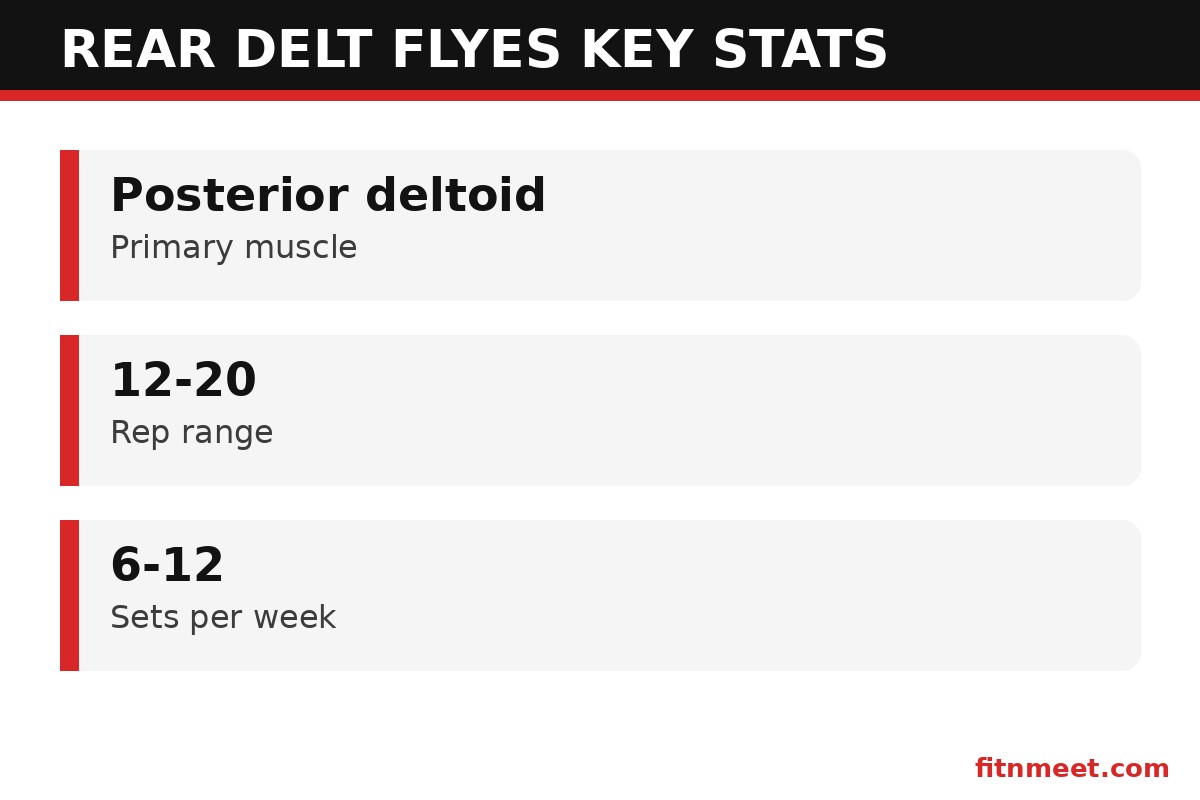
| Hypertrophy | 6–12 | 12–20 | Moderate (1–2 RIR) | 2–3×/week |
| Strength-endurance | 6–10 | 15–25 | Light–moderate | 2×/week |
| Specialization block | 12–16 | 10–20 | Moderate, intensifiers | 3×/week |
Load selection rule: if you cannot pause one second at the top with control, the weight is too heavy. Rear delt flyes muscles are small — most trained men use 10–25 lb dumbbells, most trained women 5–15 lb. Ego is the enemy; the dumbbells should look embarrassingly light to an observer. Progression: add reps first (12 → 20), then add the smallest available increment. Fueling high-frequency shoulder work draws on the same recovery resources as everything else — FitnMeet’s sports nutrition range and workout recovery collection support the grind.
Interactions and Safety
Rear delt flyes are among the safest exercises in the gym, but advanced programming introduces considerations:
- Interaction with pressing volume: heavy bench/overhead work plus high-frequency rear delt flyes muscles work can overtax the shoulder joint’s total workload. If pressing stalls or aches appear, cut flye volume before cutting compounds.
- Interaction with rowing: rows already hit the rear delt flyes muscles secondarily — count 3 hard sets of rows as roughly 1 set of direct rear-delt work when totaling weekly volume, or you will overshoot into junk volume.
- Neck compensation: the classic form fault is shrugging the traps to move the weight. Cue: “neck long, shoulders away from ears.” If your upper traps are fried after flyes, the load bypassed the target.
- Rotator cuff aggravation: lifters with impingement should use chest-supported variations (incline bench, prone) and keep the range to pain-free arcs — the supported position removes the lower-back and momentum variables.
- Elbow position: fully straight arms shift stress to the elbow joint; maintain a soft 10–20 degree bend throughout.
Rear Delt Flyes vs Alternatives
| Exercise | Rear-delt isolation | Equipment | Learning curve | Best use |
|---|---|---|---|---|
| Dumbbell rear delt flyes | Highest | Dumbbells | Moderate | Pure hypertrophy, anywhere |
| Face pulls | High | Cable | Easy | Cuff health + rear delts |
| Reverse pec deck | Very high | Machine | Easy | Supported isolation, beginners |
| Wide-grip rows | Moderate | Barbell/cable | Moderate | Back thickness + rear delts |
| Band pull-aparts | High | Band | Easy | Warm-ups, micro-dosing |
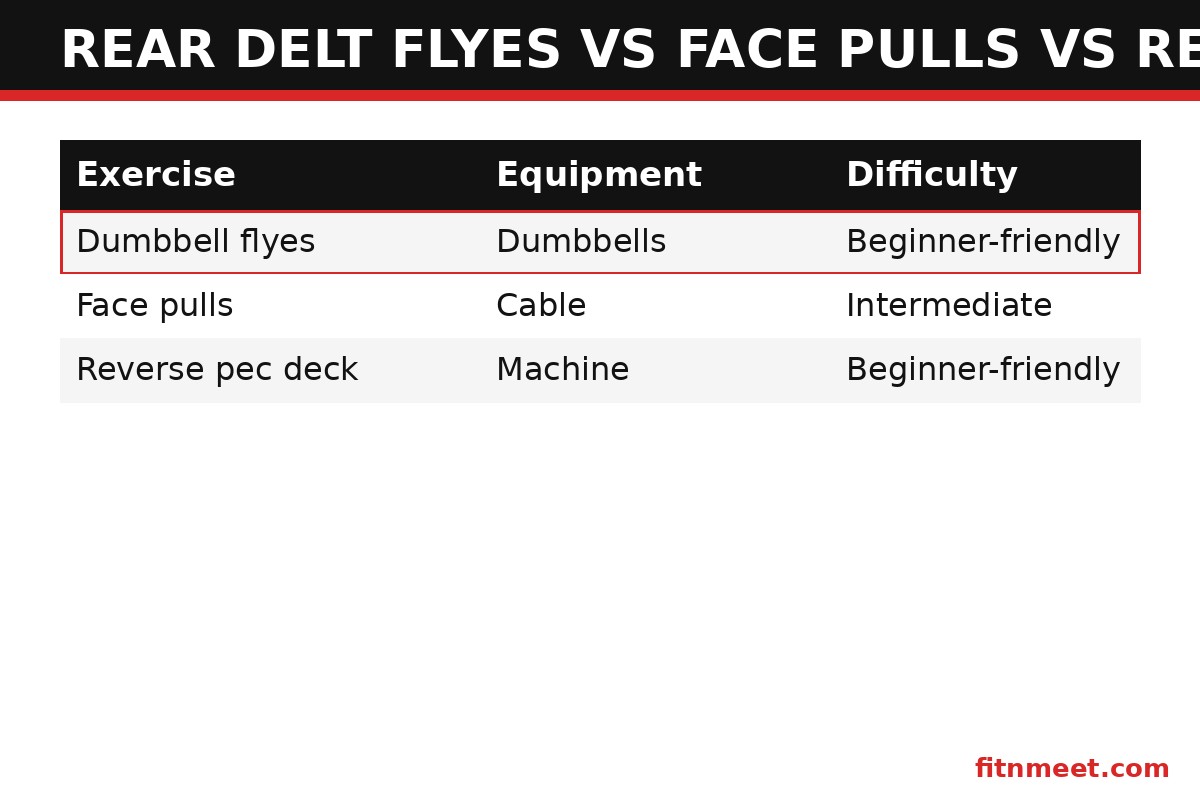
The expert stack: dumbbell rear delt flyes as the primary hypertrophy driver, face pulls for cuff health and variety, band pull-aparts for daily activation. The reverse pec deck is the best substitute when dumbbell form breaks down — the machine’s fixed path enforces the pattern. Rotator-cuff mechanics background is on Wikipedia’s rotator cuff page.
Frequently Asked Questions
What muscles do rear delt flyes work?
Rear delt flyes muscles worked are the posterior deltoid as the primary mover, with the rhomboids, middle trapezius, infraspinatus, and teres minor assisting in scapular retraction and shoulder stabilization.
How many sets of rear delt flyes per week?
For hypertrophy, 6 to 12 direct sets per week across 2 to 3 sessions is the evidence-based range. Count about 3 hard rowing sets as 1 set of direct rear delt work to avoid overshooting total volume.
What is the best rep range for rear delt flyes?
12 to 20 reps works best for most lifters. The rear delt is a small muscle that responds to controlled, high-rep work; going too heavy turns the movement into a trap-dominant heave.
Are rear delt flyes better than face pulls?
For pure rear delt isolation, flyes edge out face pulls in EMG studies. Face pulls are superior for rotator cuff health and are easier to learn. Advanced lifters should program both.
Why can’t I feel my rear delts during flyes?
The most common causes are too much weight, shrugging the traps, and an insufficient hinge. Drop the weight by half, hinge until your torso is near horizontal, keep your neck long, and pause one second at the top of each rep.
Should rear delt flyes be done before or after compounds?
Usually after, so main lifts get your best energy. The exception is a pre-activation phase, where light flyes before rows teach the rear delts to fire during the compound movement.
Can you do rear delt flyes every day?
Light band variations can be done near-daily since the rear delt flyes muscles recover in 24 to 36 hours. Heavy dumbbell flyes should be limited to 2 to 3 sessions weekly with at least a day between hard sessions.
Conclusion
Rear delt flyes muscles respond to what the rest of your training ignores: light loads, high reps, high frequency, and ruthless form standards. Run the phased protocol — activation, hypertrophy, intensification — dose 6–12 sets weekly, keep the weights embarrassingly light, and watch your shoulders gain the rear cap that pressing alone never builds. The posterior deltoid is small, but in the architecture of a complete physique and a healthy shoulder, it is load-bearing.
Serious about the specialization block? Shop FitnMeet’s training nutrition and explore the muscle development collection to fuel 10 weeks of focused rear-delt growth.
This article is for informational purposes only and is not medical advice. Consult a healthcare professional before starting a new resistance training program, especially with pre-existing shoulder conditions.