
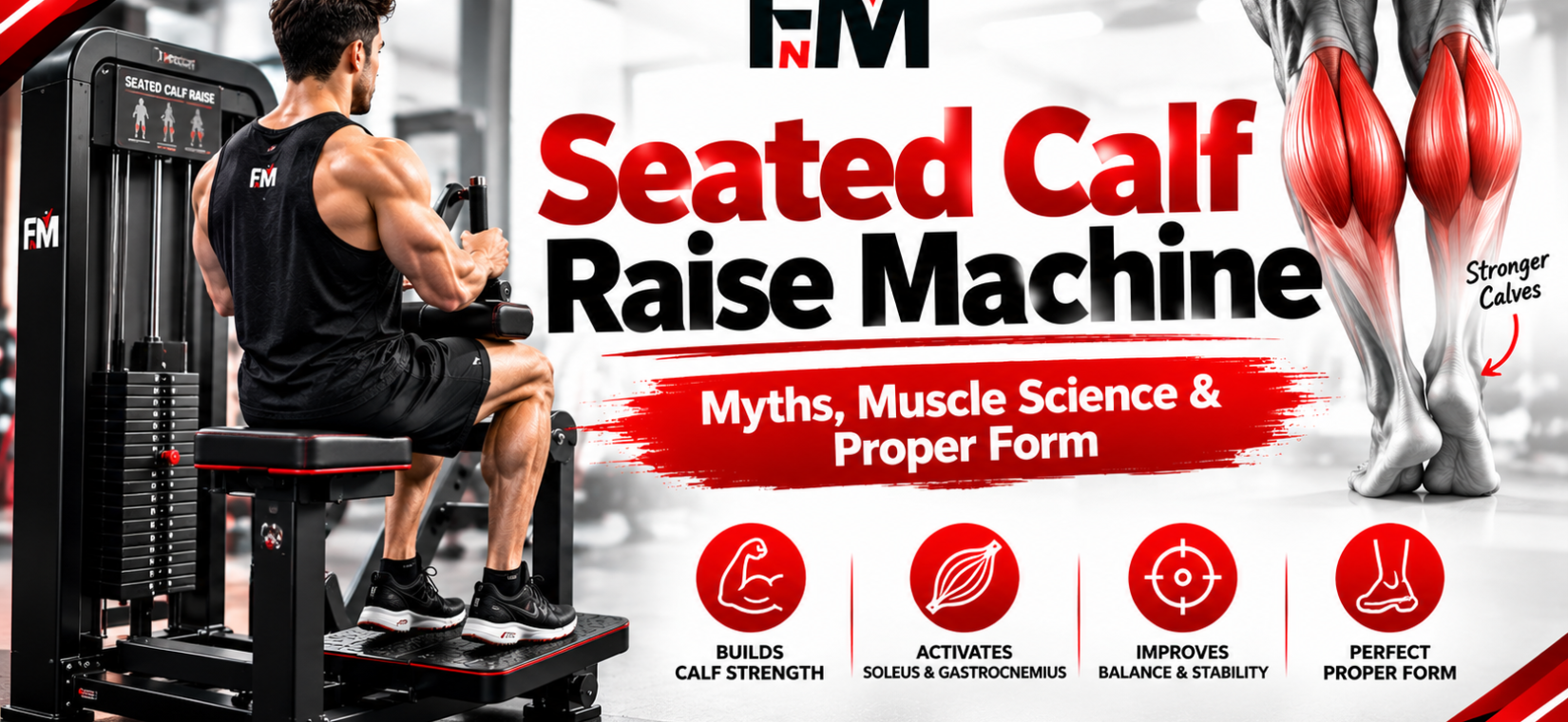
A seated calf raise machine is a lever machine that trains the calf muscles with the knees bent at 90 degrees, placing the load on weight plates or a stack resting on the thighs. Because the bent-knee position de-emphasizes the gastrocnemius, the seated calf raise machine primarily targets the deeper soleus muscle — the endurance engine of the lower leg.
Quick Answer: Do You Need It?
If your program already includes heavy standing calf work, a seated calf raise machine is the missing half of complete calf development — it targets the soleus, which standing work undertrains. If you do no direct calf work at all, adding the seated calf raise machine twice weekly is one of the simplest upgrades you can make to lower-leg strength, ankle resilience, and yes, calf size. Ten focused minutes, twice a week, is the entire investment.
5 Myths About the Seated calf raise machine — Debunked
Myth 1: “Calves are 100% genetics — training is pointless”
✗ Myth: Your calf size is entirely predetermined, so the seated calf raise machine can’t change anything.
✓ Fact: Genetics set the ceiling and the shape (muscle belly length, insertion points), but training moves you toward that ceiling. Studies on calf training show measurable hypertrophy — typically 5–10% increases in muscle thickness over 8–12 weeks of progressive training — even in “hardgainer” calves. Genetics explain why your calves aren’t huge, not why they can’t improve.
Myth 2: “Seated and standing calf raises work the same muscle”
✗ Myth: A calf raise is a calf raise — the seated calf raise machine is redundant if you do standing raises.
✓ Fact: Knee position changes everything. The gastrocnemius crosses the knee joint, so bending the knee to 90 degrees (as on the seated calf raise machine) puts it in active insufficiency — slackened and mechanically disadvantaged. The soleus, which doesn’t cross the knee, takes over. EMG research confirms: bent-knee raises shift the workload decisively toward the soleus. You need both positions for complete development. Read about the two muscles on Wikipedia’s soleus page and gastrocnemius page.
Myth 3: “Calves only respond to super high reps”
✗ Myth: You must do 50–100 reps per set or calves won’t grow.
✓ Fact: The soleus is indeed slow-twitch dominant (roughly 80% type I fibers), which is where the high-rep lore comes from. But hypertrophy research across muscle groups shows growth occurs across a wide rep range provided sets are taken close to failure. The practical answer: the seated calf raise machine works well in both moderate (10–15) and high (20–30) rep ranges — what matters is progressive overload and a full stretch, not a magic rep number.
Myth 4: “Running and walking train the calves enough”
✗ Myth: Runners don’t need the seated calf raise machine — mileage covers it.
✓ Fact: Running maintains calf endurance but rarely provides progressive overload — your body weight doesn’t increase as you adapt. Runners are actually a prime audience for the seated calf raise machine: stronger soleus muscles correlate with better running economy and fewer overuse injuries, and targeted strength work addresses what mileage alone can’t. More training explainers live in our fitness section.
Myth 5: “Half reps with heavy weight build bigger calves”
✗ Myth: Load up the seated calf raise machine and bounce out short reps for mass.
✓ Fact: Bouncing bypasses the deep stretch position where the soleus experiences the most growth-stimulating tension. Controlled reps with a 2-second pause in the deep stretch outperform heavier partial reps for hypertrophy in the limited research comparing ranges of motion. Leave the ego at the weight tree.
What Is a Seated calf raise machine?
This seated calf raise machine is simple: you sit with the balls of your feet on a platform, knees bent at 90 degrees, and a padded lever loaded with plates (or connected to a stack) rests across your lower thighs just above the knees. You press through the balls of your feet to raise your heels as high as possible, then lower them into a deep stretch below platform level. The seated calf raise machine’s pivot geometry keeps resistance aligned through the ankle’s range of motion.
Anatomically, the bent-knee position is the whole point. With the knee flexed, the two-headed gastrocnemius — the visible “calf muscle” — goes slack because it originates above the knee. The soleus, a broad flat muscle lying underneath that attaches below the knee, becomes the prime mover. The soleus is a postural endurance muscle: it fires all day during standing and walking, resists fatigue remarkably well, and contributes heavily to ankle stability and push-off power. FitnMeet’s strength training guides explain how small-muscle accessories like this fit into a complete program.
It’s worth appreciating just how much work the soleus does outside the gym. During walking, the soleus generates a large share of the forward-propulsion force — biomechanics studies attribute roughly half of the ankle’s positive work in walking to the soleus. During standing, it’s the primary muscle preventing you from toppling forward, firing continuously in a quiet, fatigue-resistant manner. This is why the seated calf raise machine punches above its apparent simplicity: you’re directly strengthening a muscle that works harder in daily life than almost any other in your body, yet receives almost no targeted training from typical gym programs built around squats, presses, and pulls.
Benefits of Seated Calf Training
- Complete calf development. The gastrocnemius gets plenty of work from standing raises and even squats; the soleus gets almost none. This seated calf raise machine fills the gap — training both heads of the calf is what builds full, balanced lower legs.
- Ankle resilience. A stronger soleus stabilizes the ankle joint during cutting, landing, and uneven terrain. Ankle sprains are among the most common sports injuries, and calf strength is a modifiable risk factor.
- Running economy. The soleus contributes more to forward propulsion in distance running than most runners realize. Strengthening it can improve running efficiency — free speed from ten minutes of machine work.
- Posture and balance. The soleus is a key postural muscle, constantly active during standing. Strengthening it supports balance, particularly valuable for older adults — see the National Institute on Aging’s exercise guidance.
- Achilles tendon health. Progressive calf loading is the cornerstone of Achilles tendinopathy rehab protocols. The controlled, seated position allows precise loading without balance demands.
- Better mind-muscle connection for stubborn calves. Many lifters struggle to “feel” their calves working during standing raises because balance and body English take over. The seated calf raise machine removes those distractions — you’re pinned in, the path is fixed, and all your attention goes to the contraction. That improved connection often translates to better activation and, over time, better growth in a muscle group famous for being hard to develop.
How to Use the Seated calf raise machine: Do This, Not That
- ✓ Do this: Place the balls of your feet on the platform edge, heels hanging free, so you can lower into a full stretch.
- ✗ Not that: Feet flat in the middle of the platform — you lose half the range of motion.
- ✓ Do this: Position the thigh pads just above the knees, snug but not crushing.
- ✗ Not that: Pads mid-thigh — the lever arm changes and the load shifts uncomfortably.
- ✓ Do this: Rise all the way onto the balls of your feet, pause 1 second at the top, lower over 2–3 seconds into a deep stretch, pause 1–2 seconds at the bottom.
- ✗ Not that: Bouncing through short, fast reps — the Achilles tendon does the work and the soleus gets a free ride.
- ✓ Do this: Keep knees fixed at 90 degrees throughout — no leg pressing the weight up.
- ✗ Not that: Straightening the knees to “help” — that shifts work to the quads and defeats the purpose of the seated calf raise machine.
- ✓ Do this: Start with a weight you can control for 15 clean reps.
- ✗ Not that: Maxing the stack on day one — calf cramps and Achilles irritation are the usual reward.
Sets, Reps and Programming
The soleus recovers quickly and tolerates frequency well. A proven framework:
| Goal | Sets | Reps | Tempo | Frequency |
|---|---|---|---|---|
| Hypertrophy | 3–4 | 12–20 | 1-1-3 (up-pause-down) | 2–3×/week |
| Strength | 4–5 | 8–12 | 1-2-3 | 2×/week |
| Endurance/rehab | 2–3 | 20–30 | 2-1-2 | 3×/week |
Place seated calf work at the end of lower-body sessions — fatigued calves won’t compromise your squats if you do calves last, but the reverse isn’t true. Progress by adding a small plate or 2–3 reps per set each week. Because the soleus is so fatigue-resistant, don’t fear training it often; 2–3 sessions weekly is the sweet spot for most. Support your training with solid nutrition from FitnMeet’s muscle development and recovery collections.
Side Effects and Safety
- Calf cramping. Extremely common on this seated calf raise machine, especially in the deep stretch with new trainees. Stay hydrated, ensure adequate dietary sodium and potassium, warm up with a light set, and build volume gradually.
- Achilles irritation. Aggressive deep stretching under heavy load can irritate the Achilles tendon. If you feel sharp pain (not stretch discomfort) at the back of the ankle, reduce the depth and load, and progress more slowly.
- Foot cramps. Gripping the platform with your toes causes foot cramps. Keep toes relaxed and drive through the ball of the foot.
- Knee discomfort. The thigh pads shouldn’t cause knee pain. If they do, check pad placement (just above the knee, not on it) and reduce the load.
- Balance of training. The seated calf raise machine alone neglects the gastrocnemius — pair it with straight-knee calf work (standing raises, leg-press calf presses) for complete development.
Frequently Asked Questions
What muscle does the seated calf raise machine work?
The seated calf raise machine primarily targets the soleus, the deep calf muscle beneath the gastrocnemius. Bending the knee to 90 degrees slackens the gastrocnemius (which crosses the knee joint), shifting the workload to the soleus.
Is the seated calf raise machine better than standing?
Neither is better; they target different muscles. The seated version emphasizes the soleus, while standing (straight-knee) raises emphasize the gastrocnemius. Complete calf development requires both positions.
How many reps should I do on the seated calf raise machine?
For muscle growth, 3 to 4 sets of 12 to 20 reps with a controlled tempo works well. For strength, 4 to 5 sets of 8 to 12 reps. Always include a pause in the deep stretch position rather than bouncing.
Why do my calves cramp on the seated calf raise machine?
Calf cramping is very common, especially for beginners. Causes include dehydration, low electrolytes, and jumping into heavy volume too fast. Hydrate well, warm up with a light set, and increase volume gradually over several weeks.
Can the seated calf raise machine help runners?
Yes. The soleus is a major contributor to running propulsion, and stronger calves are associated with better running economy and fewer overuse injuries. Two short sessions per week complement any running program.
How often can I train calves?
The soleus recovers quickly thanks to its slow-twitch, fatigue-resistant fiber makeup. Two to three sessions per week is ideal for most people; place calf work at the end of lower-body workouts.
Conclusion
The the seated calf raise machine isn’t redundant, isn’t pointless for “bad genetics,” and isn’t interchangeable with standing raises — it’s the only common machine that truly isolates the soleus, the endurance workhorse of your lower leg. Ten minutes twice a week with full range of motion and controlled tempo builds ankle resilience, running economy, and calves that actually grow. Myths busted, science clear, program simple. Ready to train smarter? Browse FitnMeet’s shop for training essentials and recovery support.
This article is for informational purposes only and is not medical advice. Consult a qualified coach or healthcare professional before starting a new training program.