
Testosterone pills are dietary supplements formulated with vitamins, minerals, and plant extracts intended to support the body’s natural testosterone production. Evidence for testosterone pills is mixed: a few ingredients show modest effects in clinical trials, but no over-the-counter pill reliably raises testosterone like prescription therapy, and quality varies widely between products.
Testosterone Pills: Quick Answer
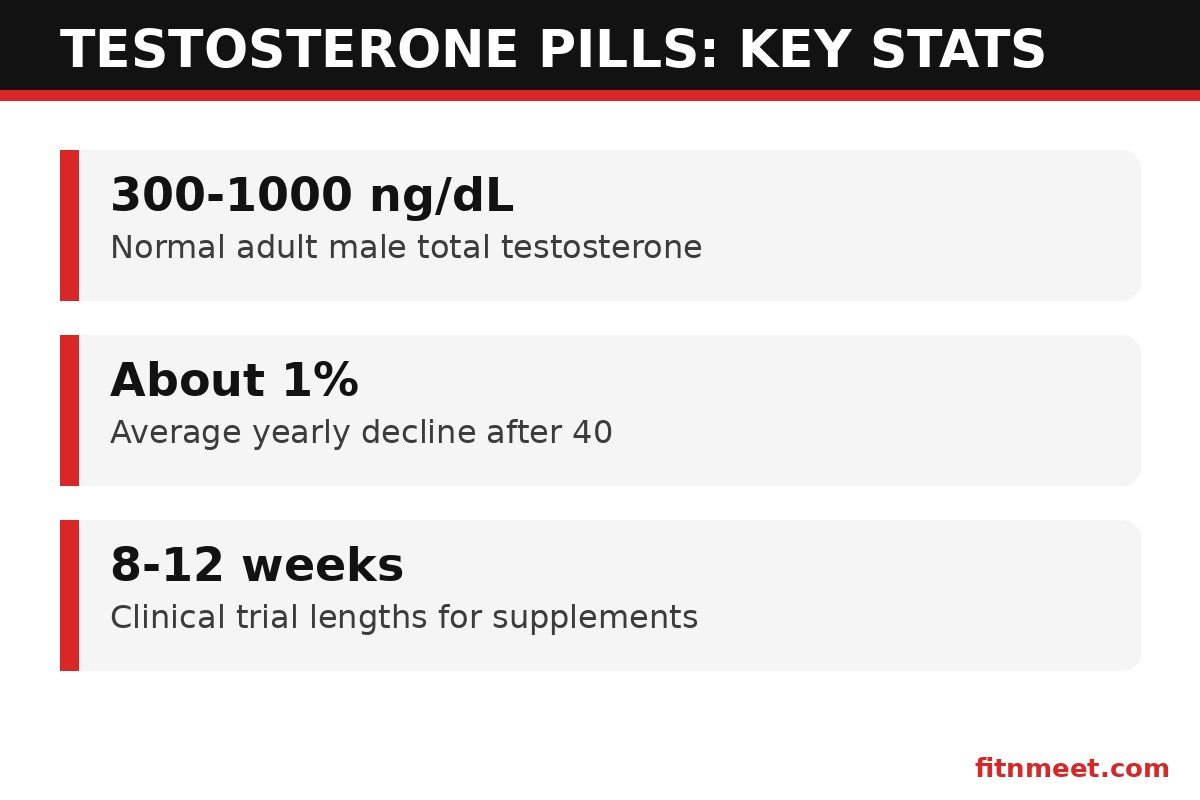
Here is the honest summary before we go deeper. Most testosterone pills combine a handful of well-known ingredients — vitamin D, zinc, magnesium, D-aspartic acid, ashwagandha, and fenugreek — at doses that roughly match what small clinical trials have tested. In those trials, effects are modest: single-digit to low-double-digit percentage increases in men who started with low or borderline levels, typically over 8 to 12 weeks. Men with already-normal testosterone generally see little to no change. That is the realistic frame for everything that follows.
Pro tip: Get a morning blood test before you consider any testosterone pills. Without a baseline total and free testosterone reading, you cannot tell whether a product did anything — and you may be fixing a problem you do not have.
What Are Testosterone Pills?
Testosterone pills are over-the-counter dietary supplements — capsules, tablets, or softgels — marketed to support healthy testosterone levels. They are not testosterone itself: unlike prescription testosterone replacement therapy (TRT), which supplies the hormone directly, these pills contain nutrients and botanicals thought to nudge the body’s own production, reduce conversion to estrogen, or free up bound testosterone.
The most common ingredients fall into three groups. Micronutrients: vitamin D, zinc, and magnesium — all involved in hormone synthesis, and all commonly under-consumed. Correcting a genuine deficiency can restore levels toward normal, which is where most of the “it worked for me” stories come from. Amino-acid derivatives: D-aspartic acid (DAA), an amino acid concentrated in the pituitary and testes that plays a role in luteinizing hormone release. Botanicals: ashwagandha, fenugreek, and tribulus terrestris, each with a small and uneven evidence base.
Did you know? Under the U.S. Dietary Supplement Health and Education Act of 1994, supplement makers do not need FDA approval before selling testosterone pills. The FDA’s dietary supplement page explains that the agency acts against unsafe or mislabeled products after they reach the market — which is why third-party testing matters so much.
Because regulation is light, label accuracy is a real concern. Independent analyses of sports supplements have repeatedly found products containing less of the listed ingredient than claimed — or unlisted substances entirely. When evaluating testosterone pills, the manufacturer’s transparency (published certificates of analysis, third-party seals) matters as much as the formula.
Why Testosterone Matters
Testosterone is the primary male sex hormone, though women produce it too in smaller amounts. In men it drives muscle protein synthesis, bone density, red blood cell production, libido, and aspects of mood and cognition. The clinical reference range for total testosterone in adult men is roughly 264 to 916 ng/dL, based on harmonized assay data published by Travison and colleagues in 2017 and adopted in Endocrine Society guidelines.
Levels peak in the late teens and twenties, then decline about 1 percent per year from around age 30 to 40 onward. By 60, a meaningful share of men sit near or below the bottom of the reference range. Low testosterone — clinically defined with both symptoms and repeatedly low morning blood levels — is associated with reduced muscle mass, increased body fat, fatigue, low libido, and depressed mood. But fatigue and low motivation have dozens of causes, which is why blood work, not guesswork, should start the conversation about testosterone pills.
Step-by-Step Guide to Using Testosterone Pills
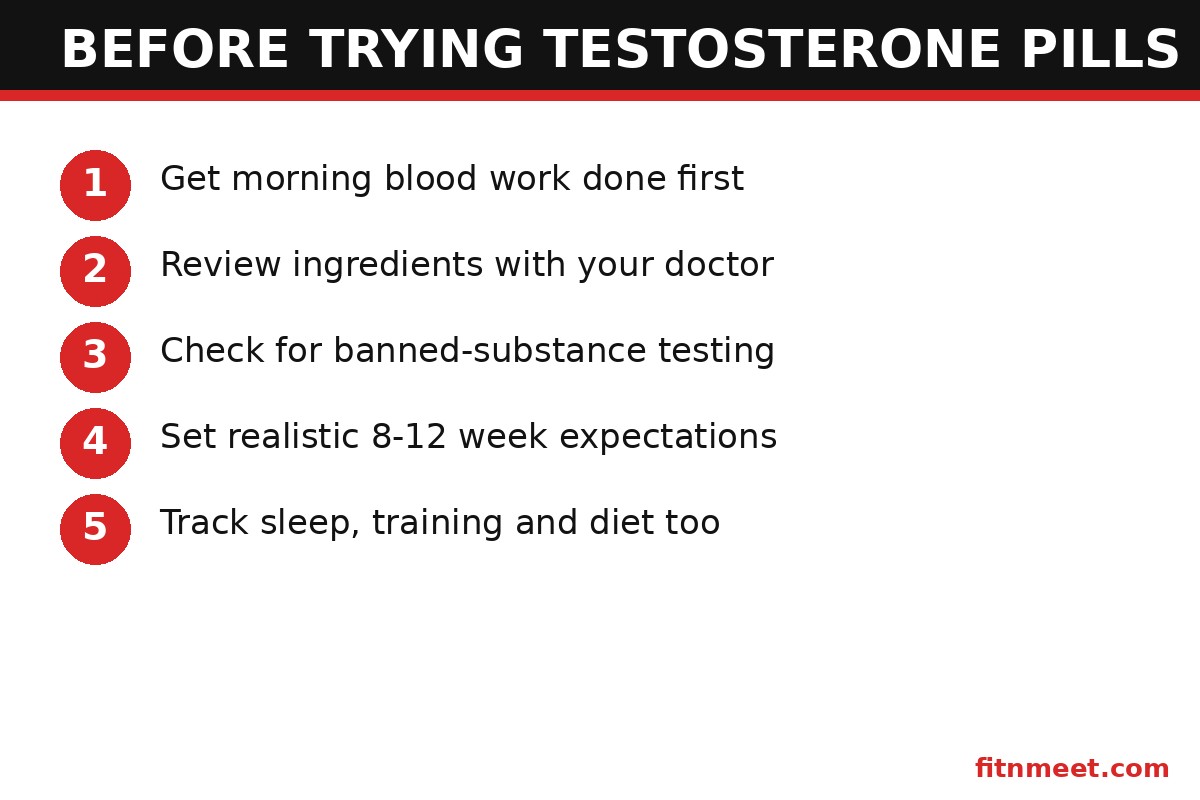
If you and your doctor decide a trial of testosterone pills is reasonable, follow this sequence:
- Get baseline blood work. Test total testosterone, free testosterone, LH, and estradiol in the morning (levels peak before 10 a.m.). Record the numbers.
- Fix the foundations first. For 4 weeks before starting any pills, lock in 7 to 9 hours of sleep, adequate calories, and 3 to 4 weekly strength sessions. Poor sleep alone can suppress morning testosterone by 10 to 15 percent.
- Choose one product with transparent dosing. Pick testosterone pills that list every ingredient amount (no proprietary blends), use doses matching published trials, and carry third-party testing certification.
- Run a defined 8- to 12-week trial. This matches the duration of most published ingredient trials. Take the product exactly as directed, at the same time daily.
- Track subjective and objective markers. Log energy, libido, training performance, and body weight weekly. Subjective changes without lab changes are usually placebo — which is fine to know honestly.
- Re-test at the end. Repeat the same morning blood panel. Compare against baseline. A meaningful response is a consistent rise into or toward the normal range, not a 5 percent wiggle within lab error.
- Decide with your doctor. If labs and symptoms improved, discuss continuing. If nothing changed, stop — doubling the dose or stacking more pills rarely helps and raises risk.
Pro tip: Change nothing else during your trial. If you simultaneously start a new diet, training program, and sleep schedule, you will never know whether the testosterone pills did anything.
Dosage and Usage
There is no universal dose for testosterone pills because formulas differ, but published trials give reference points for the main ingredients:
- Vitamin D3: 2,000 to 4,000 IU daily if blood levels are low; the well-known Pilz 2011 trial used 3,332 IU daily for a year in deficient men.
- Zinc: 15 to 30 mg daily; higher chronic doses can deplete copper, so more is not better.
- Magnesium: 200 to 400 mg daily, preferably in the evening; glycinate and citrate forms are well tolerated.
- D-aspartic acid: around 3 grams daily, matching the Topo 2009 trial that reported a 42 percent rise over 12 days in men with low-normal levels.
- Ashwagandha root extract: 600 mg daily of a standardized extract, matching Lopresti 2019, which reported a 14.7 percent testosterone increase over 8 weeks in overweight men aged 40 to 70.
- Fenugreek: 500 to 600 mg daily of standardized extract in most trials.
Take fat-soluble ingredients (vitamin D) with a meal containing some fat. Consistency beats timing for everything else — the same time each day, with or without food as the label directs. And critically: a product is only as good as its dose. Many such pills sprinkle fashionable ingredients at fractions of studied amounts; if the label hides doses inside a “proprietary blend,” treat every claim on the bottle as unverified.
Potential Benefits
Stated carefully, the plausible benefits of testosterone pills are:
- Correcting deficiency-driven suppression: the strongest case. Men deficient in vitamin D or zinc who supplement back to sufficiency often see testosterone normalize — the pill is fixing a deficiency, not supercharging a healthy system.
- Modest increases in borderline men: D-aspartic acid and ashwagandha trials show the largest effects in men starting low, with gains fading in men who already test normal.
- Libido and energy support: some trials report improved self-rated libido and vitality scores, though these subjective measures are the most placebo-prone outcomes in the literature.
- Body composition support: any genuine testosterone increase supports muscle protein synthesis, but the magnitude from pills is small compared to training, protein intake, and sleep.
- Stress and cortisol balance: ashwagandha’s best-supported effect is actually cortisol reduction (around 15 to 30 percent in stressed adults), which indirectly favors a healthier testosterone-to-cortisol ratio.
Did you know? The NIH Office of Dietary Supplements notes that no dietary supplement has convincing evidence for raising testosterone in healthy, non-deficient men. Check their fact sheets before believing dramatic label claims.
Your shopping checklist for testosterone pills: ☐ every ingredient dose listed (no blends) · ☐ doses match published trials · ☐ third-party testing seal · ☐ no “proprietary matrix” language · ☐ realistic label claims · ☐ money-back guarantee. Start with the foundations — browse FitnMeet’s vitamins collection for the basics like vitamin D and zinc.
Mistakes to Avoid
- Skipping blood work. The number-one mistake. Without labs you are guessing, and guessing with hormones is how people waste money or miss real medical issues.
- Expecting steroid-like results. Testosterone pills are not anabolic steroids and will never produce steroid-like changes. Anyone promising that is selling, not informing.
- Stacking multiple products. Combining two or three testosterone pills multiplies the risk of excessive zinc, vitamin D, or herbal doses while making it impossible to tell what worked.
- Ignoring sleep and body fat. Losing 5 to 10 percent of body weight and fixing sleep apnea raise testosterone more reliably than any pill, because excess adipose tissue converts testosterone to estrogen via aromatase.
- Buying on hype ingredients. Tribulus terrestris is the classic example: massively marketed for testosterone, with human trials consistently showing no effect on testosterone levels.
- Staying on forever without re-testing. If 12 weeks of testosterone pills changed nothing on labs, month 6 will not be different. Reassess instead of auto-renewing.
Testosterone Pills vs Other Approaches
| Approach | Evidence strength | Typical effect size | Medical supervision |
|---|---|---|---|
| Testosterone pills | Mixed, small trials | 0–15% in deficient men | Recommended |
| Prescription TRT | Strong, large trials | Restores to normal range | Required |
| Sleep optimization | Strong | 10–15% from fixing deficit | Not needed |
| Fat loss (if overweight) | Strong | Significant per 10% lost | Advised |
| Resistance training | Strong | Acute spikes; modest chronic | Not needed |
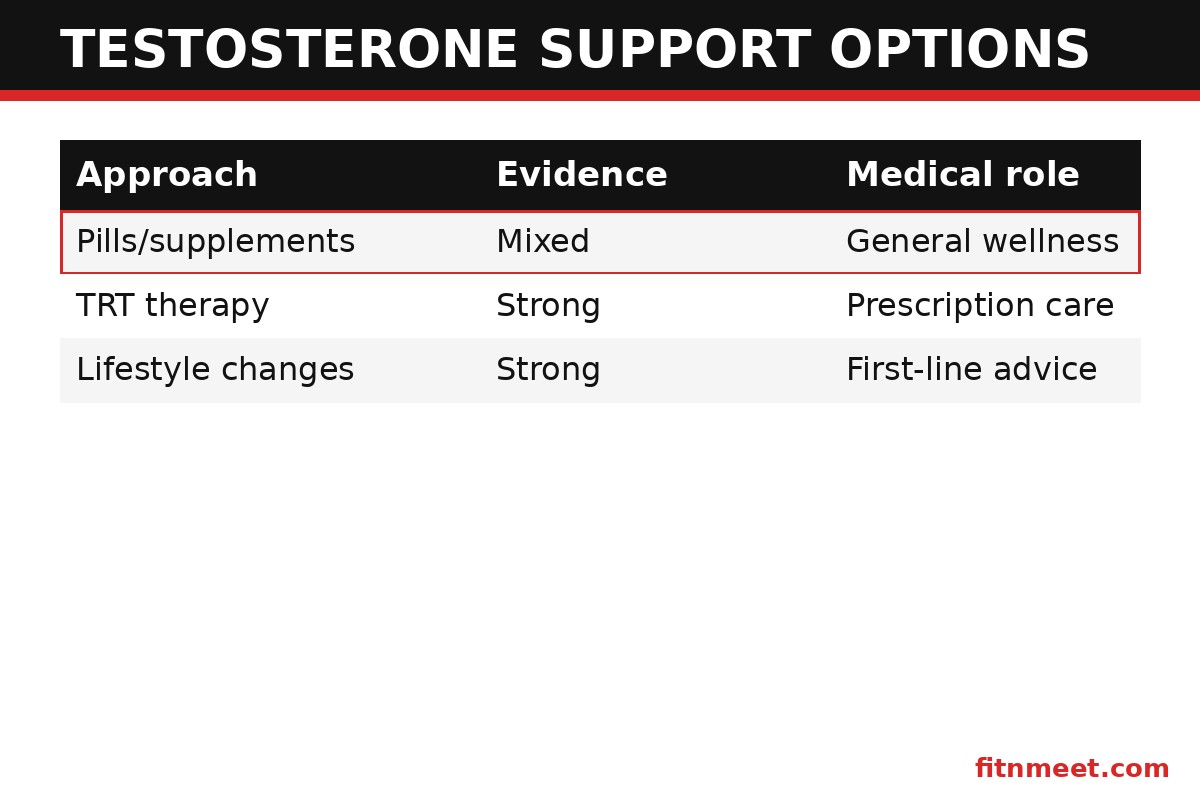
The pattern is clear: the free interventions (sleep, training, fat loss) outperform testosterone pills on evidence, and prescription therapy outperforms everything for genuinely low clinical levels. Pills occupy a middle lane — reasonable to try for borderline cases, but never the first or only move. For general wellness foundations, see FitnMeet’s health support range and the FitnMeet blog for training guides. For evidence-based guidance on those foundational habits, browse the FitnMeet health articles.
Side Effects and Safety
Testosterone pills are generally well tolerated at label doses, but “natural” does not mean risk-free. Reported side effects include digestive upset (especially zinc on an empty stomach), headaches, and sleep disturbance if stimulating ingredients are taken late. High-dose zinc over months can cause copper deficiency and lower HDL cholesterol; high-dose vitamin D can raise blood calcium.
Specific cautions: men with prostate conditions should discuss any hormone-targeting supplement with their urologist. D-aspartic acid’s long-term safety data is thin beyond 12 weeks. Athletes subject to drug testing should note that some “testosterone booster” products have been found adulterated with actual prohormones — another reason to demand third-party testing. Anyone on prescription medication, especially blood thinners or hormone therapies, needs a pharmacist or physician review for interactions before starting testosterone pills.
Frequently Asked Questions
Do testosterone pills actually work?
Testosterone pills can modestly raise testosterone in men who are deficient in key nutrients like vitamin D or zinc, or who start with low-normal levels. Effects in published trials range from zero to about 15 percent over 8 to 12 weeks. Men with already-normal levels typically see no meaningful change.
How long do testosterone pills take to work?
Most ingredient trials run 8 to 12 weeks, and that is a realistic window to judge testosterone pills. D-aspartic acid trials have shown changes in as little as 12 days, while botanicals like ashwagandha are typically studied over 8 weeks. Re-test blood levels at 12 weeks.
Are testosterone pills safe?
Testosterone pills from reputable makers are generally safe at label doses, with mild digestive upset the most common complaint. Risks rise with megadosing, stacking multiple products, or buying from sellers without third-party testing. Discuss use with your doctor first.
Can testosterone pills replace TRT?
No. Testosterone pills cannot replace prescription testosterone replacement therapy for clinically diagnosed low testosterone. TRT directly restores hormone levels under medical supervision; pills offer at best modest support and are not a treatment for hypogonadism.
What ingredients should testosterone pills contain?
Look for testosterone pills with transparent doses of vitamin D3, zinc, magnesium, D-aspartic acid (around 3 g), or standardized ashwagandha (600 mg) — the ingredients with actual human trial data. Avoid proprietary blends that hide individual doses.
Do I need a blood test before taking testosterone pills?
Yes. A morning blood test for total and free testosterone establishes your baseline, reveals whether you actually have low levels, and lets you objectively judge whether testosterone pills did anything after 8 to 12 weeks.
Can women take testosterone pills?
Women produce testosterone too, but testosterone pills are formulated and studied almost entirely in men. Women considering hormone-support supplements should work with their doctor, since even modest androgen increases can cause unwanted effects.
Conclusion
Testosterone pills are neither miracle nor scam — they are modestly-evidenced supplements that help some men, mostly those starting low or deficient, and do little for everyone else. If you try them, do it properly: baseline blood work, one transparent product, a 12-week trial, then re-test and decide with your doctor. And never skip the free wins — sleep, training, and body composition — which outperform any pill. For foundational nutrition that supports healthy hormone function, browse FitnMeet’s shop.
Disclaimer: This article is for informational purposes only and is not medical advice. Consult a healthcare professional before starting any supplement, especially products that affect hormones.