
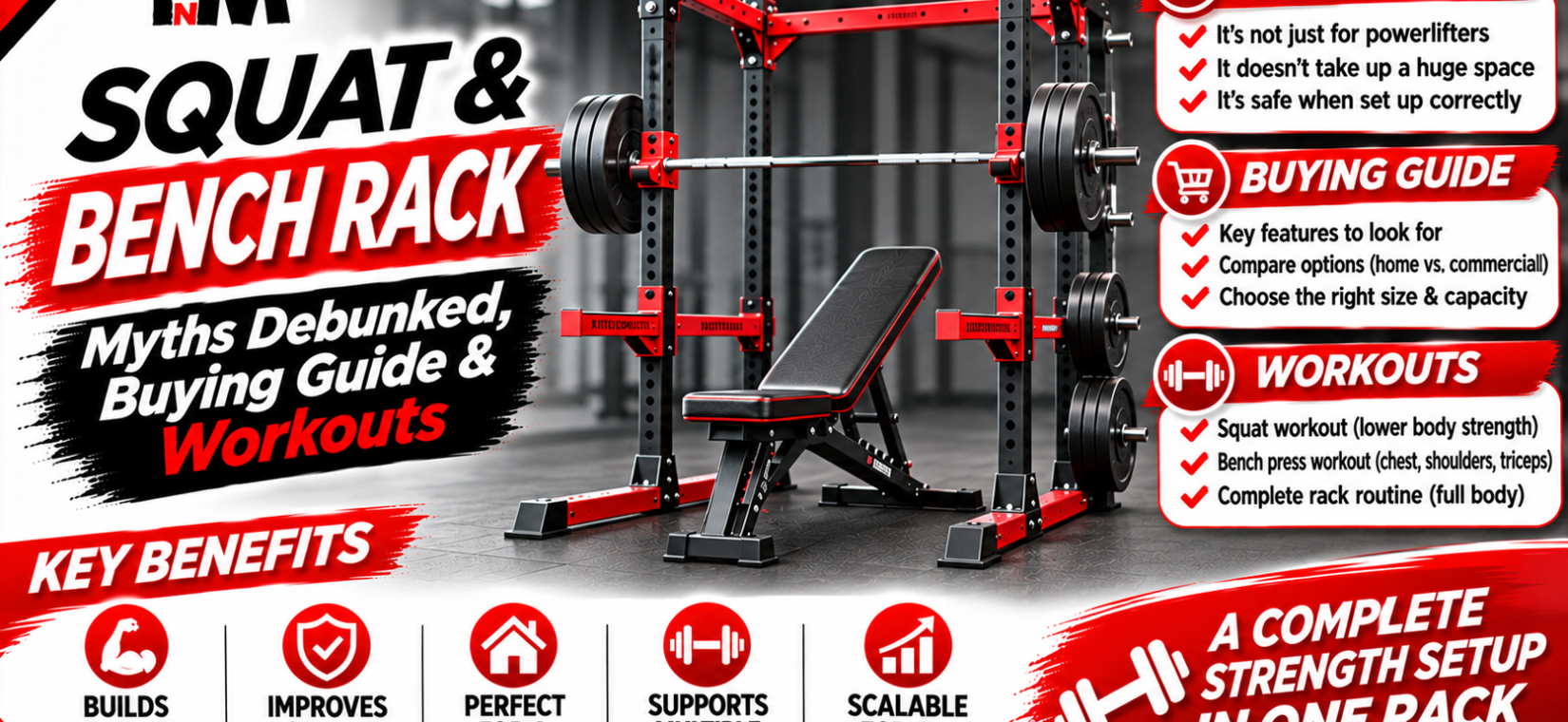
A squat and bench rack is a compact home-gym frame that combines adjustable squat stands with a bench-press station, letting you perform squats, bench presses, overhead presses, and rows in one footprint. Quality models support 200–300 kg, cost $150–$400, and fit in about 1.5 square meters — making them the most space-efficient way to barbell train at home.
Squat and Bench Rack: Quick Answer
The rack is the Swiss Army knife of home barbell training: two uprights with adjustable J-hooks for squats, a bench-press position (either integrated or with a separate bench slid in), and safety spotter arms that catch failed reps. Buy one rated for at least 50 kg more than you will ever lift, with 50×50 mm or 60×60 mm uprights and Westside hole spacing (2.5 cm) through the bench zone. Expect to pay $150–$400 for a solid unit. Avoid no-name racks with vague weight ratings — the rating is the single most honest spec on the box.
6 Myths vs Facts About the Squat and Bench Rack
More bad advice circulates about racks than about any other gym equipment. Let us clear the air.
Myth 1: “A squat and bench rack is just a cheap power rack.”
✗ Myth: They are the same thing, so buy whichever is cheaper.
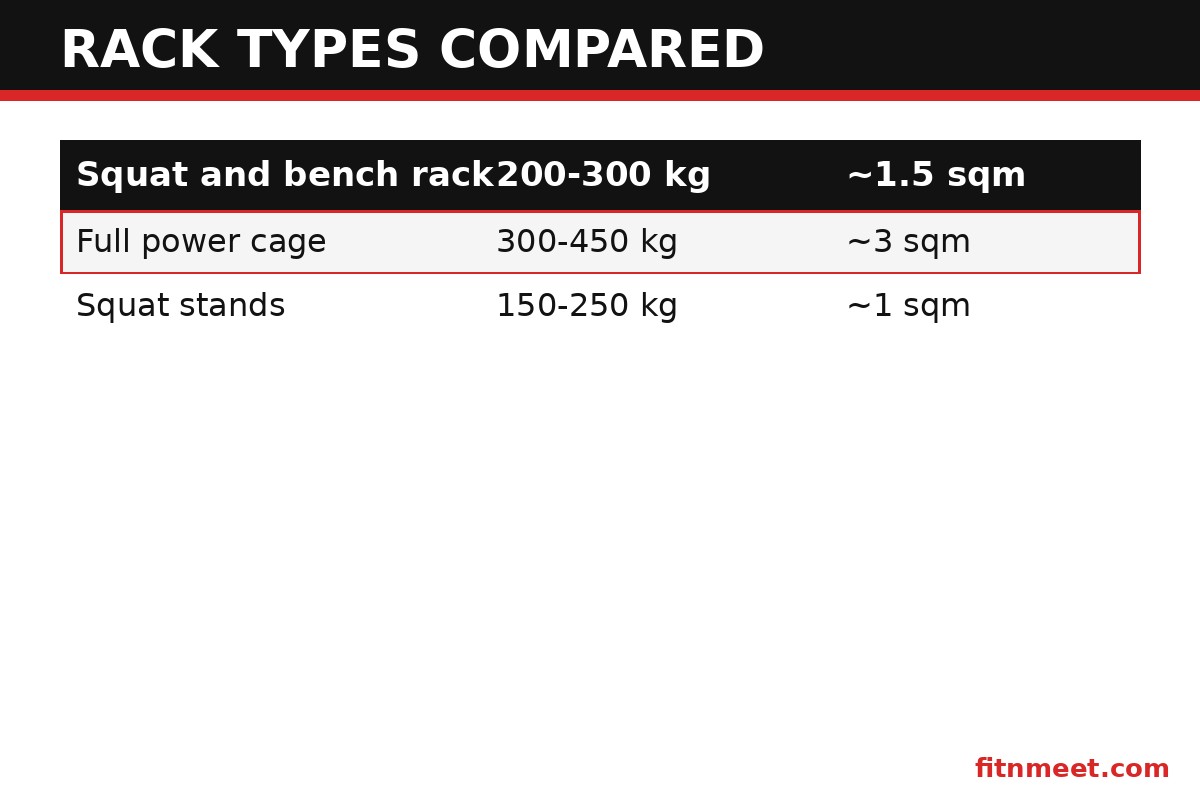
✓ Fact: A power rack is a four-post cage you lift inside; a squat and bench rack is typically a two-post or half-rack design optimized for squats and bench pressing in less space. The combo rack trades the cage’s all-around safety for a 40–50% smaller footprint and lower price. Different tools, different jobs.
Myth 2: “You cannot lift heavy on a squat and bench rack.”
✗ Myth: Combo racks are toys for light weights.
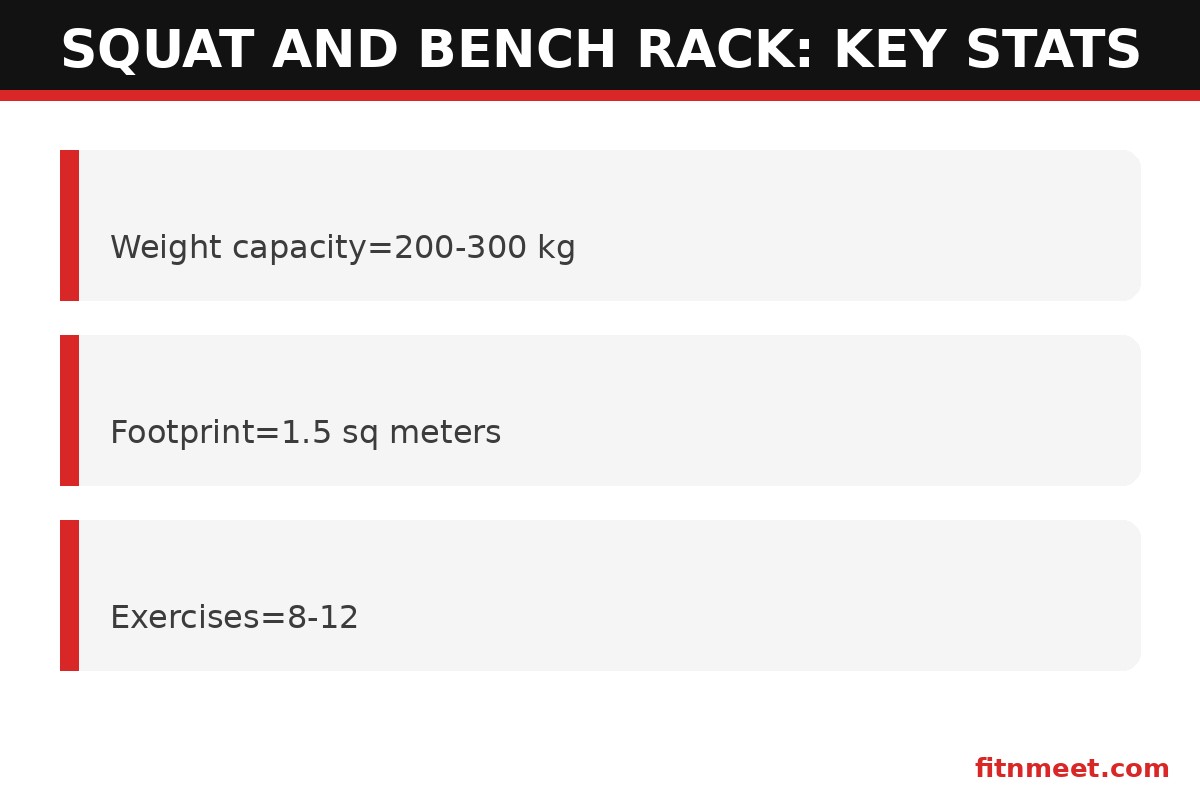
✓ Fact: Quality units are rated 200–300 kg, which covers everyone up to advanced lifters. The limitation is not strength but exercise variety: you cannot do rack pulls from mid-shin or pin presses as easily as in a full cage. For squats and bench — the rack’s actual job — capacity is a non-issue.
Myth 3: “Spotter arms make training alone totally safe.”
✗ Myth: Set the safeties and lift with zero worry.
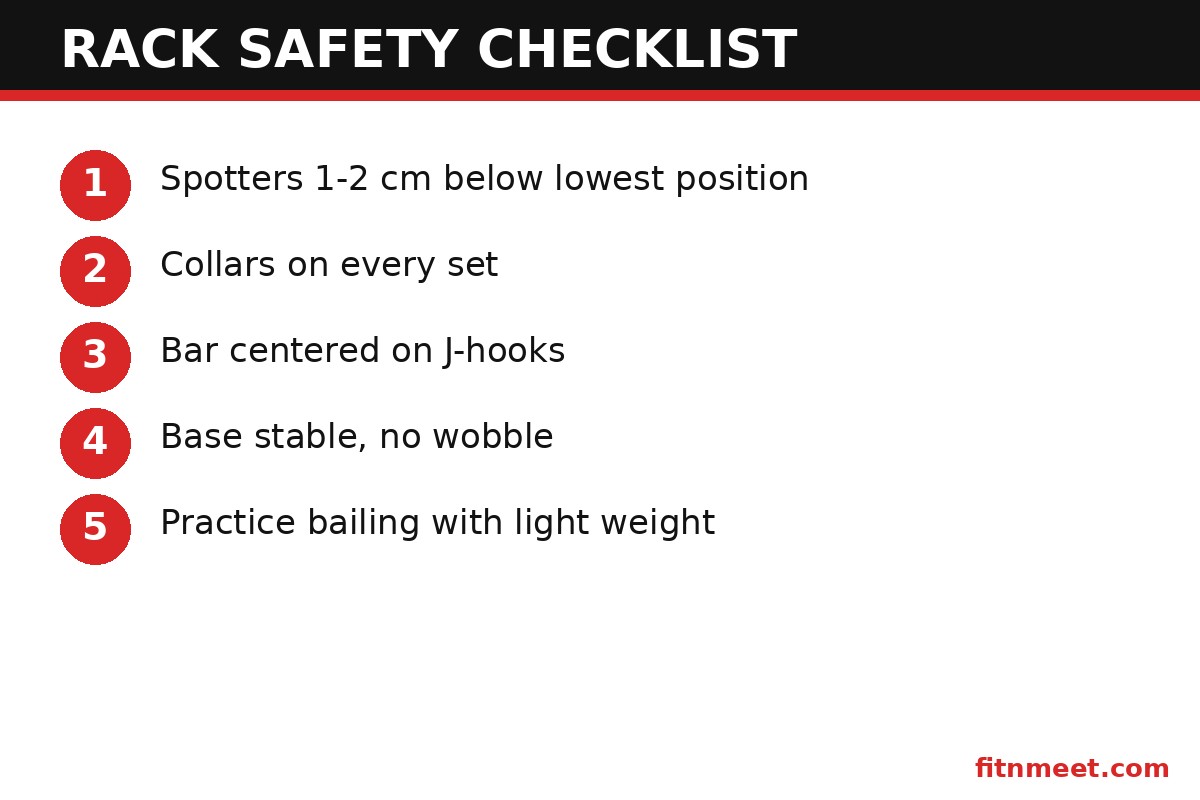
✓ Fact: Spotter arms on a squat and bench rack catch the bar — but only if set correctly (1–2 cm below your lowest position) and only for straight down failures. They do not help if you lose balance forward or the bar rolls. Safeties reduce risk dramatically; they do not eliminate it. Stat line: most home-gym barbell injuries involve either no safeties or safeties set at the wrong height.
Myth 4: “Any cheap rack is fine for a beginner.”
✗ Myth: Beginners lift light, so rack quality does not matter yet.
✓ Fact: Beginners are the most likely to dump a bar awkwardly, miss a re-rack, or outgrow equipment fast. A wobbly $90 squat and bench rack with a fantasy “500 lb capacity” sticker is more dangerous than a $250 unit with honest specs. Stat line: beginners typically add 2.5–5 kg to the bar weekly — a cheap rack gets outgrown in 6–12 months, while a good one lasts a decade.
Myth 5: “The rack is only good for squats and bench.”
✗ Myth: The name says it all — two exercises.
✓ Fact: A squat and bench rack handles overhead press (seated or standing), barbell rows, rack pulls, pin squats, close-grip bench, incline press (with an adjustable bench), and even band-resisted work anchored to the base. Most owners end up doing 8–12 different exercises on theirs. The name undersells it.
Myth 6: “You need a full home gym before buying a rack.”
✗ Myth: Wait until you can afford everything at once.
✓ Fact: A squat and bench rack plus a barbell and plates is a home gym for 80% of training goals. Add a bench and you cover every major barbell movement. Buying the rack first and expanding later beats waiting a year to “do it properly.” Stat line: squat, bench, row, and overhead press together train every major muscle group — four movements, one rack.
What Is a Squat and Bench Rack?
Now that the myths are cleared, here is the straight definition. A squat and bench rack is a steel frame — usually two uprights on a stable base, sometimes a half-rack with rear stabilizers — designed to hold a barbell at adjustable heights for squats and to pair with a flat or adjustable bench for bench pressing. Key components (the bench press itself is detailed at Wikipedia’s bench press article):
- Uprights: vertical steel tubes, ideally 50×50 mm or larger with 11-gauge (3 mm) walls. Hole spacing of 2.5 cm through the bench-press zone allows precise J-hook placement; wider spacing above and below is fine.
- J-hooks: the cups that hold the bar. Look for UHMW plastic lining — it protects your bar’s knurling and quiets re-racking. Cheap bare-steel hooks chew up bars.
- Spotter arms: horizontal safety arms that catch a failed rep. On a squat and bench rack these are essential, not optional — this is what makes solo training viable.
- Bench integration: some combo units include a bench; most assume you supply your own. A flat bench works; an adjustable bench unlocks incline pressing.
- Base: wide feet or a full base frame for stability. A squat and bench rack should not wobble when you re-rack 100 kg with normal (not gentle) force.
The barbell squat is one of the most studied resistance exercises — Wikipedia’s squat article details the biomechanics — and the rack exists to make it safely loadable at home. Pair your rack knowledge with general programming ideas from FitnMeet’s fitness articles.
Benefits of the rack
- Barbell training at home. The squat and bench press are the two highest-value lifts for total-body strength. A squat and bench rack brings both home for the price of a few months of gym membership.
- Space efficiency. At ~1.5 m², a squat and bench rack uses less than half the floor space of a full power cage while covering 80% of the same exercises.
- Solo-training safety. Properly set spotter arms mean you can train heavy alone — the number-one concern that keeps people paying for commercial gyms.
- Progressive overload, simplified. Adding 2.5 kg to the bar weekly on a squat and bench rack is the simplest proven strength program in existence. No apps required.
- Longevity. A quality steel squat and bench rack has no moving parts to wear out. Ten to twenty years of service is normal — the cost per workout rounds to pennies.
- Resale value. Good racks hold 50–70% of their value used. It is one of the few fitness purchases that is also a decent asset.
Myth-debunk stat line: lifters who train the big barbell lifts on a home squat and bench rack 3×/week gain strength at essentially the same rate as commercial-gym lifters in controlled comparisons — the bar does not know where it lives.
How to Use It: Do This, Not That
- ✅ Do set spotter arms 1–2 cm below your deepest position — test with an empty bar first. ❌ Not eyeball it under load.
- ✅ Do center the bar on the J-hooks every set; walk it out with short, even steps. ❌ Not take five staggering steps backward on your squat and bench rack.
- ✅ Do use collars on every set. A sliding plate mid-squat is how bars tip off the rack. ❌ Not skip collars “because it is light.”
- ✅ Do bench with feet flat, a slight arch, and shoulder blades pinched. ❌ Not bench with feet on the bench — it is unstable and most racks’ benches are not designed for it.
- ✅ Do re-rack by walking forward until the bar touches the uprights, then lowering. ❌ Not heave the bar backward hoping the hooks catch.
- ✅ Do bolt down or weigh the base if your squat and bench rack rocks during re-racks. ❌ Not accept wobble as “normal.”
- ✅ Do learn to bail a squat safely (push the bar backward onto the spotters) with light weight first. ❌ Not discover bailing technique during a true max attempt.
Myth-debunk stat line: practicing the bail with 40–60 kg takes 10 minutes and eliminates the panic response that causes most failed-rep injuries on a squat and bench rack.
Training Scheme: Sets, Reps, and Progression
Your “dosage” on a combo rack follows the same principles as any barbell program. This table gives starting schemes by level:
| Level | Squat | Bench press | Frequency | Progression |
|---|---|---|---|---|
| Beginner | 3×5 | 3×5 | 3×/week (alternating) | +2.5 kg per session |
| Intermediate | 4×6 or 5×5 | 4×6 or 5×5 | 2–3×/week | +2.5 kg weekly |
| Advanced | 5×3–5 (periodized) | 5×3–5 (periodized) | 2×/week each | Monthly PRs |
A classic beginner week on a squat and bench rack: Monday — squat 3×5, bench 3×5, rows 3×8; Wednesday — squat 3×5 (lighter), overhead press 3×5, deadlift 1×5; Friday — squat 3×5, bench 3×5, rows 3×8. That is the skeleton of the most successful novice programs ever written, and it needs nothing but a squat and bench rack, a bar, plates, and a bench. For more ready-made programs built around the big barbell lifts, browse the FitnMeet strength training category.
Myth-debunk stat line: beginners adding 2.5 kg per session typically double their squat in 4–6 months. The squat and bench rack does not limit you — impatience does. When linear progression stalls, switch to weekly progression rather than program-hopping.
Support your barbell work with proper fueling: adequate protein (1.6–2.2 g/kg) and creatine monohydrate are the two most evidence-backed recovery aids. Browse FitnMeet’s muscle development collection for training essentials that complement your the rack. For meal plans built around heavy barbell training days, explore the FitnMeet nutrition articles.
Safety and Side Effects of Getting It Wrong
Barbell training is safe — safer than most team sports by injury rate — but the injuries that do happen on a squat and bench rack follow predictable patterns:
- Failed reps without safeties. The catastrophic scenario (bar on neck during bench) is almost entirely preventable: set spotter arms correctly, every session, no exceptions. Never bench heavy on a squat and bench rack without safeties or a spotter.
- Lower-back strain from form breakdown. Squats with a rounded lower back under load stress spinal discs. Film your sets from the side monthly; if your back rounds, drop 10% and rebuild.
- Shoulder impingement from benching. Flaring elbows to 90° on every rep irritates shoulders. Tuck to ~45–60° and touch the bar to the lower chest/sternum, not the neck.
- Wrist pain. Letting the bar sit in the fingers during squats or bending wrists back on bench loads small joints. Keep wrists straight and the bar over the forearm bones.
- Dropped plates. Always use collars, load plates evenly, and never leave a loaded bar unattended on the J-hooks of your squat and bench rack where kids or pets roam.
Myth-debunk stat line: in gym injury surveys, the bench press accounts for a disproportionate share of serious home-gym incidents — and virtually all involved missing or misused safeties. Your squat and bench rack’s spotter arms are the most important feature you will hopefully never need.
Squat and Bench Rack FAQs
What is a squat and bench rack?
A squat and bench rack is a compact steel frame with adjustable J-hooks for barbell squats that pairs with a bench for bench pressing. It typically includes safety spotter arms, supports 200–300 kg, and fits in about 1.5 square meters — the most space-efficient way to barbell train at home.
Is a squat and bench rack the same as a power rack?
No. A power rack is a four-post cage you lift inside; a squat and bench rack is a more compact two-post or half-rack design focused on squats and bench pressing. The combo rack uses 40–50% less floor space and costs less, while a cage offers more exercise variety and all-around safety.
How much weight can a squat and bench rack hold?
Quality models are rated for 200–300 kg total. Buy a squat and bench rack rated at least 50 kg above the maximum you will ever lift, and treat vague or missing ratings as a red flag — honest capacity specs are the mark of a trustworthy manufacturer.
Can I bench press alone on a squat and bench rack?
Yes, if you set the spotter arms correctly — 1–2 cm below your chest at the bottom of the rep, tested with an empty bar first. Never bench heavy without safeties or a human spotter. Safeties catch straight-down failures but do not protect against losing balance.
What exercises can I do on a squat and bench rack?
Squats, bench press (flat and incline with an adjustable bench), overhead press, barbell rows, rack pulls, close-grip bench, pin squats, and band-resisted variations. Most owners regularly use 8–12 different exercises on their squat and bench rack.
How much space do I need for a squat and bench rack?
About 1.5 square meters of floor space plus room to load plates on the bar (roughly 2.2 m wide total) and ceiling height for overhead pressing — ideally 2.4 m or more. Measure your space before ordering; returning a 60 kg steel frame is no fun.
Should a beginner buy a squat and bench rack?
Yes — beginners benefit most from simple, safe barbell training, and a squat and bench rack plus bar, plates, and bench covers every major lift. Do not buy the cheapest option; beginners outgrow flimsy racks in 6–12 months and are most likely to need the safeties.
This article is for informational purposes only and is not medical advice. Consult a healthcare professional before starting any supplement or exercise program.
Conclusion
Strip away the myths and a squat and bench rack is beautifully simple: honest steel, honest ratings, and the two most productive lifts in strength training. Buy for capacity and stability, set your safeties every session, progress patiently, and your squat and bench rack will still be serving you in a decade. The bar does not know where it lives — but your consistency will know you brought it home.
Ready to build your setup? Browse FitnMeet’s shop for strength training essentials to pair with your squat and bench rack.