
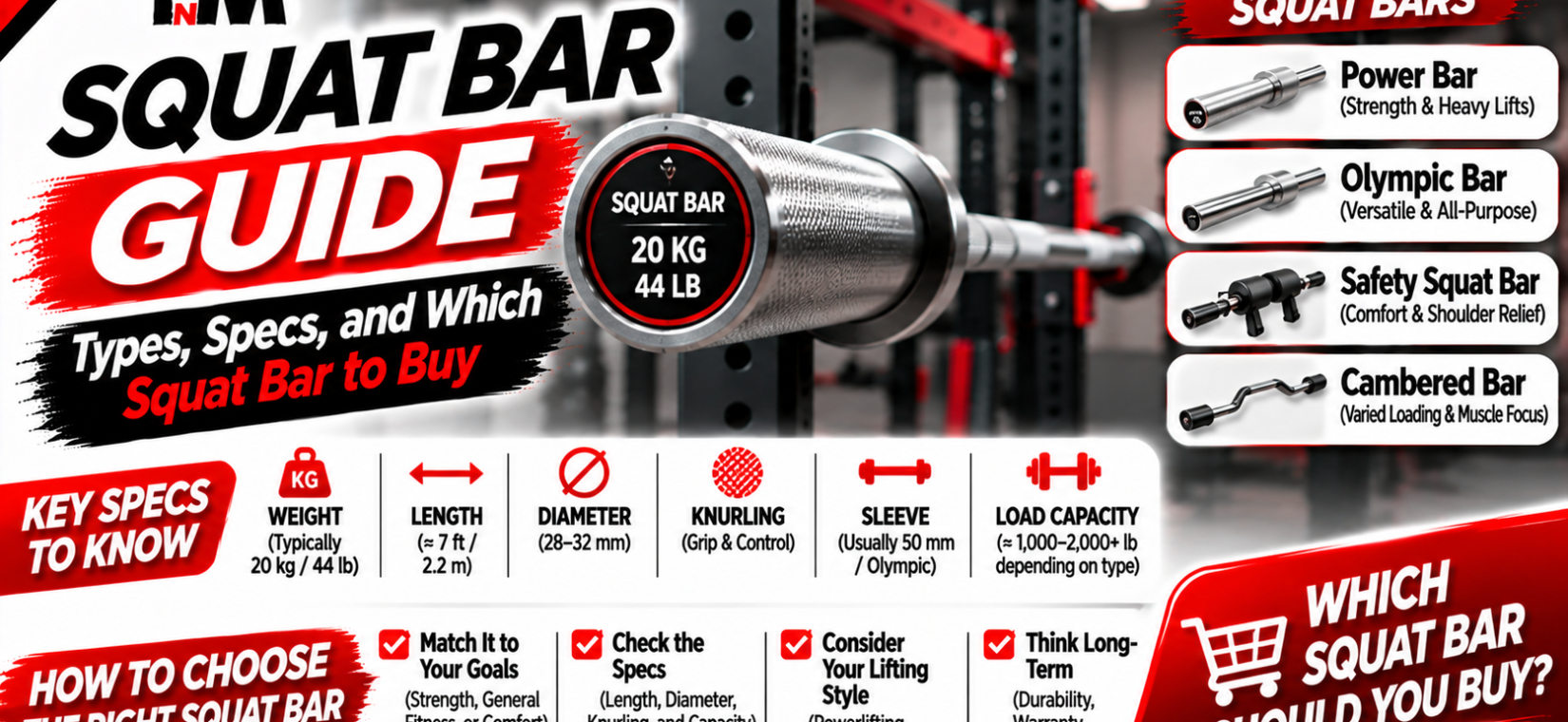
A squat bar is a barbell designed for back squats. The main types are the standard Olympic barbell (20 kg, 28 mm shaft), the thicker powerlifting bar (25 kg, 32 mm), and the safety squat bar — a cambered, padded bar with handles shifting load toward the upper back and quads.
✅ Our pick for most lifters: a quality 20 kg Olympic squat bar with 190k+ PSI tensile strength. It squats, benches, deadlifts, and presses — one bar for everything until you are squatting heavy enough to need specialization.
✗ Skip the specialty bar if: you are a beginner (under 1 year of consistent training), your gym already provides barbells, or your squat is under ~140 kg. Specialty bars solve problems most lifters do not have yet.
Quick Verdict: Which Squat Bar?
Short on time? Here is the decision in 60 seconds:
- General training, home gym, one bar for everything → 20 kg Olympic bar. The standard 2.2 m, 28 mm shaft bar handles squats, presses, deadlifts, and Olympic lifts. Buy the best tensile strength (190,000+ PSI) your budget allows.
- Competitive powerlifter squatting 200 kg+ → powerlifting-spec bar. The 25 kg, 32 mm shaft with center knurling barely flexes under maximal loads and grips a low-bar position like it is glued on.
- Shoulder pain, upper-back weakness, or quad emphasis → safety squat bar (SSB). The cambered, padded yoke with front handles lets you squat heavy without wrenching your shoulders into external rotation.
- Beginner or budget-limited → any straight Olympic-style bar. Technique and progressive overload matter 100x more than bar specialization at this stage.
The rest of this guide proves those verdicts with specs, tables, and the decision logic — so you buy your bar once, correctly.
What Is a Squat Bar?
A squat bar is any barbell used for the back squat — but in gym language, “squat bar” usually means one of the specialized designs that differ from a generic barbell in shaft thickness, knurling, whip, or shape. To choose well, you need to understand the four designs that matter.
1. The Olympic barbell (the default bar). The international standard men’s bar weighs 20 kg, measures 2.2 m long, and has a 28 mm shaft diameter; the women’s bar is 15 kg, 2.01 m, with a 25 mm shaft. It has moderate “whip” (elastic flex) and knurl marks but typically no center knurl on basic models. For 90% of lifters, this is the one — it is the bar on the rack at virtually every commercial gym in the world. You can read the full specification history on Wikipedia’s barbell page.
2. The powerlifting squat bar. Built to IPF-adjacent specs: 25 kg (55 lb), a thick 32 mm shaft, and aggressive knurling including a center knurl that bites into your upper back. The thick shaft dramatically reduces whip, so 250 kg feels stable instead of oscillating. The trade-off: 32 mm is fatiguing to grip for deadlifts and unusable for Olympic lifts, which is why this bar lives in powerlifting gyms, not general ones.
3. The safety squat bar (SSB). The most distinctive design: the bar cambers (bends) forward at the shoulders, dropping the weight plates slightly in front of your center of gravity, with a padded yoke resting on your traps and handles extending forward for your hands. Typical SSB weight is 29–32 kg (64–70 lb) before plates. The camber shifts the load forward, forcing your upper back and quads to work harder while sparing the shoulders entirely — you never have to externally rotate to grip the bar.
4. Cambered and bow bars (Buffalo/Duffalo style). A niche bar with a gentle bow along its entire length, designed to wrap slightly around the torso and reduce shoulder strain while keeping a straight-bar feel. Popular with equipped powerlifters and lifters with chronic shoulder issues.
Why does the bar you choose matter at all? Because the squat loads the spine more heavily than any other common lift — a 200 kg squat puts roughly 200 kg (plus bodyweight) through your thoracic spine and shoulders for the duration of the set. Small differences in shaft stiffness, knurl grip, and load position change how that force is distributed. The right bar does not add kilos to your total by magic; it removes the friction — shoulder pain, bar slip, instability — that was costing you kilos. Managing that spinal load well means recovery matters too — explore the FitnMeet workout recovery collection for strategies that keep you lifting pain-free.
Head-to-Head Squat Bar Comparisons
This is the core of the guide: every meaningful barbell matchup, decided on specs and use case — not marketing.
Comparison 1: Full specs table
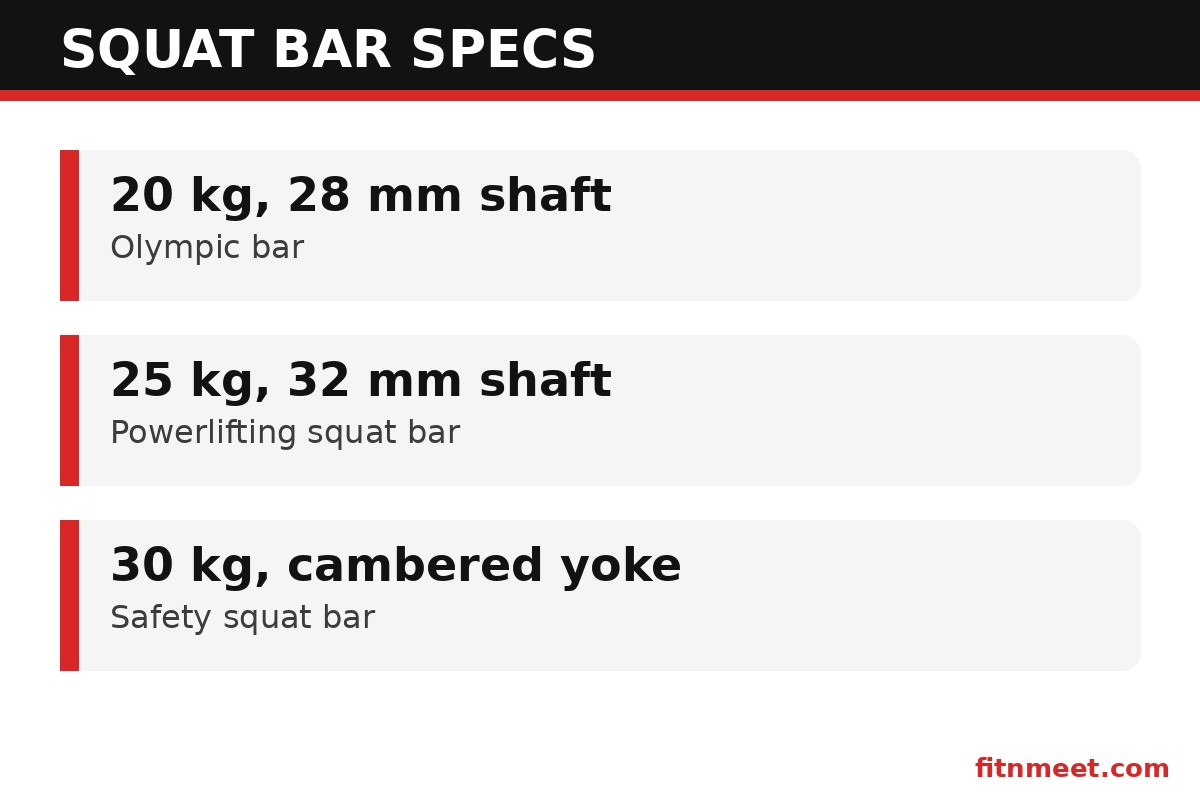
| Spec | Olympic Bar (men’s) | Powerlifting Squat Bar | Safety Squat Bar |
|---|---|---|---|
| Weight | 20 kg (44 lb) | 25 kg (55 lb) | 29–32 kg (64–70 lb) |
| Length | 2.2 m | 2.2–2.4 m | ~2.2 m (cambered) |
| Shaft diameter | 28 mm | 32 mm | ~32 mm (padded yoke) |
| Center knurl | Often absent | Aggressive, always | N/A (padded) |
| Whip (flex) | Moderate | Minimal | Minimal |
| Tensile strength | 190k–220k PSI (good bars) | 190k–220k PSI | ~190k PSI |
| Shoulder demand | Full external rotation | Full external rotation | None (handles) |
| Load position | On upper back | On upper back | Shifted slightly forward |
Comparison 2: Who is each bar for?
| Lifter profile | Best squat bar | Why |
|---|---|---|
| Beginner (squat < 100 kg) | Olympic bar | Technique > equipment; cheapest path |
| General home gym | Olympic bar | One bar for squat, bench, deadlift, press |
| Powerlifter (squat 180 kg+) | Powerlifting bar | Stability under maximal low-bar loads |
| Shoulder impingement/pain | Safety squat bar | Zero shoulder rotation required |
| Quad development focus | Safety squat bar | Forward camber increases knee/quad demand |
| Olympic weightlifter | Olympic bar (28 mm) | Whip and spin needed; never a stiff power bar |
| Older lifter, joint-friendly training | Safety squat bar | Comfort + upper-back stimulus, less joint stress |
Comparison 3: Price and value
| Bar type | Typical price range | Value verdict |
|---|---|---|
| Olympic bar (good quality) | $250–$400 | Best value — does everything |
| Powerlifting bar | $350–$600 | Worth it only for dedicated powerlifters |
| Safety squat bar | $300–$550 | Excellent second bar; high comfort ROI |
| Budget Olympic-style bar | $120–$200 | Fine under ~140 kg; upgrade later |
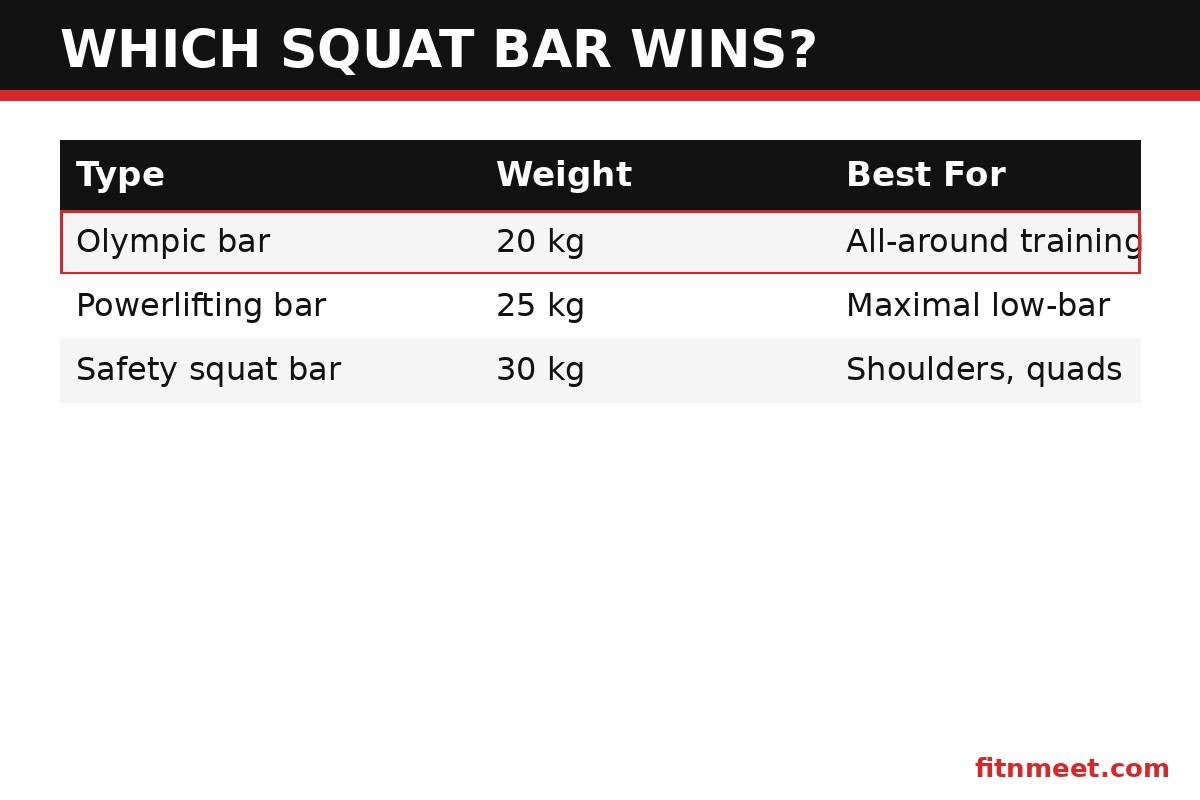
The pattern across all three tables: the standard Olympic bar wins on versatility and value; the powerlifting bar wins on maximal-load stability; the SSB wins on comfort and joint-friendliness. There is no universal “best” — only the best bar for your body and your goals.
Benefits of the Right Squat Bar
- Shoulder health. The SSB’s handles eliminate the externally rotated, loaded shoulder position that aggravates impingement and rotator-cuff issues. Lifters who had “accepted” shoulder pain during squats often report it vanishing in the first SSB session — the single most dramatic benefit any specialty bar delivers.
- Upper-back and quad development. The SSB’s forward camber acts like a front-squat/back-squat hybrid: studies and coaching experience agree it increases thoracic erector and quadriceps demand versus a straight bar at the same load. It is a legitimate assistance lift, not just a comfort tool.
- Bar stability at limit loads. A 32 mm powerlifting bar with aggressive center knurling does not oscillate or slide under 250+ kg the way a whippy 28 mm bar can. For competitive powerlifters, that stability is worth real kilos on the platform.
- Training longevity. The right bar lets beat-up lifters keep squatting heavy for decades: less shoulder stress, better load distribution, and (with the SSB) the ability to train around injuries rather than through them.
- Grip and confidence. Center knurling on a proper bar locks the bar to your back — no more re-racking mid-set to re-chalk, no more asymmetric bar slip turning a heavy single into a grinder.
How to Choose a Squat Bar (Decision Steps)
Answer these questions in order. Your choice will make itself:
- Do you compete in powerlifting? → Yes: get a powerlifting-spec bar (25 kg, 32 mm, center knurl) for specificity. → No: continue.
- Do your shoulders hurt when you squat? → Yes, consistently: the SSB is your answer — it removes the problem rather than managing it. → No: continue.
- Is this your only barbell? → Yes: buy the best 20 kg Olympic bar you can afford (190k+ PSI, good knurl). Versatility beats specialization. → No, you own a straight bar already: continue.
- What is your squat? → Under 140 kg: a specialty bar is premature; invest in coaching or a rack instead. → 140 kg+: an SSB as a second bar is the highest-ROI purchase in most home gyms.
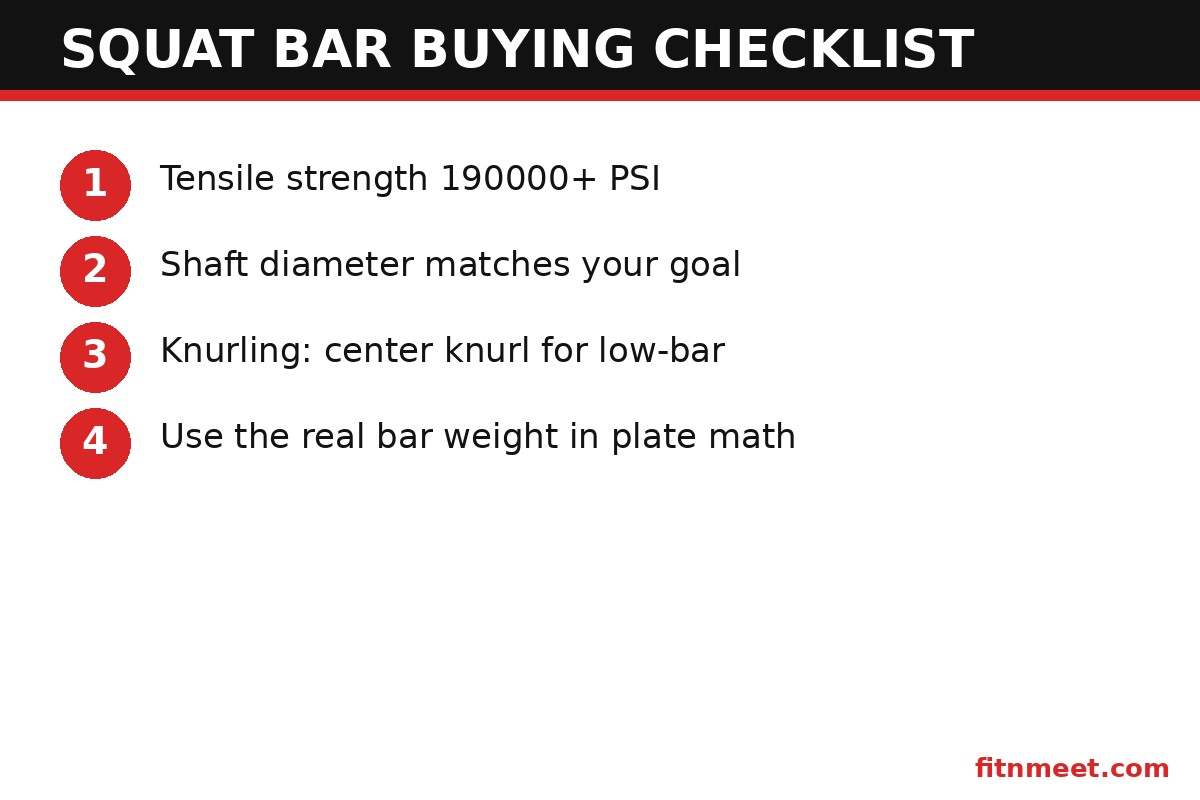
- Check the non-negotiables: tensile strength ≥190,000 PSI, warranty ≥5 years (lifetime is common at good brands), knurling that matches your use (aggressive for low-bar, moderate for high-bar/Olympic).
- Verify the weight math: remember the SSB weighs ~30 kg and the powerlifting bar 25 kg — plate math on the platform and in your log must use the real bar weight, not 20 kg.
✅ Decision shortcut: One bar → Olympic 20 kg. Two bars → add a safety squat bar. Competitive powerlifter → powerlifting bar as the primary squat bar. That covers 95% of lifters correctly.
Squat Bar Specs and Sizing Guide
When comparing any barbell, these are the specifications that actually predict performance:
- Tensile strength (PSI): the headline durability number — 190,000+ PSI for serious training, 165,000+ PSI minimum for anything loaded heavily. Below that, bars can permanently bend under heavy squats.
- Shaft diameter: 28 mm (Olympic, versatile), 29 mm (power bar standard), 32 mm (powerlifting bar, maximal stiffness). Thicker = stiffer = less whip, but harder to grip.
- Knurling: depth and pattern determine grip. Center knurl is near-mandatory for heavy low-bar squatting; knurl marks (rings) are spaced per federation standards. “Volcano” or “diamond” patterns are marketing terms — feel the bar if possible.
- Sleeve construction: bushings (durable, slower spin, fine for squats) vs. bearings (fast spin, needed for Olympic lifts). For pure squat training, bushings are preferable and cheaper.
- Finish: bare steel (best grip, needs oiling), black oxide, zinc, or cerakote (corrosion resistance, slightly less grip). For a garage gym in humid climates, coated finishes are worth it.
- Warranty: lifetime warranties are standard from reputable barbell makers — a 1-year warranty on a “heavy-duty” bar is a contradiction.
Women and smaller lifters: the 15 kg women’s Olympic bar (25 mm shaft) is a legitimate bar, not a lesser one — the thinner shaft suits smaller hands and the lighter starting weight fits progression better. Junior lifters should start with technique bars (5–10 kg) before any full-size barbell. For the strength-training programming side, see FitnMeet’s strength training articles and the muscle development collection. For beginner-friendly programs and form guides suited to every level, browse the FitnMeet fitness articles.
Squat Bar Safety
- Always squat in a rack with safeties. No bar — however good — replaces spotter arms or safety pins set just below your bottom position. The majority of serious squat injuries come from failed reps without safeties, not from equipment failure.
- Inspect the bar. Check sleeves for smooth rotation and the shaft for bends or cracked knurling periodically. A bent bar loads the spine asymmetrically — retire it to landmine duty.
- Respect the SSB learning curve. The SSB pitches you forward; start at 50–60% of your straight-bar squat for the first 2–3 sessions while your upper back adapts. Ego-lifting a new bar is how backs get hurt.
- Collar your plates. Specialty bars (especially cambered ones) shift plates more than straight bars. Collars are non-negotiable.
- Center knurl + bare skin: aggressive center knurling on a powerlifting bar will abrade your neck and upper back — wear a shirt, and consider a bar pad only for warm-ups (never for heavy low-bar work, where it creates instability).
This article is for informational purposes only and is not medical advice. Consult a healthcare professional before starting any supplement or exercise program.
Frequently Asked Questions
What is a squat bar?
A squat bar is a barbell designed or selected for back squats. The main types are the standard Olympic barbell (20 kg, 28 mm shaft), the thicker powerlifting bar (25 kg, 32 mm shaft with aggressive knurling), and the safety squat bar — a cambered, padded bar with handles that spares the shoulders.
Do I need a special squat bar to squat?
No. A standard Olympic barbell is a perfectly good bar for the vast majority of lifters. Specialty bars (powerlifting or safety bars) solve specific problems — maximal-load stability or shoulder pain — that most lifters do not have, especially beginners.
What is the difference between a squat bar and a regular barbell?
A powerlifting squat bar is thicker (32 mm vs 28 mm), heavier (25 kg vs 20 kg), stiffer, and has aggressive center knurling compared to a regular Olympic barbell. A safety squat bar differs more dramatically: it is cambered with a padded yoke and front handles, changing the load position entirely.
How much does a safety squat bar weigh?
Most safety squat bars weigh 29–32 kg (64–70 lb) before plates — significantly more than a 20 kg Olympic bar. Always use the real bar weight in your plate math and training log, or your percentages will be wrong.
Is a safety squat bar harder than a regular squat bar?
For most lifters, yes — expect to SSB-squat roughly 10–20% less than your straight-bar squat at first. The forward camber increases upper-back and quad demand, which is exactly why it is such an effective assistance lift.
What squat bar should a beginner buy?
A quality 20 kg Olympic barbell with at least 190,000 PSI tensile strength. It is the most versatile bar — good for squats, benches, deadlifts, and presses — and technique matters far more than bar specialization in the first year or two of training.
Conclusion
The bar decision is simpler than the equipment forums make it look. One bar for everything: a quality 20 kg Olympic bar with 190,000+ PSI tensile strength. A second bar for comfort and variety: the SSB, the highest-ROI specialty purchase in most home gyms. A primary bar for competitive powerlifting: the 25 kg, 32 mm powerlifting bar with aggressive center knurling. Match the bar to your body, your numbers, and your goals — then stop shopping and start squatting, because the bar never lifted the weight for anyone.
Building out the home gym? Pair your bar choice with programming from FitnMeet’s strength training guides and fuel the work with the muscle development collection — then shop the full FitnMeet store for everything around the bar.