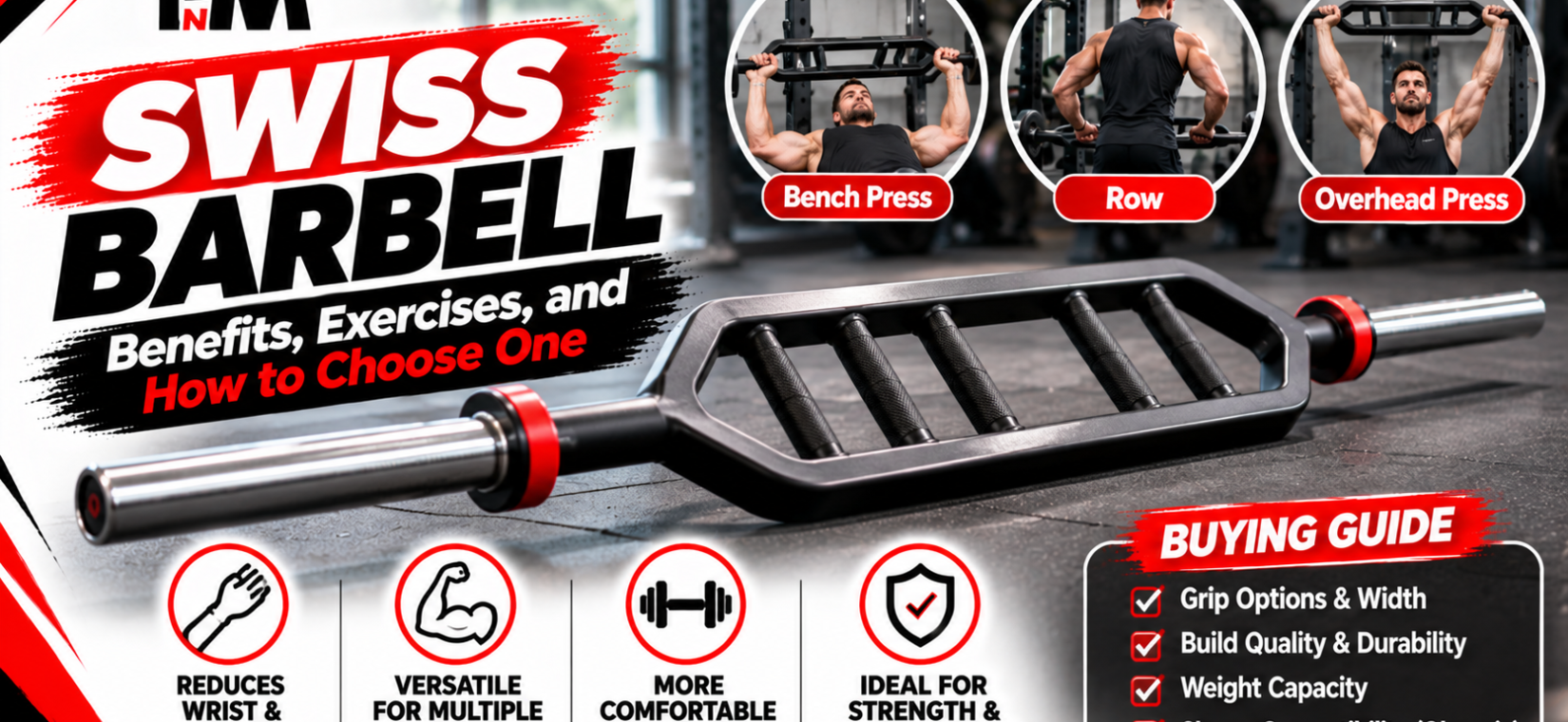
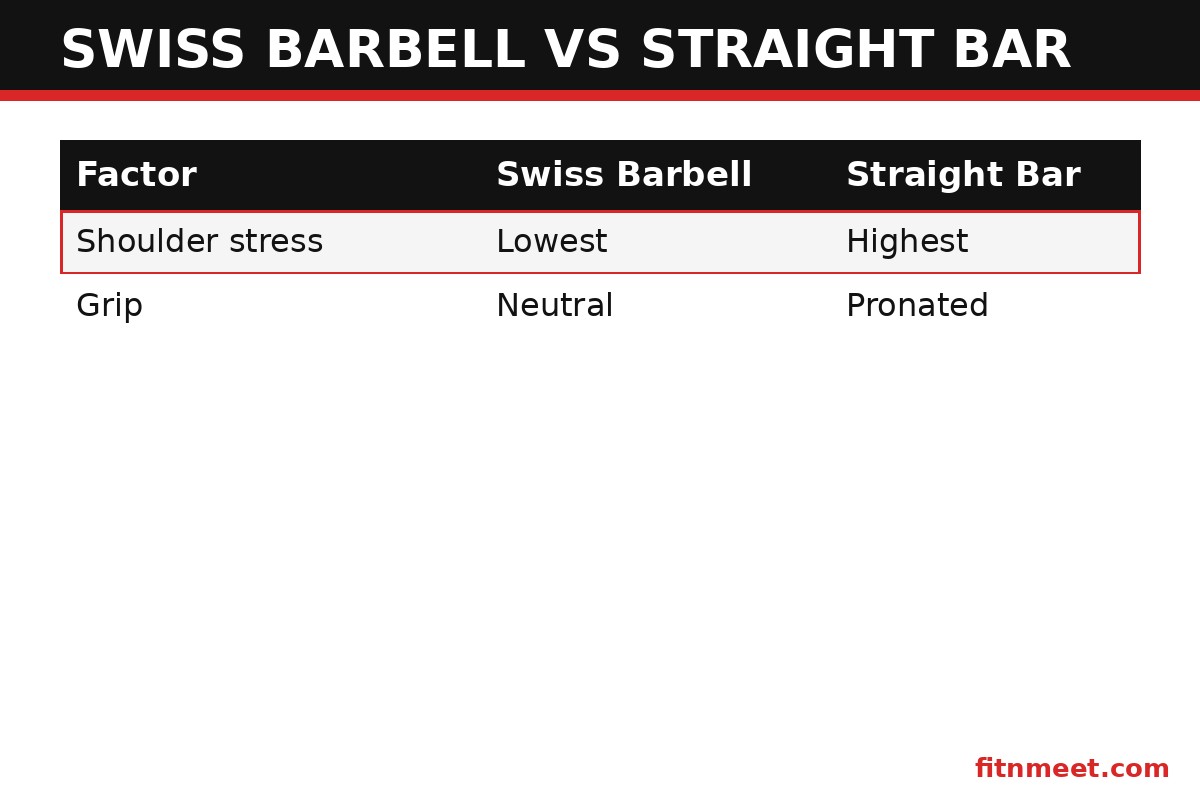
A Swiss barbell — also called a football bar or multi-grip bar — is a specialty barbell with several pairs of parallel, neutral-grip handles instead of a single straight shaft. It lets you press, row, and curl with palms facing each other, reducing shoulder strain. Typical weight: 20–35 lbs.
Swiss Barbell: Quick Verdict
Our pick — buy a Swiss barbell if: your shoulders ache on straight-bar bench press, you want neutral-grip pressing and rowing variety, or you train at home and want one bar that covers pressing, curls, and rows with joint-friendly grips.
Skip it if: you compete in powerlifting (you must train the straight-bar competition lifts), you only have budget for one bar (a standard Olympic bar comes first), or your gym already has dumbbells covering every neutral-grip movement you need.
The bottom line: it is the best specialty bar for shoulder-friendly pressing, full stop. The neutral grip places the shoulder in a more natural position — less internal rotation, less impingement risk — which is why lifters with a history of shoulder irritation often find they can press pain-free with one when a straight bar hurts. It will not replace your main barbell, but as a second bar it earns its floor space fast.
What Is a Swiss Barbell?
It is a specialty bar built like a ladder: two long outer rails joined by 3–4 sets of parallel handles running perpendicular to the bar’s length. You grip the rungs with a neutral grip — palms facing each other — instead of the pronated grip of a straight bar. Most designs offer multiple grip widths (narrow, medium, wide), and some add angled handles for additional wrist options.
The name is a historical accident — the bar has nothing specifically to do with Switzerland. “Football bar” is the other common name, because American football strength programs popularized it for pressing with beat-up shoulders. Whatever you call it, it fills one clear gap: heavy bilateral pressing without the shoulder torque of a straight bar. You can read about the standard bar it is derived from on Wikipedia’s barbell page.
Typical specs: 5–7 feet long, 20–35 lbs in weight, with a loadable sleeve length shorter than an Olympic bar (most take standard Olympic plates). Because the weight sits in the same plane as a straight bar, it loads the pressing muscles similarly — the difference is entirely in joint angles. Neutral-grip pressing keeps the elbows tucked closer to the torso, which reduces the shoulder abduction angle that aggravates impingement in many lifters.
Where did the Swiss barbell come from? Strength lore credits its popularization to American football weight rooms in the 1980s and 90s, where linemen with battered shoulders needed to keep bench pressing heavy through the season. Equipment makers responded with the ladder-frame design, and the name “football bar” stuck in those circles while “Swiss bar” spread through powerlifting gyms. The dual naming still confuses buyers today, but both labels describe the identical tool — if a product page says “multi-grip bar,” you are looking at the same thing.
Common exercises include the neutral-grip bench press, overhead press, bent-over row, JM press (a triceps builder), hammer curls, and shrugs. It is a pressing-first tool — you would not squat or deadlift with it — but within its lane it is remarkably versatile.
Swiss Barbell Head-to-Head Comparisons
Swiss barbell vs straight bar vs dumbbells for pressing
| Factor | Swiss barbell | Straight barbell | Dumbbells |
|---|---|---|---|
| Grip | Neutral (palms in) | Pronated (palms forward) | Any grip |
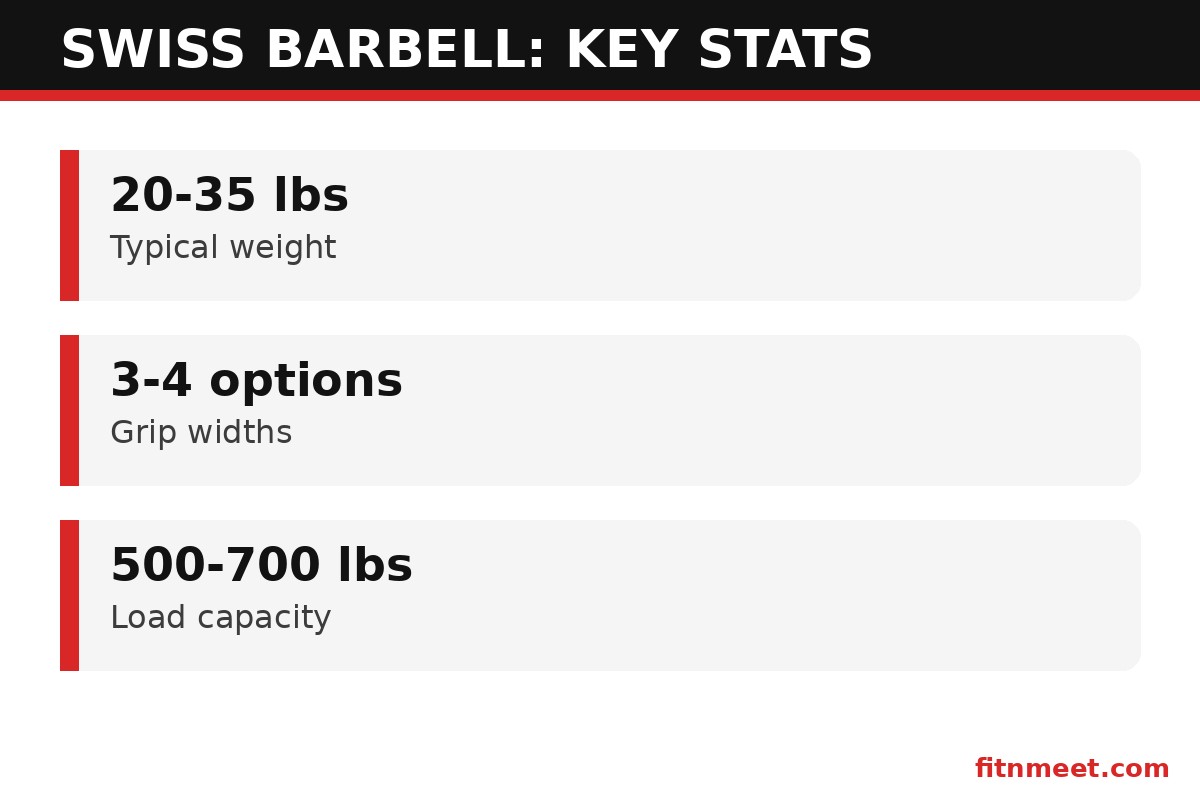
| Shoulder stress | Lowest — tucked elbows, less impingement | Highest — wide pronated grip abducts shoulder | Low — free path, but stability demand high |
| Max load | High (300+ lbs typical capacity) | Highest (1000+ lbs) | Limited by dumbbell size and setup |
| Learning curve | Easy | Moderate | Moderate (balance) |
| Versatility | Press, row, curl, JM press | Squat, bench, deadlift, press, row | Nearly unlimited |
| Cost | $150–$400 | $200–$500+ (quality Olympic bar) | $300–$1000+ (full set) |
The takeaway: it beats the straight bar on shoulder comfort and beats dumbbells on loading convenience for pressing. It loses to the straight bar as a general strength tool — you cannot squat or deadlift with it — which is why it is a second bar, not a first. For lifters comparing pressing options, the classic movement context is the bench press, where grip choice most visibly changes shoulder mechanics.
Swiss barbell designs compared
| Design | Handles | Feel | Best for |
|---|---|---|---|
| Standard straight-handle Swiss barbell | 3–4 parallel grips | True neutral, simple | Most buyers; pressing and rows |
| Angled-handle Swiss barbell | Handles canted ~10–15° | Slightly more natural wrist angle | Lifters with wrist sensitivity |
| Cambered Swiss barbell | Grips dropped below bar plane | Deeper stretch on presses | Chest development emphasis |
| Cable-attachment / short Swiss bar | 2 grips, short frame | Light, maneuverable | Cable rows and home-gym accessory work |
For a first purchase, the standard straight-handle design is the right call — it is the most versatile and the cheapest. Angled handles are a genuine comfort upgrade for some lifters’ wrists, worth it if you have tried both. Cambered versions add range of motion for chest pressing but feel unstable until you adapt; treat them as a specialist upgrade, not a starter bar.
Benefits of a Swiss Barbell
| Benefit | Why it matters | Who benefits most |
|---|---|---|
| Shoulder-friendly pressing | Neutral grip reduces internal rotation and impingement risk | Lifters with shoulder irritation or impingement history |
| Multiple grip widths | Narrow/medium/wide options target triceps, chest, or back differently | Home-gym lifters wanting variety from one bar |
| Heavy bilateral loading | Load 200–300+ lbs with two hands — dumbbells cannot match the convenience | Strength-focused pressers |
| Wrist comfort | Neutral wrist alignment reduces strain versus pronated grips | Lifters with wrist issues on straight bars |
| Row and curl versatility | Neutral-grip rows and hammer curls in the same session | Upper-body accessory days |
The shoulder benefit deserves emphasis because it is the reason most people buy a Swiss barbell. When lifters with cranky shoulders switch their heavy pressing to a neutral grip, many report they can train pain-free within weeks — not because the Swiss barbell heals anything, but because it removes the aggravating mechanics while keeping the training stimulus. Pair that with smart programming from FitnMeet’s strength training resources and you have a sustainable pressing plan.
Programming a Swiss barbell into your week
You do not need to rebuild your program around a Swiss barbell — slot it into existing pressing days. A simple approach: keep your main straight-bar bench as the heavy day, then use the neutral-grip bar for a second, higher-rep pressing day (3–4 sets of 8–12). Rows and hammer curls with the bar fit naturally at the end of upper-body sessions. Lifters managing shoulder irritation often flip the ratio — making the neutral-grip press the primary movement for 6–8 weeks while the shoulder calms down, then reintroducing the straight bar gradually. Track both bars’ numbers separately in your log; the grip change typically costs 5–10% off your straight-bar bench at first, and that gap narrows as you adapt to the handles.
How to Choose a Swiss Barbell: Decision Guide
Answer these questions in order — your Swiss barbell choice will be obvious by the end:
- Do you already own a quality straight Olympic bar? If no, buy that first. A Swiss barbell is a specialty second bar, not a replacement.
- Do your shoulders hurt when you bench with a straight bar? If yes, one moves to the top of your wishlist — neutral-grip pressing is the single biggest reason to own one.
- Home gym or commercial gym? Home-gym lifters get more value from one because it multiplies pressing and rowing options without buying dumbbell sets. If your commercial gym already has one, test it there for a month before buying.
- Straight, angled, or cambered handles? Start with straight handles unless you have tried angled ones and prefer them. Cambered is a later upgrade.
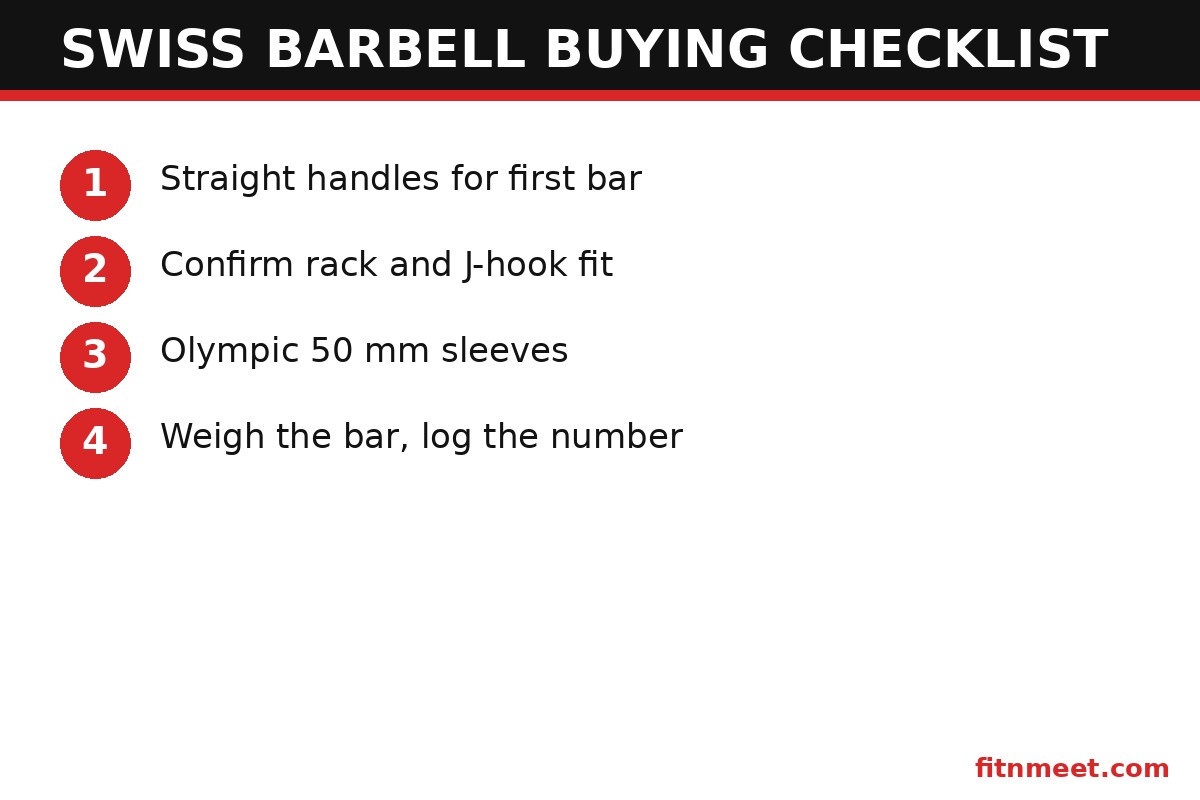
- What is your rack situation? Measure your rack’s J-hooks: most rails are 5–7 feet long and rack like a normal bar, but short cable-style versions do not rack at all — confirm before buying.
- What load capacity do you need? Most quality models are rated 500–700 lbs, far above what most lifters will press. Do not pay extra for 1,000-lb ratings you will never use.
- Knurling or no knurling? Light knurling on the handles improves grip security for rows and heavy presses; bare steel is fine for pressing only. Avoid aggressive knurling — it tears up hands on high-rep accessory work.
Swiss Barbell Specs and Sizing
There is no single standard for Swiss barbell dimensions, but most fall in these ranges:
| Spec | Typical range | What to look for |
|---|---|---|
| Length | 60–84 inches (5–7 ft) | Long enough to rack; short enough for your space |
| Weight | 20–35 lbs | Count it in your loaded total like any bar |
| Grip options | 3–4 widths | At least narrow + wide spacing |
| Sleeve diameter | 50 mm (Olympic) | Must fit your existing plates |
| Load capacity | 500–700 lbs | More than enough for pressing work |
Weigh your bar on a bathroom scale when it arrives and note the number — since bars vary from 20 to 35 lbs, “225 on the bar” means different totals on different bars. Log the bar weight in your training notes the same way powerlifters log their 45-lb Olympic bar.
Swiss Barbell: Safety Notes
It is as safe as any barbell when used sensibly. The main safety notes are practical: rack compatibility — confirm the rails sit securely in your J-hooks before loading heavy; unracking — the multiple handles can catch on rack uprights, so unrack deliberately; load balance — center yourself on the correct grip pair so the bar does not tilt; and collars — use them, since plates can walk on the shorter sleeves of some designs.
One more consideration: the shoulder-friendliness of the bar is not a license to ignore pain. If pressing hurts even with a neutral grip, that is a signal to get assessed, not to push through. The bar removes aggravating mechanics — it does not diagnose or treat injuries. Support your training with proper fuel from FitnMeet’s muscle development collection and sports nutrition range.
Inspect a new Swiss barbell before heavy use: check that welds are clean and complete, sleeves spin freely, and the frame has no cracks at the handle joints. Cheap bars sometimes skimp on weld quality, and a handle failing under 200 lbs is a genuine hazard. Buying from established strength-equipment makers and checking the rated capacity against your planned loads eliminates nearly all of this risk.
This article is for informational purposes only and is not medical advice. Consult a healthcare professional before starting any supplement or exercise program.
Swiss Barbell: Frequently Asked Questions
What is a Swiss barbell used for?
It is used for neutral-grip pressing, rowing, and curling. Its parallel handles let you bench press, overhead press, bent-over row, and hammer curl with palms facing each other, which is easier on the shoulders and wrists than a straight bar.
Is a Swiss barbell better than a straight bar?
Neither is universally better. A Swiss barbell is better for shoulder-friendly pressing and grip variety, while a straight barbell is essential for squats, deadlifts, and competition lifts. Most lifters treat it as a specialty second bar.
How much does a Swiss barbell weigh?
Most models weigh between 20 and 35 pounds, lighter than a standard 45-pound Olympic bar. Weigh yours on a scale when it arrives and include the bar weight in your logged totals.
Can you bench press with a Swiss barbell?
Yes, the neutral-grip bench press is the signature exercise for this bar. Tuck your elbows at roughly 45 degrees, grip the medium or wide handles, and press as normal. Many lifters with shoulder irritation find this variation pain-free.
Is a Swiss barbell good for shoulders?
The neutral grip places the shoulder in less internal rotation than a straight bar, which reduces impingement risk for many lifters. It does not treat injuries, but it lets many people press heavy without aggravating sensitive shoulders.
What is the difference between a Swiss bar and a football bar?
There is no difference. Swiss barbell, football bar, and multi-grip bar are three names for the same piece of equipment: a barbell with multiple parallel neutral-grip handles.
Conclusion
Compared head-to-head, the verdict is clear: if your shoulders complain about straight-bar pressing, it is the most joint-friendly way to keep pressing heavy. It will not replace your Olympic bar, but as a second bar it delivers pressing variety, rowing options, and genuine shoulder relief in one purchase. Choose straight handles, confirm rack fit, and weigh the bar before you log your lifts.
Building out your training setup? Explore the FitnMeet shop and the muscle development collection at FitnMeet — the right gear plus the right fuel is how strong, healthy shoulders are built.