
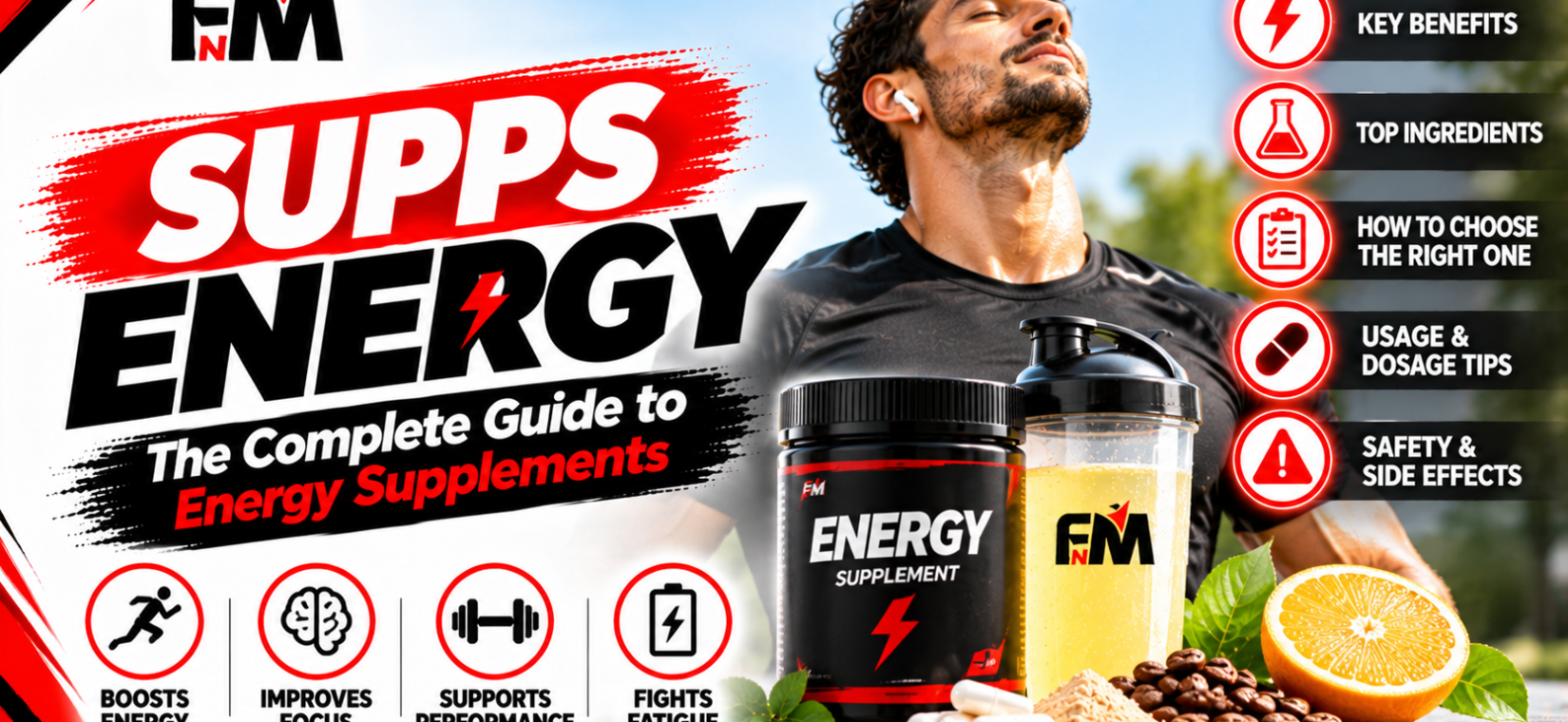
Supps energy refers to supplements formulated to increase energy, alertness, and workout performance — typically built on caffeine plus supporting ingredients like B-vitamins, creatine, beta-alanine, and adaptogens. Supps energy products work best when matched to a specific need (pre-workout fuel vs. daily fatigue) and dosed within safe caffeine limits of 400 mg per day for most adults.
In 30 seconds: Energy supplements = energy supplements. Core effective ingredients: caffeine (3–6 mg/kg), creatine (3–5 g/day), B-vitamins (if deficient). Use pre-workout 30–45 min before training. Cap caffeine at 400 mg/day. Cycle stimulants to avoid tolerance. Food and sleep beat any pill for baseline energy.
Supps Energy: Fast Facts
- What it is: energy supplements covers pre-workouts, energy capsules, and stim-based focus formulas — any supplement whose primary claim is more energy.
- What actually works: caffeine is the most evidence-backed ingredient in these formulas; creatine supports high-intensity output; B-vitamins help only if you are deficient.
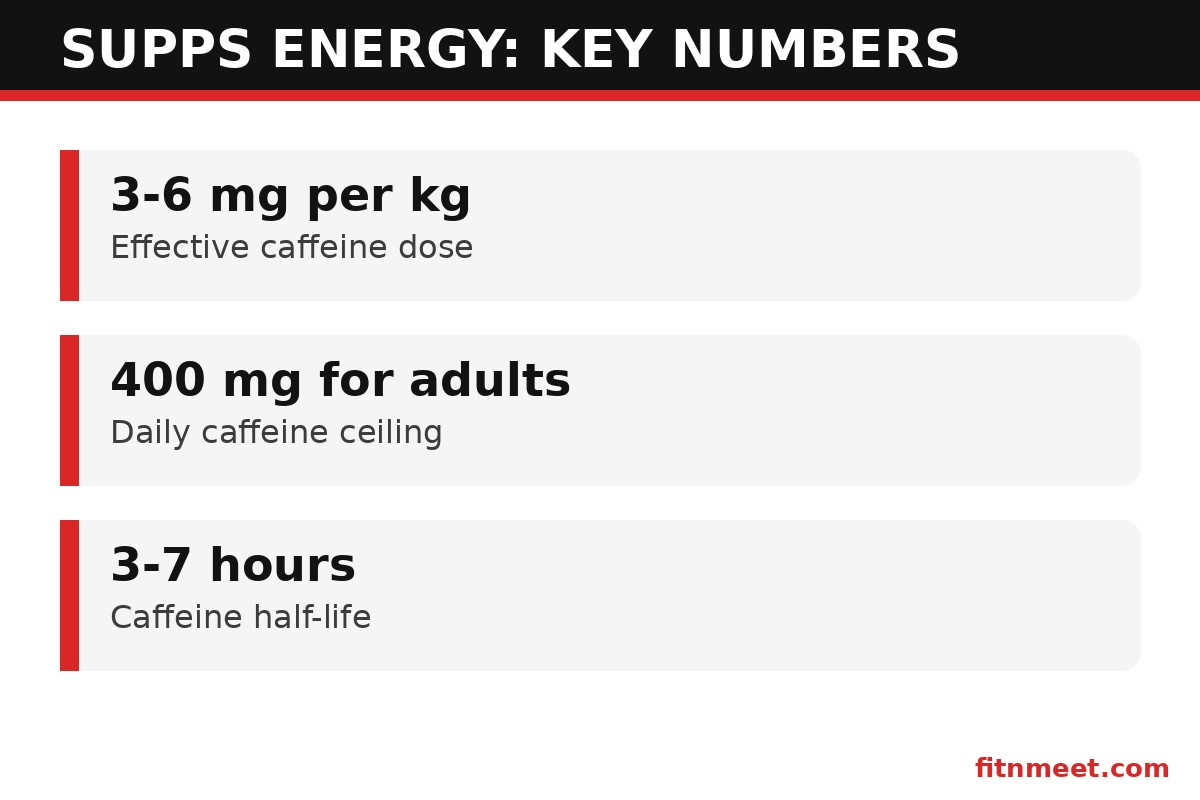
- Effective caffeine dose: 3–6 mg per kg of bodyweight, taken 30–60 minutes before activity — roughly 200–400 mg for most adults.
- Daily ceiling: health authorities generally consider up to 400 mg of caffeine per day safe for healthy adults.
- Biggest mistake: using stimulant products to mask chronic sleep deprivation instead of fixing sleep — tolerance builds within 1–2 weeks of daily stim use.
- Who should skip it: anyone with heart conditions, anxiety disorders, or caffeine sensitivity; pregnant women should cap caffeine at 200 mg/day.
Q: Do I need energy supplements if I drink coffee?
A: Often not — a cup of coffee delivers 95–200 mg of caffeine, squarely in the effective range. These formulas products add value mainly through precise dosing and complementary ingredients (beta-alanine, citrulline), not through caffeine alone.
What Is Supps Energy?
Stimulant products is shorthand for the energy-supplement category: products designed to raise perceived energy, alertness, and physical performance. The category spans three subtypes. Pre-workout formulas combine caffeine with performance ingredients (citrulline, beta-alanine, creatine) for training sessions. Daily energy capsules offer milder stimulation for work and study, often with adaptogens like rhodiola or ashwagandha. Stim-free “energy” formulas rely on B-vitamins, CoQ10, or cordyceps — supporting cellular energy production without stimulants.
How does energy supplements actually create “energy”? Mostly it does not create energy at all — caffeine blocks adenosine receptors, muting the brain’s fatigue signals without adding fuel. True cellular energy comes from food (calories), sleep (recovery), and the mitochondria’s ATP production, which nutrients like B-vitamins, iron, and CoQ10 support. Understanding this distinction separates effective these formulas use from expensive placebo: stimulants borrow alertness from later; foundational nutrients enable the body to produce its own.
Q: What is the main ingredient in stimulant products products?
A: Caffeine, by a wide margin — it appears in roughly 90% of energy supplements formulas at 150–350 mg per serving. Everything else in the formula is supporting cast.
The pharmacology is well mapped: caffeine’s half-life is 3–7 hours (longer in slow metabolizers and with certain medications), which is why afternoon these formulas use disrupts sleep. For the underlying science, see Wikipedia’s caffeine article and the dietary supplement overview.
What Are the Benefits of Supps Energy?
- Improved workout performance: caffeine at 3–6 mg/kg reliably improves strength, power, and endurance metrics in meta-analyses — the single best-supported benefit across all stimulant products products.
- Sharper focus and alertness: caffeine plus L-theanine (a common energy supplements pairing) improves attention and reaction time with less jitter than caffeine alone, per multiple RCTs.
- Reduced perceived effort: these formulas users consistently rate workouts as feeling easier at the same output — caffeine lowers perceived exertion by roughly 5–6%.
- Faster reaction and decision-making: relevant for athletes in skill sports and for long study or driving sessions.
- What stimulant products will not do: replace sleep (one all-nighter impairs cognition as much as legal intoxication — no pill reverses that), build muscle directly, or fix fatigue caused by iron deficiency, thyroid issues, or depression. Persistent exhaustion deserves a medical workup, not a stronger pre-workout.
Q: How fast does energy supplements kick in?
A: Caffeine-based these formulas peaks in the blood around 45–60 minutes after ingestion, with noticeable effects starting at 15–20 minutes. Take pre-workout formulas 30–45 minutes before training.
How Do You Use Supps Energy Products?
FAQ-style steps for getting stimulant products right:
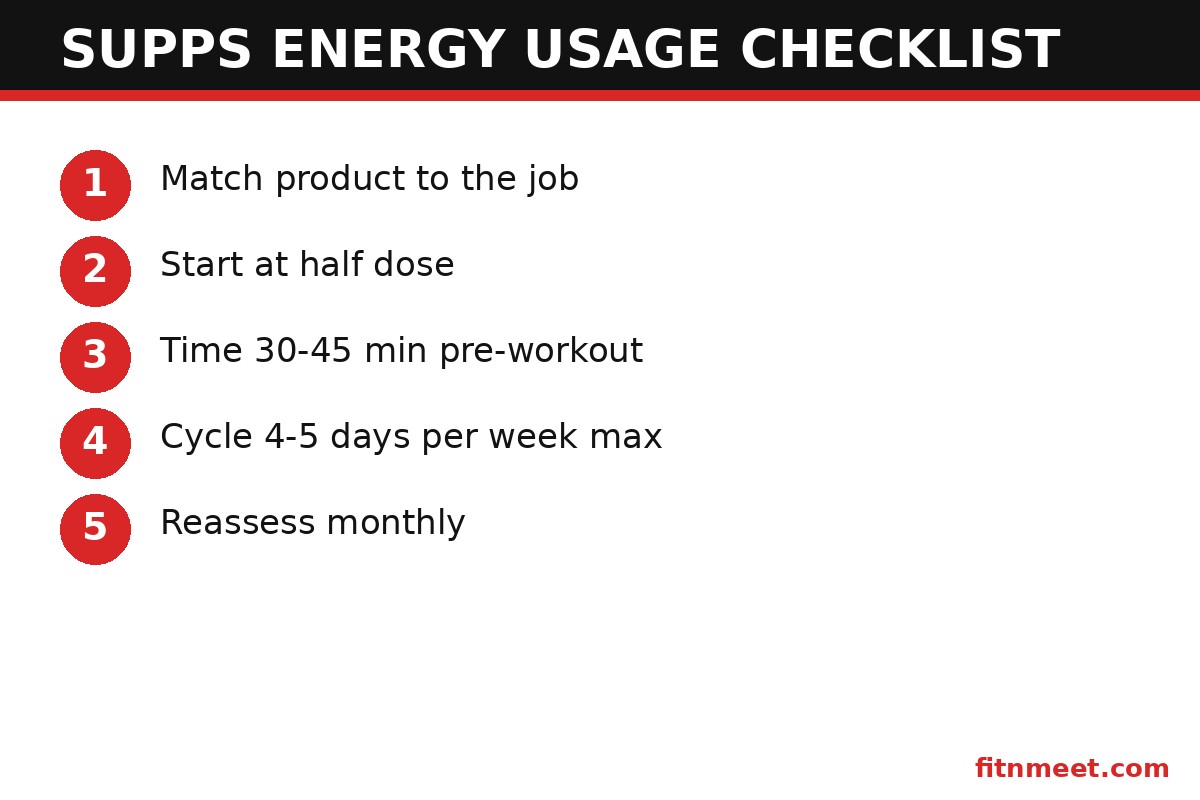
Step 1 — Match the product to the job. Training in 45 minutes? Full pre-workout with 200–300 mg caffeine. Long workday? Milder 100–150 mg capsule with L-theanine. Evening training? Stim-free formula — caffeine after 2 PM costs you sleep.
Step 2 — Start at half dose. Assess tolerance with half a serving of any new energy supplements product. Caffeine sensitivity varies enormously with genetics (CYP1A2 variants), and full doses surprise fast metabolizers and slow ones alike — in opposite ways.
Step 3 — Time it correctly. 30–45 minutes pre-workout for training formulas; with breakfast for daily energy capsules. Never within 8 hours of bedtime — caffeine’s 5-hour average half-life means a 4 PM dose is still half-active at 9 PM.
Step 4 — Cycle to prevent tolerance. Daily stim-based these formulas loses punch within 1–2 weeks as adenosine receptors upregulate. Use stimulants 4–5 days per week maximum, or take a full stim break week every 6–8 weeks.
Step 5 — Stack smart, not heavy. Caffeine + L-theanine (2:1 ratio) is the classic focus stack. Adding creatine (3–5 g) covers power output. Do not stack multiple caffeinated products — total the milligrams across everything, including coffee.
Step 6 — Reassess monthly. If you need ever-stronger stimulant products to feel normal, that is tolerance and sleep debt talking — not a product deficiency. Scale back, fix sleep, and reset.
Supps Energy: People Also Ask
Why do I crash after supps energy wears off?
The “crash” is adenosine rebound: caffeine blocks fatigue receptors for hours, and when it clears, the accumulated fatigue signals flood back at once — often feeling worse than baseline. Mitigate it by keeping doses moderate (under 200 mg per serving), avoiding these formulas on an empty stomach, and not re-dosing to chase the peak.
Q: Can energy supplements replace pre-workout meals?
A: No — these formulas masks fatigue; food provides actual fuel. Training fasted with only stimulants works for short sessions but underperforms fueled training for sessions over 60 minutes. Eat 1–3 hours before training; use energy supplements as the cherry on top.
Are stim-free supps energy products worth it?
They serve a real niche: late-day training, caffeine-sensitive users, and tolerance breaks. Ingredients like citrulline (6–8 g for blood flow), beta-alanine (3.2 g/day for muscular endurance), and creatine work without stimulants — the pump and performance support are genuine, just without the buzz. For stim-free training support, browse FitnMeet’s pre-workouts collection and sports nutrition range.
How much caffeine is actually in supps energy?
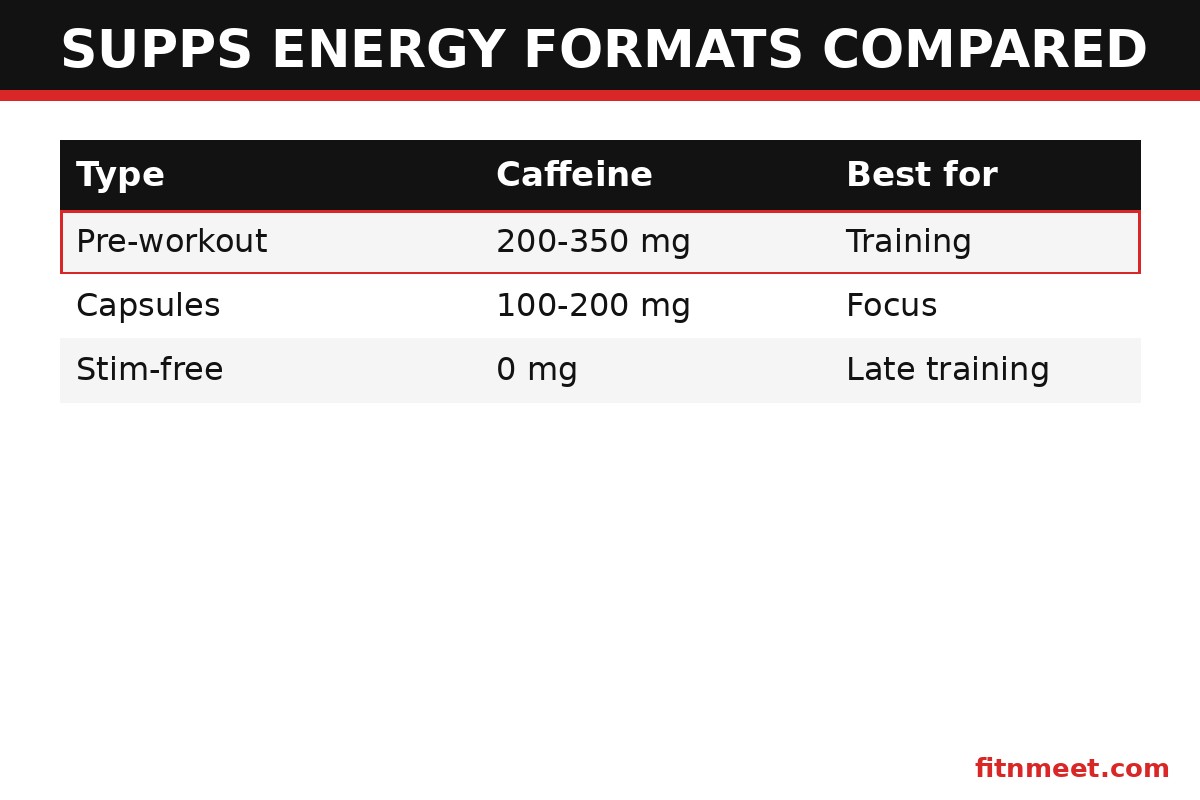
Typical servings: energy capsules 100–200 mg, pre-workouts 200–350 mg, “hardcore” formulas up to 400+ mg per scoop. Always read the label and total your daily intake across all sources — coffee, tea, energy drinks, and supps energy combined. The 400 mg/day general ceiling applies to the total, not per product.
Do supps energy products cause weight loss?
Caffeine modestly raises metabolic rate (roughly 3–11% for a few hours) and can suppress appetite short-term — but the effect is small and tolerance develops. No supps energy product produces meaningful fat loss on its own; diet and training do that work. For structured fat-loss support, see the weight loss collection.
Supps Energy Products Compared
| Type | Typical caffeine | Key extras | Best for | Watch out for |
|---|---|---|---|---|
| Pre-workout powder | 200–350 mg | Citrulline, beta-alanine, creatine | Training performance | Over-scooping; evening use |
| Energy capsules | 100–200 mg | L-theanine, B-vitamins | Work/study focus | Daily tolerance buildup |
| Energy drinks (canned) | 80–300 mg | Sugar or sweeteners, taurine | Convenience | Sugar load; cost per mg |
| Stim-free formulas | 0 mg | Citrulline, creatine, adaptogens | Late training, sensitive users | Weaker subjective “kick” |
| Plain caffeine pills | 100–200 mg | Nothing | Cheapest precise dosing | No performance extras |
Q: Which supps energy type is best for beginners?
A: Start with the simplest: a 100–200 mg caffeine capsule (or plain coffee) with L-theanine. Master dosing and timing before graduating to multi-ingredient pre-workouts — most beginners do not need the full stim stack. Compare simple beginner-friendly energy options in the FitnMeet shop before committing to a full pre-workout formula.
Supps Energy and Sleep: The Trade-Off
The most underappreciated fact about supps energy is its half-life math: caffeine’s 3–7 hour half-life means a 300 mg pre-workout at 5 PM still leaves ~150 mg active at 10 PM — enough to fragment sleep architecture even when you fall asleep fine. Poor sleep then increases next-day fatigue, which increases stimulant reliance: the classic dependency loop. Advanced users break it with a hard caffeine curfew (no stims within 8–10 hours of bed), stim-free formulas for evening sessions, and a weekly audit: if your sleep tracker shows declining deep sleep on training days, the pre-workout timing is the prime suspect. Remember the hierarchy — 7–9 hours of sleep improves performance more than any legal supplement ever will. Use supps energy to enhance good recovery, never to finance bad recovery.
Is Supps Energy Safe?
- Caffeine ceiling: up to 400 mg/day is considered safe for most healthy adults; above that, anxiety, insomnia, rapid heartbeat, and digestive upset climb sharply.
- Heart conditions: anyone with arrhythmia, hypertension, or heart disease should clear supps energy with a cardiologist — stimulants raise heart rate and blood pressure acutely.
- Anxiety and caffeine sensitivity: stimulant-based supps energy can trigger or worsen anxiety; sensitive users should choose stim-free formulas.
- Pregnancy: cap total caffeine at 200 mg/day during pregnancy; many clinicians advise avoiding high-stim supps energy entirely.
- Medication interactions: caffeine interacts with certain antibiotics, thyroid drugs, and psychiatric medications — check with a pharmacist.
- Proprietary blends: avoid supps energy products hiding doses behind “proprietary blends” — you cannot manage what you cannot measure.
- Youth athletes: pediatric guidelines advise against high-caffeine supps energy for children and young teens; food, sleep, and training are the appropriate levers.
Disclaimer: This article is for informational purposes only and is not medical advice. Consult a healthcare professional before starting supps energy products or any supplement, especially if you have a heart condition, anxiety disorder, take prescription medications, or are pregnant or breastfeeding.
Supps Energy: Full FAQ
What does supps energy mean?
Supps energy is shorthand for energy supplements — products formulated to increase alertness, energy, and workout performance, typically built on caffeine plus supporting ingredients like B-vitamins, creatine, or adaptogens.
What is the best supps energy ingredient?
Caffeine, at 3-6 mg per kg of bodyweight taken 30-60 minutes before activity, is the most evidence-backed ingredient. Creatine (3-5 g daily) and the caffeine + L-theanine pairing have the next-strongest support.
How much supps energy caffeine is safe per day?
Up to 400 mg of total caffeine per day is considered safe for most healthy adults, from all sources combined. Pregnant women should cap at 200 mg/day, and sensitive individuals less.
Why do I build tolerance to supps energy?
Daily caffeine upregulates adenosine receptors within 1-2 weeks, dulling the effect. Cycling stimulants 4-5 days per week, or taking a stim-break week every 6-8 weeks, preserves responsiveness.
Can I take supps energy every day?
Stim-free formulas, yes. Stimulant-based supps energy works best cycled — daily use builds tolerance and can mask sleep debt. If you need it daily to feel normal, fix sleep first.
What is the crash after supps energy?
The crash is adenosine rebound when caffeine clears — accumulated fatigue signals returning at once. Moderate doses, food beforehand, and avoiding re-dosing minimize it.
Are stim-free supps energy products effective?
Yes, for performance without stimulation — citrulline, beta-alanine, and creatine all have genuine evidence. You get the training support without the buzz, jitters, or sleep disruption.
Conclusion
Supps energy works — caffeine is one of the most reliable performance ingredients in all of sports nutrition — but it works best as a precision tool, not a daily crutch. Dose 3–6 mg/kg before training, cap total caffeine at 400 mg/day, cycle stimulants to beat tolerance, and never let a scoop replace sleep. Get those fundamentals right and supps energy becomes what it should be: a small, honest edge on the days you need it.
Train fueled and focused: explore FitnMeet’s pre-workouts collection, the sports nutrition range, or start at fitnmeet.com for more evidence-based guides.