
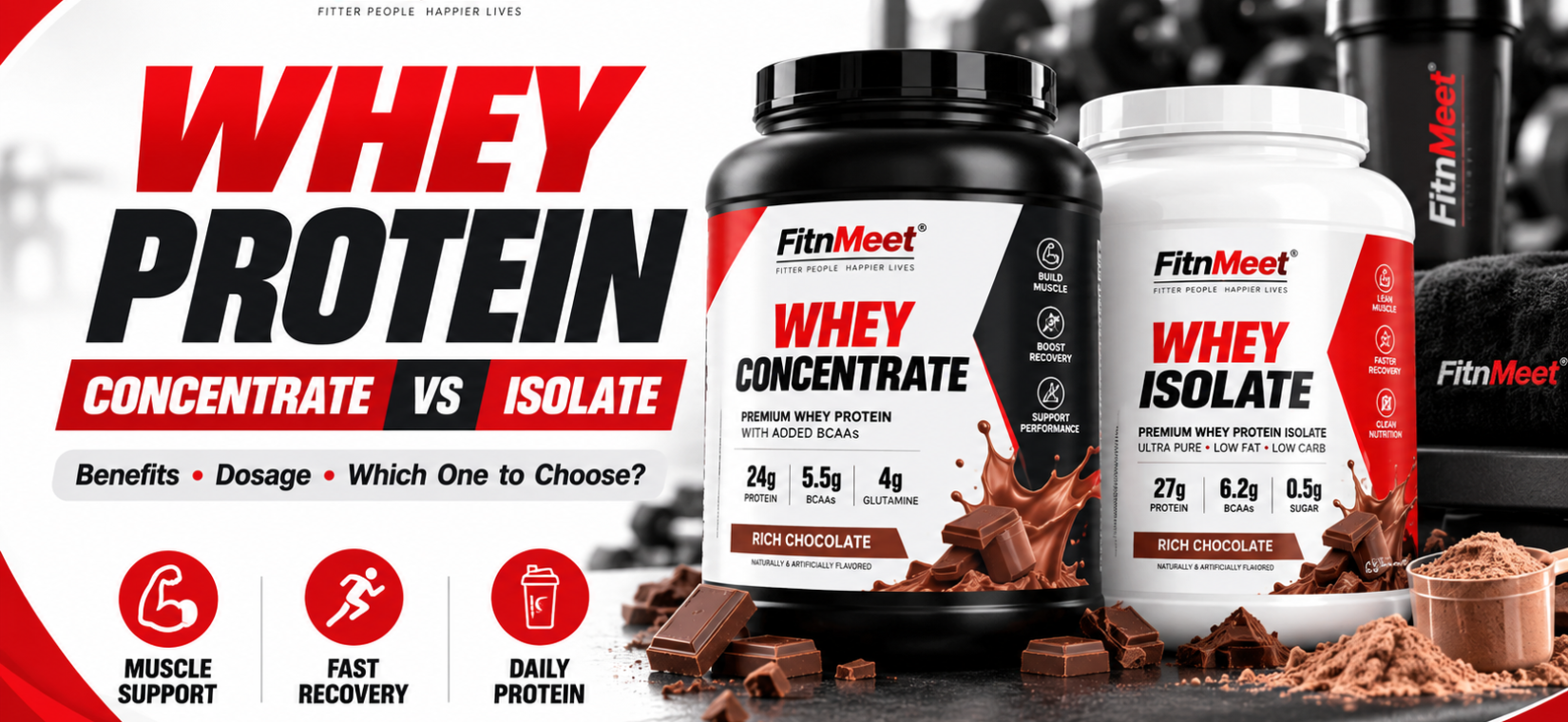
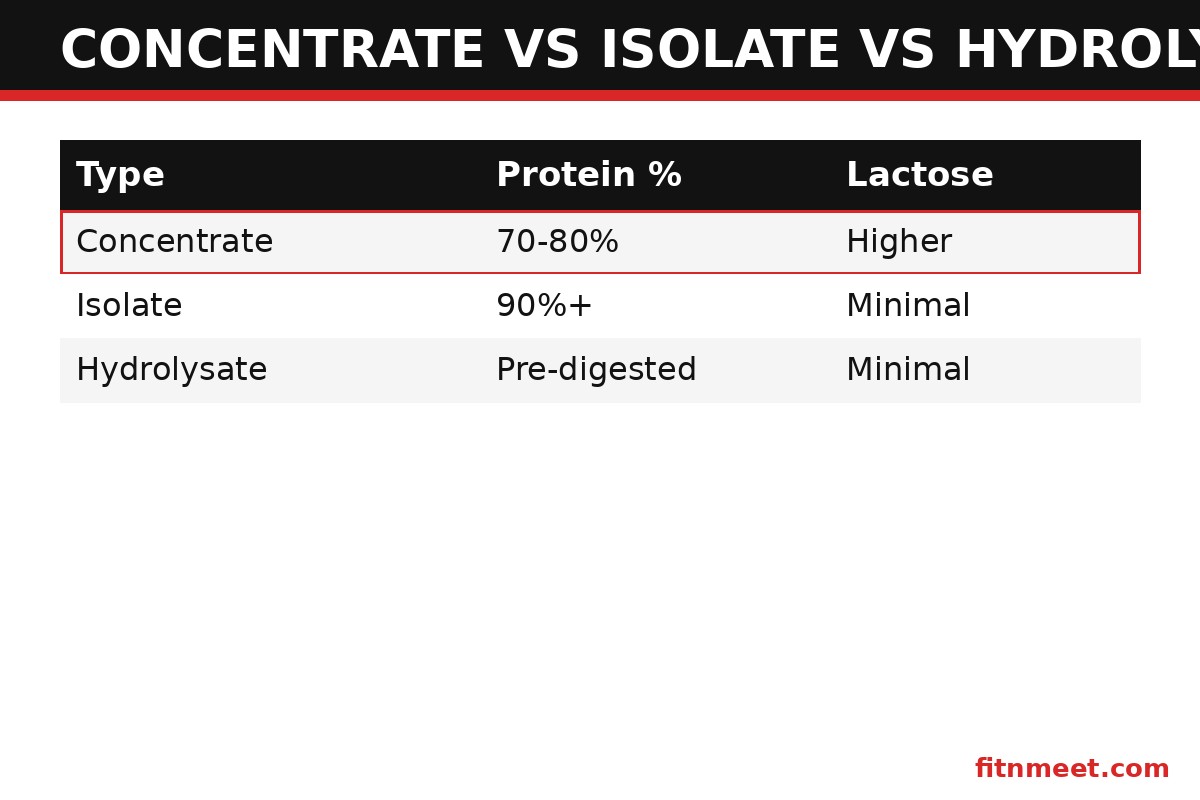
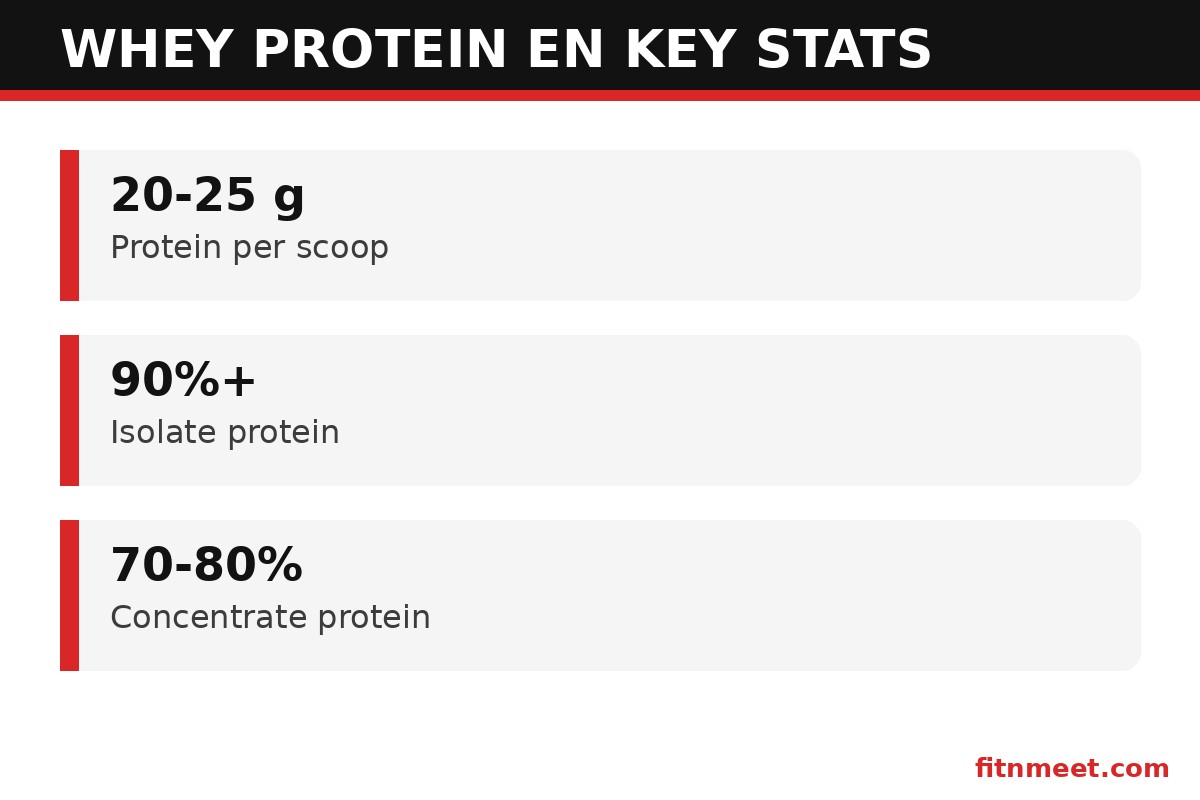
Whey protein refers to whey protein powder — the concentrated protein extracted from milk during cheese-making — sold as concentrate (70–80% protein), isolate (90%+ protein), or hydrolysate (pre-digested). A standard serving delivers 20–25 g of complete protein rich in leucine, making it the most-studied protein supplement for muscle growth and recovery.
Whey Protein En: Quick Verdict
Our pick for most people: whey protein concentrate. A quality whey protein concentrate delivers 20–24 g of protein per serving at the lowest cost per gram, with an excellent amino acid profile. Unless you are lactose-intolerant or cutting aggressively, concentrate is the value king.
Skip if: you are lactose intolerant (choose isolate), you need the absolute leanest macros for contest prep (choose isolate), or a product hides behind a “proprietary blend” without disclosing protein per serving — that is a red flag regardless of type.
The rest of this guide justifies that verdict with numbers: three head-to-head tables, a decision tree for choosing your whey protein, and dosage grounded in sports-nutrition research.
What Is Whey Protein?
Whey is the liquid left over when milk is curdled during cheese production. Dry and filter that liquid and you get whey protein powder — a complete protein containing all nine essential amino acids, with a PDCAAS (protein digestibility) score of 1.0, the maximum. It is particularly rich in leucine (~10–12% by weight), the amino acid that triggers muscle protein synthesis. You can read the production background on Wikipedia’s whey protein page.
Three processing levels create the three products you see on shelves:
- whey protein concentrate (WPC): filtered to 70–80% protein. Retains more lactose, milk fat, and bioactive compounds. Cheapest option.
- whey protein isolate (WPI): further filtered to 90%+ protein. Nearly lactose-free, very low fat. Costs 30–60% more than concentrate.
- whey protein hydrolysate (WPH): pre-digested (enzymatically broken into peptides) for fastest absorption. Bitter taste, highest price — used mainly in medical formulas and premium sports products.
All three are Whey Protein En; the difference is purity, price, and digestibility — not some fundamentally different protein. For a deep selection, see FitnMeet’s protein category, including options like whey protein isolate for the lactose-sensitive.
Head-to-Head Comparisons
Variant 4 is table-heavy. Here are the three comparisons that actually determine a protein purchase.
Table 1: Concentrate vs isolate vs hydrolysate
| Factor | Concentrate (WPC) | Isolate (WPI) | Hydrolysate (WPH) |
|---|---|---|---|
| Protein content | 70–80% | 90%+ | 90%+ (peptides) |
| Protein per 30 g scoop | 21–24 g | 25–27 g | 25–27 g |
| Lactose | Moderate (~3–5 g) | Minimal (<1 g) | Minimal |
| Absorption speed | Fast | Faster | Fastest |
| Taste/texture | Creamiest | Thinner | Bitter notes |
| Cost per 25 g protein | $ (baseline) | $$ (+30–60%) | $$$ (+80–150%) |
| Best for | Most lifters, best value | Lactose sensitivity, cutting | Elite athletes, medical use |
Table 2: Whey protein vs other protein sources
| Source | Protein per serving | Leucine | Digestion speed | Cost |
|---|---|---|---|---|
| Whey Protein En (concentrate) | 21–24 g | ~2.5 g | Fast (~1–2 h) | $ |
| Casein | 20–24 g | ~2.0 g | Slow (6–8 h) | $$ |
| Egg white protein | 20–24 g | ~2.1 g | Medium | $$$ |
| Soy isolate | 20–25 g | ~1.9 g | Medium | $ |
| Pea protein | 20–24 g | ~1.6 g | Medium | $ |
| Chicken breast (100 g) | 31 g | ~2.7 g | Slow (whole food) | $$ |
Table 3: When timing matters (and when it doesn’t)
| Scenario | Priority | Whey Protein En role |
|---|---|---|
| Total daily protein below 1.6 g/kg | Critical | Cheapest fix: 1–2 scoops close the gap |
| Post-workout within 2 hours of a meal | Low | Convenience only — the meal covers it |
| Training fasted (morning) | High | Fast whey stops the catabolic window quickly |
| Before bed | Moderate | Casein theoretically better; whey still beats nothing |
| Cutting / calorie deficit | High | Isolate preserves muscle with minimal calories |
The research bottom line, per the International Society of Sports Nutrition position stand: total daily protein intake (1.6–2.2 g/kg for muscle growth) matters far more than protein type or timing minutiae. Whey Protein En wins because it is the cheapest, best-tasting way to hit that total — not because of magic timing effects. The NIH’s exercise and athletic performance fact sheet reviews the protein evidence in detail. For the rest of your training fuel,
browse the FitnMeet sports nutrition range. To see every type stacked up side by side, read our whey isolate vs whey protein compared in detail for the full breakdown.
Benefits of Whey Protein En
- Muscle growth: meta-analyses show whey supplementation plus resistance training adds roughly 1–2 kg more lean mass over 12+ weeks versus training alone — driven by leucine-triggered muscle protein synthesis.
- Recovery: fast-digesting whey delivers amino acids to damaged muscle within an hour, reducing soreness markers in several trials.
- Fat loss support: high-protein diets preserve lean mass in a deficit; whey is the most convenient high-protein, low-calorie food available (~120 kcal per 25 g protein for isolate).
- Satiety: protein is the most satiating macronutrient; a whey shake between meals measurably reduces subsequent calorie intake in controlled studies.
- Immune and antioxidant support: whey is rich in cysteine, a precursor to glutathione, the body’s master antioxidant — relevant for hard-training athletes.
- Convenience: 25 g of complete protein in 30 seconds, no cooking, portable. Compliance beats perfection, and Whey Protein En maximizes compliance.
As your lifts get heavier, it helps to know when to wear a weightlifting belt for heavy training.
How to Choose: Decision Steps
Answer these in order — your protein choice falls out automatically:
- Are you lactose intolerant? Yes → whey isolate (lactose <1 g). No → continue.
- Are you in contest prep or an aggressive cut? Yes → isolate, for maximum protein per calorie. No → continue.
- Does your budget matter? Yes → concentrate; the 30–60% savings buy a lot of chicken. No → isolate for the marginal purity edge.
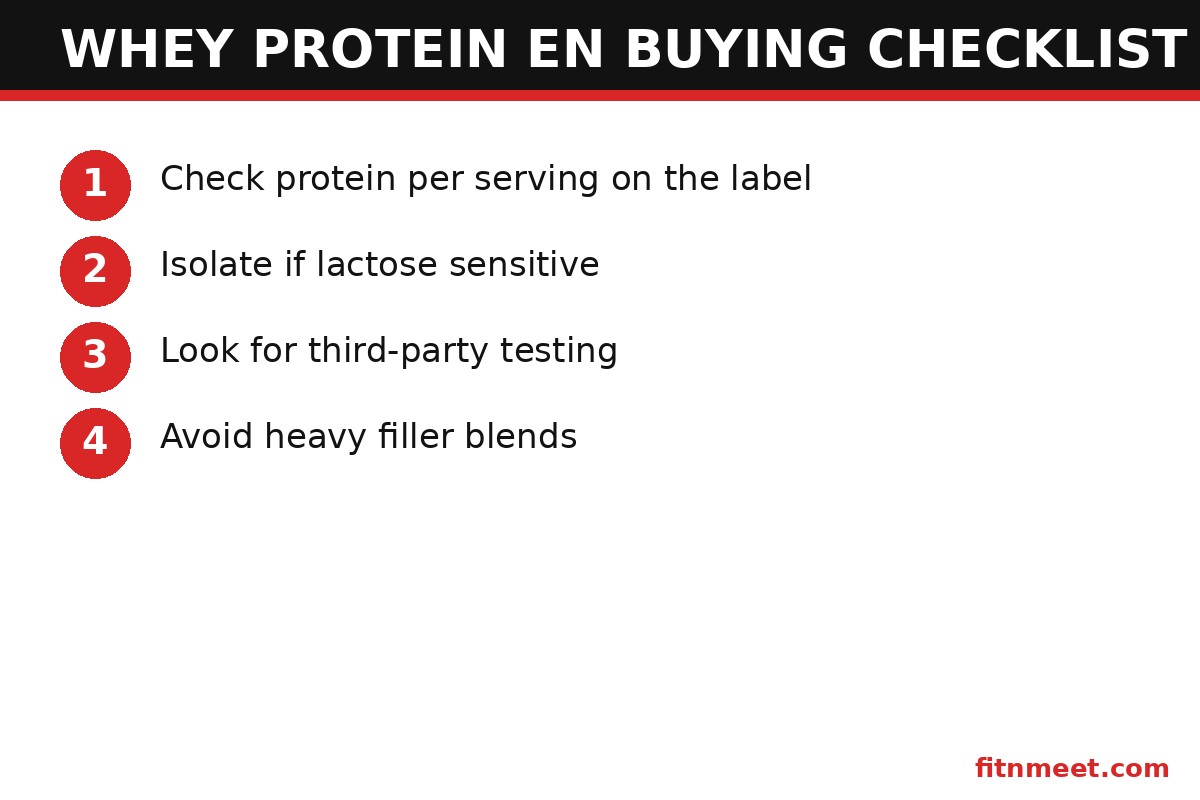
- Check the label: protein per serving ≥20 g, sugar ≤3 g, no “proprietary blend” hiding the dose, third-party tested (NSF/Informed Choice) if you compete.
- Flavor reality check: chocolate and vanilla mask whey best; unflavored is versatile for smoothies but chalky in water. Buy a small tub first.
Comparison conclusion: For ~80% of buyers, Whey Protein En concentrate is the right answer — cheapest per gram of protein, best taste, perfectly effective. Isolate earns its premium only for lactose issues or strict cutting. Hydrolysate is overkill for non-elites. Compare Whey Protein En options in FitnMeet’s protein category.
Once you have picked your type, learn how to buy vitamins online safely to avoid counterfeit or underdosed products.
If your decision points to isolate for lactose sensitivity or contest prep, 100% whey isolate chocolate delivers over 90% protein with minimal lactose. If concentrate wins on value, a whey protein concentrate gives you 20–24 g of protein per scoop at the lowest cost per gram.
Whey Protein En for Special Diets
Whey Protein En fits most eating patterns, but a few situations deserve specific guidance.
Lactose intolerance
As covered above, whey isolate is the answer: under 1 g of lactose per serving, tolerated by most sensitive individuals. If even isolate bothers you, look for isolate with added lactase enzyme, or switch to an egg-white or plant protein. Never assume a “whey blend” is safe — blends often lean heavily on concentrate.
Vegetarian and gluten-free diets
Whey protein is vegetarian (though not vegan) and naturally gluten-free. Flavored versions can include additives, so celiac buyers should check for certified gluten-free labeling — cross-contamination in flavoring facilities is the real risk, not the whey itself.
Diabetes and blood sugar
Whey protein has a notable insulinotropic effect — it stimulates insulin release, which is part of why it pairs well with post-workout carbs. For type 2 diabetics, small trials show whey taken before meals can blunt post-meal glucose spikes. That is a potential benefit, but anyone on glucose-lowering medication should discuss it with their doctor, since the combined effect could push blood sugar too low.
Older adults
Adults over 60 face anabolic resistance: muscles respond less to protein, so per-meal doses matter more. Research suggests 35–40 g of whey per meal maximally stimulates muscle protein synthesis in older adults, versus ~20 g in the young. For this group, Whey Protein En is arguably the single highest-value supplement — cheap, easy to consume, and directly targeting age-related muscle loss.
What about “too much protein”?
Healthy kidneys handle high protein fine, but there is still no reason to exceed ~2.2 g/kg/day for muscle goals — beyond that, extra protein is just expensive calories. One to two scoops of Whey Protein En daily sits comfortably inside evidence-based ranges for nearly everyone.
Special diets can leave micronutrient gaps, so review our complete guide to essential vitamins A through E for what to watch.
Whey Protein En Dosage
| Goal | Daily protein target | Typical This protein powder use |
|---|---|---|
| General fitness | 1.2–1.6 g/kg bodyweight | 1 scoop (20–25 g) post-workout or as a snack |
| Muscle growth | 1.6–2.2 g/kg bodyweight | 1–2 scoops daily to fill dietary gaps |
| Fat loss | 2.0–2.4 g/kg bodyweight | 1–2 scoops; isolate preferred for calorie control |
| Older adults (muscle preservation) | 1.2–1.6 g/kg bodyweight | 1 scoop daily; leucine content especially valuable |
Practical rules: one scoop is 20–30 g of powder; count the protein grams, not scoops. Spread intake across 3–5 meals at 0.3–0.5 g/kg per meal for optimal muscle protein synthesis. Mix with water for fewest calories, milk for extra protein and creaminess. For muscle-building nutrition around your shakes, see FitnMeet’s muscle development collection and sports nutrition range. Combine smart dosing with a solid program from the FitnMeet strength training category.
Safety and Side Effects
Whey Protein En is among the most-studied supplements in existence, with an excellent safety profile in healthy adults:
- Digestive issues — bloating or gas, almost always from lactose in concentrate; switching to isolate resolves it.
- Acne — some individuals report breakouts, possibly linked to milk-derived growth factors; not universal.
- Kidney concerns — high protein does not damage healthy kidneys (a persistent myth); those with existing kidney disease should consult a doctor about total protein intake.
- Heavy metals — independent tests have found trace contaminants in some cheap proteins; third-party tested products mitigate this.
Frequently Asked Questions
What is the difference between whey concentrate and isolate?
Whey Protein En concentrate is 70 to 80 percent protein and contains some lactose and fat, while isolate is filtered to 90 percent-plus protein with minimal lactose. Isolate costs 30 to 60 percent more per serving.
How much Whey Protein En should I take daily?
Most active adults do well with 1 to 2 scoops daily, providing 20 to 50 g of protein toward a total target of 1.6 to 2.2 g per kg of bodyweight for muscle growth. Count protein grams, not scoops.
Is Whey Protein En good for weight loss?
Yes. Whey Protein En is high in protein and low in calories, which preserves muscle and increases satiety during a deficit. Isolate is the leaner choice at about 120 calories per 25 g of protein.
Can lactose-intolerant people use Whey Protein En?
Yes, choose whey protein isolate, which contains less than 1 g of lactose per serving and is tolerated by most lactose-sensitive people. Avoid concentrate, which retains several grams of lactose.
When is the best time to take Whey Protein En?
Total daily protein matters far more than timing. That said, Whey Protein En is ideal post-workout or when training fasted, since its fast digestion delivers amino acids to muscles within about an hour.
Does Whey Protein En cause kidney damage?
No. In healthy adults, high protein intake including Whey Protein En does not damage kidneys, according to multiple reviews. People with existing kidney disease should discuss total protein intake with their doctor.
Which Whey Protein En is best for beginners?
A quality whey concentrate is the best beginner choice: lowest cost per gram of protein, best taste, and fully effective for muscle growth. Upgrade to isolate later only if lactose or strict cutting demands it.
Conclusion
Whey Protein En remains the king of protein supplements for a simple reason: no other source delivers 25 g of complete, leucine-rich protein as cheaply, conveniently, and tastily. Choose concentrate for value, isolate for lactose sensitivity or strict cuts, dose 1–2 scoops toward 1.6–2.2 g/kg daily, and let total intake — not timing magic — do the work.
Shop Whey protein and the full FitnMeet protein range to find the concentrate or isolate that fits your goals and budget.
This article is for informational purposes only and is not medical advice. Consult a healthcare professional before starting any supplement.