
Buying vitamins online safely means choosing reputable retailers, reading the full Supplement Facts label, checking for third-party testing seals (USP or NSF), verifying dosages against established daily values, and avoiding too-good-to-be-true claims. When you buy vitamins online from vetted sources, you get wider selection and better prices than brick-and-mortar stores — without the quality gamble.
Quick Answer: Buying Vitamins Online
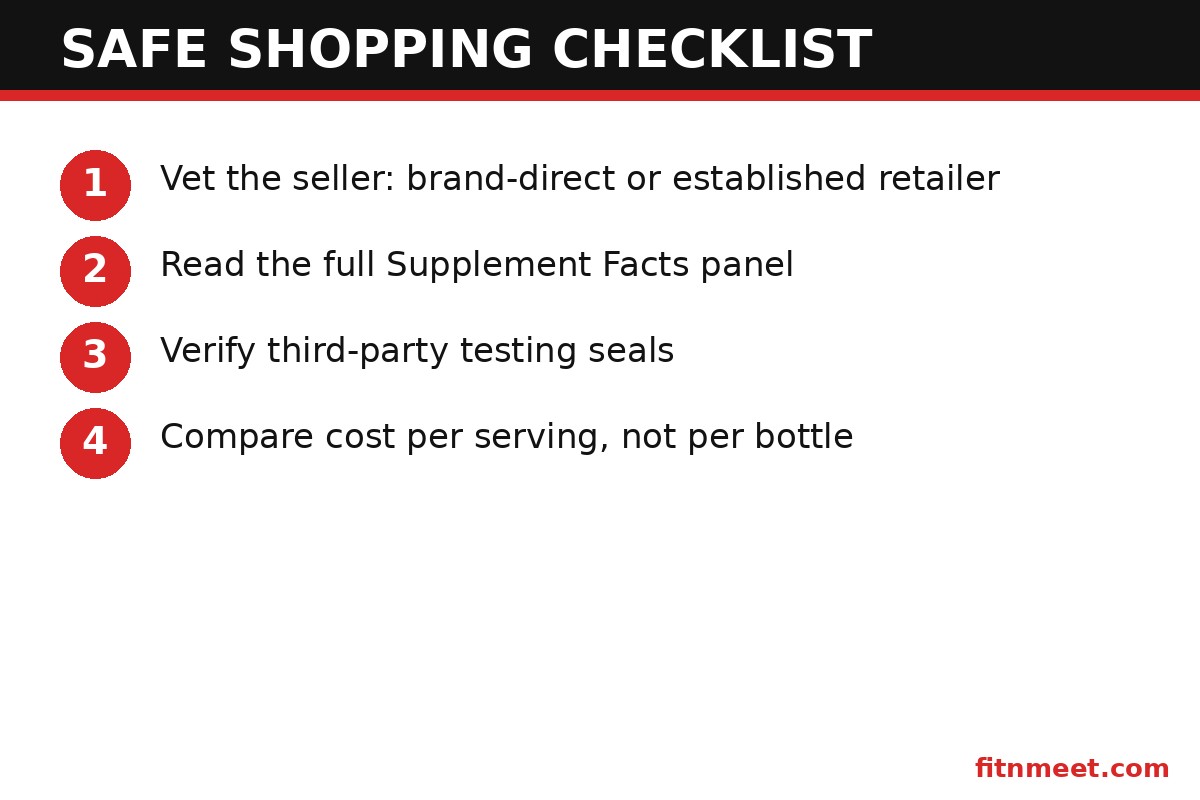
To buy vitamins online safely: (1) shop from established retailers or brand-direct stores with transparent contact information; (2) read the Supplement Facts panel — check serving size, dose per serving, and % Daily Value; (3) look for third-party testing seals such as USP Verified or NSF Certified; (4) compare the dose to your actual needs rather than buying the highest milligram count; (5) check expiration dates and storage guidance; (6) be skeptical of disease-cure claims, which are illegal for supplements. Follow those six rules and buying vitamins online is as safe as — often safer than — grabbing a bottle off a drugstore shelf.
What Does Buying Vitamins Online Involve?
Buying vitamins online means purchasing dietary supplements — vitamin D, vitamin C, B-complex, multivitamins, minerals, and specialty formulas — through e-commerce websites rather than physical stores. The category spans three main seller types: brand-direct stores (buying from the manufacturer’s own website), specialty supplement retailers (online shops focused on sports nutrition and wellness), and general marketplaces (large platforms where thousands of third-party sellers list products).
Understanding this landscape matters because quality control differs sharply between them. Brand-direct and established specialty retailers typically source straight from manufacturers with intact supply chains. Marketplaces, by contrast, have documented problems with counterfeit and expired supplements sold through third-party sellers — a 2023 investigation found that products bought from marketplace resellers were significantly more likely to have labeling discrepancies than the same products bought brand-direct. When you buy vitamins online, where you buy is as important as what you buy.
It also helps to understand what “vitamins” covers legally. In the United States, vitamins are regulated as dietary supplements under the Dietary Supplement Health and Education Act of 1994 (DSHEA). The critical fact every online shopper should know: the FDA does not review dietary supplements for safety and effectiveness before they reach the market — manufacturers are responsible for ensuring their products are safe and accurately labeled. The FDA’s dietary supplements Q&A states this plainly. This is precisely why third-party testing seals and retailer reputation matter so much when you buy vitamins online: the pre-market safety net most consumers assume exists does not.
1 Pro tip: Before you buy vitamins online, write down why you want each vitamin. “Vitamin D because my bloodwork showed 18 ng/mL” leads to smart dosing; “multivitamin because everyone takes one” leads to a drawer of half-finished bottles.
For the full breakdown of each vitamin, see our vitamins A to E benefits and dosage guide.
Why Buy Vitamins Online?
The shift toward buying vitamins online is not just convenience — there are structural reasons online shopping serves supplement buyers better, provided you shop carefully.
Selection. A typical drugstore stocks 100–200 supplement SKUs; a good online retailer stocks thousands. If you need a specific form — say, vitamin D3 in olive oil drops rather than tablets, or methylated B-complex rather than standard — you will find it online in minutes. Niche needs (allergen-free, vegan capsules, specific doses) are essentially only served well by online vitamin retailers.
Price transparency. When you buy vitamins online, comparing cost-per-serving across ten products takes minutes. In a store, you are comparing front labels while standing in an aisle. Online, you can divide bottle price by serving count and dose to find the true cheapest effective option — a calculation that routinely reveals the “premium” bottle is 3x the price per milligram of the equivalent standard product.
Information access. Online product pages can carry full Supplement Facts panels, third-party lab reports (Certificates of Analysis), customer reviews, and Q&A sections. A physical bottle gives you a tiny label. For an informed buyer, buying vitamins online provides more information, not less — if you actually read it.
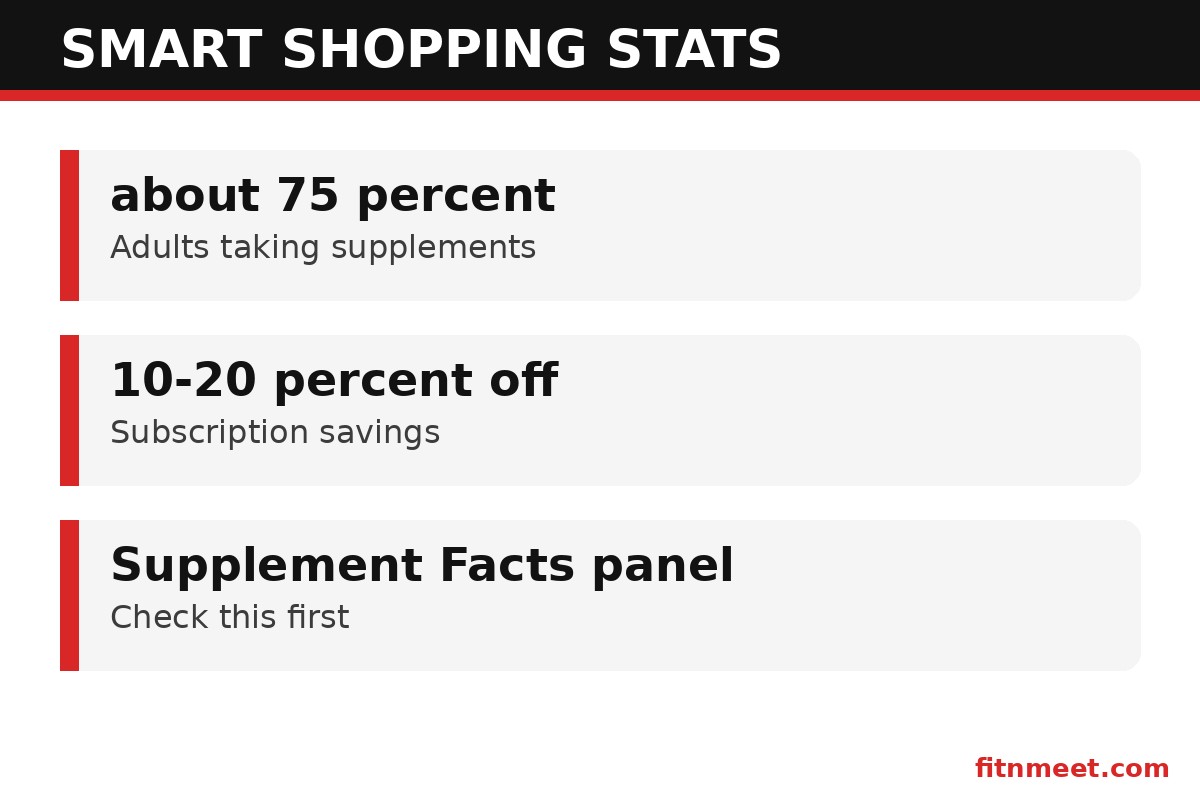
Subscription savings. Most online vitamin retailers offer 10–20% subscription discounts for staples you take daily (vitamin D, multivitamins). Over a year, that is real money on products with no reason to buy at full retail.
Did you know? Surveys by the Council for Responsible Nutrition consistently find that around three-quarters of U.S. adults take dietary supplements — yet fewer than 1 in 4 can correctly explain what third-party testing seals mean. When you buy vitamins online, that knowledge gap is what separates smart shoppers from marketing victims.
Access to testing data. The best online sellers publish Certificates of Analysis or link to USP/NSF verification. Try asking a cashier for a heavy-metals report — then appreciate what buying vitamins online from a transparent retailer offers.
Step-by-Step Guide to Buying Vitamins Online
Follow this process every time you buy vitamins online, and you will filter out the vast majority of bad products before spending a cent.
Step 1: Define the need
- Get bloodwork if possible — vitamin D (25-OH), B12, ferritin, and magnesium (RBC) are the tests that most often change supplement decisions.
- Match the vitamin to a real gap: low D → D3; tingling/fatigue → check B12; heavy training → consider magnesium and zinc.
- Write down the target dose before browsing, so marketing does not set it for you.
Step 2: Vet the seller
- Prefer brand-direct stores and established specialty retailers with real contact information, published quality policies, and a physical business address.
- On marketplaces, buy only from the brand’s official storefront — not the cheapest third-party reseller. Check seller ratings and how long the account has existed.
- Search “[brand name] + third-party testing” and “[brand name] + lawsuit/recall” before buying vitamins online from an unfamiliar company.
2 Pro tip: When you buy vitamins online, screenshot or save the product page showing the Supplement Facts panel. If the formula changes later, you have proof of what you originally bought — useful for both safety and subscription management.
Step 3: Read the Supplement Facts panel like a professional
- Serving size vs. container: a “60-tablet” bottle with a 2-tablet serving is 30 servings. Always compute price per serving, not per bottle.
- Dose per serving and % Daily Value: 5,000% DV of B12 looks impressive but is usually pointless — B12 absorption caps at a few micrograms per dose. Match the dose to your target, not to the biggest number.
- Form matters: D3 (cholecalciferol) over D2 for vitamin D; methylcobalamin or cyanocobalamin both work for B12; magnesium glycinate or citrate over oxide for absorption; look for these specifics when you buy vitamins online.
- “Other ingredients”: shorter is better. Avoid products loaded with artificial colors, and note allergens (soy, gluten, shellfish) if relevant.
- Proprietary blends: in vitamins these hide how much of each nutrient you get. For basic vitamins there is no legitimate reason to hide doses — prefer fully transparent labels.
Step 4: Verify third-party testing
- Look for USP Verified, NSF Certified, or Informed-Choice/Sport seals on the label or product page. These programs test that the bottle contains what the label claims, in the claimed amounts, without harmful contaminants.
- No seal does not automatically mean a bad product — testing costs money that small brands may not have — but a seal is the strongest single trust signal when you buy vitamins online.
- Be wary of fake-looking seals. Real programs are verifiable: USP and NSF both maintain online directories of certified products.
Step 5: Check reviews critically
- Read 2- and 3-star reviews first — they contain the real complaints (stomach upset, huge pills, late expiry).
- Distrust products with thousands of 5-star reviews posted within days of each other, or reviews that read like ad copy.
- Look for reviews mentioning specific, verifiable outcomes (“my D levels went from 19 to 42 ng/mL in 3 months”) over vague praise (“amazing energy!”).
Step 6: Confirm logistics before checkout
- Check the expiration date policy — reputable sellers disclose it or guarantee 12+ months of shelf life.
- Consider shipping conditions: gummies can melt in summer heat; probiotics may need cold packs. Vitamins them
- selves are generally heat-stable, but packaging matters.
- Compare the final price per serving including shipping, not the headline bottle price.
For mineral dosing done right, see our zinc picolinate dosage guide.
Dosage Guide: How Much to Buy
One of the most common errors when people buy vitamins online is purchasing doses far above — or pointlessly below — what they need. Use this reference table of common vitamins, anchored to U.S. Daily Values and Tolerable Upper Intake Levels (ULs) from the National Academies, summarized on the NIH Office of Dietary Supplements fact sheets:
| Vitamin | Daily Value (adult) | Upper limit (UL) | Common online dose |
|---|---|---|---|
| Vitamin D3 | 15 mcg (600 IU) | 100 mcg (4,000 IU) | 25–50 mcg (1,000–2,000 IU) |
| Vitamin C | 90 mg | 2,000 mg | 250–1,000 mg |
| Vitamin B12 | 2.4 mcg | None established | 25–100 mcg (daily) or 1,000 mcg (weekly) |
| Magnesium | 420 mg (men) / 320 mg (women) | 350 mg (supplemental) | 100–300 mg |
| Zinc | 11 mg (men) / 8 mg (women) | 40 mg | 8–15 mg |
| Vitamin A (preformed) | 900 mcg RAE | 3,000 mcg RAE | Avoid high-dose unless prescribed |
| Iron | 18 mg (premenopausal women) | 45 mg | Only if deficient — test first |
Two principles to carry with you every time you buy vitamins online. First, more is not better: fat-soluble vitamins (A, D, E, K) accumulate in tissue, and exceeding the UL of vitamin A or D can cause real harm. Second, match the dose to the deficiency: someone with a vitamin D level of 15 ng/mL needs a different strategy than someone at 35 ng/mL maintaining. When in doubt, the standard daily-value-range product beats the mega-dose — you can read the underlying nutrient science on Wikipedia’s vitamin overview.
Did you know? Vitamin D deficiency affects an estimated 1 billion people worldwide (Holick, 2017). It is the single most common reason people buy vitamins online — and also the nutrient where a $15 blood test most often prevents both under- and over-dosing. For more on filling nutrient gaps through food first, explore the FitnMeet nutrition articles.
Benefits of Buying Vitamins Online
Beyond the selection and price advantages covered earlier, buying vitamins online offers several practical benefits worth naming explicitly:
- Access to full lab documentation. Top online sellers publish Certificates of Analysis showing heavy-metal and potency test results. This level of transparency is nearly impossible to get from a physical shelf.
- Auto-delivery for daily staples. Vitamins you take every day — D3, multivitamins, magnesium — are ideal for subscriptions: 10–20% off, no stockouts, and one less errand.
- Niche formulations. Allergen-free, vegan, kosher, halal, dye-free, specific-dose, and practitioner-grade lines are overwhelmingly an online phenomenon.
- Better comparison tools. Side-by-side Supplement Facts panels, cost-per-serving calculators, and filtered searches by certification make it faster to buy vitamins online intelligently than to comparison-shop in person.
- Privacy and comfort. No awkward questions, no upsell at the register — research at your own pace.
🛒 Your smart shopping list — starter stack for most adults:
- Vitamin D3, 25 mcg (1,000 IU) daily — the most common deficiency
- A quality multivitamin or targeted B-complex — not both
- Magnesium glycinate, 100–200 mg in the evening
- Vitamin C, 250–500 mg — cheap insurance, especially in winter
Find vetted staples in FitnMeet’s vitamins collection and health support range — then compare labels using the checklist above before you buy vitamins online anywhere.
If you prefer a chewable format for your daily multi, multivitamin gummies for adults make the habit easy to stick with — just confirm the dose per gummy matches your target on the Supplement Facts panel.
Mistakes to Avoid When Buying Vitamins Online
These are the errors that cost online vitamin shoppers the most money — or worse, their health:
1. Buying the highest dose available
Marketing trains shoppers to equate milligrams with value. In vitamins, the relationship is often inverse: a 5,000 mcg B12 tablet is not “stronger” than a 100 mcg one in any meaningful way, because absorption saturates. Buy the dose that matches your need, not the biggest number on the page.
2. Ignoring % Daily Value math
A multivitamin at 100% DV plus a standalone vitamin C at 1,000 mg (1,111% DV) plus a “immune blend” with more C can quietly push you past the 2,000 mg UL. When you buy vitamins online, add up overlapping nutrients across all products you take — stacking is the most common route to excessive intake.
3. Trusting disease claims
Any product page claiming a vitamin “cures,” “treats,” or “prevents” a named disease is breaking the law — supplements may only make structure/function claims (“supports immune health”) with an FDA disclaimer. Disease claims are the brightest red flag when you buy vitamins online; legitimate sellers do not make them.
4. Skipping the “other ingredients”
Two vitamin D3 products can have identical active doses and wildly different filler profiles. If you react to soy, gluten, or artificial sweeteners, the “other ingredients” line is where problems hide.
5. Buying from unknown marketplace resellers
The cheapest listing for a popular vitamin is very often a third-party reseller — the exact channel where counterfeit, expired, or improperly stored supplements concentrate. Saving 15% is not worth a bottle of unknown provenance.
6. Hoarding sale bottles past expiry
Vitamins degrade: vitamin C oxidizes, fish-oil-adjacent products go rancid, and potency declines after expiration. Buying a 3-year supply because it was 50% off is false economy.
3 Pro tip: Set a phone reminder for two weeks before a subscription shipment. That pause is your chance to reassess: do blood levels still justify this dose, or was this a 3-month correction course that should end?
High-dose D3 needs extra care, so review our vitamin D3 5000 IU dosing and safety guide.
Vitamins Online vs In-Store: Comparison
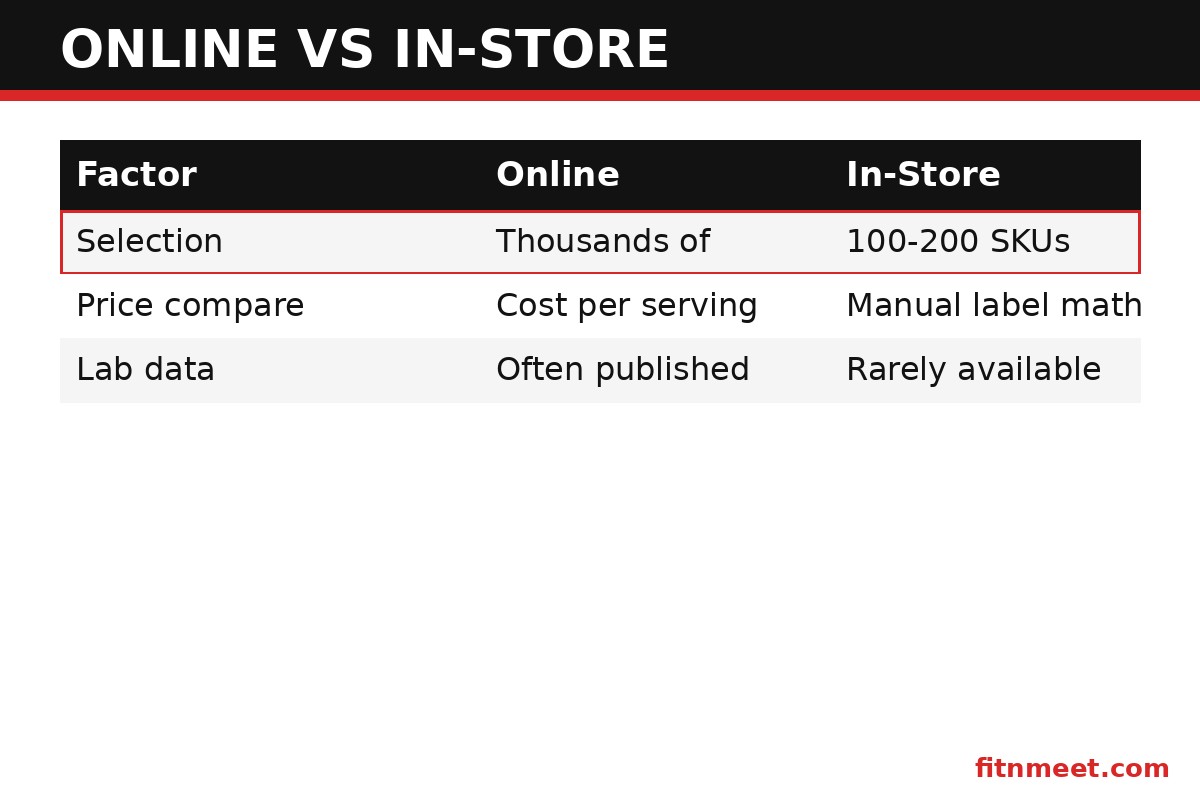
| Factor | Buying Vitamins Online | Buying In-Store |
|---|---|---|
| Selection | Thousands of SKUs, niche forms | 100–200 SKUs, mainstream only |
| Price comparison | Cost-per-serving in minutes | Manual label math in the aisle |
| Lab/test data access | Certificates often published | Rarely available |
| Immediacy | 2–5 day shipping wait | Same-day |
| Counterfeit risk | Higher on marketplaces; low brand-direct | Very low |
| Subscriptions | 10–20% off, auto-delivery | Rare |
| Expert guidance | Reviews + Q&A (variable quality) | Pharmacist (high quality, limited time) |
The balanced verdict: buy vitamins online for selection, price, and documentation — but buy brand-direct or from e
stablished specialty retailers, not the cheapest marketplace reseller. Use in-store purchases for urgent needs and for the occasional pharmacist consultation. The channels complement each other; neither is universally superior. For more supplement-buying guides, visit the FitnMeet blog.
If you prefer a chewable option, read our vitamin C gummies research review.
Side Effects and Safety Notes
Vitamins are not risk-free, and buying vitamins online in mega-doses amplifies the risks. Key safety notes:
- Fat-soluble vitamins accumulate. Chronic vitamin A intake above the 3,000 mcg RAE UL can cause liver damage and bone thinning; vitamin D above 4,000 IU/day long-term risks hypercalcemia. These are the nutrients where “more” genuinely hurts.
- Iron is the most dangerous common mineral. Iron overdose is a leading cause of pediatric poisoning fatalities. Never buy vitamins online containing iron for a household with small children unless specifically prescribed — and keep all iron products locked away.
- Nutrient interactions are real. Calcium inhibits iron absorption (separate them by 2+ hours); zinc above 40 mg/day long-term can induce copper deficiency; vitamin K can interfere with warfarin. A quick check of interactions beats learning the hard way.
- Start low with new products. Even quality vitamins can cause nausea (iron, zinc on empty stomachs) or vivid dreams (B6 at night). Half-dose for a few days when trying something new.
- Supplements are not substitutes. No vitamin replaces sleep, training, or a decent diet. They fill gaps — the word “supplement” is the job description.
Frequently Asked Questions
Is it safe to buy vitamins online?
Yes, when you buy vitamins online from reputable sources. Choose brand-direct stores or established specialty retailers, look for third-party testing seals (USP, NSF), and read the full Supplement Facts panel. Avoid the cheapest third-party marketplace resellers, where counterfeit and expired supplements concentrate.
How do I know if online vitamins are good quality?
Check for third-party testing seals (USP Verified, NSF Certified, Informed-Choice), transparent Supplement Facts labels with exact doses, published Certificates of Analysis, and realistic claims. Products making disease-cure claims or hiding doses in proprietary blends are red flags when you buy vitamins online.
Are online vitamins cheaper than store vitamins?
Usually yes. When you buy vitamins online you can compare cost-per-serving across products in minutes, access subscription discounts of 10–20%, and find niche formulations stores do not stock. Always compare price per serving — not per bottle — including shipping.
What should I check on the label before buying vitamins online?
Check serving size and servings per container, dose per serving with % Daily Value, the specific nutrient form (D3 over D2, glycinate over oxide), the ‘other ingredients’ list for allergens, and the expiration date. Compute cost per serving before deciding.
Can I overdose buying vitamins online?
Yes — easy access makes it easier to stack overlapping products past safe limits. Fat-soluble vitamins (A, D, E, K) accumulate in tissue, and iron overdose is dangerous, especially for children. Add up each nutrient across everything you take and stay under the Tolerable Upper Intake Level (UL).
Do I need a prescription to buy vitamins online?
No. Vitamins are dietary supplements and do not require a prescription. However, high-dose iron, vitamin A, or vitamin D used to correct a diagnosed deficiency should be guided by bloodwork and a clinician — buying vitamins online does not replace medical advice for deficiency treatment.
Conclusion
Buying vitamins online is the smartest way to shop for supplements — wider selection, transparent pricing, access to lab data, and subscription savings that physical stores cannot match. But the online market rewards informed buyers and punishes careless ones. The six-rule filter never changes: define the need, vet the seller, read the full label, verify third-party testing, check reviews critically, and confirm the logistics. Run every purchase through that process, and the vitamins arriving at your door will be exactly what the label promises at a fair price.
Start your next order on solid ground: browse FitnMeet’s vitamins collection and the health support range, compare labels with the checklist in this guide, and shop the full FitnMeet store with confidence.
This article is for informational purposes only and is not medical advice. Consult a healthcare professional before starting any supplement, especially if you are pregnant, nursing, taking medication, or managing a medical condition.