
TL;DR: A vitamin A B C D E supplement covers the five most commonly under-consumed vitamin groups: A for vision and immunity, B-complex for energy metabolism, C for immunity and collagen, D for bones, and E as an antioxidant. For most people, a varied diet of colorful produce, whole grains, and healthy fats covers all five — a vitamin A B C D E supplement exists to fill the specific gaps your diet leaves behind.
At a glance: 5 vitamin groups · 3 fat-soluble · 2 water-soluble groups · ~35% of US adults low in vitamin D · 8 distinct B vitamins
Contents:
- Key Stats Snapshot: Vitamin A B C D E Supplement Facts
- What Is a Vitamin A B C D E Supplement?
- Benefits of a Vitamin A B C D E Supplement
- How a Vitamin A B C D E Supplement Works in the Body
- Vitamin A B C D E Supplement Dosage Guide: How Much Do You Need?
- Vitamin A B C D E Supplement Comparison
- Side Effects and Safety of Vitamin A B C D E Supplements
- Food-First Alternatives to a Vitamin A B C D E Supplement
- Frequently Asked Questions About Vitamin A B C D E Supplements
Key Stats Snapshot: Vitamin A B C D E Supplement Facts
- ~35% of US adults have low vitamin D — NHANES data: roughly one in three US adults has blood levels below 20 ng/mL.
- Hundreds of biochemical roles — the 8 B vitamins act as coenzymes in hundreds of energy-metabolism reactions.
- Vitamin A RDA: 900 / 700 mcg — retinol activity equivalents (RAE) per day for adult men / women.
- Vitamin C RDA: 90 / 75 mg — smokers need an extra 35 mg daily due to higher oxidative stress.
These headline numbers frame the whole story behind any vitamin A B C D E supplement: these nutrients are needed in tiny amounts, but shortfalls are surprisingly common — and each of the five groups does a fundamentally different job in the body.
What Is a Vitamin A B C D E Supplement?
A vitamin A B C D E supplement is any product — usually a multivitamin or a targeted formula — designed to deliver the five lettered vitamin groups: A, the B-complex family, C, D, and E. “Essential” means your body cannot make enough of them on its own, so they must come from food or from a vitamin A B C D E supplement. Together, these five groups cover an enormous share of human physiology — from the retina of your eye to the mineralization of your bones.
A useful first split: vitamins A, D, and E are fat-soluble — they dissolve in fat, are stored in the liver and fatty tissues, and do not need to be consumed every single day. The B vitamins and vitamin C are water-soluble — they dissolve in water, are not stored in large amounts, and need regular replenishment. This single distinction explains most of the practical differences in how a vitamin A B C D E supplement is dosed and how deficiency develops.
Note that “B” in any vitamin A B C D E supplement is actually a family of eight distinct vitamins: B1 (thiamine), B2 (riboflavin), B3 (niacin), B5 (pantothenic acid), B6 (pyridoxine), B7 (biotin), B9 (folate), and B12 (cobalamin). You can read the chemistry and history of each on Wikipedia’s vitamin overview.
Why group vitamins A, B, C, D, and E together at all? Because they are the five vitamin groups most people ask about, most likely to be under-consumed, and most commonly sold as supplements. Understanding them as a set — rather than as five isolated pills — is the fastest way to build a sane supplementation strategy.
Benefits of a Vitamin A B C D E Supplement
Each group covered by a vitamin A B C D E supplement earns its place with distinct, evidence-backed roles:
- Vitamin A — vision and immunity: forms retinal, the light-sensing molecule in the retina, and maintains the integrity of skin and mucosal barriers — the body’s first line of immune defense. The WHO estimates vitamin A deficiency blinds 250,000–500,000 children per year worldwide, making it the leading preventable cause of childhood blindness.
- B vitamins — energy metabolism: act as coenzymes that convert food into cellular energy (ATP). B12 and folate are additionally essential for red blood cell formation and DNA synthesis. Marginal B12 status affects an estimated up to 20% of US adults over 60, often silently.
- Vitamin C — antioxidant defense and collagen: a potent water-soluble antioxidant that drives collagen synthesis (for skin, tendons, and blood vessels) and improves non-heme iron absorption from plant foods. Severe deficiency causes scurvy — rare today, but suboptimal intake is common in smokers and people with low fruit and vegetable consumption.
- Vitamin D — bone health and immune regulation: controls calcium absorption and bone mineralization, and modulates immune function. Beyond the ~35% of US adults with low blood levels, deficiency risk climbs in northern latitudes, darker-skinned individuals, and anyone who works indoors year-round.
- Vitamin E — cell membrane protection: the body’s primary fat-soluble antioxidant, protecting cell membranes from oxidative damage. True deficiency is rare, but vitamin E works in concert with vitamin C and selenium in the antioxidant network.
For lifters, the B-complex and vitamin D entries matter most: energy metabolism powers training, and vitamin D status correlates with muscle function in multiple observational studies. A quality vitamin A B C D E supplement from FitnMeet’s vitamins collection covers the full A-through-E range for filling dietary gaps.
How a Vitamin A B C D E Supplement Works in the Body
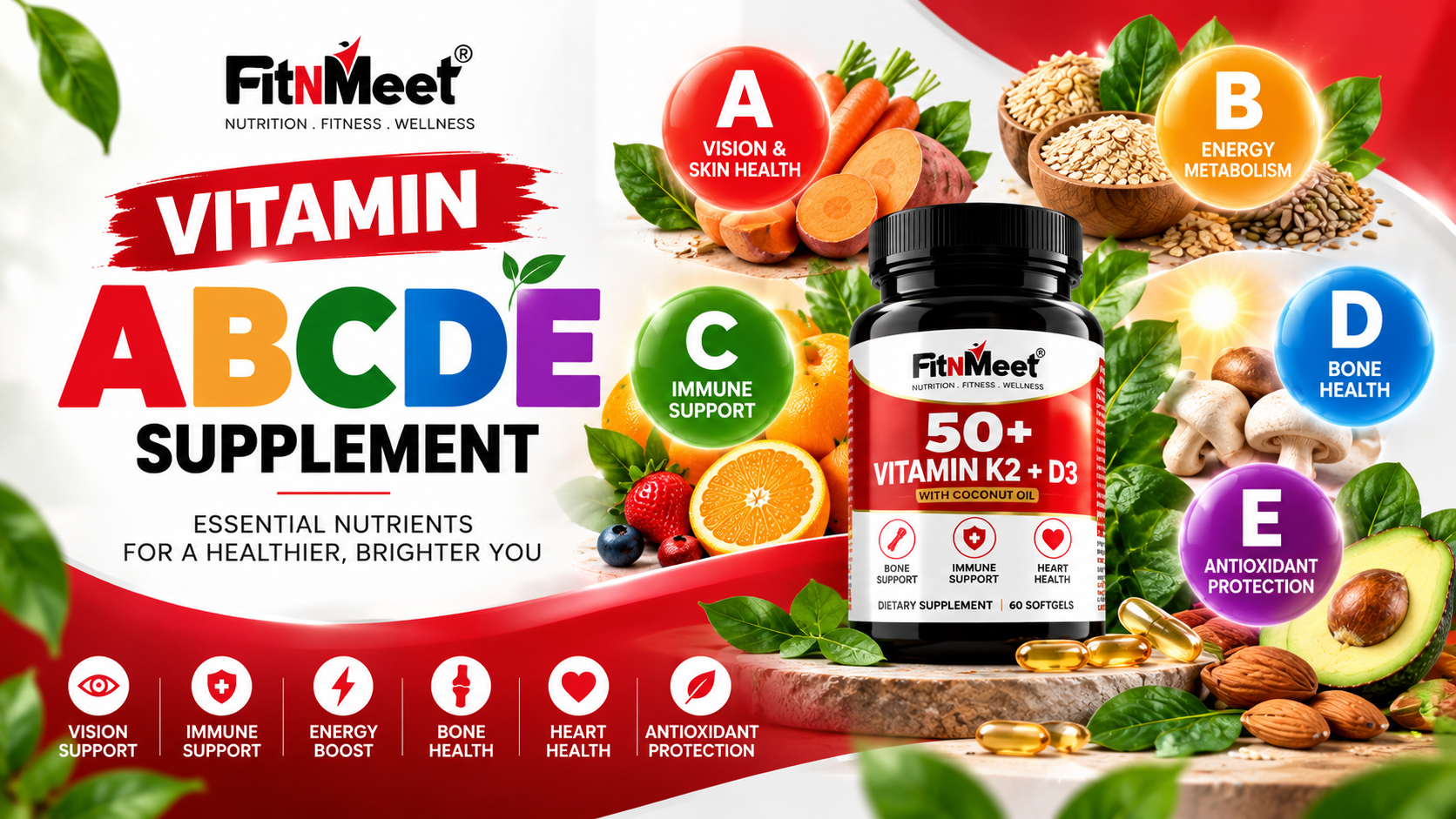
The nutrients in a vitamin A B C D E supplement work through three broad mechanisms: coenzyme action, gene regulation, and antioxidant defense.
Coenzyme action (mostly B vitamins): B1, B2, B3, B5, and B6 become parts of enzyme complexes that strip energy from carbohydrates, fats, and proteins. Without enough B vitamins, the metabolic machinery literally runs slower — which is why B-complex deficiency shows up as fatigue and weakness before anything else.
Gene regulation (vitamins A and D): these two are unusual — they act more like hormones than classic vitamins. Vitamin A’s active form (retinoic acid) and vitamin D’s active form (calcitriol) bind to nuclear receptors that switch genes on and off, controlling cell differentiation, immune responses, and calcium handling. This hormone-like behavior is why vitamins A and D have tolerable upper limits: more is not always better, even in a vitamin A B C D E supplement.
Antioxidant defense (vitamins C and E): training, pollution, and normal metabolism generate free radicals — unstable molecules that damage cells. Vitamin E neutralizes them in fatty environments (like cell membranes), while vitamin C does the same in watery environments (like blood plasma) and even regenerates used-up vitamin E. They are a team, which is one more reason to think of a vitamin A B C D E supplement as a set rather than five isolated pills.
The NIH fact sheet on vitamin A and the NIH fact sheet on vitamin D detail these mechanisms with full references for readers who want the deep science.
Vitamin A B C D E Supplement Dosage Guide: How Much Do You Need?
Use this checklist to set sensible daily targets — whether from food, a vitamin A B C D E supplement, or both. Doses below are adult RDAs unless noted:
- ☐ Vitamin A: 900 mcg RAE (men) / 700 mcg RAE (women). Upper limit: 3,000 mcg — do not exceed long-term.
- ☐ B-complex: varies by member — key anchors are B12 at 2.4 mcg and folate at 400 mcg DFE daily. B6 upper limit is 100 mg.
- ☐ Vitamin C: 90 mg (men) / 75 mg (women), plus 35 mg extra for smokers. Upper limit: 2,000 mg.
- ☐ Vitamin D: 600 IU (15 mcg) under age 70; 800 IU (20 mcg) at 70+. Upper limit: 4,000 IU. Get a blood test if you suspect deficiency — dosing blind is guessing.
- ☐ Vitamin E: 15 mg alpha-tocopherol daily. Upper limit: 1,000 mg — high doses can interfere with blood clotting.
- ☐ Food first: audit your diet for a week before buying a vitamin A B C D E supplement; many people meet A, C, and E needs from food alone.
- ☐ Re-test, don’t guess: vitamin D and B12 are cheap to test and worth confirming, especially if you train hard or eat plant-based.
Fill the gaps, not the guesswork. If your diet audit shows shortfalls, targeted supplementation beats a random multivitamin. Browse FitnMeet’s vitamins collection and shop to match products to the exact gaps you found.
Vitamin A B C D E Supplement Comparison
This table puts the five groups covered by a vitamin A B C D E supplement side by side:
| Vitamin group | Solubility | Adult RDA | Top food sources | Deficiency red flags |
|---|---|---|---|---|
| A | Fat-soluble | 900/700 mcg | Liver, sweet potato, carrots, spinach | Night blindness, dry eyes |
| B-complex | Water-soluble | Varies (B12: 2.4 mcg) | Meat, eggs, legumes, whole grains | Fatigue, anemia, nerve tingling (B12) |
| C | Water-soluble | 90/75 mg | Citrus, bell peppers, kiwi, strawberries | Bleeding gums, slow wound healing |
| D | Fat-soluble | 600–800 IU | Sunlight, fatty fish, fortified milk | Bone pain, muscle weakness |
| E | Fat-soluble | 15 mg | Almonds, sunflower seeds, wheat germ oil | Rare; nerve issues in severe cases |
The pattern worth memorizing: the fat-soluble members of a vitamin A B C D E supplement (A, D, E) carry overdose risk because the body stores them, while the water-soluble members (B-complex, C) carry deficiency risk because the body does not. That asymmetry should drive every dosing decision you make.
Side Effects and Safety of Vitamin A B C D E Supplements
The nutrients in a vitamin A B C D E supplement are safe at food and RDA-level doses. Problems start with megadoses — almost always from supplements, not food:
- Vitamin A toxicity: chronic intake above 3,000 mcg RAE can cause liver damage, bone thinning, and birth defects. This is the most dangerous overdose profile in any vitamin A B C D E supplement — respect the upper limit.
- Vitamin D toxicity: very high doses (typically 10,000+ IU/day for months) raise blood calcium, causing nausea, weakness, and kidney problems. Rare but real.
- Vitamin E: doses near the 1,000 mg upper limit may increase bleeding risk, especially combined with blood thinners.
- Vitamin C: the safest member of a vitamin A B C D E supplement at high doses; excess mostly causes digestive upset and is excreted. Still, stay under 2,000 mg/day.
- B vitamins: generally safe, but chronic B6 above 100 mg/day can cause nerve damage — the one B vitamin with a meaningful toxicity profile.
- Drug interactions: vitamin E with anticoagulants needs care; vitamin D plus thiazide diuretics can raise calcium. Check with a pharmacist if you take prescription drugs.
Food-First Alternatives to a Vitamin A B C D E Supplement
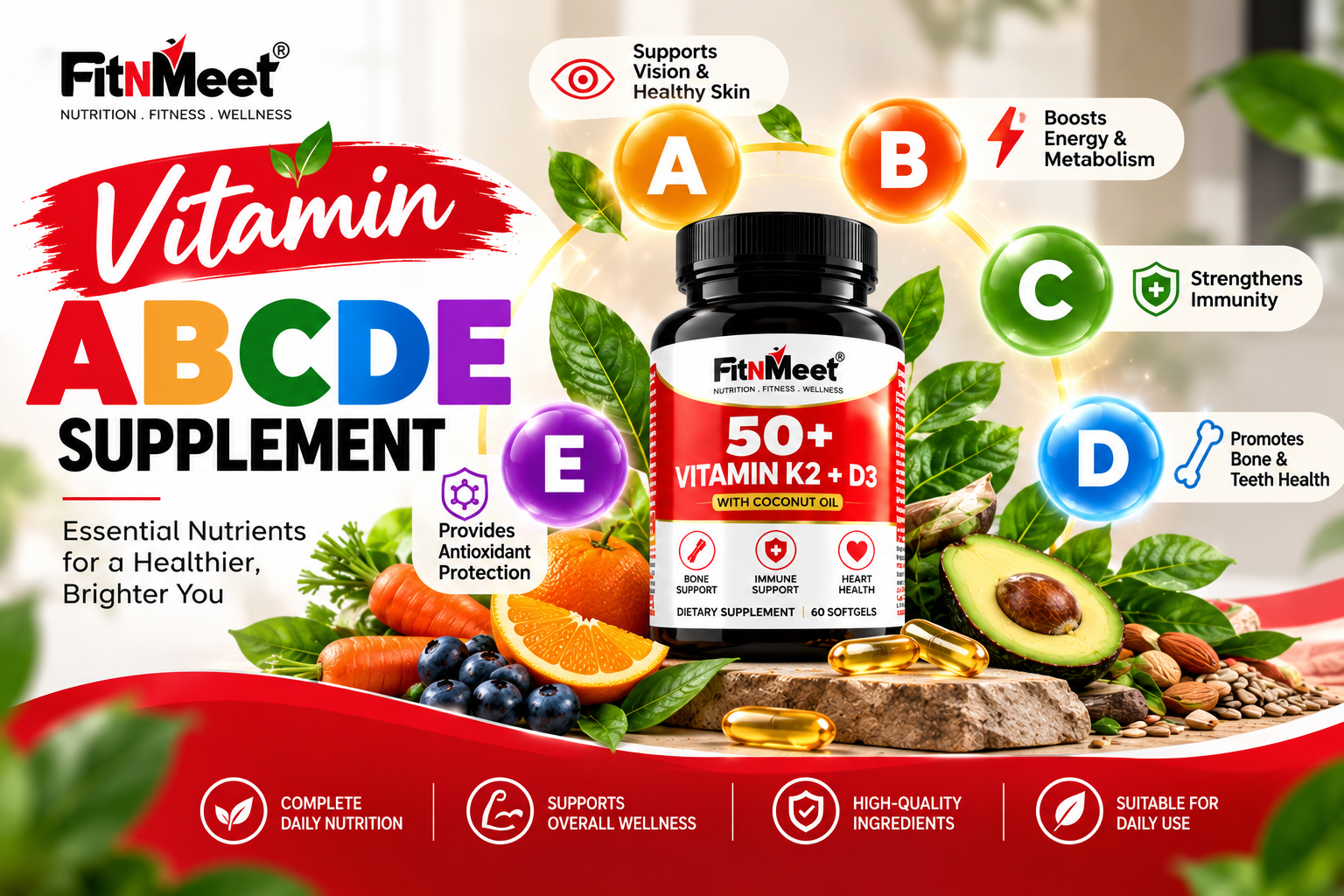
Supplements are gap-fillers, not foundations. Before buying a vitamin A B C D E supplement, try the food-first route:
- Vitamin A: one medium sweet potato delivers over 1,000 mcg RAE — more than a full day’s RDA in a single food.
- B vitamins: eggs, lentils, and whole grains cover most of the complex; nutritional yeast is the plant-based standout for B12-fortified options.
- Vitamin C: one large bell pepper provides roughly 150 mg — nearly double the men’s RDA.
- Vitamin D: 10–20 minutes of midday sun on arms and legs a few times weekly; fatty fish (salmon, sardines) for dietary intake.
- Vitamin E: a 30 g handful of almonds supplies about 7–8 mg, half the daily target.
When diet alone cannot close the gap — restrictive diets, indoor lifestyles, heavy training loads — a vitamin A B C D E supplement makes sense. Explore FitnMeet’s health support and anti-aging ranges alongside the core vitamins collection.
Frequently Asked Questions About Vitamin A B C D E Supplements
What is a vitamin A B C D E supplement good for?
A vitamin A B C D E supplement collectively supports vision and immunity (A), energy metabolism and red blood cell formation (B-complex), antioxidant defense and collagen synthesis (C), bone health and immune regulation (D), and cell membrane protection (E). These are the five most commonly supplemented vitamin groups because shortfalls in one or more are widespread.
Which vitamins in a vitamin A B C D E supplement are fat-soluble?
Vitamins A, D, and E are fat-soluble, meaning they dissolve in fat and are stored in the liver and fatty tissues. The B vitamins and vitamin C are water-soluble and need regular replenishment. This is why overdosing is a bigger concern with A, D, and E, while deficiency is the bigger concern with B-complex and C.
Can I take all the vitamins in a vitamin A B C D E supplement together?
Yes — they are commonly combined in multivitamins, and balanced diets provide them together. The main caution is total dosage: keep vitamin A under 3,000 mcg RAE, vitamin D under 4,000 IU, and vitamin E under 1,000 mg daily from all sources combined.
What are the signs of deficiency in vitamins A, B, C, D, and E?
Red flags include night blindness (A), fatigue and tingling in hands/feet (B12), bleeding gums and slow wound healing (C), bone pain and frequent illness (D), and — rarely — nerve problems (E). Blood tests can confirm D and B12 status directly.
How much of each vitamin do I need daily from a vitamin A B C D E supplement?
Adult RDAs: vitamin A 900/700 mcg, B12 2.4 mcg, folate 400 mcg, vitamin C 90/75 mg, vitamin D 600–800 IU, vitamin E 15 mg. Needs rise with smoking (vitamin C), limited sun (vitamin D), plant-based diets (B12), and pregnancy (folate).
Is it better to get vitamins A, B, C, D, and E from food or from a vitamin A B C D E supplement?
Food first is the standard advice: nutrients from whole foods come with fiber and co-factors, and overdose risk is essentially zero. A vitamin A B C D E supplement is the right tool when diet, sunlight, or life stage leaves a measurable gap — confirmed by diet audit or blood test where possible.
Can a vitamin A B C D E supplement help with gym performance?
Indirectly. B vitamins drive the energy metabolism that powers training, vitamin D status is linked to muscle function in observational research, and vitamin C supports connective-tissue repair. No vitamin in the A B C D E set is a direct performance enhancer like creatine or caffeine.
Are there side effects of taking a vitamin A B C D E supplement?
At RDA doses, side effects are rare. Risks come from megadoses: vitamin A above 3,000 mcg can damage the liver, excess vitamin D raises blood calcium, high vitamin E may increase bleeding risk, and chronic B6 above 100 mg can harm nerves. Vitamin C excess mainly causes stomach upset.
Vitamins A, B, C, D, and E are five groups, three mechanisms, and one simple strategy: eat a varied diet, get some sun, and use a vitamin A B C D E supplement only for the gaps you can name. The numbers tell the story — ~35% of adults low in D, up to 20% of older adults marginal in B12, and hundreds of thousands of children blinded yearly by vitamin A deficiency worldwide. These are not exotic problems; they are common, measurable, and fixable.
Start with a one-week diet audit, consider blood tests for D and B12, and dose to the RDA — not to marketing. Respect the upper limits on the fat-soluble members (A, D, E), replenish the water-soluble ones (B-complex, C) steadily, and re-check rather than guessing forever. Ready to close your gaps? Browse FitnMeet’s vitamins collection, health support range, and the full shop at fitnmeet.com.
Disclaimer: This article is for informational purposes only and is not medical advice. Consult a healthcare professional before starting any supplement.