
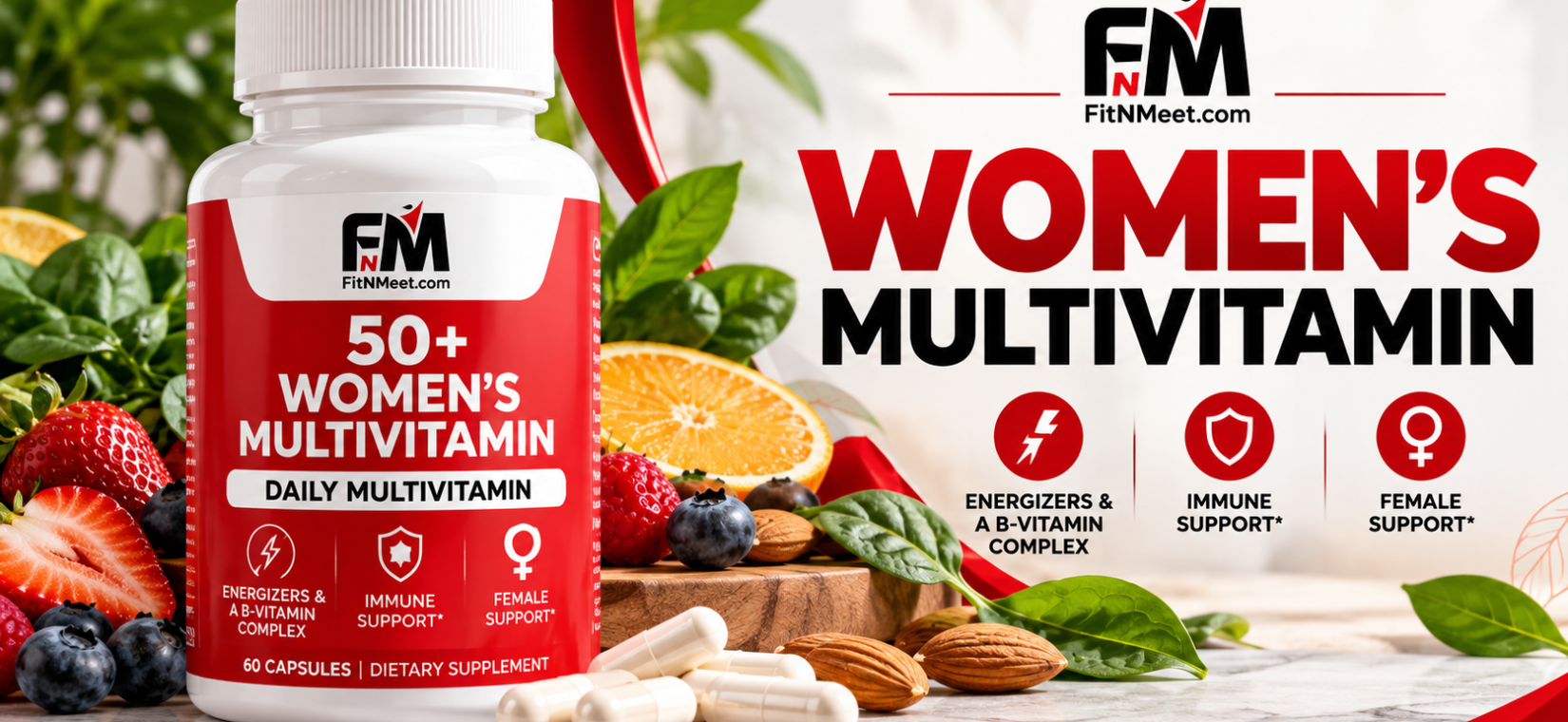
A womens multivitamin is a daily supplement formulated with the vitamins and minerals women most commonly under-consume — typically higher iron, folate, calcium, and vitamin D than a standard multi. It is designed to fill dietary gaps, support bone health, energy metabolism, and reproductive health, and is most useful for women with restricted diets or increased nutrient needs.

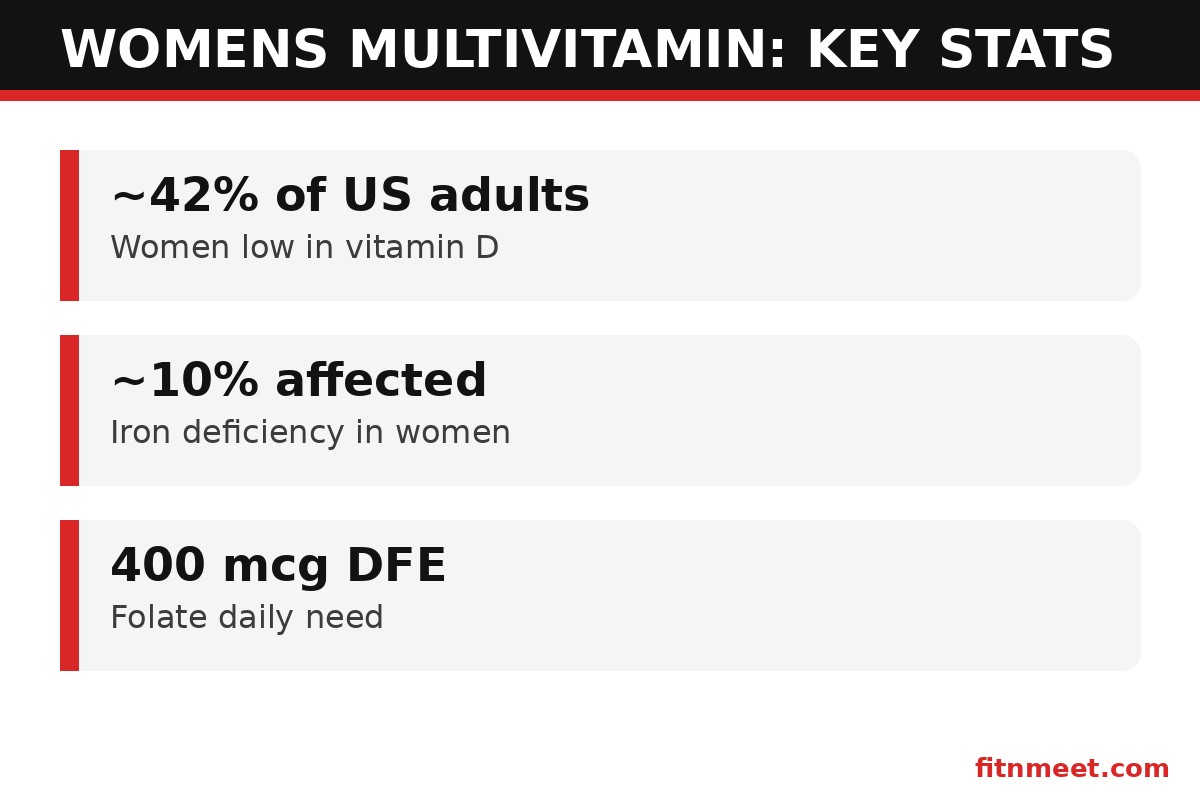
Womens Multivitamin: Key Stats Snapshot
Nutrient gaps are common
9 out of 10 — the share of Americans falling short on at least one key micronutrient, per NHANES dietary data.
Vitamin D shortfall
~42% — estimated share of US adults with vitamin D insufficiency, a nutrient every womens multivitamin includes.
Iron deficiency in women
~10% — share of US women aged 12–49 with iron deficiency, the main reason a womens multivitamin carries more iron than a standard multi.
Folate for pregnancy
400 mcg — the daily folic acid recommended before and during early pregnancy to prevent neural tube defects.
What Is a Womens Multivitamin?
A womens multivitamin is a once-daily (sometimes twice-daily) supplement that combines essential vitamins and minerals in amounts tuned to women’s physiology. Compared with a generic multivitamin, a womens multivitamin typically contains more iron (to offset menstrual losses), more folate (400 mcg for reproductive-age women), calcium and vitamin D for bone density, and sometimes extras like biotin, collagen-supporting vitamin C, or cranberry extract.
The core idea behind the multi is gap-filling, not megadosing. National dietary surveys repeatedly show that women under-consume vitamin D, calcium, iron, magnesium, and potassium. A the multi delivers roughly 100% of the Daily Value for a dozen-plus micronutrients in a single dose — an insurance policy for days when diet falls short, not a replacement for food.
Formulas vary. A basic the multi covers the essentials (A, C, D, E, K, B-complex, iron, calcium, magnesium, zinc, iodine, selenium). Premium versions add lutein for eyes, or probiotics for digestion. Gummy versions of the multi often omit iron (it tastes metallic and destabilizes gummies), so tablet or capsule forms are usually the more complete choice.
Womens Multivitamin Benefits
The benefits of a womens multivitamin track directly to the nutrients it supplies:
- Bone strength. Calcium (1,000 mg/day needed) plus vitamin D in a womens multivitamin supports bone mineral density. After menopause, women can lose up to 20% of bone density in 5–7 years; adequate calcium and D slow that loss.
- Energy metabolism. B-vitamins (B12, folate, B6) in the multi drive red blood cell formation and energy metabolism. Correcting a B12 or iron shortfall often resolves the fatigue people blame on “low energy.”
- Immune support. Vitamins C, D, and zinc in the multi support normal immune function. A 2020 meta-analysis linked vitamin D supplementation to a 12% reduction in acute respiratory infections.
- Healthy pregnancy. The 400 mcg of folic acid in the multi (for reproductive-age women) reduces neural tube defect risk by 50–70%, per CDC data — the single strongest evidence-based benefit.
- Skin, hair, and nails. Biotin, vitamin C (collagen synthesis), and zinc in the multi support the tissues behind visible appearance claims, though dramatic “hair growth” results are overstated in marketing.
- Antioxidant protection. Vitamins C and E plus selenium in the multi help neutralize free radicals generated by training, pollution, and normal metabolism.
How a Womens Multivitamin Works in the Body
A womens multivitamin works by topping up blood and tissue levels of micronutrients that act as cofactors in thousands of enzymatic reactions. Iron carries oxygen in hemoglobin; B12 and folate build red blood cells and DNA; vitamin D regulates calcium absorption; magnesium participates in 300+ enzymatic reactions including muscle contraction.
Absorption is not instant. Fat-soluble vitamins (A, D, E, K) in a womens multivitamin absorb best with a meal containing some fat, which is why taking it with breakfast or lunch beats taking it on an empty stomach. Water-soluble B-vitamins and vitamin C absorb quickly, with excess excreted in urine — the reason high-dose B-complex formulas turn urine bright yellow (harmless riboflavin).
Consistency matters more than timing. Tissue stores of nutrients like vitamin D and B12 build over weeks of daily use of the multi. Missing occasional days barely matters; missing weeks lets levels slide back. For a deeper look at how individual nutrients function, the NIH Office of Dietary Supplements fact sheets are the gold-standard reference.
Womens Multivitamin Dosage & Usage
Using a womens multivitamin correctly is simple — the label dose is almost always right:
- ☑ Take the label dose. One (or two, if directed) tablets of a womens multivitamin daily — more is not better and can push fat-soluble vitamins toward excess.
- ☐ Take it with food. A meal with some fat maximizes absorption of the fat-soluble vitamins in a womens multivitamin and prevents nausea.
- ☐ Separate from certain meds. Iron and calcium in the multi can reduce absorption of thyroid medication and some antibiotics — space them 2–4 hours apart.
- ☐ Stay consistent. Daily use for 8–12 weeks before judging whether the multi is helping energy or wellbeing.
- ☐ Check the iron. Postmenopausal women and those with high iron stores should consider the multi without iron, or a standard low-iron formula.
- ☐ Store properly. Keep the multi sealed, cool, and dry; moisture degrades B-vitamins and vitamin C.
Womens Multivitamin Comparisons
| Feature | Womens multivitamin | Standard multivitamin | Prenatal vitamin |
|---|---|---|---|
| Iron | ~18 mg (100% DV) | Lower or none | ~27 mg (higher) |
| Folate | ~400 mcg DFE | Varies | 600+ mcg DFE |
| Calcium | 200–500 mg | Often minimal | 200–300 mg |
| Vitamin D | 15–25 mcg | Similar | 15 mcg |
| Best for | General women’s health | Basic coverage | Pregnancy & trying to conceive |
The practical takeaway: a womens multivitamin beats a generic multi for premenopausal women because of the iron and folate. But the multi is not a prenatal — women who are pregnant or trying to conceive need the higher folate and iron of a dedicated prenatal formula, ideally chosen with their doctor.
Womens Multivitamin Side Effects & Safety
A womens multivitamin is well tolerated by most women, but a few issues are common:
- Nausea. Iron in a womens multivitamin causes nausea in roughly 10–20% of users on an empty stomach — the main reason to take it with food.
- Constipation. Iron can cause constipation or dark stools; increasing fiber and water usually resolves it.
- Excess intake risk. More than one the multi per day, or stacking it with separate vitamin D/iron pills, can push vitamin A, iron, or zinc above safe upper limits.
- Drug interactions. Calcium and iron reduce absorption of levothyroxine and tetracycline antibiotics; vitamin K can interfere with warfarin. Check with a pharmacist if you take prescription drugs.
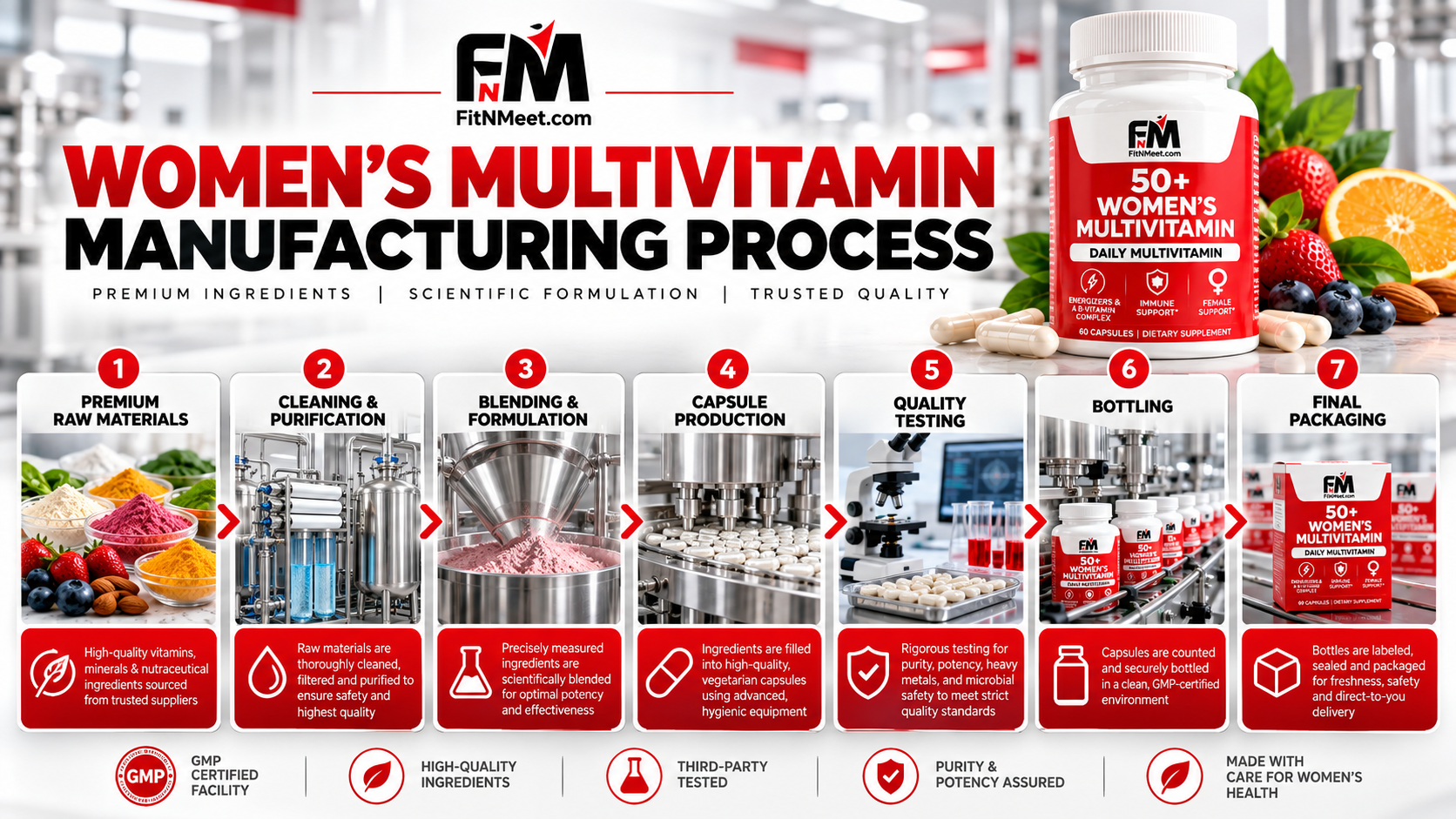
Supplement quality varies since the FDA does not pre-approve multis. Choose the multi with third-party verification (USP, NSF) to confirm the label matches the bottle.

Alternatives to a Womens Multivitamin
- Targeted single nutrients. If bloodwork shows one deficiency (say, vitamin D at 18 ng/mL), a dedicated vitamin D3 supplement corrects it faster than the modest dose in a womens multivitamin.
- Food-first approach. Leafy greens, legumes, dairy, eggs, and fatty fish can cover most of what the multi provides — dietitians generally prefer food sources when diet quality is high.
- Prenatal formula. For pregnancy or planned pregnancy, a prenatal replaces the multi with higher folate and iron.
- Men’s or senior formulas. Postmenopausal women may do better with a senior formula (no iron, more B12 and D) than a standard the multi.
Pair any choice with the broader health support and vitamins ranges, and browse the full shop to compare labels side by side.
Womens Multivitamin for Active Women and Athletes
Training raises micronutrient demands, and female athletes sit at the intersection of two risk factors: higher losses and higher needs. Iron is the headline concern — it is lost through sweat, foot-strike hemolysis (red blood cells crushed in the feet during running), gastrointestinal micro-bleeding, and menstruation. A 2021 review in the journal Nutrients estimated that up to 35% of female athletes are iron deficient, compared with roughly 10% of women in the general population. Low ferritin (the body’s iron store) shows up as heavy legs, plateaued endurance, and restless sleep long before full anemia develops. For more on training nutrition for active women, explore the FitnMeet health articles.
A womens multivitamin built for active women typically supplies the full 18 mg Daily Value of iron alongside the co-factors that make iron usable: vitamin C (which can triple non-heme iron absorption when taken together) and B12 and folate for red blood cell production. Vitamin D matters too — indoor training, sunscreen, and winter months leave many athletes deficient, and deficiency is linked to stress fractures; one study of military recruits found vitamin D supplementation cut stress fracture incidence significantly.
Calcium needs also climb with training volume, particularly for amenorrheic athletes whose estrogen — and therefore bone protection — runs low. The International Olympic Committee’s RED-S (Relative Energy Deficiency in Sport) framework specifically flags calcium, vitamin D, and iron as the micronutrients to monitor in under-fueled athletes. A practical protocol: take a daily multi with breakfast, get ferritin and vitamin D tested once a year, and add single-nutrient supplements only where bloodwork shows a gap. Food still does the heavy lifting — red meat, lentils, dairy, and leafy greens — but for women training five-plus hours a week, the insurance of a daily multi is cheap compared with a season lost to deficiency-driven fatigue.
Womens Multivitamin FAQs
What does a womens multivitamin do?
A the multi fills common nutrient gaps with iron, folate, calcium, vitamin D, and B-vitamins. It supports bone health, energy metabolism, immunity, and reproductive health, acting as nutritional insurance rather than a replacement for food.
Should every woman take a womens multivitamin?
Not necessarily. Women with varied, nutrient-rich diets may not need one. A the multi is most useful for women with restricted diets, heavy menstrual bleeding, limited sun exposure, or increased needs such as intense training.
When is the best time to take a womens multivitamin?
Take the multi with breakfast or lunch. Food improves absorption of fat-soluble vitamins and prevents the nausea that iron can cause on an empty stomach.
Can a womens multivitamin replace a prenatal vitamin?
No. Prenatal vitamins contain more folate (600+ mcg) and iron (27 mg) than a standard the multi. Women who are pregnant or trying to conceive should use a dedicated prenatal formula.
Does a womens multivitamin cause weight gain?
No. A the multi contains negligible calories and does not cause weight gain. Any appetite changes are unrelated to the micronutrients themselves.
How long until a womens multivitamin works?
Correcting a deficiency takes 8-12 weeks of consistent daily use. A the multi is a long-term habit, not a quick fix; benefits like steadier energy build gradually as tissue stores replenish.
Conclusion
A womens multivitamin is a practical daily habit for filling the nutrient gaps — iron, vitamin D, folate, calcium — that national data show most women carry. It will not transform your health overnight, but 8–12 weeks of consistent use tops up the micronutrient stores behind steady energy, strong bones, and normal immunity. Choose a formula with 100% Daily Value coverage, third-party testing, and iron matched to your life stage.
Ready to compare options? Browse FitnMeet’s vitamins collection to find a womens multivitamin that fits your needs — and pair it with solid training and whole-food nutrition for the best results.
This article is for informational purposes only and is not medical advice. Consult a healthcare professional before starting any supplement.