
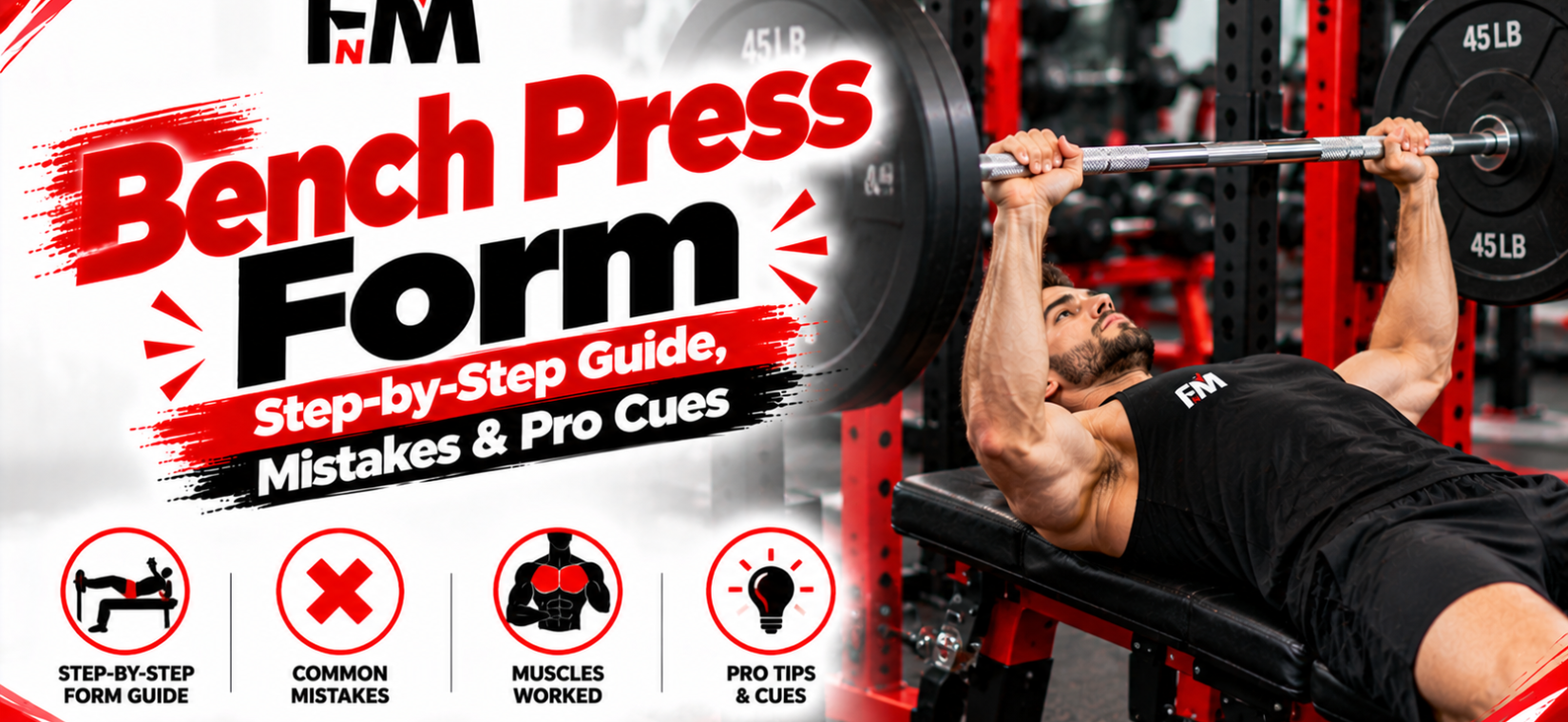
Why Bench Press Form Matters
Proper bench press form is the difference between building a big, strong chest and ending up with wrecked shoulders. The bench press is the most popular upper-body lift in the world — and one of the most butchered. This guide breaks down perfect bench press form step by step, plus the mistakes that stall progress and cause injury.
Biomechanics research confirms that small technique variations significantly change shoulder joint loading during the press (PubMed: bench press technique and shoulder loads).
Bench Press Form: Step-by-Step
Master these six steps to ingrain perfect bench press form.
Step 1 — Set your base
Lie on the bench with eyes under the bar. Plant your feet flat on the floor, driving them down to create full-body tension. Your butt stays glued to the bench.
Step 2 — Create the arch
Retract your shoulder blades — squeeze them together and down, as if pinching a pencil between them. This creates a slight natural arch in your upper back and puts your shoulders in a safe, stable position.
Step 3 — Grip the bar
Grip slightly wider than shoulder-width. Wrap your thumbs around the bar (never thumbless). The bar should sit across the base of your palm, directly over your wrist — not in your fingers.
Step 4 — Unrack with control
Straighten your arms to lift the bar off the J-hooks, then move it horizontally until it’s over your lower chest/upper abs — not over your face.
Step 5 — Lower with control
Lower the bar to your lower chest (nipple line or slightly below) over 2–3 seconds. Tuck your elbows to roughly 45–75 degrees from your torso — not flared to 90 degrees.
Step 6 — Press explosively
Drive the bar up and slightly back toward the rack, pressing your feet into the floor and keeping your shoulder blades pinned. Lock out without shrugging your shoulders toward your ears.
5 Common Bench Press Form Mistakes
1. Flaring elbows to 90 degrees
Elbows flared straight out puts enormous stress on the shoulder joint. Keep them tucked at 45–75 degrees.
2. Bouncing the bar off your chest
Bouncing uses momentum, not muscle — and risks cracked ribs. Pause briefly on the chest instead.
3. Lifting your butt off the bench
Butt lift turns the press into a decline cheat and destabilizes your base. Reduce the weight and keep contact.
4. Flat back, no scapular retraction
Benching with shoulders rolled forward is the classic recipe for impingement. Pin those shoulder blades back and down every set.
5. Wrong bar path
The bar should touch low on the chest and press up-and-back in a slight J-curve — not straight up and down over the throat.
Bench Press Form Cues That Work
- “Bend the bar” — try to bend the bar in half to engage your lats and keep elbows tucked.
- “Meet the bar with your chest” — lift your chest slightly to meet the bar rather than letting it crash down.
- “Push yourself away from the bar” — think of pushing your body into the bench instead of pushing the bar up.
- “Screw your feet into the floor” — external rotation torque from the feet up creates total-body tightness.
Bench Press Variations for Better Form
Close-grip bench press
Hands shoulder-width apart. Shifts emphasis to triceps and is gentler on shoulders — great for learning the tuck pattern.
Dumbbell bench press
Dumbbells like our rubber hex dumbbells allow a deeper stretch and natural wrist rotation — excellent for fixing imbalances.
Incline bench press
An incline bench set to 30 degrees targets the upper chest while reinforcing the same safe pressing mechanics.
Floor press
Limits range of motion, protecting shoulders while building lockout strength. Perfect for lifters with shoulder issues.
Bench Press Form FAQs
Should my feet be flat on the floor?
Yes for standard powerlifting-style form — flat feet create leg drive and stability. Some lifters bench with feet on the bench to reduce arching, but flat feet is the stronger position.
Where should the bar touch my chest?
Lower chest, around the nipple line or slightly below. Touching too high (near the throat) with flared elbows is the most injurious pattern.
How wide should my grip be?
Start with index fingers on the bar’s outer rings (standard Olympic marking). Adjust slightly narrower if you feel shoulder discomfort.
Is arching my back cheating?
A natural upper-back arch from scapular retraction is correct and safe. An extreme exaggerated arch is a powerlifting technique — fine in competition, unnecessary for general training.
How often should I bench press?
1–3 times per week depending on your program. Beginners progress well with twice weekly; advanced lifters often bench 3–4 times with varied intensity.
Dial in your bench press form now, and every future PR will be built on a safe, strong foundation.