
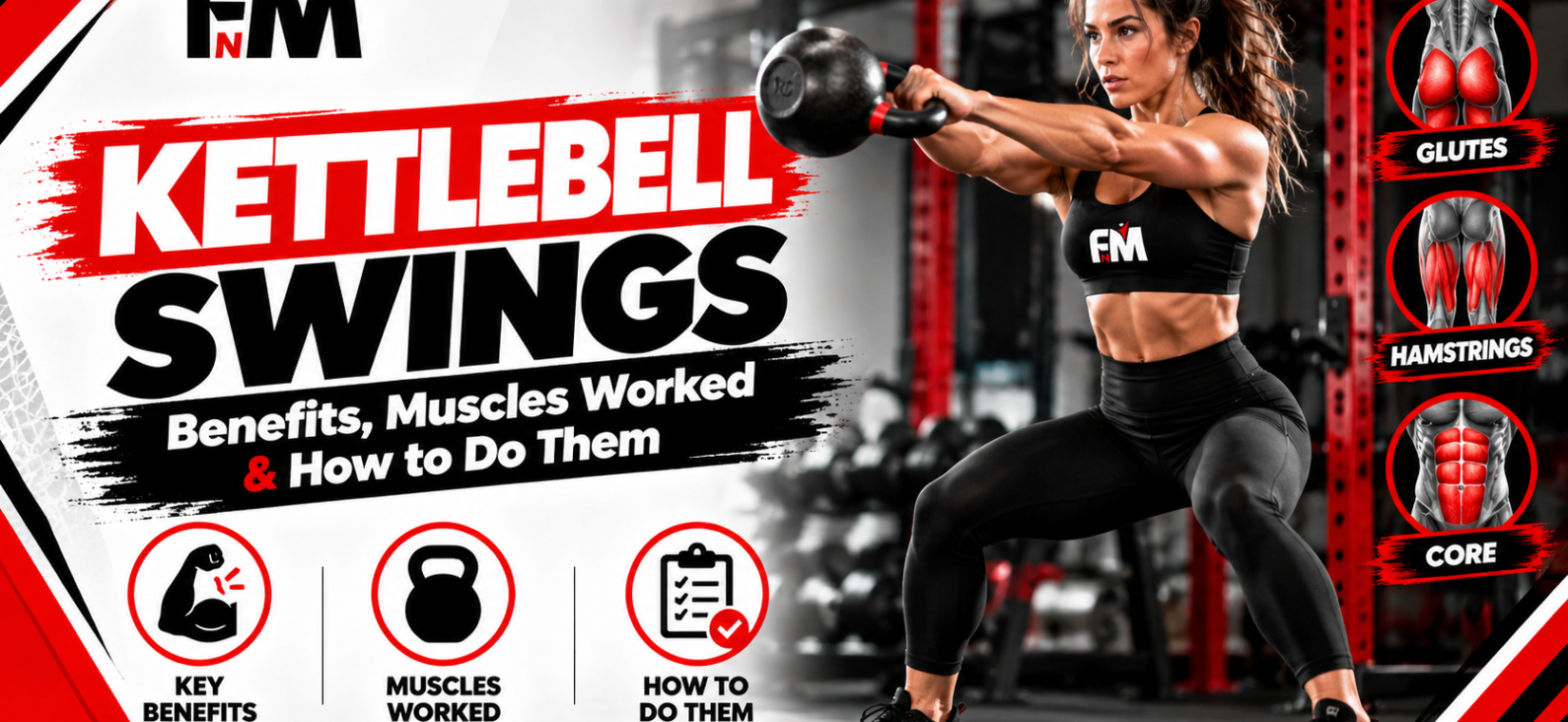
What Are Kettlebell Swings?
The kettlebell swing is a ballistic hip-hinge exercise where you drive a kettlebell from between your legs up to chest or shoulder height using the explosive power of your hips and glutes — not your arms. It is widely considered one of the most efficient full-body exercises you can do, combining strength training and cardio in a single movement.
Unlike slow isolation lifts, the swing trains the posterior chain — the glutes, hamstrings, lower back, and core — while elevating your heart rate. A few sets of swings can deliver the conditioning effect of a sprint session and the muscle-building stimulus of a deadlift, which is why coaches call it a “one-exercise workout.”
Muscles Worked by Kettlebell Swings
Kettlebell swings primarily target:
- Glutes — the main engine of the movement
- Hamstrings — loaded on the backswing, contracted on the drive
- Lower back (erectors) — stabilizes the spine throughout
- Core and abs — braced hard at the top of every rep
- Shoulders, lats, and grip — secondary stabilizers
Research on kettlebell training consistently shows high muscle activation across the entire back of the body, making it one of the best exercises for fixing the weaknesses caused by sitting all day.
Benefits of Kettlebell Swings
1. Builds explosive hip power
The swing teaches your hips to generate force quickly — the same quality that improves sprinting, jumping, and deadlift lockout strength.
2. Torches calories and improves conditioning
Because swings recruit so much muscle mass at high speed, they burn significant calories in short sessions and improve cardiovascular fitness without long runs. In fact, hard sets can burn up to 20 calories per minute — on par with sprinting.
3. Strengthens the posterior chain
Glutes and hamstrings are the biggest, most powerful muscles in your body. Swings develop them directly, improving posture and reducing lower-back pain risk.
4. Trains grip and core simultaneously
Holding a heavy bell through dozens of reps builds crushing grip strength, while bracing against the bell’s momentum builds a rock-solid core.
5. Minimal equipment, train anywhere
All you need is one kettlebell and a few square feet of space. Pick the right weight from our 35 lb kettlebell range or browse all kettlebell sizes from 5 lb to 80 lb.
How to Do Kettlebell Swings: Step-by-Step
Step 1 — Set up
Stand with feet slightly wider than shoulder-width, toes pointed slightly out. Place the kettlebell on the floor about a foot in front of you.
Step 2 — Hinge and grip
Push your hips back (like closing a car door with your backside), keep your back flat, and grip the handle with both hands. Tilt the bell toward you to engage your lats.
Step 3 — Hike the bell
Hike the kettlebell back between your legs like a football center snap, keeping your forearms against your inner thighs.
Step 4 — Explode forward
Drive your hips forward explosively — snap them to full extension as if jumping. The bell should float up to chest height from hip power alone. Your arms are just ropes.
Step 5 — Brace at the top
At the top, stand tall: glutes squeezed, abs braced, lats packed. The bell should feel weightless for a moment.
Step 6 — Guide it down
Let the bell fall back down, hinging at the hips to receive it. Don’t squat — push the hips back and repeat.
Common Kettlebell Swing Mistakes
- Squatting instead of hinging — the swing is a hip hinge, not a squat. If your knees travel far forward, reset your pattern.
- Lifting with the arms/shoulders — if your shoulders are doing the work, the bell is too heavy or your hip snap is weak.
- Rounding the lower back — keep the spine neutral; stop the set when form breaks down.
- Overextending at the top — leaning back hyperextends the spine. Stand tall and stop.
- Wrong weight — beginners often go too light. Most active men start with a 35 lb kettlebell; most active women with a 20 lb kettlebell.
Kettlebell Swing Variations
Two-hand swing
The standard version described above. Best for learning and heavy conditioning work.
One-hand swing
Challenges grip and anti-rotation core strength. Switch hands every 5–10 reps or each set.
Hand-to-hand swing
Switch hands at the top of each rep. Great for coordination and longer conditioning sets.
Double kettlebell swing
One bell in each hand for advanced lifters — doubles the load and the demand on the grip.
Sample Kettlebell Swing Workouts
Beginner: 10-minute EMOM
Every minute on the minute, do 10 swings. Rest the remainder of the minute. Repeat for 10 rounds (100 total swings).
Intermediate: 5×20
5 sets of 20 swings with 60–90 seconds rest between sets.
Advanced: Swing ladder
Do 10, 15, 20, 25, then 20, 15, 10 swings with 30 seconds rest between rungs.
Store your bell safely between sessions on a kettlebell stand to protect your floors.
How to Program Kettlebell Swings
For general fitness, program kettlebell swings 2–3 times per week on non-consecutive days — either as a standalone conditioning session or as a finisher after strength work. Start with 5 sets of 10–20 reps, resting 60–90 seconds between sets, and add one set per week until you can handle 200 total reps per session. On heavy days, use a challenging bell for sets of 10 with full recovery; on light days, use a moderate bell for high-rep EMOM sets. Pair your kettlebell swings with barbell strength training — a weight rack lets you squat and press heavy on alternate days — and keep swing sessions under 30 minutes to protect your lower back as fatigue builds.
Kettlebell Swings FAQs
Are kettlebell swings good for beginners?
Yes, with proper instruction. Learn the hip hinge first (practice with a light bell or even no weight), then add load gradually. A 20 lb kettlebell is a sensible starting point for most beginners.
How many kettlebell swings should I do per day?
100 total swings per session, 2–3 times per week, is a proven effective dose for most people. Quality of reps matters far more than quantity.
Do kettlebell swings build muscle?
Yes — especially in the glutes, hamstrings, and back. For maximum muscle growth, use a challenging weight and pair swings with grinds like presses and squats — our weight rack is ideal for heavy barbell work.
Can kettlebell swings replace cardio?
For many people, yes. High-rep swing sessions elevate heart rate into the cardio zone while also building strength — true concurrent training.
What weight kettlebell should I use for swings?
Swings use the hips, your strongest muscles, so go heavier than you think: most active men 35–53 lb, most active women 18–35 lb.