
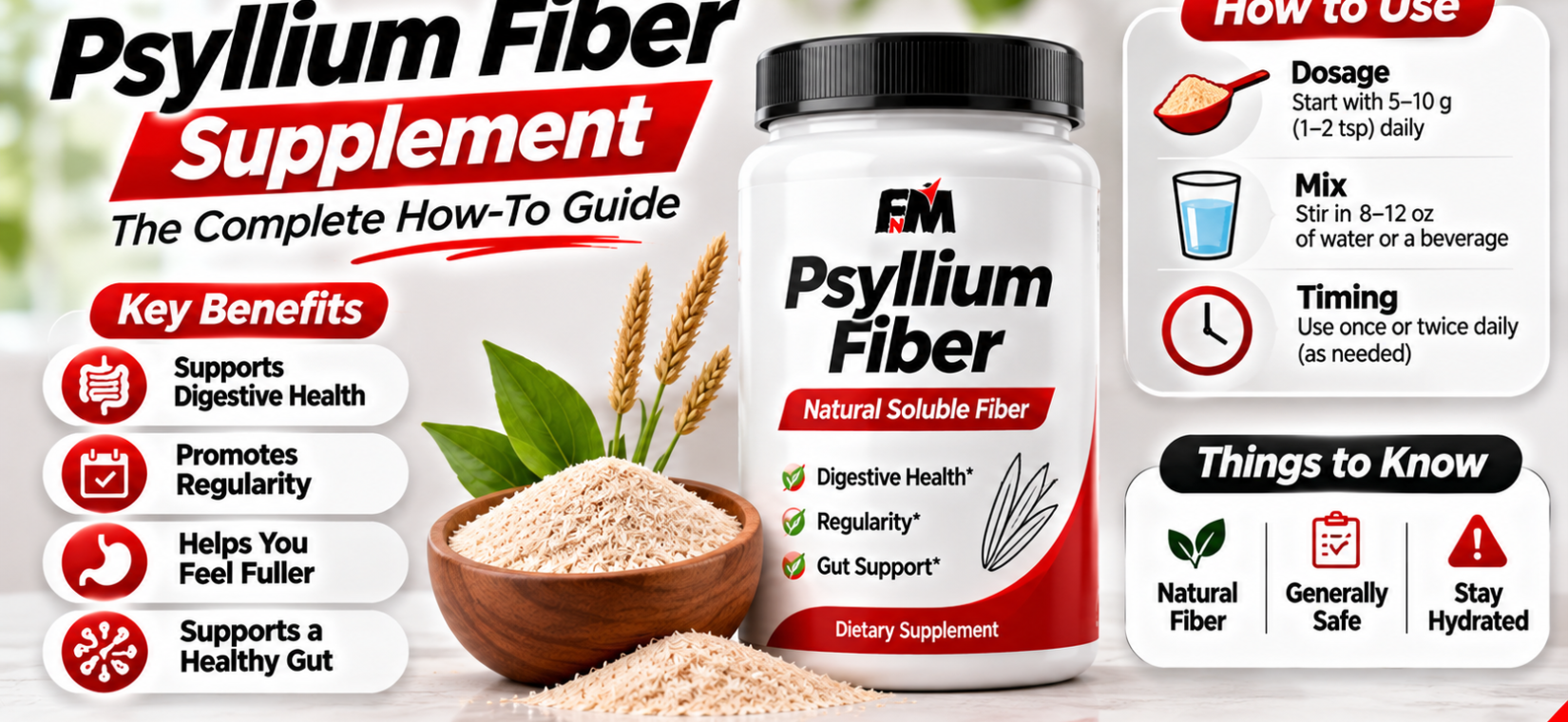
Psyllium fiber supplement is a soluble fiber supplement made from psyllium husk that absorbs water to form a gel in the digestive tract. A typical dose of 5 to 10 grams daily supports regularity, healthy cholesterol levels, and blood sugar control. Always take it with plenty of water to avoid choking or intestinal blockage.
Quick Answer
What it is: a soluble-fiber powder from psyllium seed husks (Plantago ovata).
Standard dose: 5–10 g of husk per day (1–2 tablespoons), split into 1–2 servings.
How to take it: stir into at least 8 oz (240 ml) of water and drink immediately, then drink another glass of water.
Main benefits: lowers LDL cholesterol ~7%, improves blood sugar control, relieves constipation, increases satiety.
Timeline: digestive effects in 12–72 hours; cholesterol and blood sugar changes over 4–8 weeks.

What Is Psyllium?
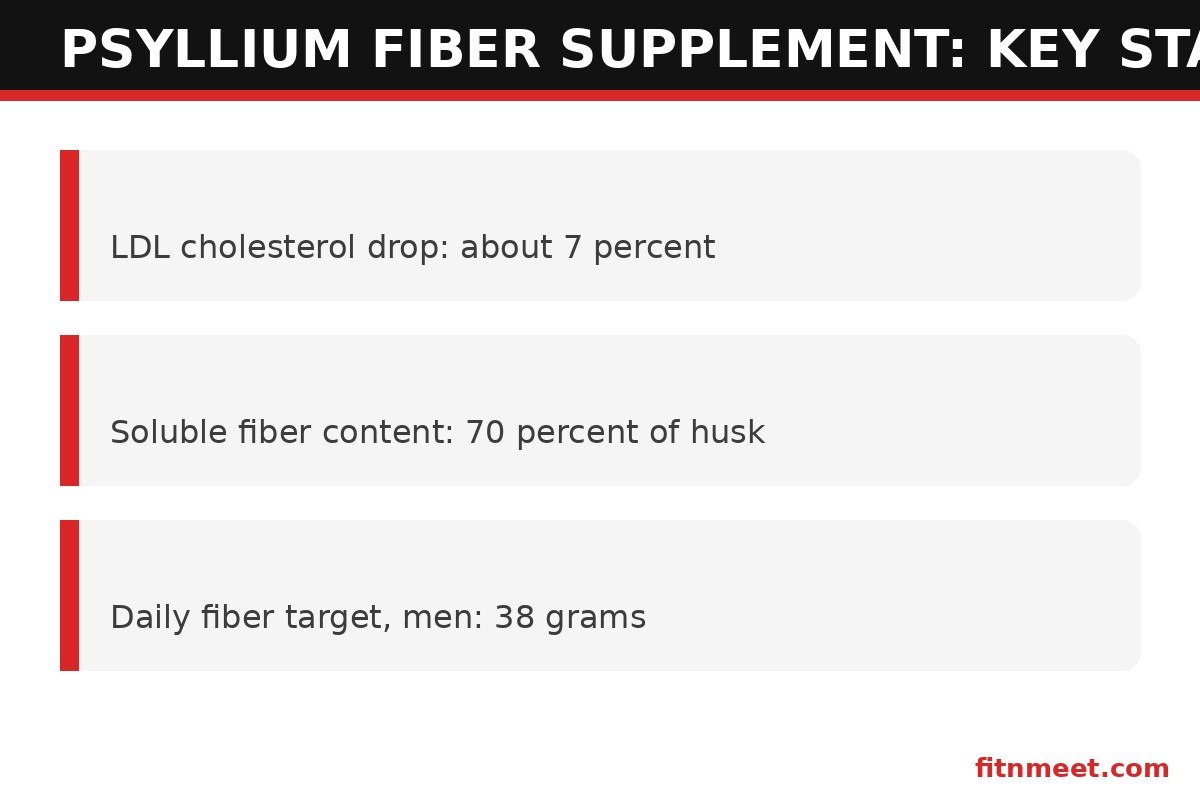
Psyllium is the outer husk of seeds from Plantago ovata, a plant grown mainly in India. A psyllium fiber supplement is simply those husks cleaned, milled into powder (or left whole) and packaged — sometimes plain, sometimes flavored, sometimes in capsules. Nutritionally it is about 70% soluble fiber, which is what makes it special.
Soluble fiber dissolves in water and forms a thick gel. That gel is the entire mechanism: it traps bile acids in the intestine (forcing the liver to pull cholesterol from the blood to make more), slows the absorption of glucose, adds bulk and water to stool, and stretches the stomach to signal fullness. Insoluble fiber like wheat bran cannot do most of this — it mainly just adds bulk.
One tablespoon of psyllium husk (about 5 grams) delivers roughly 4 grams of soluble fiber. Compare that with food: you would need 2 cups of oatmeal or 4 apples to match it. That density is why a psyllium fiber supplement is the most practical way to close a fiber gap. Choosing a plain psyllium fiber supplement without added sugars keeps the calorie cost near zero. Background reading: Wikipedia’s psyllium article and Wikipedia’s dietary fiber overview.
Why Your Fiber Intake Probably Falls Short
The Institute of Medicine recommends 38 grams of fiber per day for men and 25 grams for women — yet average intake in the US sits around 15 grams. That 10-to-23-gram gap is one of the most common nutritional deficiencies in the developed world, and it is invisible: nobody feels “low fiber” the way they feel low energy.
The consequences are not invisible, though. Low fiber intake is linked to constipation (affecting roughly 16% of adults), higher LDL cholesterol, worse blood sugar control, and a less diverse gut microbiome. Lifters and athletes are not exempt — high-protein diets built on meat, eggs and shakes are often extremely low in fiber, which is why digestive complaints are so common on a bulk.
Closing the gap with food alone means eating 5+ servings of vegetables, 2–3 servings of fruit and multiple servings of legumes or whole grains every day. Admirable, but unrealistic for many schedules. A psyllium fiber supplement delivers 4–8 grams of soluble fiber in 30 seconds, which is why dietitians routinely recommend it as the bridge while people work on the food side. For lifters on high-protein diets, a daily psyllium fiber supplement is the simplest fix for the digestive sluggishness that low-fiber bulking causes.
Step-by-Step Guide to Taking Psyllium
Follow this protocol exactly and your psyllium fiber supplement routine will avoid 95% of the problems people report with fiber supplements.
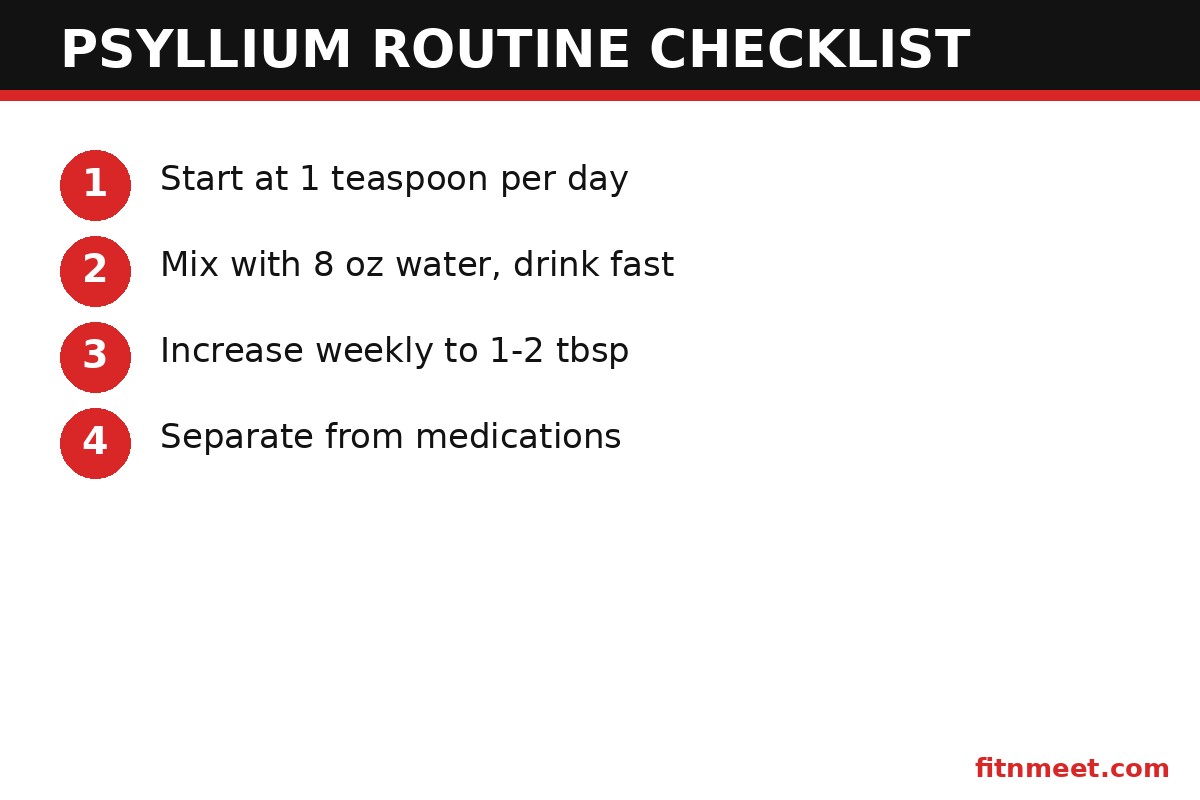
- Start small: 1 teaspoon (about 2 g) per day.
- Take it with breakfast or your first big glass of water of the day.
- Stay at this dose for 4–5 days so gut bacteria adapt gradually.
- Mix it correctly.
- Fill a glass with at least 8 oz (240 ml) of cold water.
- Stir in the psyllium fiber supplement briskly — it thickens within 30–60 seconds.
- Drink it immediately, then follow with another half glass of plain water.
- Increase weekly.
- Week 2: 2 teaspoons daily. Week 3: 1 tablespoon. Week 4+: up to 2 tablespoons (10 g) if needed.
- Split doses above 1 tablespoon into morning and evening servings.
- Time it around meals.
- For blood sugar and satiety: 15–30 minutes before your largest meal.
- For cholesterol: consistency matters more than timing — same time daily.
- For constipation: morning dosing works best for most people.
- Separate your medications.
- Take prescription drugs at least 1–2 hours before or after psyllium — the gel can reduce absorption.
- This applies to thyroid medication, some antidepressants and diabetes drugs in particular.
- Hydrate all day.
- Aim for an extra 2–3 glasses of water daily on top of the mixing water.
- Fiber without water causes constipation; fiber with water cures it.
Dosage and Usage
The evidence-based dosage of a psyllium fiber supplement depends on your goal:
| Goal | Daily dose | Timing | Evidence |
|---|---|---|---|
| Lower LDL cholesterol | 10 g husk | Split AM/PM with meals | Meta-analysis: −0.33 mmol/L LDL (~7%) |
| Blood sugar control | 5–10 g husk | 15–30 min before meals | Meta-analysis: improved fasting glucose & HbA1c in T2D |
| Constipation relief | 5 g husk | Morning with full glass of water | Effect in 12–72 hours |
| Satiety / weight support | 5 g husk | Before largest meal | Increased fullness in meal trials |
The cholesterol-lowering dose of a psyllium fiber supplement has the firmest numbers: a meta-analysis in the American Journal of Clinical Nutrition found that about 10 grams of psyllium per day lowered LDL cholesterol by 0.33 mmol/L — roughly 7% — with larger drops in people who started higher. That is why the FDA’s authorized health claim specifies 7+ grams of soluble fiber from psyllium daily.
For blood sugar, a 2015 meta-analysis found psyllium significantly improved fasting glucose and HbA1c in people with type 2 diabetes, likely because the gel slows carbohydrate absorption. If you take diabetes medication, monitor your readings when starting — improved control can mean your dose needs adjusting, which is a good problem to have but one to manage with your doctor.
Benefits of a Psyllium Fiber Supplement
- Lowers LDL cholesterol ~7%. The best-evidenced benefit. The gel binds bile acids; the liver pulls LDL from the blood to replace them. Effects appear in 4–8 weeks at 10 g/day.
- Steadies blood sugar. Slower glucose absorption means smaller post-meal spikes — valuable for pre-diabetes and type 2 diabetes management alongside diet and medication.
- Relieves constipation. Psyllium increases stool water content and bulk. Most users see results within 12–72 hours, without the cramping of stimulant laxatives.
- Supports weight management. The gel delays stomach emptying, increasing fullness after meals. In trials, pre-meal psyllium reduced subsequent calorie intake.
- Feeds gut bacteria. Soluble fiber ferments into short-chain fatty acids like butyrate, which nourish the colon lining and support a diverse microbiome.
- Heart-health claim backed by the FDA. Few supplements carry an authorized FDA health claim; psyllium’s soluble fiber does.
Pair your psyllium fiber supplement routine with heart-smart nutrition from the FitnMeet health support collection, and if weight management is the goal, the weight loss collection complements the satiety effect.
- Plain psyllium husk powder (no added sugars or artificial sweeteners)
- A dedicated shaker bottle or glass for mixing
- A water bottle to carry for all-day hydration
Find everyday nutrition essentials in the FitnMeet shop and the vitamins collection.
Mistakes to Avoid
- Starting with a full dose. Jumping to 2 tablespoons on day one causes gas, bloating and cramping. Ramp up over 3–4 weeks.
- Not drinking enough water. The #1 cause of psyllium complaints. Fiber + too little water = worse constipation and, rarely, intestinal blockage.
- Taking it dry or letting it sit. Psyllium gels in under a minute. Mix and drink immediately — a glass of gel is unpleasant and harder to swallow safely.
- Buying sugar-loaded flavored versions. Some flavored psyllium fiber supplement products pack 10+ grams of sugar per serving, defeating the blood-sugar purpose. Plain husk is cheapest and cleanest.
- Taking it with medications. The 1–2 hour separation rule is non-negotiable for thyroid meds, many antidepressants and diabetes drugs.
- Expecting overnight cholesterol changes. Lipid panels move over 4–8 weeks. Test too early and you will wrongly conclude it is not working.
- Using it as a laxative crutch without fixing diet. A psyllium fiber supplement bridges the gap; the long-term fix is 25–38 g of daily fiber from food.
Psyllium vs Other Fiber Supplements
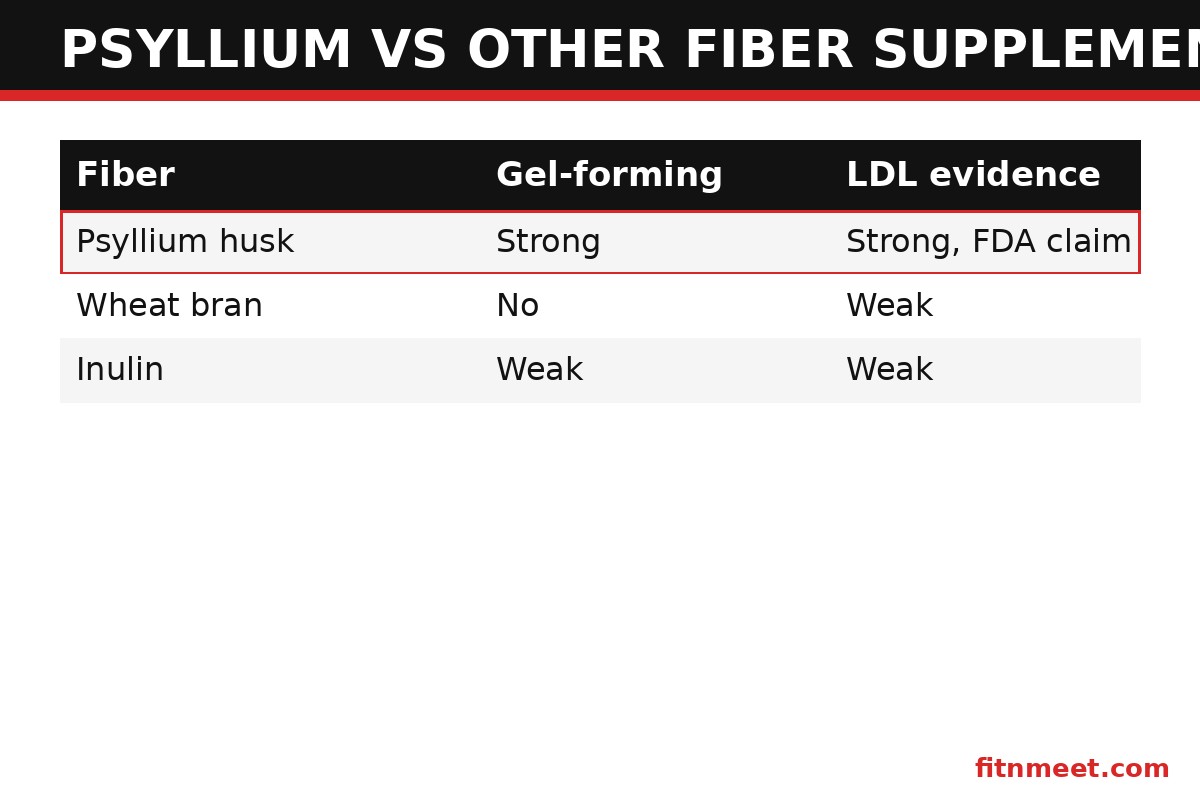
| Fiber | Type | Gel-forming | LDL evidence | Gas/bloating |
|---|---|---|---|---|
| Psyllium husk | ~70% soluble | Strong | Strong (FDA health claim) | Low–moderate |
| Wheat bran | Mostly insoluble | No | Weak | Moderate |
| Methylcellulose | Soluble (synthetic) | Moderate | Moderate | Low |
| Inulin / chicory root | Soluble (fermentable) | Weak | Weak | High |
| Oat bran (beta-glucan) | Soluble | Moderate | Moderate (FDA claim) | Low |
Psyllium wins for cholesterol and overall versatility: a psyllium fiber supplement is the only fiber product with both an FDA heart-health claim and strong evidence across constipation, blood sugar and satiety. Methylcellulose is the gentlest on the gut but has thinner evidence. Inulin ferments fast, which feeds gut bacteria well but causes the most gas — a poor choice for beginners. Oat bran is excellent as food but impractical as a concentrated supplement.
For pure constipation with no cholesterol concerns, any of these work. For the full package — lipids, glucose, regularity and fullness — a psyllium fiber supplement is the evidence-based default, and clinical guidance widely lists fiber as the first-line approach for constipation. More evidence-based explainers live in our nutrition section.
Side Effects and Safety
- Gas and bloating: common in week one, fades as gut bacteria adapt. Ramping slowly prevents most of it.
- Choking hazard: the serious risk. Always mix with at least 8 oz of water and drink promptly. People with swallowing difficulties should avoid powdered psyllium.
- Medication interactions: psyllium can reduce absorption of many drugs. The 1–2 hour separation rule covers nearly all cases.
- Allergic reactions: rare but documented, mostly in workers inhaling psyllium dust. Stop use if you develop itching, hives or breathing difficulty.
- Intestinal blockage: extremely rare, almost always linked to taking psyllium with too little water.
For healthy adults who hydrate properly, a psyllium fiber supplement is among the safest supplements in existence — it is essentially concentrated plant husk with decades of use data. People with esophageal narrowing, intestinal strictures or a history of bowel obstruction should get medical clearance first.
Frequently asked questions
How much psyllium fiber supplement should I take daily?
Start with 1 teaspoon (about 2 g) per day and increase weekly to 1–2 tablespoons (5–10 g). The cholesterol-lowering dose studied most is 10 g/day split into two servings; 5 g/day is enough for regularity and satiety. Always take each dose with at least 8 oz of water.
When is the best time to take a psyllium fiber supplement?
Take your psyllium fiber supplement 15–30 minutes before your largest meal for blood sugar and appetite benefits, or in the morning for constipation. For cholesterol, timing matters less than daily consistency. Keep it 1–2 hours away from prescription medications.
Can a psyllium fiber supplement help lower cholesterol?
Yes. A meta-analysis in the American Journal of Clinical Nutrition found about 10 g/day of psyllium lowered LDL cholesterol by roughly 7%, with bigger drops in people with higher starting levels. The FDA authorizes a heart-health claim for 7+ grams of soluble fiber from psyllium per day.
Does psyllium cause bloating?
It can during the first week as gut bacteria adjust to the extra fermentable fiber. Starting at 1 teaspoon and increasing weekly, splitting doses, and drinking plenty of water minimizes it. Persistent severe bloating from a psyllium fiber supplement may mean you increased too fast — drop back a step for a week.
Is it safe to take a psyllium fiber supplement every day?
Yes — daily long-term use of a psyllium fiber supplement is safe for healthy adults and is how the cholesterol and blood sugar benefits were demonstrated in trials. The keys are adequate water, gradual dose increases, and separating it from medications by 1–2 hours.
Psyllium husk vs psyllium powder — which is better?
They are the same material in different grinds; powder mixes faster and gels more quickly, while whole husk is slightly gentler to drink. Capsules work but require 7–10 per full dose. Choose plain, unflavored psyllium fiber supplement products without added sugars regardless of form.
The bottom line
A psyllium fiber supplement is the highest-leverage 30 seconds in nutrition: 5–10 grams of husk powder, a full glass of water, and you cover the soluble-fiber gap that 90%+ of adults carry. The payoff is measurable — ~7% lower LDL in 4–8 weeks, steadier blood sugar, reliable regularity and real help with appetite. Start at 1 teaspoon, ramp over a month, hydrate aggressively, and keep your psyllium fiber supplement away from your medications. Make it a non-negotiable daily habit.
Build the rest of your foundation alongside it: more vegetables, legumes and whole grains, plus the everyday essentials in the FitnMeet vitamins collection and the full FitnMeet shop.
Disclaimer: This article is for informational purposes only and is not medical advice. Consult a healthcare professional before starting any supplement.