
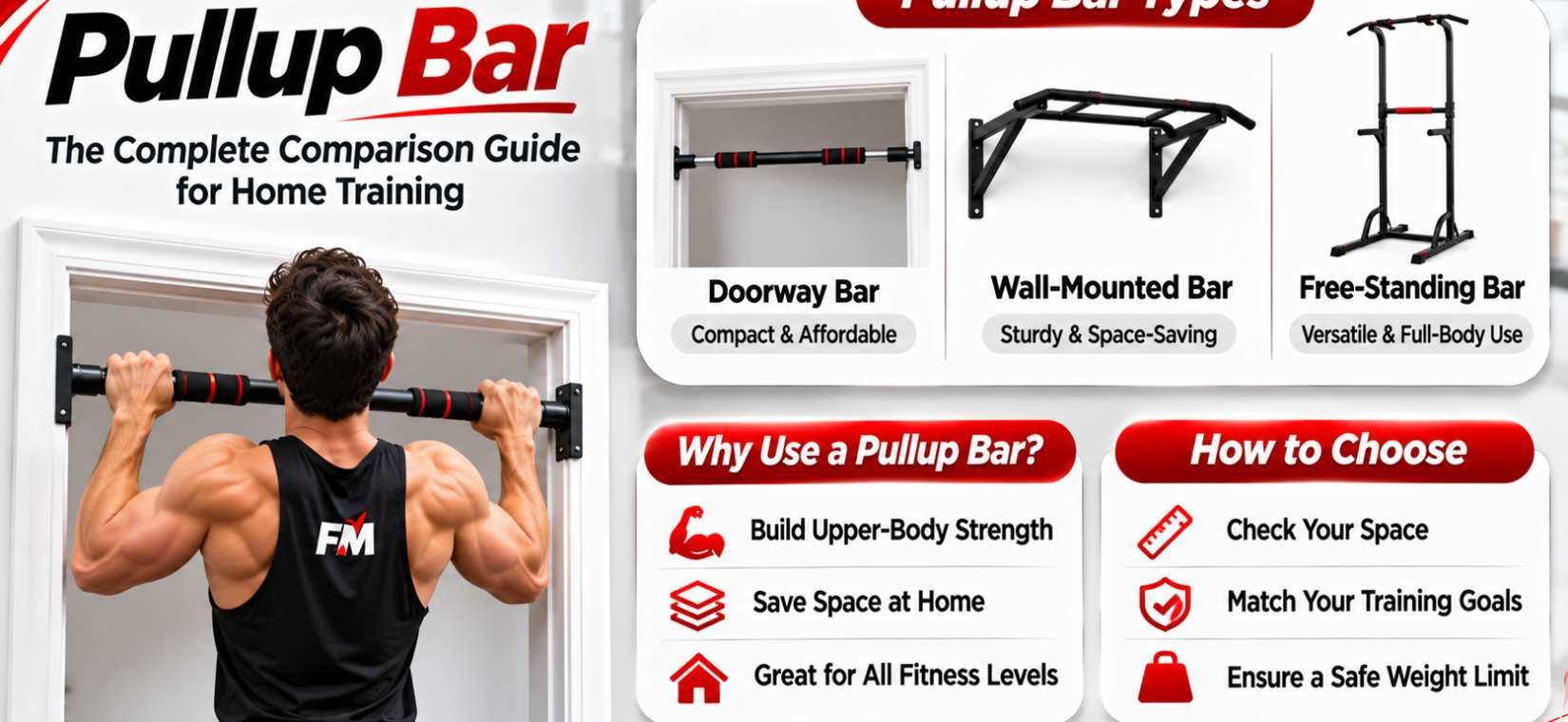
Pullup bar is a horizontal bar mounted in a doorway, on a wall, or as part of a rack for performing pull-ups and chin-ups. Doorway models use leverage against the frame and need no screws, while wall-mounted and rack-mounted bars are sturdier for weighted pull-ups. Check the weight rating and doorway fit before buying.
A pullup bar is a simple horizontal bar, fixed high enough to hang from, that mounts in a doorway, on a wall, or on a freestanding frame that lets you perform pull-ups, chin-ups and hanging exercises at home. The right bar matches your doorway or wall type, supports your bodyweight with margin, and offers enough grip positions to keep training varied for years.
Quick Verdict: Which Pullup Bar Wins?
Our pick: For most renters and beginners, a leverage-style doorway bar is the best first purchase — no drilling, 15-minute setup, and enough capacity for weighted work later.
Skip if: your doorframes are decorative molding with no solid trim, you weigh over the bar’s rated limit, or you need a bar for kipping and dynamic movements — mount to a wall or buy a freestanding tower instead.
The rest of this guide proves the verdict with numbers: three pullup bar types compared feature by feature, plus how a pullup bar stacks up against the alternatives competing for your money.
What Is a Pullup Bar?
A pullup bar is the simplest serious upper-body training tool ever sold. It is a rigid horizontal bar, typically 90–120 cm wide, fixed at a height that lets you hang with bent or straight knees. From that hang you can train the entire pulling chain: pull-ups (pronated grip), chin-ups (supinated grip), neutral-grip pulls, hanging leg raises for the core, and dead hangs for grip and shoulder health.
Three designs dominate the market. Doorway leverage bars use your bodyweight to press against the frame — the harder you pull, the tighter they wedge. Wall-mounted bars bolt into studs or masonry and are the most solid option. Freestanding towers (power towers) stand on the floor and need no doorway or drilling at all, at the cost of floor space. Every recommendation in this guide flows from those three designs.
Did you know? The pull-up is one of the oldest strength tests on record — the pull-up exercise has been a military fitness standard for over a century, and a doorway pullup bar brings that test home for the price of a restaurant meal. More equipment guides live in our strength training section.
Head-to-Head: Pullup Bar Types Compared
This is the decision that matters. The table below compares the three designs on the factors that actually affect your training.
| Feature | Doorway Leverage Pullup Bar | Wall-Mounted Pullup Bar | Freestanding Tower |
|---|---|---|---|
| Installation | None — wedges in frame | Drill into studs/masonry | Assemble with bolts |
| Typical weight limit | 130–150 kg | 180–270 kg | 120–150 kg |
| Grip positions | Wide, narrow, neutral | Wide, narrow, neutral, rings | Pull-up, dips, leg raise |
| Space needed | A doorway | A wall + clearance | ~1.5 m² floor space |
| Renter-friendly | Yes | No | Yes |
| Kipping/dynamic moves | Not recommended | Yes | Risky — can tip |
| Price range | $25–$60 | $40–$120 | $100–$300 |
| Best for | Beginners, renters | Serious home gyms | Multi-exercise stations |
The doorway bar wins on convenience, the wall-mounted bar wins on raw capacity and stability, and the tower wins if you want dips and leg raises in one station. Match the row that matters most to you — not the one with the most checkmarks.
Which Type Holds the Most Weight?
Wall-mounted models lead: quality bars rated to 270 kg give even a 120 kg lifter doing weighted pull-ups a comfortable safety margin. Doorway leverage bars typically rate 130–150 kg, which covers most bodyweight trainees. Always buy a bar rated at least 1.5× your bodyweight — ratings assume perfect installation, and real life is never perfect.
Pullup Bar vs the Alternatives
| Option | Cost | Pull-up training quality | Space | Verdict |
|---|---|---|---|---|
| Pullup bar (home) | $25–$300 once | Excellent | Doorway/wall/corner | Best value for pull training |
| Gym membership | $30–$80/month | Excellent + machines | Travel required | Wins on variety, loses on cost/convenience |
| Resistance bands | $20–$50 | Assisted only — no true pull-up | Drawer | Great accessory, not a replacement |
| Tree branch / playground | Free | Variable — weather dependent | Outdoors | Free but unreliable |
A home bar pays for itself against a gym membership in one to three months if pull-ups are your priority. Bands are the perfect companion to a mounted bar — not a substitute — because band-assisted pull-ups on a real bar build the exact movement pattern you want.
Benefits of Training With a Pullup Bar
- Complete upper-body pulling: it trains lats, biceps, rear delts, traps and forearms in one movement — no other home tool hits the back this completely.
- Core and grip for free: hanging leg raises build the abs, and every rep builds crushing grip strength.
- Scalable for years: assisted → strict → weighted. One bar serves you from your first rep to a 40 kg weighted pull-up.
- Zero commute: the average gym trip costs 20–40 minutes of travel. A doorway bar turns dead time into training time.
- Posture correction: desk workers’ rounded shoulders respond well to regular hanging and pulling — 30 seconds of dead hang daily decompresses the spine noticeably.
- Measurable progress: pull-up reps are the cleanest strength metric there is. Going from 0 to 10 on the bar is a transformation you can count.
How to Choose Your Pullup Bar: 5 Decision Steps
- Measure your doorway. Standard interior frames are 70–90 cm wide. Your bar must span the frame with the leverage pads resting on solid trim — measure trim width too, not just the opening.
- Check your bodyweight against the rating. Take the manufacturer’s limit, subtract your weight plus any added weight for weighted pull-ups. You want at least 50% headroom.
- Decide: drill or no drill? Renters and the drill-shy should shortlist doorway leverage bars only. Homeowners building a permanent setup should strongly consider wall-mounted — it is the last pullup bar you will buy.
- Count the grip positions you will actually use. Wide, narrow and neutral covers 95% of trainees. Extra handles and ab straps are nice but should not decide the purchase.
- Read the failure reviews, not the five-stars. Search reviews for “broke”, “slipped” and “warranty” — how the manufacturer handles failures tells you more than any marketing spec.
Setting up a home gym? A pullup bar is step one. Fuel your training with the FitnMeet sports nutrition range, support muscle growth via the muscle development collection, and browse the full shop for everything your home program needs.
Three Pullup Bar Workouts to Try This Week
You do not need a complicated program to get value from the bar. These three sessions cover the main training goals, and each takes under 25 minutes.
Session 1: First pull-up builder
Warm up with arm circles and 2×30-second dead hangs. Then do 5 sets of negative-only reps: jump or step up so your chin clears the bar, then lower yourself over a full 5 seconds. Rest 90 seconds between sets. Finish with 2 more dead hangs at 70% effort. Do this twice a week and most people earn their first strict rep within 6-10 weeks.
Session 2: Rep accumulator
For trainees with 3-8 strict reps. Set a timer for 15 minutes and perform sets of half your max (for example 3 reps if your max is 6) every 90 seconds, stopping each set well short of failure. You will accumulate 25-40 quality reps without the fatigue of grinding sets. Add one set to the total each week.
Session 3: Weighted progression
For trainees with 10+ strict reps. Warm up, then do 5×5 with added weight (dip belt or a backpack with books), resting 2-3 minutes between sets. When all 5×5 feels solid, add 2.5 kg. This is how a simple bar builds an elite-level pull.
Installation and Usage Basics
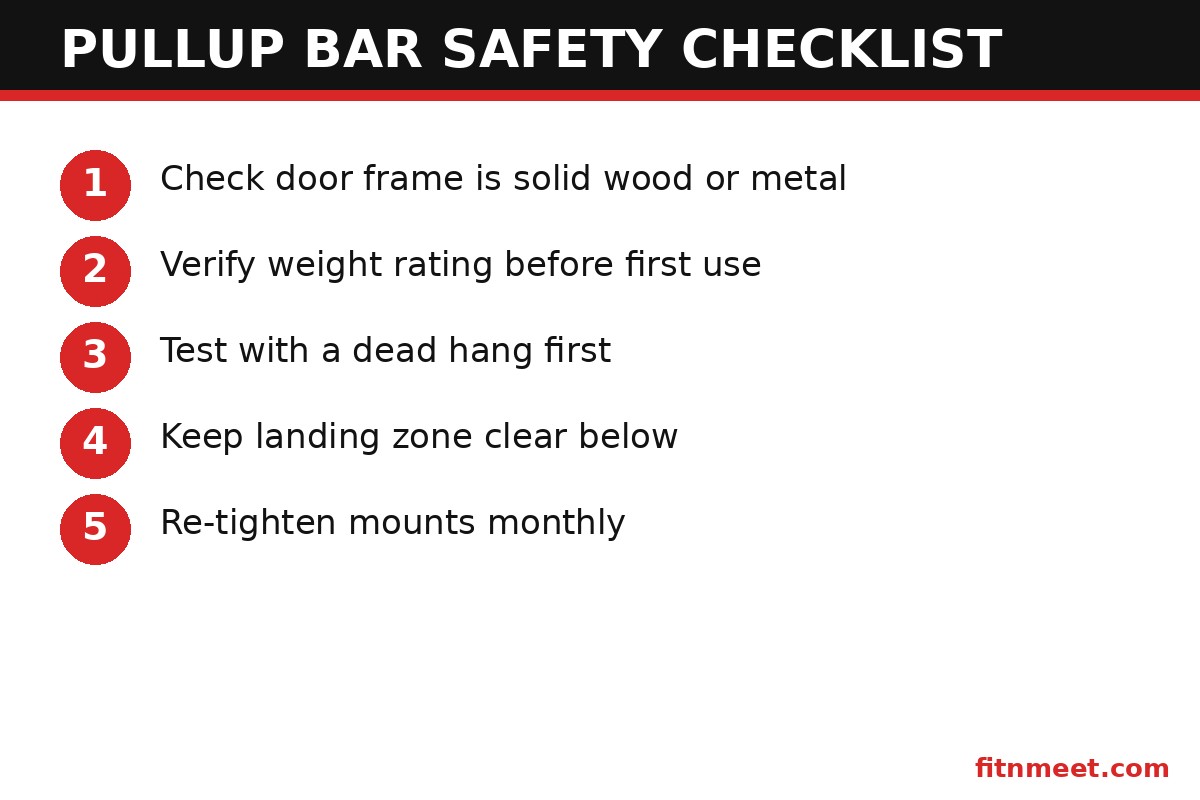
A doorway bar installs in minutes: hook the top bar over the frame, let the leverage arms press against the trim on the other side, and test with a partial hang before committing your full weight. Foam pads protect the trim — replace them if they compress flat. Wall-mounted models need a stud finder, a level, and lag bolts into at least two studs (or proper masonry anchors); this is a 30-minute job that rewards care.
Programming is simple: 3–5 sets of pull-ups or chin-ups, 2–3 times per week, leaving 1–2 reps in reserve. Beginners who cannot do one rep should start with dead hangs (build to 60 seconds) and negative-only reps (jump up, lower over 5 seconds). Add one rep per week and the bar will carry you from zero to double digits within a few months — NIH exercise guidance supports progressive bodyweight training as a legitimate strength method at any age.
Grip Variations Worth Learning
Once strict reps feel comfortable, vary the stimulus. Wide-grip pull-ups emphasize the lats, close-grip chin-ups shift work to the biceps, and neutral-grip pulls are the friendliest on elbows and shoulders. Commando pull-ups (sideways, alternating sides) and archer pull-ups build toward one-arm strength. Rotating two variations per training block keeps elbows happy and progress moving.
Maintenance: Keeping the Bar Safe for Years
Foam grips compress and tear – replace them when they flatten, because torn foam exposes hard plastic that chews up hands. Wipe the bar monthly to remove sweat salt that corrodes coatings. For wall-mounted units, re-torque the lag bolts every three months; wood compresses and bolts loosen. Doorway models deserve a quick stability check each session: one firm tug before your first set takes two seconds and catches problems early.
Safety Notes
Every bar failure story starts with an assumption: assuming the trim was solid, assuming the rating had margin, assuming the bolts were in studs. Test every new installation with gradually loaded hangs before full training. Re-check wall-mounted bolts quarterly — houses settle. Keep the area under the bar clear; a failed rep should end with your feet on the floor, not on furniture. Doorway models and kipping do not mix: the dynamic load can exceed the leverage friction. If anything creaks, shifts or flexes unexpectedly, stop and re-install.
This article is for informational purposes only and is not medical advice. Consult a healthcare professional before starting any supplement or exercise program.
Frequently Asked Questions
Will a pullup bar damage my doorframe?
A leverage-style bar can leave pressure marks on soft trim, but foam pads minimize this. Solid hardwood trim handles it fine; decorative or hollow molding may crack. Wall-mounted and freestanding options avoid the doorway entirely.
How much weight can a pullup bar hold?
Doorway leverage bars typically rate 130-150 kg, wall-mounted bars 180-270 kg, and freestanding towers 120-150 kg. Always buy a bar rated at least 1.5 times your bodyweight including any added weight.
Can a beginner use a pullup bar?
Absolutely – this equipment is ideal for beginners. Start with dead hangs to build grip, then negative-only reps (jump up, lower slowly over 5 seconds). Most consistent beginners reach their first full pull-up within 4-12 weeks.
Doorway vs wall-mounted pullup bar – which is better?
Wall-mounted is stronger and more stable, making it better for weighted and dynamic work. Doorway bars win on convenience with zero drilling. Renters should choose doorway; homeowners building a permanent gym should choose wall-mounted.
How often should I train on a pullup bar?
Two to three sessions per week works for most people, with 3-5 sets per session. Daily low-volume practice (greasing the groove) also works well for building your first pull-up, as long as every set stays well short of failure.
Can you build muscle with just a pullup bar?
Yes, for the upper body pulling muscles. Progressive overload through added reps, slower tempos, and eventually added weight builds serious lat, bicep and back thickness. Pair bar work with push-ups and squats for balanced full-body training.
Conclusion
The comparison is clear: a doorway leverage pullup bar is the best starting point for most people, a wall-mounted bar is the endgame for serious home gyms, and a tower suits multi-exercise needs. Whichever type you choose, the formula is identical — hang often, add reps weekly, and stay consistent. Ready to start? Explore the FitnMeet muscle development collection and workout recovery range to support your pull-up journey, or browse the full shop.