
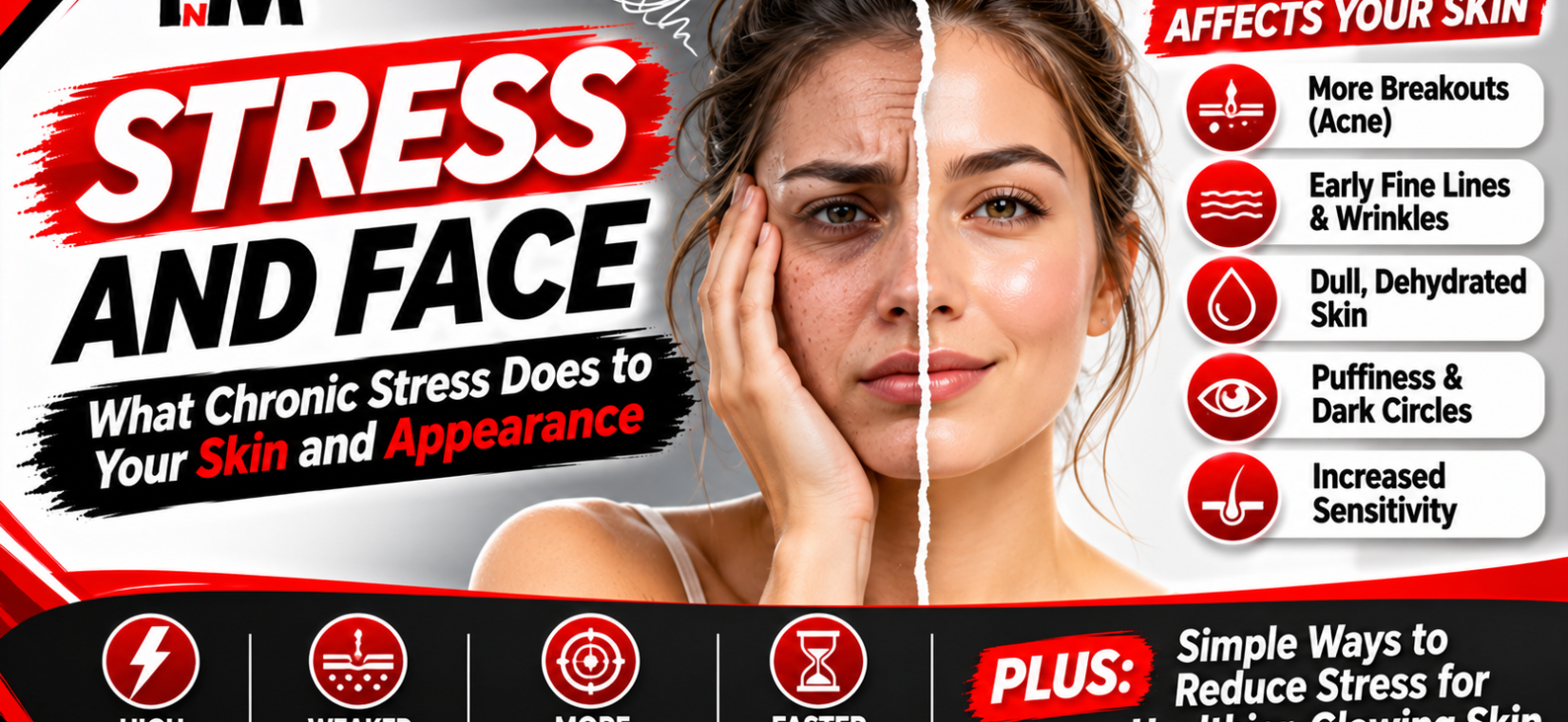
Stress and face problems are connected through cortisol, the body’s main stress hormone. When stress stays high, cortisol breaks down collagen, increases oil production, slows skin repair, and triggers breakouts, dullness, and premature wrinkles. The good news: managing stress and face issues together with sleep, exercise, and skin-friendly habits can visibly reverse many of these changes within weeks.
You have probably seen it in the mirror: a brutal work week ends, and your skin looks tired, puffy, or broken out — even though your skincare routine never changed. That is not your imagination. The stress and face connection is one of the most documented links in dermatology, and it runs deeper than a few pimples before a big presentation. Chronic stress reshapes how your skin behaves at the cellular level, affecting collagen, hydration, barrier function, and even how fast wounds heal.
This guide breaks down the science of the stress and face relationship, what the research says about cortisol and skin aging, the real benefits of lowering stress for your appearance, how the mechanism works in the body, a practical daily protocol (in minutes, not hours), safety notes, and how stress management compares to purely cosmetic approaches. By the end, you will have a complete, evidence-based plan for protecting your face from the inside out.
What Is the Stress and Face Connection?
The stress and face connection describes how psychological stress produces visible changes in facial skin: breakouts, dullness, under-eye puffiness, fine lines that deepen faster, flare-ups of eczema or rosacea, and even temporary hair shedding. These are not separate problems that happen to coincide with stressful times — they are direct downstream effects of the same hormonal cascade.
When your brain perceives a threat — a deadline, financial worry, conflict — it activates the HPA axis (hypothalamic-pituitary-adrenal axis), which floods the body with cortisol and adrenaline. Cortisol is useful in short bursts: it mobilizes energy and suppresses non-essential functions. But when stress becomes chronic, cortisol stays elevated for weeks or months, and your skin pays the price. The stress and face relationship is essentially the story of what happens when a short-term survival hormone becomes a long-term background signal.
Your skin is also a surprisingly active hormonal organ. Skin cells carry receptors for cortisol, adrenaline, and related stress signals — meaning your face does not just reflect stress indirectly through poor sleep or skipped workouts. It responds to stress hormones directly. Oil glands ramp up sebum production, collagen-producing fibroblasts slow down, and the skin’s barrier — the lipid layer that keeps moisture in and irritants out — weakens. That is why the stress and face link shows up even in people whose diet and skincare stay constant during stressful periods.
Dermatologists see the pattern so often they have shorthand for it. Acne that appears along the jawline and chin during exam season or project crunches. Eczema patches that flare the week of a move. Rosacea that reddens during conflict-heavy months. Telogen effluvium — diffuse hair shedding — that starts 2 to 3 months after a major stressor like surgery, illness, or grief. Each of these is a different face of the same underlying stress and face mechanism.
What the Research Says About Stress and Face
The scientific literature on the stress and face link spans dermatology, endocrinology, and psychoneuroimmunology. One of the most replicated findings is that psychological stress delays wound healing. In controlled studies, researchers found that stressed individuals healed skin wounds measurably slower than non-stressed controls — a direct demonstration that stress impairs the skin’s repair machinery, not just its appearance.
Another well-documented strand of the stress and face research concerns the skin barrier. Barrier function is measured by transepidermal water loss (TEWL): the more water escapes through the skin, the weaker the barrier. Multiple studies have shown that acute and chronic stress increase TEWL and slow barrier recovery after disruption. In plain terms, stressed skin loses moisture faster and lets irritants in more easily — which is why sensitive, reactive, red skin so often accompanies high-stress months.
Hair research adds another dimension to the stress and face story. Telogen effluvium, the stress-triggered shedding condition, pushes a larger-than-normal share of hair follicles into the resting (telogen) phase simultaneously. The shedding typically begins 2 to 3 months after the triggering event, which is why people often miss the connection — the hair loss arrives long after the stressful period ended.
None of this means stress single-handedly causes wrinkles or that calm people never get acne. Genetics, sun exposure, and age remain the dominant drivers of skin aging. But the research consensus is clear: chronic stress accelerates every one of those processes. Addressing the stress and face connection does not replace sunscreen or a good routine — it removes a constant headwind working against them.
7 Benefits of Lowering Stress for Your Face
1. Fewer stress breakouts. Lower cortisol means calmer oil glands. Many people notice jawline and chin breakouts fading within 2 to 4 weeks of consistently better stress management — one of the fastest visible wins in the stress and face playbook.
2. Better collagen maintenance. Reducing chronic cortisol exposure lets fibroblasts get back to building collagen and elastin. You will not reverse a decade of aging, but you slow the accelerated breakdown that chronic stress and face damage causes.
3. Stronger skin barrier. As stress hormones normalize, transepidermal water loss decreases and the barrier recovers faster from daily insults like wind, harsh cleansers, and pollution. The result is skin that holds hydration and reacts less.
4. Less puffiness and dark circles. Stress disrupts sleep and raises fluid-retaining hormones. Better stress control usually means deeper sleep, and deeper sleep means less morning puffiness and lighter under-eye shadows — a visible stress and face improvement that shows up in days.
5. Calmer inflammatory conditions. Eczema, psoriasis, and rosacea are all inflammation-driven, and stress is a known trigger for flares. Stress management will not cure these conditions, but it consistently reduces how often and how severely they flare.
6. Reduced hair shedding. Telogen effluvium resolves once the triggering stress passes and follicles re-enter the growth phase — a process that takes 3 to 6 months. Managing stress shortens the trigger window and helps the stress and face (and hair) recovery start sooner.
7. A healthier resting expression. Chronic stress shows up as a furrowed brow, clenched jaw, and tight mouth — the muscle tension of the stress and face loop literally etches expression lines deeper over time. Relaxation practices soften that resting tension, and your face reads as calmer and younger.
How Stress Works in the Body to Age Your Face
To fix the stress and face problem, it helps to see the full chain of events. It starts in the brain: the amygdala flags a threat, the hypothalamus signals the pituitary, and the adrenal glands release cortisol and adrenaline. In the short term this is the fight-or-flight response — heart rate up, digestion down, energy mobilized. The trouble starts when the signal never switches off.
Step 1: Cortisol rises and stays high. With chronic stress, the HPA axis loses its normal daily rhythm. Instead of cortisol peaking in the morning and falling at night, levels stay elevated into the evening — which is also why stressed people lie awake at 2 a.m. staring at the ceiling.
Step 2: Oil glands overproduce. Sebaceous glands carry corticotropin-releasing hormone (CRH) receptors. Stress signals tell them to make more sebum. Excess oil mixes with dead skin cells and inflammation-causing bacteria, and the classic stress and face breakout cycle begins.
Step 3: Collagen production slows. Cortisol suppresses fibroblast proliferation and increases matrix metalloproteinases — enzymes that chew through existing collagen. The net effect is thinner dermis and faster formation of fine lines.
Step 4: The barrier weakens. Stress impairs the production of the lipids and proteins that form the skin’s protective barrier. Water escapes faster, irritants penetrate deeper, and sensitivity rises. This is the mechanism behind the red, reactive stress and face look.
Step 5: Inflammation rises system-wide. Chronic stress is linked to higher circulating levels of pro-inflammatory cytokines. Since acne, eczema, psoriasis, and rosacea are all inflammatory conditions, this systemic shift lowers the threshold for every one of them to flare.
Step 6: Behaviors compound the damage. Stressed people sleep less, touch their faces more, skip workouts, eat more sugar, and sometimes pick at their skin. Each of these independently worsens the stress and face picture — which is why the protocol below targets habits, not just hormones.
The Wikipedia overview of stress in biology covers the HPA axis and cortisol response in detail if you want the deeper physiology. For the nutrition side of skin repair, FitnMeet’s nutrition guides explain which foods supply the building blocks your skin needs.
Your Daily Stress-and-Face Protocol
Think of stress management like a supplement: the dose matters. Sporadic relaxation does little; a consistent daily dose changes the stress and face equation. Here is a protocol-style plan built from widely recommended guidelines — no special equipment needed.
Morning (10–15 minutes): Start with 5 minutes of slow breathing or meditation before checking your phone, then get 10 minutes of daylight exposure. Morning light anchors your cortisol rhythm so it peaks when it should and falls by evening. Splash your face with cool water afterward — it reduces overnight puffiness and wakes up circulation.
Midday movement (20–30 minutes): Aim for at least 150 minutes of moderate activity per week, the widely recommended baseline. A brisk 25-minute walk at lunch lowers cortisol for hours afterward and improves sleep quality that night. Exercise is one of the few interventions proven to improve both stress hormones and the stress and face markers like barrier function and inflammation.
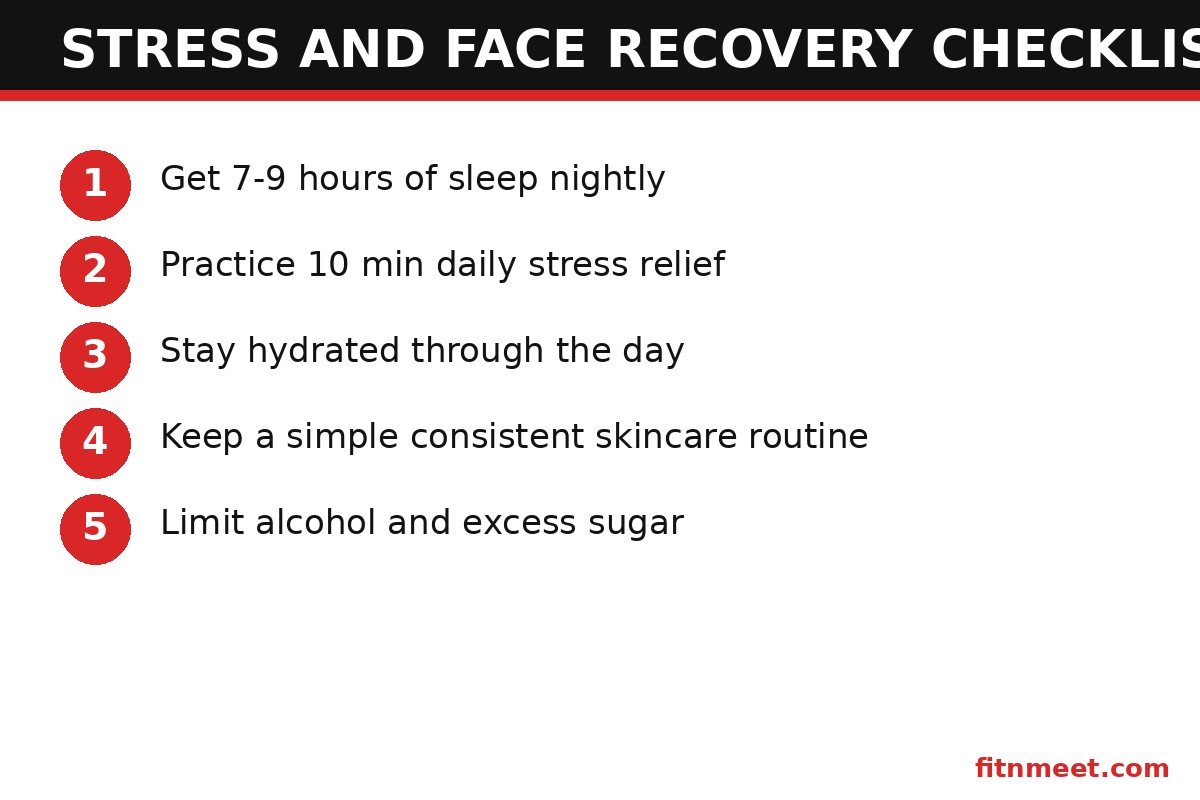
Evening wind-down (30–60 minutes before bed): Dim lights, no work email, and a consistent bedtime. Target 7 to 9 hours of sleep — the range health authorities recommend for adults. Poor sleep is both a consequence and a cause of stress, so protecting sleep is protecting your face. If racing thoughts keep you up, write tomorrow’s to-do list on paper; externalizing worries measurably reduces bedtime rumination.
Weekly dose: Two to three longer recovery sessions per week — a 45-minute yoga class, a sauna visit, a nature hike, or a proper rest day. People managing the stress and face cycle often see visible skin improvements within 3 to 4 weeks of consistent practice: calmer breakouts first, then better tone and less puffiness.
Support the protocol from the inside with targeted vitamins and an anti-aging routine that protects collagen while your hormones rebalance.
Side Effects and Safety: When Stress Needs Professional Help
Stress management techniques are safe for nearly everyone, but it is important to distinguish everyday stress from conditions that need professional care. If you experience persistent anxiety, panic attacks, depression, or stress that interferes with work and relationships for more than a few weeks, talk to a healthcare professional or mental health provider. No breathing exercise replaces treatment for an anxiety disorder.
On the skin side, see a dermatologist if breakouts are severe, painful, or scarring; if eczema or psoriasis spreads or cracks; or if hair shedding continues beyond 6 months. These can have causes beyond the stress and face mechanism — hormonal disorders, deficiencies, or autoimmune conditions — that need proper diagnosis.
Be cautious with quick-fix claims. “Stress detox” teas, unregulated cortisol-blocking supplements, and extreme fasting protocols marketed for the stress and face crowd are mostly unproven and occasionally harmful. The U.S. Food and Drug Administration’s guidance on dietary supplement safety is worth reading before buying any stress-relief product. Stick with the boring fundamentals — sleep, movement, light, routine — which carry the strongest evidence and the lowest risk.
Stress and Face: Stress Management vs Cosmetic Fixes
Stress management and cosmetic treatments are not competitors — they solve different halves of the stress and face problem. Here is how they compare:
| Approach | What it fixes | Time to visible results | Cost & effort |
|---|---|---|---|
| Stress management (sleep, exercise, breathing) | Root cause: cortisol, inflammation, barrier damage | 2–6 weeks | Free to low; daily habit |
| Skincare routine (cleanser, moisturizer, SPF) | Barrier support, UV protection, hydration | 2–8 weeks | Low–moderate; daily habit |
| Dermatologist treatments (prescriptions, peels) | Active acne, scarring, stubborn conditions | 4–12 weeks | Moderate–high; appointments |
| Cosmetic procedures (fillers, lasers) | Volume loss, deep wrinkles, texture | Days to weeks | High; repeat sessions |
The takeaway for the stress and face puzzle: cosmetic fixes treat what stress damaged, while stress management stops the damage at the source. Most dermatologists recommend doing both — protect the barrier and lower the cortisol. For recovery-focused nutrition that supports skin repair, see FitnMeet’s health support range.
Frequently Asked Questions
Can stress really change how your face looks?
Yes. Chronic stress raises cortisol, which increases oil production, slows collagen repair, weakens the skin barrier, and disrupts sleep. Together these cause the classic stress and face signs: breakouts, dullness, puffiness, and faster-developing fine lines.
How long does it take for stress-related skin problems to clear up?
Breakouts often calm within 2 to 4 weeks of consistent stress management and better sleep. Barrier repair and tone improvements typically take 4 to 8 weeks. Stress-related hair shedding resolves over 3 to 6 months once the trigger passes.
Does stress cause wrinkles?
Stress does not create wrinkles on its own, but it accelerates the processes behind them. Cortisol suppresses collagen production and increases enzymes that break collagen down, while stress-driven facial tension deepens expression lines faster over time.
Why do I break out on my jawline when stressed?
The jawline and chin are rich in hormone-sensitive oil glands. When stress hormones surge, these glands overproduce sebum, which mixes with dead skin cells and triggers the deep, tender breakouts typical of the stress and face cycle.
What is the fastest way to fix stress-related dull skin?
Prioritize 7 to 9 hours of sleep, 20 to 30 minutes of daily movement, and consistent hydration. These three address the biggest stress and face drivers — poor sleep, high cortisol, and barrier dehydration — and most people see brighter skin within two weeks.
Can stress cause hair loss on top of skin problems?
Yes. Telogen effluvium is stress-triggered shedding that starts 2 to 3 months after a major stressor and usually resolves within 6 months. If shedding persists longer, see a dermatologist to rule out other causes.
Conclusion
The stress and face connection is real, measurable, and — most importantly — reversible. Cortisol-driven breakouts, barrier damage, puffiness, and accelerated fine lines all respond to the same fundamentals: 7 to 9 hours of sleep, 150 minutes of weekly movement, morning daylight, and a consistent wind-down routine. You do not need expensive treatments to start; you need a daily dose of calm. Support your skin from the inside with solid nutrition and recovery habits — browse FitnMeet’s wellness collection to build yours — and give it 4 weeks. Your mirror will show you the difference.
This article is for informational purposes only and is not medical advice. If you have a persistent skin condition, hair loss, or symptoms of anxiety or depression, consult a healthcare professional.